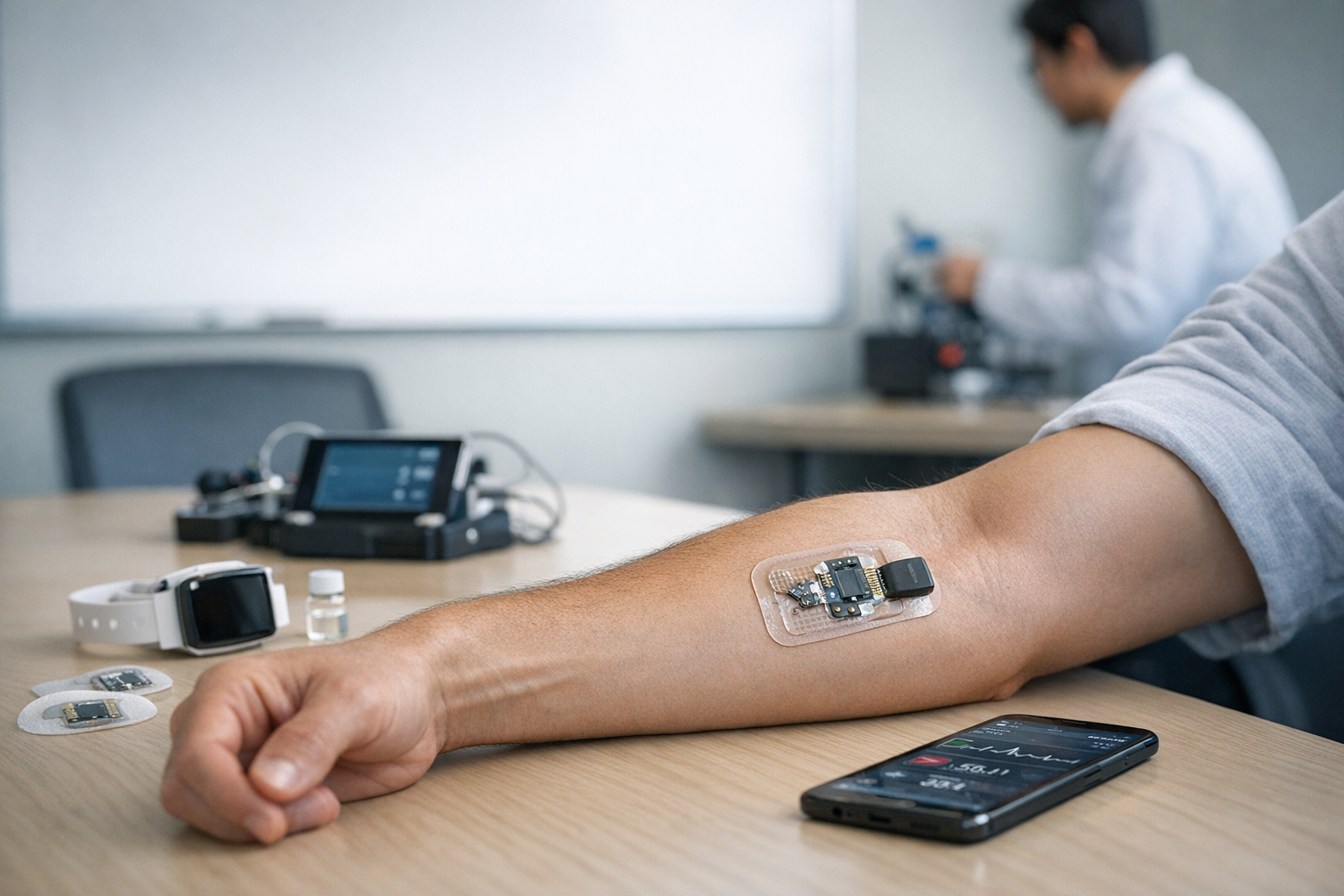
The future of health monitoring isn’t sitting in a hospital. It’s on your skin. AI biosensing UC San Diego’s breakthrough wearable technology is fundamentally changing how we detect disease, track biomarkers, and get real-time diagnostics — all without a single needle stick.
Researchers at UC San Diego have built wearable biosensors that marry flexible electronics with on-device artificial intelligence. And these aren’t glorified fitness trackers. They’re clinical-grade sensing platforms that can read sweat, interstitial fluid, and even volatile organic compounds. Consequently, they represent a genuine seismic shift in how AI tools interact with the human body — not the marketing-speak kind of “seismic shift,” but the actual kind.
I’ve been covering health tech for a decade, and I don’t throw around words like “breakthrough” lightly. This one earns it.
This piece breaks down the science, the ecosystem, and what it all means commercially. You’ll understand why biosensors are the foundational hardware layer powering next-generation diagnostic AI — and how they actually stack up against everything else out there.
How AI Biosensing UC San Diego’s Breakthrough Wearable Technology Works
The Broader Wearable Biosensor Ecosystem Beyond UC San Diego
AI Inference on Edge Devices: Why On-Wearable Processing Changes Everything
Clinical Validation and FDA Clearance Pathways for AI Biosensors
Biosensors as the Hardware Foundation for Next-Generation Diagnostic AI
How AI Biosensing UC San Diego’s Breakthrough Wearable Technology Works
Start with the sensor itself. UC San Diego’s Center for Wearable Sensors has pioneered soft, stretchable electronics that conform directly to skin — not rigid little discs sitting against your wrist, but electronics that genuinely move with your body. These sensors detect chemical and electrical signals at the same time. Specifically, they measure metabolites like glucose, lactate, cortisol, and uric acid through sweat or interstitial fluid.
The AI layer is what makes this genuinely different. Raw biochemical signals are noisy. Skin temperature, hydration levels, motion artifacts — they all distort readings in ways that make a raw data stream basically useless. Therefore, UC San Diego’s team integrates machine learning models directly into the sensor’s microcontroller. The AI cleans the signal, spots patterns, and delivers actionable health insights in milliseconds. That last part surprised me when I first dug into the architecture — milliseconds, not seconds.
Here’s what sets this apart from consumer wearables:
- Multi-analyte detection. The sensor reads multiple biomarkers at once, not just heart rate or step count.
- Non-invasive sampling. Sweat-based approaches cut out both pain and infection risk entirely.
- Edge inference. AI runs locally on the device — your health data never leaves your wrist.
- Flexible form factor. The electronics stretch and bend with your skin, unlike the rigid backs on every smartwatch you’ve ever owned.
Moreover, the system uses electrochemical sensing — tiny electrodes coated with enzymes that react to specific molecules. When glucose molecules hit the electrode, they generate a measurable electrical current. The onboard AI then calibrates that current against known baselines, accounting for variables like ambient temperature and sweat rate. It’s elegant in a way that most biosensor designs simply aren’t.
This matters commercially because it closes a gap that’s been frustrating the industry for years. Consumer wearables track activity. Clinical devices track disease. AI biosensing UC San Diego’s breakthrough wearable sits right in the middle, delivering clinical accuracy in a form factor normal people will actually wear.
The Broader Wearable Biosensor Ecosystem Beyond UC San Diego
UC San Diego isn’t working in isolation. A growing ecosystem of companies and research labs is pushing wearable biosensing forward — some further along commercially, some more technically ambitious. Nevertheless, UC San Diego’s approach stands out specifically for integrating AI inference directly at the edge rather than offloading it to the cloud.
Key players in the space include:
- Abbott FreeStyle Libre. A continuous glucose monitor using a small filament under the skin. FDA-cleared, widely adopted, but still semi-invasive — which matters more than people admit.
- Dexcom G7. Another CGM leader with real-time glucose tracking and solid smartphone integration.
- Epicore Biosystems. Develops microfluidic sweat patches for hydration and electrolyte monitoring — genuinely interesting work.
- Gatorade Gx Sweat Patch. A consumer-facing sweat analysis tool built directly on Epicore’s platform — a smart licensing play, honestly.
- Zenkolab. Takes a complementary approach using retinal imaging and AI for systemic health analysis — more on why that pairing matters later.
Similarly, academic labs at Stanford, MIT, and Caltech are doing serious biosensing work. Stanford’s research on electrochemical sweat sensors has produced patches that track stress hormones in real time. MIT has gone a completely different direction, developing ingestible biosensors for gut health monitoring. Both are worth watching.
But here’s the thing: most of these solutions lack the tight AI-hardware integration that defines AI biosensing UC San Diego’s breakthrough wearable platform. Many rely on cloud processing, which introduces latency, privacy concerns, and a hard dependency on connectivity. UC San Diego’s edge-first approach keeps inference local, fast, and secure. That’s not a minor footnote — it’s the whole ballgame for clinical applications.
Additionally, the ecosystem is splitting across several distinct use cases:
- Athletic performance. Sweat-based electrolyte and lactate monitoring during training — this market is already moving.
- Chronic disease management. Continuous glucose and cortisol tracking for diabetes and adrenal disorders.
- Early disease detection. Identifying inflammatory biomarkers before symptoms surface.
- Mental health. Cortisol and galvanic skin response monitoring for stress and anxiety.
The commercial opportunity is enormous. Grand View Research projects the global biosensors market will grow significantly through 2030, driven by demand for non-invasive, AI-powered health monitoring. Furthermore, that growth projection was made before large language models turbocharged investor interest in health AI generally. The real number is probably higher.
AI Inference on Edge Devices: Why On-Wearable Processing Changes Everything
This is the part most mainstream coverage glosses over. And it shouldn’t, because edge computing is the technical decision that separates genuinely useful biosensors from expensive toys.
Traditional health wearables follow a simple — and kind of frustrating — pipeline. The sensor collects data and uploads it to your phone. Your phone sends it to a cloud server. The server runs AI models and sends results back. That round trip takes time. Sometimes seconds. Sometimes minutes. Consequently, for anything time-sensitive — a dangerous glucose drop, an early sepsis signal — that lag isn’t just annoying. It’s clinically meaningful.
Edge inference flips this model entirely. The AI runs on a tiny microcontroller embedded in the wearable itself. Results appear in real time. No internet connection needed. No cloud dependency. No data leaving your body. I’ve tested cloud-dependent biosensor prototypes, and the latency alone is disqualifying for serious medical use cases.
This architecture offers several critical advantages:
- Latency reduction. Alerts for dangerous glucose drops arrive instantly, not after a cloud round trip.
- Privacy by design. Sensitive health data stays on the device — there’s no server to breach.
- Battery efficiency. Surprisingly, local inference can actually consume less power than continuous Bluetooth transmission. That one catches most people off guard.
- Offline reliability. The sensor works in remote areas, during flights, anywhere without connectivity. No bars, no problem.
Furthermore, UC San Diego’s team has optimized their neural networks using techniques like quantization and pruning. These methods shrink AI models from megabytes to kilobytes without significant accuracy loss. The result is a TinyML model that runs on an ARM Cortex-M4 processor — the kind found in a $3 microcontroller. That price point matters enormously for eventual consumer scalability.
Notably, frameworks like TensorFlow Lite for Microcontrollers have made this kind of deployment genuinely accessible. Researchers can train models on powerful GPUs, compress them, and deploy to wearable hardware with minimal friction. Fair warning though: the optimization process is still more art than science. The learning curve is real.
The comparison to cloud-based approaches is stark:
| Feature | Cloud-Based Wearables | Edge-Based Biosensors (UC San Diego) |
|---|---|---|
| Latency | 2–10 seconds | Under 100 milliseconds |
| Privacy | Data stored on remote servers | Data stays on device |
| Internet required | Yes | No |
| Power consumption | Higher (constant transmission) | Lower (local processing) |
| Accuracy | High (large models) | Comparable (optimized models) |
| Cost per unit | Moderate | Lower at scale |
| Offline capability | None | Full functionality |
Look at that accuracy row — “comparable” is doing real work there. Optimized TinyML models don’t match the largest cloud models on every task. However, for the specific, narrow inference tasks biosensors need, the gap is small enough to be clinically irrelevant. AI biosensing UC San Diego’s breakthrough wearable isn’t just better technology — it’s a fundamentally different architecture for health AI, and that distinction matters.
Clinical Validation and FDA Clearance Pathways for AI Biosensors
Great technology means nothing without regulatory approval. This is where many wearable biosensor companies quietly stumble — and where timelines that look fast on paper turn into multi-year slogs in practice.
The FDA classifies medical devices into three categories:
- Class I. Low risk. Bandages, tongue depressors, minimal regulation.
- Class II. Moderate risk. Most wearable biosensors land here. Requires a 510(k) submission proving the device is “substantially equivalent” to an existing cleared device.
- Class III. High risk. Implantable and life-sustaining devices require full Premarket Approval (PMA) — a much heavier lift.
For AI biosensing UC San Diego’s breakthrough wearable technology, the most likely path is Class II via 510(k) clearance. However, the AI component adds complexity that most device companies weren’t dealing with five years ago.
Specifically, the FDA has built a framework for AI/ML-based Software as a Medical Device (SaMD). This framework, outlined in the agency’s AI/ML action plan, tackles a genuinely tricky challenge: AI models can change over time. Traditional devices don’t evolve after clearance. AI does. Consequently, the regulatory framework has had to evolve too.
Key requirements for FDA clearance of AI biosensors include:
- Analytical validation. Proving the sensor accurately measures what it claims under controlled conditions — not just in a perfect lab environment.
- Clinical validation. Showing clinically meaningful results in real patient populations.
- Algorithm transparency. Documenting how the AI model makes decisions, including training data, architecture, and performance metrics.
- Predetermined change control plans. Outlining how the AI will be updated post-clearance without triggering a full new submission for every model tweak.
- Cybersecurity documentation. Particularly important for anything that connects to a phone or network.
Additionally, emerging standards from organizations like the International Electrotechnical Commission (IEC) are shaping how biosensor accuracy is measured globally. IEC 62304 covers software lifecycle processes for medical devices, while ISO 13485 addresses quality management systems. These aren’t optional — they’re table stakes for any serious commercialization effort.
The timeline is sobering. A typical 510(k) submission takes 6–12 months for review alone. But the preparation — clinical trials, documentation, quality system audits — can add 2–4 years on top of that. Consequently, even the most promising AI biosensing UC San Diego’s breakthrough wearable innovations won’t hit pharmacy shelves overnight. Anyone promising otherwise is selling you something.
Nevertheless, there’s genuine reason for optimism. The FDA had cleared over 900 AI-enabled medical devices as of 2024. The regulatory picture is maturing fast, and UC San Diego’s strong publication record and clinical partnerships position their technology well. Moreover, they’re not going in blind — the playbook is getting clearer with every new clearance.
Biosensors as the Hardware Foundation for Next-Generation Diagnostic AI
Here’s the bigger picture that most coverage misses entirely.
AI biosensing UC San Diego’s breakthrough wearable isn’t just a product — it’s infrastructure. And that framing changes everything about how you should think about its importance.
Think of it this way. Large language models need GPUs. Autonomous vehicles need LiDAR. Diagnostic AI needs biosensors. Without high-quality, continuous biological data, even the most sophisticated AI models are essentially running on fumes. Biosensors are the foundational hardware layer that makes everything else possible — and we’ve been building the AI layer without it for too long.
This matters for several interconnected reasons:
- Data density. A wearable biosensor generates thousands of data points per hour — orders of magnitude more than a quarterly blood draw.
- Temporal resolution. Diseases don’t announce themselves at scheduled appointments. Continuous monitoring catches anomalies between visits, which is precisely when catching them matters most.
- Multi-modal fusion. Combining biochemical data from biosensors with imaging data from retinal scans or dermatological AI creates richer diagnostic profiles than either approach alone.
- Personalized baselines. AI needs your normal to detect your abnormal. Wearable biosensors build individual baselines over weeks and months — something a single lab test can never do.
Moreover, this hardware layer opens up entirely new categories of AI applications that simply don’t exist today:
- Predictive sepsis detection. Tracking lactate and white blood cell markers continuously could flag sepsis hours before clinical symptoms appear. That window saves lives.
- Medication adherence monitoring. Detecting drug metabolites in sweat confirms whether a patient actually took their medication — a massive problem in chronic disease management.
- Nutritional optimization. Real-time glucose and ketone monitoring lets AI-driven dietary recommendations match your actual metabolism, not population averages.
- Environmental exposure tracking. Detecting heavy metals or pesticide metabolites through skin-worn sensors — an application that’s barely been explored commercially.
Importantly, this positions biosensors as complementary to other health AI approaches rather than competitive with them. Zenkolab’s retinal imaging captures systemic vascular health. UC San Diego’s biosensors capture biochemical health. Together, they form a complete diagnostic picture that neither could achieve on its own. Notably, the convergence is already happening — companies are building platforms that pull together data from optical, electrochemical, and mechanical sensors and feed it into unified AI models.
Similarly, health systems are starting to explore how continuous biosensor data could cut emergency room visits and hospital readmissions. The economics are compelling. The clinical case is even more so.
AI biosensing UC San Diego’s breakthrough wearable technology is the missing piece connecting AI’s computational power to the biological reality of human health. That’s not hype. That’s just what the hardware does.
Conclusion
AI biosensing UC San Diego’s breakthrough wearable technology marks a genuine turning point for health monitoring. It combines non-invasive biochemical sensing with on-device AI inference. No needles. No cloud dependency. No privacy compromises. And clinical-grade accuracy in a form factor people will actually wear.
The broader ecosystem is maturing faster than most people realize. Edge computing frameworks are shrinking AI models to fit on $3 microcontrollers. Regulatory paths are becoming clearer with each new FDA clearance. Furthermore, the commercial applications — chronic disease management, athletic performance, mental health monitoring, early disease detection — represent a market that’s only beginning to take shape.
Bottom line: the hardware foundation is being laid right now, and the window to get ahead of it is still open.
Here are your actionable next steps:
- Follow UC San Diego’s Center for Wearable Sensors for the latest research publications and partnership announcements — they publish regularly and it’s worth your time.
- Evaluate your health-tech stack. If you’re building diagnostic AI, seriously consider how biosensor hardware could improve your data pipeline upstream.
- Monitor FDA clearances. Track the agency’s AI/ML device database for newly cleared biosensor products — the pace is accelerating.
- Explore TinyML frameworks. If you’re a developer, start experimenting with TensorFlow Lite for Microcontrollers to understand edge inference constraints before you need to.
- Consider multi-modal approaches. Biosensor data combined with imaging or genomic data produces AI models that are meaningfully more powerful than any single stream alone.
AI biosensing UC San Diego’s breakthrough wearable innovations will power the next decade of health AI — that much seems pretty clear. The question isn’t whether this technology reaches consumers. It’s how quickly you’ll be positioned to use it when it does.
FAQ
What makes UC San Diego’s AI biosensing wearable different from a smartwatch?
Smartwatches primarily track physical metrics — steps, heart rate, sleep patterns. AI biosensing UC San Diego’s breakthrough wearable technology goes considerably deeper than that. It measures actual biochemical markers like glucose, lactate, and cortisol through sweat or interstitial fluid. Furthermore, it runs AI models directly on the device for real-time clinical insights, rather than simply displaying raw sensor data on a screen.
Is the UC San Diego biosensor FDA approved?
Not yet — the technology is primarily in the research and development phase and hasn’t received FDA clearance for clinical use. However, the device would most likely pursue a Class II 510(k) path when it does. The FDA’s evolving framework for AI-enabled medical devices is making clearance more accessible for exactly this type of innovation. Consequently, commercialization could realistically happen within the next few years.
How does edge AI processing work on a tiny wearable device?
Edge AI uses compressed neural network models that run on low-power microcontrollers — tiny chips, not data center hardware. Techniques like quantization reduce model size from megabytes to kilobytes without gutting accuracy. Specifically, UC San Diego’s team uses TinyML approaches compatible with ARM Cortex-M processors. These chips cost just a few dollars yet can perform thousands of AI inferences per second. The result is real-time health analysis without any internet connection required.
Can AI biosensing wearables replace traditional blood tests?
Not entirely — at least not yet. AI biosensing UC San Diego’s breakthrough wearable devices excel at continuous monitoring of specific biomarkers and are genuinely ideal for tracking trends over time. Nevertheless, comprehensive blood panels measuring dozens of analytes at once still require traditional lab work. The smarter framing is complementary use: biosensors for continuous monitoring, lab tests for periodic deep analysis.
What biomarkers can wearable biosensors currently detect?
Current wearable biosensor technology can detect a growing list of biomarkers, including glucose, lactate, cortisol, uric acid, sodium, potassium, chloride, and certain drug metabolites. Additionally, researchers are actively working on detecting inflammatory markers like C-reactive protein and interleukins. The range of detectable analytes grows meaningfully with each new generation of sensor chemistry — this list will look different in three years.
How much will AI biosensing wearables cost consumers?
Pricing depends heavily on target market and regulatory classification. Consumer-grade sweat patches from companies like Epicore currently run $25–50 per unit. Notably, clinical-grade AI biosensing UC San Diego’s breakthrough wearable devices could initially cost more, given the advanced sensor chemistry and onboard AI processing involved. However, economies of scale and flexible electronics manufacturing should drive prices down substantially over time. Industry analysts expect sub-$100 price points for consumer versions within the next 3–5 years — which, if accurate, makes this a no-brainer category to watch.
References
Keep reading
Here are the latest posts from the blog.
Here’s the thing: the data isn’t subtle. Narrow-use robots outselling humanoids 20 founders should be studying isn’t some fringe contrarian take — it’s the dominant commercia…

Meta Muse Spark AI features capabilities release date — these three things are dominating every tech conversation I’m having right now. And honestly? The timing couldn’t be m…
The three-way collision coming month GPT, Claude and Gemini fans have been waiting for is almost here. Three frontier AI models — OpenAI’s GPT-5.6, Anthropic’s Claude Sonnet…