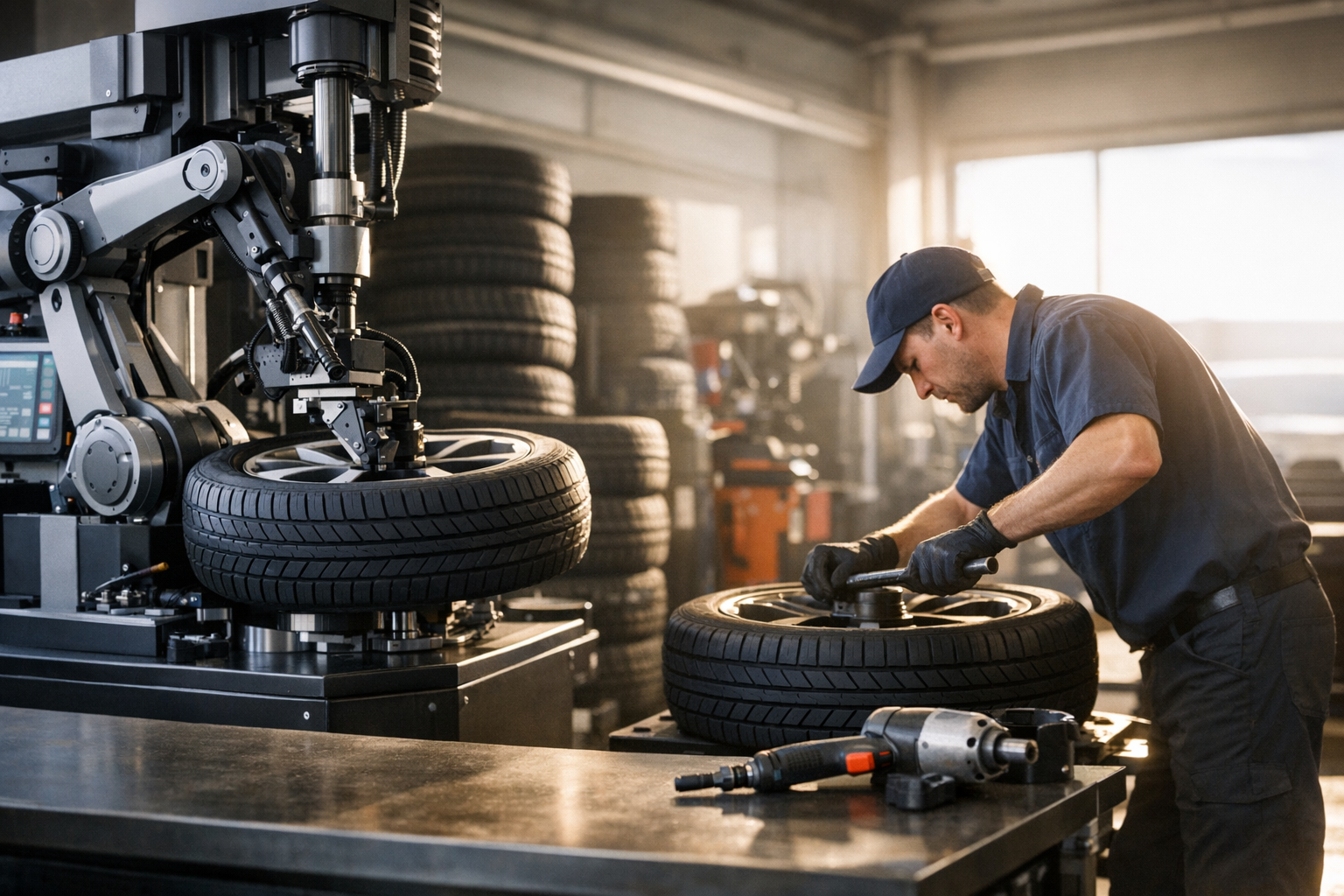
The race between robotic tire changer automation mechanics technologies and traditional human labor is heating up — and fast. Fleet operators, dealership chains, and independent shops are all asking the same question: can robots actually replace skilled tire technicians, and should they?
The answer isn’t simple. However, the data points toward a real tipping point, and we’re closer than most shop owners realize.
Automated tire-changing systems now handle most passenger and light-truck tire sizes. They’re faster, more consistent, and — notably — increasingly affordable. Meanwhile, the skilled labor shortage keeps getting worse, and nobody’s got a clean solution to that problem on the human side.
This breakdown covers hardware specs, real deployment costs, speed benchmarks, and workforce implications. You’ll walk away knowing whether robotic tire changer automation makes financial sense for your operation heading into 2026.
How Robotic Tire Changers Actually Work
Before comparing robots to humans, it helps to understand what you’re actually buying. Modern robotic tire changer systems aren’t just fancy tire machines — they’re integrated cells combining several technologies at once.
Vision systems use cameras and LiDAR to scan each wheel, identifying tire size, rim type, and valve stem position. Consequently, the robot adjusts its grip and tool path automatically — no per-wheel programming needed. This is surprising when you first dig into the specs, because you’d expect more manual setup between vehicles.
Articulated robotic arms — typically six-axis models from manufacturers like FANUC or ABB — handle the physical work: demounting, rim inspection, mounting, and inflation. Specifically, these arms apply precise, repeatable force, and that consistency matters more than it sounds. Rim damage from sloppy manual mounting costs shops thousands every year. Many service managers don’t even track it as a line item until they start comparing before-and-after numbers.
Bead-breaking and mounting heads are custom end effectors that copy traditional tire machine motions — but with robotic precision. Furthermore, integrated torque sensors prevent over-tightening lug nuts, which is one of those common human errors that quietly generates warranty headaches.
Here’s the thing: the full process is more automated than most people picture.
- Vehicle enters the bay (driven or conveyed)
- Robotic lift positions the vehicle
- Lug nuts are removed automatically
- The wheel transfers to the tire-changing cell
- Old tire is demounted, new tire is mounted
- Wheel returns to the vehicle
- Lug nuts are torqued to manufacturer spec
- Vehicle exits
Notably, some systems from companies like RoboTire complete all four tires in under 25 minutes. That’s roughly half the time a skilled human mechanic needs — and that gap compounds across a full shift.
Speed Benchmarks: Robots vs. Manual Mechanics in 2026
Speed is the most obvious advantage. But does it actually hold up in real-world conditions? Mostly, yes.
A skilled manual mechanic typically changes four tires in 45–60 minutes. That includes lifting, demounting, mounting, balancing, and torquing. Additionally, fatigue slows humans down over a full shift in ways that are easy to underestimate. The tenth tire change of the day takes meaningfully longer than the first — and that’s consistent across shop floors.
Robotic tire changer automation mechanics 2026 systems don’t get tired. They maintain consistent cycle times from job one to job one hundred. According to RoboTire’s published specs, their system targets a full four-tire swap in approximately 25 minutes.
Here’s a side-by-side look at how that plays out:
| Metric | Manual Mechanic | Robotic Tire Changer |
|---|---|---|
| Four-tire swap time | 45–60 minutes | 20–28 minutes |
| Daily throughput (8-hour shift) | 8–10 vehicles | 16–20 vehicles |
| Consistency over shift | Declines with fatigue | Stays constant |
| Rim damage rate | 2–5% | Under 0.5% |
| Lug nut torque accuracy | Variable | Within ±2% of spec |
| Overnight/weekend operation | Requires staffing | Fully autonomous |
Therefore, a single robotic cell can roughly double the throughput of one human technician. Moreover, robots can run second and third shifts without overtime pay — which is where the ROI math really starts to look interesting.
Balancing deserves a separate mention. Some robotic systems integrate dynamic balancing directly into the cell; others still require a separate step. Similarly, TPMS sensor relearning varies by system. The most advanced 2026 robotic tire changer platforms handle both automatically, though fair warning: not every vendor will tell you upfront which features are included versus add-ons.
Speed alone doesn’t justify the investment, though. You need to look at the full financial picture.
Deployment Costs and ROI Analysis for 2026
Here’s where the conversation gets real.
Robotic tire changer automation isn’t cheap upfront — there’s no sugarcoating that. Nevertheless, the math often works out faster than shop owners expect, especially once you account for throughput gains on top of labor savings.
Hardware costs for a complete robotic tire-changing cell range from $150,000 to $400,000. That spread depends on:
- Number of robotic arms (single vs. dual)
- Integrated balancing capability
- Vehicle lift type (in-ground vs. above-ground)
- Software licensing model
- Brand and country of manufacture
Installation and integration typically add 15–25% to the hardware cost. You’ll need electrical upgrades, compressed air capacity, and possibly floor modifications. Importantly, most installations require 2–4 weeks of downtime for the affected bay — plan accordingly.
Ongoing costs include maintenance contracts ($8,000–$15,000 annually), software updates, and occasional end-effector replacement. Conversely, you’re cutting or significantly reducing labor costs for that bay.
Here’s a simplified ROI scenario that’s actually conservative:
- Robotic cell cost (installed): $275,000
- Annual maintenance: $12,000
- Replaced labor cost: One full-time technician at $55,000/year (salary plus benefits)
- Throughput increase: 80% more vehicles per bay
- Additional revenue from throughput: ~$90,000/year (based on $50/tire-change service)
Net annual benefit lands around $133,000 — that’s $55,000 in labor savings plus $90,000 in additional revenue, minus $12,000 in maintenance. Consequently, the payback period comes out to roughly 24 months.
For high-volume operations like Discount Tire locations or fleet maintenance depots, payback can be even faster. Although smaller independent shops may struggle to justify the capital outlay, leasing models are emerging that lower the barrier to entry considerably.
The Bureau of Labor Statistics reports the median annual wage for automotive service technicians at around $47,000. In high-cost markets like California or New York, that number climbs significantly. Therefore, robotic tire changer automation mechanics 2026 delivers stronger ROI wherever labor is expensive — which, these days, is most places.
Labor Market Impact and the Skilled Trades Shortage
This is the uncomfortable part. Let’s not dance around it.
Robots will displace some jobs. But the full picture is more nuanced than the headlines suggest, and the doom-and-gloom framing misses important context.
The automotive service industry already faces a severe technician shortage. The TechForce Foundation has documented this gap for years. Demand for automotive technicians consistently outpaces the supply of new graduates. Specifically, the industry needs roughly 100,000 new technicians annually but only gets about 37,000. That’s not a rounding error — that’s a structural crisis.
Robotic tire changer automation in 2026 doesn’t eliminate mechanics entirely. Instead, it shifts what the labor requirement actually looks like. Shops still need people for:
- Customer service and vehicle intake
- Diagnostic work and inspections
- Robotic cell supervision and troubleshooting
- Complex services robots can’t handle (yet)
- Quality control and final checks
Additionally, someone needs to maintain the robots themselves. This creates a new job category — robotic maintenance technician — that typically pays more than traditional tire technician positions. Meanwhile, the repetitive, physically demanding tire-mounting work moves to machines. That tradeoff is real.
The pattern mirrors what happened in manufacturing decades ago. Robots didn’t eliminate factory jobs entirely — they changed which jobs existed. Similarly, robotic tire changer automation will reshape, not destroy, the automotive service workforce. The transition is always messier in the short term than the long-term numbers suggest.
Nevertheless, transition pain is real. Technicians who only do tire work face genuine displacement risk. Shops that invest in retraining programs will handle this shift more smoothly — and notably, community colleges are already adding robotics maintenance to their automotive programs, which is an encouraging sign.
Union considerations also matter here. Some collective bargaining agreements restrict automation deployment. Heads up: shops operating under such agreements should consult labor counsel before purchasing robotic systems. Don’t let a $275,000 purchase turn into a grievance process.
Enterprise Adoption Patterns and Market Leaders
Who’s actually buying these systems right now?
The adoption curve for robotic tire changer automation mechanics 2026 follows a predictable pattern — and we’re moving into the phase where the early majority starts buying. That typically means the technology is proven enough to trust.
Early adopters (2022–2024) were primarily large fleet operators and forward-thinking dealership groups. They had the capital, the volume, and the appetite for experimentation. Companies like RoboTire partnered with Discount Tire for pilot deployments, and those early tests confirmed the technology in real-world conditions.
Early majority (2025–2026) includes regional tire chains, large independent shops, and municipal fleet operations. These buyers want proven technology with clear ROI data. Importantly, they’re benefiting directly from lessons learned during the pilot phase — fewer surprises, better install timelines, and more mature software.
Key players in the robotic tire-changing space right now:
- RoboTire — The most visible U.S.-based system, focused on full automation
- FANUC and ABB — Supplying the robotic arms powering many custom integrations
- Hunter Engineering — A dominant force in wheel service equipment, reportedly developing automated solutions
- Various Chinese manufacturers — Offering lower-cost systems for price-sensitive markets (worth investigating, but vet the support infrastructure carefully)
The International Federation of Robotics tracks global robot installations across industries. Service robotics — including automotive applications — is one of the fastest-growing segments. Furthermore, falling robot prices make 2026 a particularly attractive entry point, since industrial robot costs have dropped roughly 50% over the past decade when adjusted for capability.
Integration with shop management software is another factor that doesn’t get enough attention. The best robotic tire changer systems connect directly to point-of-sale and inventory platforms. Consequently, tire orders, service records, and billing happen automatically — cutting out paperwork errors and speeding up the customer experience in ways that compound over time.
Notably, some dealership management system providers like CDK Global are already building automation-ready APIs. That signals the broader automotive retail ecosystem expects robotic adoption to accelerate — and they’re positioning accordingly.
Limitations and Practical Challenges
No technology is perfect. And honestly, any vendor who tells you otherwise is a red flag.
Robotic tire changer automation has real limitations. Buyers who understand them upfront will have a much smoother deployment than those who discover them after the check clears.
Tire variety presents the biggest challenge. Robots handle standard passenger and light-truck tires well. However, run-flat tires, low-profile performance tires, and oversized truck tires require different handling techniques — and some robotic systems struggle with these edge cases. Although manufacturers are improving flexibility with each software cycle, a human technician still handles unusual sizes more easily. Plan for that reality.
Space requirements catch some shops off guard. A robotic tire-changing cell needs more floor space than a traditional tire machine — typically a 12×16-foot footprint minimum. Older shops with tight bays may need renovation, which adds cost and time that isn’t always in the initial proposal.
Downtime and reliability matter enormously. When a human mechanic calls in sick, you find a replacement. When a robot goes down, that bay produces zero revenue until repairs are complete. Therefore, maintenance contracts and spare parts availability aren’t optional considerations — they’re critical purchasing criteria. Ask vendors specifically about their average response time for service calls.
Other practical challenges worth knowing about:
- Power requirements — Most systems need 480V three-phase power, which many older shops don’t have
- Compressed air — Higher volume demands than manual operations
- Insurance — Some carriers haven’t caught up with robotics liability (get this conversation started early)
- Customer perception — Some customers genuinely trust humans more than machines, and that’s a real objection you’ll field
- Regulatory uncertainty — OSHA guidelines for collaborative robotics in service environments are still evolving
Importantly, none of these limitations kill the case for the technology. They simply mean robotic tire changer automation mechanics works best alongside human labor — not as a wholesale replacement. The smartest shops will use robots for high-volume standard work while keeping skilled technicians for complex jobs. That hybrid model is where the smart money is going.
Conclusion
Robotic tire changer automation mechanics represents a genuine turning point for the automotive service industry. The speed advantages are clear — roughly double the throughput of manual operations. The ROI math works for medium-to-large operations, with payback periods around two years. And the labor market pressure isn’t going away, which makes the timing increasingly hard to ignore.
However, this isn’t an all-or-nothing decision. The most successful adopters will blend robotic efficiency with human flexibility. So here are your actionable next steps:
- Audit your tire service volume. If you’re changing fewer than 20 sets per day, the ROI timeline stretches significantly — run the numbers honestly.
- Assess your facility. Confirm you have the space, power, and air capacity for a robotic cell before you get attached to any particular system.
- Request demos from multiple vendors. Don’t commit based on spec sheets alone — see the systems handle your actual tire mix, including your edge cases.
- Model your specific ROI. Use your local labor costs, your service pricing, and your actual volume. Generic calculators will mislead you.
- Plan for workforce transition. Identify retraining paths for displaced technicians — robotics maintenance skills are valuable, transferable, and increasingly in demand.
- Start conversations with your insurance carrier and legal team early. Get ahead of liability and regulatory questions before they become surprises.
The technology behind robotic tire changer automation is mature enough for production deployment in 2026. The question isn’t whether it works — the question is whether your operation is ready to make it work.
FAQ
How much does a robotic tire changer cost in 2026?
A complete robotic tire changer cell costs between $150,000 and $400,000 installed. The price depends on features like integrated balancing, dual-arm configurations, and software licensing. Leasing options from some vendors can reduce the upfront commitment to monthly payments of $3,000–$7,000. Additionally, maintenance contracts typically run $8,000–$15,000 per year — factor that into your total cost of ownership from day one.
Can robotic tire changers handle all tire sizes and types?
Not yet — and any vendor who tells you otherwise is overselling. Current robotic tire changer automation systems handle most standard passenger and light-truck tires reliably. However, run-flat tires, ultra-low-profile fitments, and oversized off-road tires can cause issues. Manufacturers are expanding compatibility with each software update. Nevertheless, most shops keep a manual bay available for unusual sizes, and that’s probably the right call for now.
Will robotic tire changers eliminate mechanic jobs?
They’ll change mechanic jobs more than eliminate them. Robotic tire changer automation mechanics technology displaces repetitive tire-mounting work. Meanwhile, it creates demand for robotic maintenance technicians, system supervisors, and diagnostic specialists. The automotive industry already has a severe technician shortage — consequently, robots may fill gaps that humans can’t rather than simply pushing workers out. That’s the more honest framing.
What’s the typical payback period for a robotic tire-changing system?
Most medium-to-high-volume operations see payback within 18–30 months. The exact timeline depends on your labor costs, service volume, and pricing. Specifically, shops in high-wage markets with 25+ tire changes per day hit ROI fastest. Lower-volume shops may need 36–48 months. Therefore, a careful volume analysis before purchasing isn’t optional — it’s the whole ballgame.
Do robotic tire changers require special facility modifications?
Yes, typically. You’ll need adequate floor space (at least 12×16 feet), 480V three-phase electrical service, and increased compressed air capacity. Furthermore, some systems require in-ground lifts or specific floor anchoring. Installation usually takes 2–4 weeks. Importantly, consult with the vendor’s engineering team before signing a purchase agreement — identify every facility requirement upfront, not after you’ve committed.
Are there safety concerns with robotic tire changers in a shop environment?
Safety is actually a selling point here. Robotic tire changer automation reduces common human injuries like back strains, pinched fingers, and repetitive stress injuries — and that has real value beyond the obvious. The systems include safety fencing, light curtains, and emergency stop mechanisms that comply with current OSHA guidelines. Although regulations for service-environment robotics are still evolving, the existing safety frameworks from industrial robotics apply well. Train all staff on emergency procedures and maintain safety systems according to manufacturer specifications. Don’t skip that part.
References
Keep reading
Here are the latest posts from the blog.

The Meta layoffs impact AI engineering talent market conversation isn’t slowing down — it’s accelerating. When Meta cut roughly 8,000 positions across multiple rounds, shockw…

LLM request batching: optimizing latency-throughput is reshaping how engineering teams serve large language models at scale. The tension is simple: batch more requests togeth…

Vercel AI SDK zero-config deployment patterns represent a genuine inflection point in how developers ship intelligent applications. And I don’t say that lightly — I’ve watche…