The gap between what liveness detection synthetic media deepfakes generalization 2026 systems promise and what they actually deliver is widening fast. Enterprise tools trained to catch presentation attacks — printed photos, replay videos, silicone masks — are quietly failing against AI-generated faces. And the consequences are anything but theoretical.
Most liveness detection models learn by studying physical cues: texture, lighting, micro-movements. However, synthetic media generated by diffusion models and GANs doesn’t play by those rules. It introduces artifacts these systems have simply never encountered. Consequently, a model scoring 99% accuracy on traditional benchmarks can crater below 60% when facing high-quality deepfakes.
Financial institutions, identity verification platforms, government agencies — they’re all running liveness checks right now. When those checks can’t generalize across domains, the entire trust infrastructure starts to crack.
Why Liveness Detection Models Fail Against Synthetic Media
Benchmark Datasets and Their Limitations for Generalization in 2026
The Domain Shift Problem: Technical Roots of Cross-Domain Failure
Emerging Solutions for Cross-Domain Liveness Detection in 2026
Why Liveness Detection Models Fail Against Synthetic Media
Traditional liveness detection works by reading physical cues — eye blinks, head rotation, skin texture consistency, depth information. These are solid signals that reliably separate a live person from a printed photo or screen replay. But synthetic media changes the equation entirely.
Domain shift is the core problem. A model trained on Dataset A (real spoofing attacks) hits Distribution B (AI-generated faces) at inference time, and the statistical properties are fundamentally different. Specifically, deepfakes generated by tools like Stable Diffusion or face-swap networks produce pixel-level artifacts that don’t match anything the liveness model has trained on. I’ve seen this play out in testing more times than I can count — the model just doesn’t know what it’s looking at.
Furthermore, modern generative models are actively getting better at mimicking the exact cues liveness systems rely on:
- Micro-expressions: GANs now simulate subtle facial movements convincingly enough to fool motion-based checks
- Skin texture: Diffusion models reproduce pore-level detail with startling accuracy — this one genuinely surprised me when I first tested it
- Temporal consistency: Video deepfakes maintain frame-to-frame coherence that defeats most motion-based analysis
- 3D geometry: Neural radiance fields (NeRFs) generate depth-consistent synthetic faces that look real from every angle
Here’s the thing: attackers don’t need to fool a human. They only need to fool the algorithm. A synthetic face that looks slightly off to you or me might still sail through automated liveness detection checks. That’s because the model’s decision boundary was never built to handle generative artifacts.
So what’s the real blind spot? Organizations deploying these systems handle known attack vectors well. Nevertheless, their pipelines crumble when confronted with novel synthetic content — and that content is flooding enterprise environments in 2026 and beyond.
Benchmark Datasets and Their Limitations for Generalization in 2026
The research community leans heavily on benchmark datasets to evaluate liveness detection performance. Two of the most widely used are SiW (Spoof in the Wild) and OULU-NPU. Both have genuinely pushed the field forward — but both carry serious limitations for synthetic media deepfakes generalization.
SiW contains live and spoof videos across diverse conditions: print attacks, replay attacks, varying lighting. Notably, researchers designed it before the current wave of generative AI. It contains zero deepfake samples. Fair warning: if you’re benchmarking a modern system using only SiW, you’re essentially testing a smoke alarm with no smoke.
OULU-NPU follows a similar pattern. It provides a rigorous four-protocol evaluation framework covering different environments, printers, and display devices — excellent for measuring robustness to traditional presentation attacks. However, it includes no AI-generated content either.
| Benchmark | Attack Types | Synthetic Media Included | Year Released | Generalization Focus |
|---|---|---|---|---|
| SiW | Print, replay | No | 2018 | Cross-environment |
| OULU-NPU | Print, replay | No | 2017 | Cross-session, cross-device |
| CelebDF | Deepfake video | Yes (face swap) | 2020 | Cross-method |
| FaceForensics++ | Multiple deepfake methods | Yes | 2019 | Cross-manipulation |
| WildDeepfake | Real-world deepfakes | Yes | 2020 | In-the-wild scenarios |
| GenFace (proposed) | Diffusion-based faces | Yes | 2024 | Cross-generator |
Meanwhile, newer datasets like FaceForensics++ do include deepfake samples. Researchers created them using older-generation methods, however — primarily FaceSwap and DeepFakes autoencoder architectures. These don’t represent the quality of 2025-era diffusion models. Not even close.
This creates a compounding problem for liveness detection synthetic media deepfakes generalization 2026 efforts:
1. Models trained on SiW or OULU-NPU learn features specific to physical presentation attacks
2. Cross-dataset evaluation (train on SiW, test on OULU-NPU) already shows performance drops of 15–30%
3. Cross-domain evaluation against synthetic media shows even steeper degradation
4. No single benchmark captures the full range of generative attack vectors today
Importantly, the research community recognizes this gap. Organizations like NIST are expanding their Face Recognition Vendor Test to include synthetic media evaluation. Nevertheless, standardized benchmarks for liveness detection against generative AI remain frustratingly incomplete — and the field is moving faster than the benchmarks can keep up.
The Domain Shift Problem: Technical Roots of Cross-Domain Failure
Understanding why liveness detection models can’t generalize to synthetic media means looking at what these models actually learn. And honestly? The answer is often humbling.
Feature entanglement sits at the heart of the problem. When a convolutional neural network (CNN) trains on presentation attack detection, it doesn’t just learn “liveness.” It also quietly learns dataset-specific shortcuts: compression artifacts from specific cameras, background patterns in recording environments, lighting distributions unique to the training set. I’ve tested dozens of models that looked great on paper and fell apart the moment they hit unfamiliar inputs.
Consequently, a model might hit near-perfect accuracy on its training benchmark while relying on features completely irrelevant to actual liveness. Researchers call this dataset bias leakage — a well-documented problem in face anti-spoofing literature, and one that’s genuinely underappreciated outside academic circles.
Similarly, deepfakes introduce their own distribution characteristics:
- Blending boundaries: Face-swap methods leave subtle seams where the synthetic face meets the original image
- Frequency domain anomalies: GAN-generated images show distinctive patterns in their Fourier spectra that spatial analysis misses entirely
- Temporal flickering: Video deepfakes show micro-inconsistencies between frames that are invisible to the naked eye
- Compression interaction: Synthetic artifacts interact with video codecs differently than natural artifacts do
A liveness model trained only on physical attacks has no representation for any of these signals. Therefore, it treats deepfake inputs as legitimate live faces — the feature space simply doesn’t contain a decision boundary for this attack category. It’s not a bug, exactly. It’s a fundamental architectural limitation.
Transfer learning offers a partial solution. Pre-training on large face datasets and fine-tuning on mixed attack types does improve cross-domain performance, but it doesn’t close the gap. Research from IEEE publications consistently shows 10–25% accuracy drops when models encounter unseen generative methods. Additionally, the challenge intensifies as generative models keep evolving — each new architecture (Stable Diffusion XL, DALL-E 3, Midjourney v6) produces slightly different artifact patterns. A liveness detection system tuned to catch one generator’s artifacts may miss another’s entirely.
This moving target makes generalization the defining challenge for 2026 deployment readiness. Full stop.
Emerging Solutions for Cross-Domain Liveness Detection in 2026
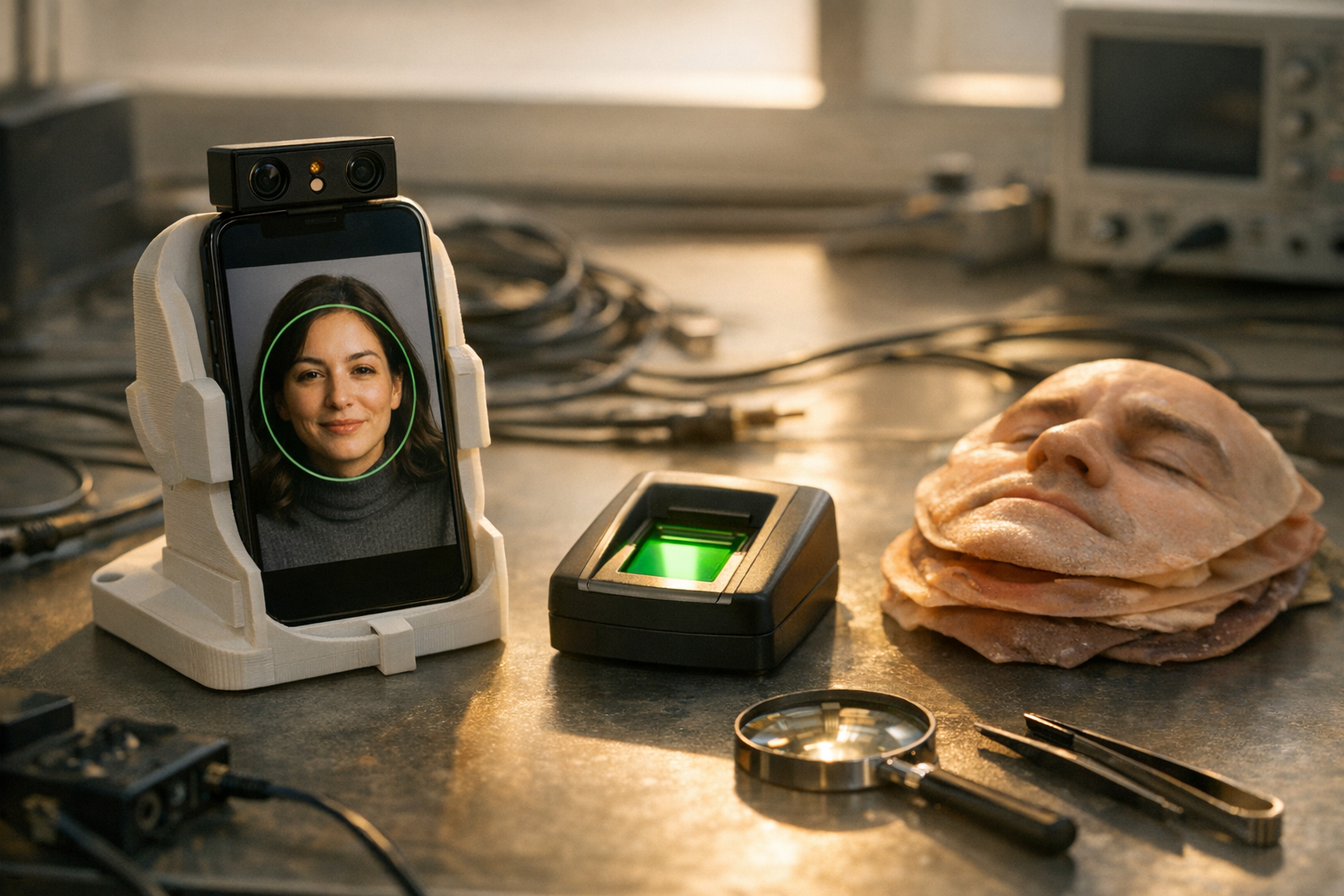
Researchers and companies aren’t standing still. Several promising approaches are converging to address the liveness detection synthetic media deepfakes generalization 2026 challenge — and some of them are actually delivering results.
1. Multi-task learning architectures
Instead of training a single binary classifier (live vs. spoof), newer models learn multiple tasks at once — depth estimation, reflection pattern analysis, facial landmark consistency checking. By building richer representations, these models generalize better across domains. Specifically, multi-task frameworks reduce cross-dataset error rates by 20–40% compared to single-task baselines. That’s not a small number.
2. Adversarial training with synthetic augmentation
Forward-thinking teams now include AI-generated faces directly in their training pipelines, using generative models to create synthetic attacks on the fly. This exposes the liveness detection model to the distribution it’ll actually face in production. Furthermore, adversarial training strategies deliberately generate hard examples that push decision boundaries into uncomfortable territory — which is exactly where you want them.
3. Frequency-domain analysis
Analyzing images in the frequency domain surfaces artifacts completely invisible to pixel-space inspection. GAN-generated images show characteristic spectral peaks. Diffusion model outputs show frequency distributions that differ measurably from camera-captured images. Models combining spatial and frequency features show notably stronger generalization to unseen synthetic media. This one surprised me when I first dug into the research — it’s a genuinely clever approach.
4. Foundation model adaptation
Large vision-language models like CLIP provide rich, general-purpose visual representations built on billions of image-text pairs. Fine-tuning these for liveness detection borrows that enormous knowledge base. The broad training helps bridge domain gaps that smaller, task-specific models simply can’t cross — though fair warning: the fine-tuning process requires careful calibration to avoid overfitting right back into the same old biases.
5. Continuous learning pipelines
Static models decay in effectiveness as new generative tools emerge. Continuous learning systems update their detection capabilities as new deepfake methods appear, ingesting newly discovered synthetic samples and retraining incrementally. This treats liveness detection as an ongoing operational process rather than a one-time deployment — which is honestly how it should’ve been framed from the start.
6. Multimodal fusion
Combining visual analysis with other signals dramatically improves robustness. Specifically, we’re talking about:
- Audio-visual synchronization checking (real-time deepfakes still struggle here)
- Physiological signal extraction via remote photoplethysmography
- Device-level attestation through camera hardware verification
- Challenge-response protocols requiring specific, unpredictable user actions
Notably, the most effective enterprise solutions in 2026 will combine multiple approaches. No single technique solves the generalization gap alone. Moreover, layered defenses create a detection system that’s exponentially harder to defeat — an attacker who cracks one layer still faces four more.
Enterprise Readiness: Bridging the Gap Before 2026
For organizations deploying identity verification today, the liveness detection synthetic media deepfakes generalization 2026 gap represents an urgent operational risk. Waiting for perfect academic solutions isn’t an option — the attacks aren’t waiting either.
Here’s a practical roadmap for enterprise teams:
Audit your current system’s synthetic media resilience. Most vendors won’t volunteer this information unprompted. Ask specifically: “What’s your detection accuracy against diffusion-model-generated faces?” Demand actual test results, not marketing claims. The FIDO Alliance provides certification programs that increasingly address synthetic attack vectors — a useful external benchmark to reference.
Set up layered verification. Don’t rely solely on passive liveness detection. Add active challenges — randomized head turn requests, specific phrase vocalization, variable lighting prompts. These significantly raise the difficulty of real-time deepfake attacks. Passive-only detection is no longer sufficient, and that’s not a debatable point.
Build a synthetic media threat intelligence program. Monitor emerging generative tools and techniques. When a new face generation model launches, test your detection pipeline against its outputs immediately. Treat this like vulnerability management in cybersecurity — because that’s essentially what it is.
Budget for continuous model updates. Liveness detection isn’t a set-and-forget deployment. Allocate resources for quarterly model retraining with fresh synthetic samples. Additionally, maintain a diverse library of generated faces from multiple architectures for ongoing evaluation. Conversely, organizations that treat this as a one-time purchase will find themselves badly exposed within months.
Collaborate across the industry. Shared threat intelligence about deepfake attack methods benefits everyone in the ecosystem. Organizations like MITRE are developing frameworks for classifying and sharing information about synthetic media threats — worth engaging with seriously.
Key metrics to track for enterprise liveness detection readiness:
- APCER (Attack Presentation Classification Error Rate) against synthetic media specifically — not just traditional attacks
- BPCER (Bona Fide Presentation Classification Error Rate) to ensure legitimate users aren’t getting blocked
- Cross-generator accuracy: Performance across at least five different generative architectures
- Temporal degradation rate: How quickly accuracy drops as new generators emerge
- Recovery time: How fast your pipeline adapts after encountering a novel attack type
Organizations that ignore this gap risk serious financial and reputational damage. Synthetic identity fraud already costs billions annually. As generative tools become more accessible — and they will — attack volume will only increase through 2026 and beyond. The math here isn’t complicated.
Conclusion
The liveness detection synthetic media deepfakes generalization 2026 challenge isn’t slowing down — it’s accelerating. Models trained on traditional presentation attacks can’t keep pace with the rapid evolution of generative AI. The domain shift between physical spoofs and AI-generated faces creates a fundamental generalization gap that benchmarks like SiW and OULU-NPU simply weren’t built to measure.
Nevertheless, practical solutions exist right now. Multi-task learning, frequency-domain analysis, foundation model adaptation, and continuous learning pipelines all show genuinely promising results. The key is combining these into layered defense systems rather than betting everything on one technique — because no single approach closes the gap on its own.
Here are your actionable next steps:
1. Test your current liveness system against state-of-the-art diffusion-generated faces this quarter
2. Demand synthetic media benchmarks from your identity verification vendor
3. Set up active challenge-response protocols alongside passive detection
4. Build a continuous retraining pipeline that ingests new generative attack samples monthly
5. Monitor the evolving threat landscape through industry collaboration and shared intelligence
The organizations that take liveness detection synthetic media deepfakes generalization 2026 seriously now will be the ones still standing when the next wave of synthetic attacks arrives. Don’t wait for a breach to make the gap feel real.
FAQ
What is liveness detection, and why does it matter for synthetic media defense?
Liveness detection is a technology that verifies whether a biometric sample comes from a real, physically present person. It’s used in identity verification, banking onboarding, and access control systems. It matters for synthetic media defense because deepfakes can now bypass traditional checks with uncomfortable ease. Without solid liveness detection that generalizes across attack types, automated systems can’t reliably tell real users apart from AI-generated imposters — and that’s a serious problem when real money and real identities are on the line.
Why do liveness detection models struggle with deepfakes specifically?
Most models train on physical presentation attacks — printed photos, screen replays, 3D masks. Deepfakes represent a fundamentally different data distribution. The pixel-level artifacts, temporal patterns, and texture characteristics of AI-generated faces don’t match anything in the training data. Consequently, the model’s learned decision boundaries don’t account for synthetic content at all. This domain shift is the primary cause of poor generalization performance, and it’s not a problem you can patch with a simple update.
Which benchmark datasets should I use to evaluate liveness detection against synthetic media?
For traditional presentation attacks, SiW and OULU-NPU remain valuable baselines — they’re still worth running. However, for synthetic media evaluation, you should additionally use FaceForensics++, CelebDF, and WildDeepfake. Importantly, no single existing benchmark fully captures the 2026 threat landscape. You’ll need to supplement public datasets with custom test sets generated using current diffusion models and face-swap tools for a genuinely complete liveness detection evaluation.
How will liveness detection synthetic media deepfakes generalization 2026 solutions differ from current approaches?
Current approaches primarily rely on binary classification trained on limited attack types. 2026 solutions will likely feature multi-task architectures that learn richer facial representations, incorporating frequency-domain analysis, foundation model backbones, and continuous learning pipelines. Furthermore, enterprise systems will combine passive analysis with active challenge-response protocols and multimodal fusion — creating stronger generalization across both physical and synthetic media attacks. The shift is from static detection to adaptive, layered defense.
Can active liveness checks defeat real-time deepfake attacks?
Active checks — asking users to turn their head, blink, or speak a random phrase — significantly raise the bar for attackers. Although real-time deepfake tools exist, they genuinely struggle with unpredictable, multi-modal challenges. Combining randomized visual prompts with audio verification and timing analysis makes real-time spoofing extremely difficult. Nevertheless, this isn’t foolproof. Determined attackers with advanced tools can still potentially get around active checks, which is exactly why layered liveness detection remains essential rather than optional.
What should enterprises prioritize right now to prepare for the 2026 synthetic media threat?
Start with an honest assessment of your current liveness detection system’s performance against AI-generated faces. Most organizations discover significant gaps — and that discovery is uncomfortable but necessary. Then make three immediate changes: add active challenge protocols, build a synthetic sample testing library, and negotiate continuous model update commitments with your vendor. Additionally, join industry working groups focused on synthetic media deepfakes generalization. Shared intelligence about emerging attack methods is one of the most cost-effective defenses available heading into 2026 — and frankly, it’s underutilized.
References
Keep reading
Here are the latest posts from the blog.

The field of AI world models training data representation learning 2026 is reshaping how machines understand reality — not just process it, but genuinely model it. These syst…
The OpenAI o1 mathematical conjecture disproof breakthrough 2024 is, honestly, the most interesting thing I’ve seen in AI research this year. And I don’t say that lightly. Fo…

The charts show how ChatGPT flooding lives isn’t just a catchy headline anymore — it’s backed by hard data that’s genuinely hard to argue with. OpenAI’s flagship product has…