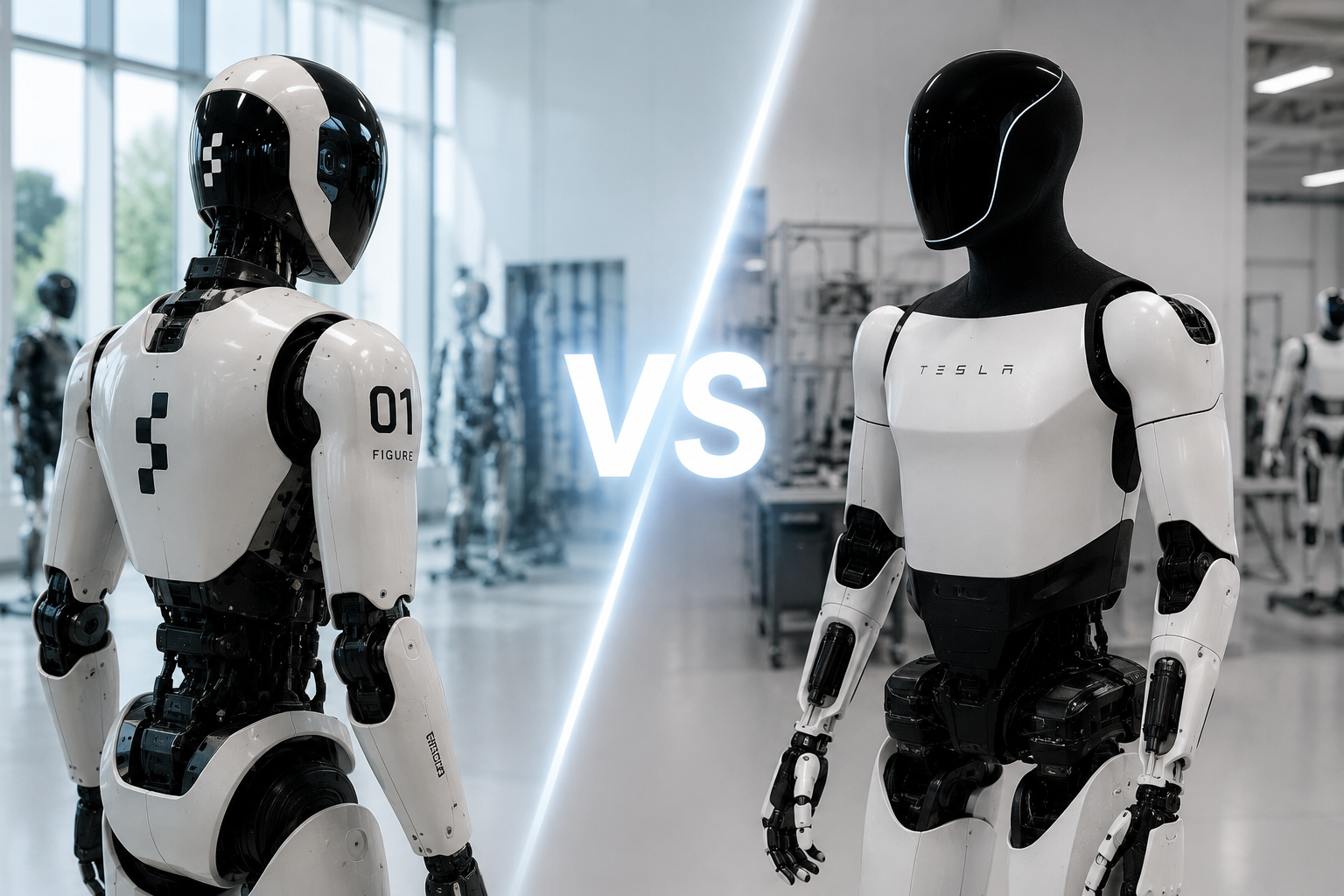
The race to build humanoid robots at scale just split into two distinct lanes. Figure AI vs Optimus is the clearest divergence yet in how companies plan to manufacture humanoids, and the gap is wider than most people realize.
In the Figure AI vs Optimus split, one company embeds itself inside an automotive giant’s existing infrastructure. The other builds everything under its own roof, from the chips up.
Figure AI signed a deal with BMW to deploy robots at its Spartanburg, South Carolina plant. Tesla, meanwhile, quietly retooled sections of its Fremont factory for Optimus production. Figure AI vs Optimus isn’t just two different strategies — it’s two fundamentally different philosophies about how humanoid robotics will scale.
Understanding why Figure AI vs Optimus diverges this sharply matters for investors, engineers, and anyone tracking automation. The timelines, risks, and capital requirements couldn’t be more different.
Why Figure AI vs Optimus Defines the Humanoid Scaling Debate
Figure AI vs Optimus: Capital and Production Capacity Compared
Figure AI vs Optimus: Supply Chain Risk, Outsourced vs Owned
Why Automakers Are Betting on Figure AI vs Optimus Differently
Figure AI vs Optimus: Comparing Timelines to Scale
Why Figure AI vs Optimus Defines the Humanoid Scaling Debate
Humanoid robotics is at a genuine crossroads. Two models are emerging for getting robots from prototype to mass production, and watching Figure AI vs Optimus play out in parallel is genuinely fascinating.
On one side of Figure AI vs Optimus, Figure AI chose the OEM partnership model. It embeds its robots inside existing manufacturing infrastructure. BMW’s Spartanburg plant already produces roughly 1,500 vehicles a day, so Figure doesn’t need to build factories — it needs to prove its robots can work alongside humans in a proven, high-pressure environment.
On the other side of Figure AI vs Optimus, Tesla chose vertical integration. Its approach mirrors what it did with electric vehicles: build the factory, design the chips, write the software, control every step. Fremont has undergone significant retooling for Optimus Gen 3 assembly lines. This playbook is ambitious and expensive, and it either pays off massively or it doesn’t.
Two Models Behind Figure AI vs Optimus
Figure AI vs Optimus scaling timelines look very different as a result. Figure can deploy robots incrementally across BMW’s global network of 31 plants. Tesla must invest billions in dedicated capacity before shipping a single unit externally.
In Figure AI vs Optimus terms, Figure’s capital risk is shared with BMW, while Tesla’s sits entirely on its own balance sheet. The partnership model lets Figure test real-world performance without betting the company on factory construction; Tesla believes owning the entire stack creates long-term advantages that justify the cost.
This isn’t just a manufacturing debate — Figure AI vs Optimus is a bet on which path reaches meaningful production volume first. The answer isn’t obvious, not even close.
Figure AI vs Optimus: Capital and Production Capacity Compared
Numbers tell the real story in the Figure AI vs Optimus comparison. Here’s what each company needs to spend and what they realistically expect to produce.
On Figure’s side of the Figure AI vs Optimus ledger, Figure AI raised $675 million in its Series B at a $2.6 billion valuation. Microsoft, NVIDIA, and Jeff Bezos all participated, which says something about the confidence in the room. That capital funds R&D and initial deployments, not factory construction — BMW absorbs the facility costs directly.
On Tesla’s side of Figure AI vs Optimus, Tesla generated over $8.9 billion in free cash flow in 2023. But dedicating Fremont floor space to Optimus means giving up vehicle production capacity — every square foot used for robots is a square foot not building a Model S, X, or 3, an opportunity cost that doesn’t show up in a press release.
| Factor | Figure AI (BMW Partnership) | Tesla (Fremont In-House) |
|---|---|---|
| Estimated initial capex | $200–400M (R&D focused) | $1–3B (factory retooling) |
| Production facility cost | Borne by BMW | Borne by Tesla |
| Target initial annual units | 500–1,000 (2025–2026) | 1,000–5,000 (2026–2027) |
| Long-term annual target | 10,000+ across OEM partners | 100,000+ (Elon Musk’s stated goal) |
| Time to first deployment | Already started (2024) | Late 2025 earliest |
| Supply chain control | Shared with BMW | Fully owned |
| Revenue model | Robot-as-a-service + unit sales | Unit sales + internal deployment |
Figure’s estimated initial capex runs $200 to $400 million, R&D-focused, with BMW covering the facility. Its initial target is 500 to 1,000 units a year by 2025–2026. Longer term, Figure aims for 10,000-plus units across OEM partners, with supply chain control shared with BMW throughout.
Tesla’s estimated initial capex runs $1 to $3 billion for factory retooling, borne entirely by Tesla. Its initial target is 1,000 to 5,000 units a year by 2026–2027. Longer term, Tesla is chasing Musk’s stated goal of 100,000-plus units annually, with supply chain control fully owned in-house.
Revenue models diverge too, another axis of Figure AI vs Optimus worth tracking. Figure blends robot-as-a-service contracts with unit sales, letting BMW pay for uptime rather than hardware alone. Tesla leans on unit sales plus internal deployment, mirroring how it sells cars directly rather than through dealers. Neither model is proven yet at scale.
The capex profiles reveal something most Figure AI vs Optimus coverage glosses over. Figure’s burn rate stays manageable because BMW handles facilities. Tesla’s approach requires massive upfront spending before a single dollar of external revenue materializes.
Unit economics differ too. Figure refines robot design while BMW handles logistics, tooling, and worker training. Tesla has to build all of that internally, from scratch. Tesla’s stated goal of sub-$20,000 units requires manufacturing scale that doesn’t exist yet — current low-volume humanoids run $50,000 to $150,000 per unit, another reminder of how far apart Figure AI vs Optimus economics really are.
Figure AI vs Optimus: Supply Chain Risk, Outsourced vs Owned
This is where the strategies diverge most sharply, and it’s the part most people skip over. Looking at Figure AI vs Optimus through a supply chain lens changes how you think about both bets.
On Figure’s side of Figure AI vs Optimus, BMW runs one of the world’s most sophisticated automotive supply chains. Spartanburg alone sources components from hundreds of Tier 1 and Tier 2 suppliers. Figure benefits from BMW’s purchasing power, logistics networks, and quality control systems — systems that took decades to build.
This isn’t a new pattern in manufacturing. Automakers have outsourced specialized components like brakes, transmissions, and electronics to Tier 1 suppliers for decades. Figure is simply the newest category to slot into that existing relationship.
Figure gains access to BMW’s existing supplier relationships, ISO 9001-certified quality systems, logistics spanning three continents, a trained manufacturing workforce, and proven safety protocols for human-robot collaboration.
But the Figure side of Figure AI vs Optimus has real vulnerabilities too. Figure doesn’t fully control its own destiny. BMW could renegotiate terms, slow deployments, or prioritize vehicle production during a downturn. Figure must also design robots that fit BMW’s manufacturing constraints, not the other way around.
Where Figure AI vs Optimus Diverge on Risk
On Tesla’s side of Figure AI vs Optimus, Tesla controls everything. It designs its own chips through Dojo, makes battery packs in-house, and writes its own software stack. For Optimus, Tesla can optimize every component for cost and performance without negotiating with partners.
That control comes at a price. Tesla must build humanoid-specific supply chains essentially from scratch. Actuators for bipedal robots differ fundamentally from EV motors, and the sensors needed for humanoid manipulation don’t overlap much with autopilot hardware.
The Figure AI vs Optimus risk profile breaks down cleanly:
- Partner dependency risk: high for Figure, near zero for Tesla
- Capital intensity risk: low for Figure, very high for Tesla
- Component sourcing risk: low for Figure (BMW’s network), high for Tesla (new suppliers)
- Timeline risk: moderate for Figure, high for Tesla (factory delays compound fast)
- Design flexibility risk: moderate for Figure (BMW constraints), low for Tesla (full control)
Each side of Figure AI vs Optimus trades one set of risks for another. Neither is clearly superior — the question is which risks prove more manageable in practice.
Why Automakers Are Betting on Figure AI vs Optimus Differently
The Figure AI vs Optimus comparison reveals a broader industry trend worth sitting with. Traditional automakers see humanoids as tools. Tesla sees them as products. That distinction explains almost everything else.
The clearest way to frame Figure AI vs Optimus philosophically: BMW doesn’t want to sell robots — it wants robots that make car manufacturing cheaper and more flexible. BMW has invested heavily in factory automation for decades, and humanoid robots are the logical next step, handling tasks fixed automation can’t: moving between workstations, adapting to model changeovers, working in spaces built for humans.
For BMW, Figure’s robots are a means to an end. They cut labor costs in physically demanding tasks like body shop work and internal logistics. BMW doesn’t care who builds the robot — it cares about uptime, reliability, and cost per task hour.
BMW isn’t the only data point in Figure AI vs Optimus. Other automakers are placing similar bets:
- Mercedes-Benz partnered with Apptronik to test Apollo robots in its plants
- Hyundai acquired Boston Dynamics and is integrating robots into its operations
- Toyota Research Institute continues developing humanoid capabilities internally
None of these OEMs are trying to sell robots to consumers. They’re focused on internal deployment first, which creates a fundamentally different incentive structure than Tesla’s. That momentum matters for Figure specifically — every additional automaker signing a similar deal validates the partnership model and hands Figure more real-world data to refine its robots.
On Tesla’s end of Figure AI vs Optimus, Elon Musk has repeatedly said Optimus could become Tesla’s most valuable product. He envisions millions of units doing household tasks, elder care, and industrial work. Tesla isn’t building Optimus primarily to improve its own factories — it’s building Optimus to sell.
That’s a completely different business, and it’s why Tesla needs the Fremont restart. You can’t sell millions of robots through a partner’s factory. This is the sharpest contrast in Figure AI vs Optimus: Figure’s BMW deal gets humanoids into real production faster, while Tesla’s Fremont restart positions Optimus for a far larger addressable market.
Figure AI vs Optimus: Comparing Timelines to Scale
The Figure AI vs Optimus timeline comparison favors Figure in the short term and Tesla in the long term. But “long term” is doing a lot of work in that sentence, and robotics timelines have a long history of slipping.
Figure’s timeline:
- 2024: Initial deployment of Figure 02 robots at BMW Spartanburg
- 2025: Expanded deployment across multiple BMW workstations
- 2026: Potential expansion to additional BMW plants globally
- 2027–2028: New OEM partnerships, backed by a proven track record
Figure’s advantage in Figure AI vs Optimus is speed. Robots are already working in Spartanburg — that’s not vaporware. Each successful deployment builds the case for broader adoption, and real-world data from BMW helps Figure improve faster than simulation alone.
Tesla’s timeline:
- 2024: Internal testing of Optimus Gen 2 at Fremont and Giga Texas
- 2025: Fremont retooling for dedicated Optimus production lines
- 2026: Limited Gen 3 production run, estimated in the hundreds of units
- 2027–2028: Scaled production targeting thousands of units annually
- 2030+: Mass production toward Musk’s stated goal of millions per year
On Tesla’s side of Figure AI vs Optimus, the timeline has already slipped, and it’s worth being honest about that. Musk originally suggested Optimus would be in production by 2025. The Gen 3 ramp has faced delays tied to actuator reliability and software integration. Still, Tesla’s deep pockets provide runway most startups don’t have.
Key risks for Figure:
- BMW could slow deployments if conditions worsen
- Proving ROI at Spartanburg is essential before expansion
- Competition from Apptronik, Agility Robotics, and others for the same OEM deals
Key risks for Tesla:
- Factory retooling delays compound quickly and expensively
- Actuator and battery supply constraints remain unresolved
- Software maturity for unstructured environments is still unsolved
- Pulling engineering resources from vehicle production carries its own cost
These timelines aren’t fixed. A breakthrough in AI-driven manipulation could speed up either company. A recession could slow both. Figure AI vs Optimus, ultimately, is a bet on which risks show up first.
Conclusion: What Figure AI vs Optimus Means for Robotics
The debate over Figure AI vs Optimus isn’t really about which company builds a better robot. It’s about which manufacturing philosophy wins the race to scale, and those are genuinely different questions.
On one side of Figure AI vs Optimus, Figure chose the partnership path: faster, cheaper, and lower risk near term. BMW provides the factory, supply chain, and workforce; Figure provides the robot. This gets humanoids into real production today, not a demo reel.
On the other side, Tesla chose vertical integration: slower, more expensive, higher risk, but with essentially unlimited upside if it reaches mass production. Owning the entire stack means controlling cost, quality, and margin at scale in ways a partnership never can.
Watch these Figure AI vs Optimus signals over the next 18 months. Does BMW expand Figure’s deployment or quietly scale it back? Can Tesla actually produce hundreds of Optimus units by late 2026? Do other automakers sign deals with Figure? Does Tesla’s cost per unit approach $20,000? And where does investor capital actually flow?
Figure AI vs Optimus may not produce a single winner. Both models could succeed in different segments — Figure dominating industrial deployment through OEM partnerships, Tesla owning consumer and small-business markets through vertical integration. Whichever model wins, the manufacturing playbook that emerges will likely define how every other robotics company approaches scale for the next decade.
FAQ About Figure AI vs Optimus
Which Company Wins the Figure AI vs Optimus Race First?
In the Figure AI vs Optimus race, Figure AI will likely deploy robots in production environments first — it already has units operating at BMW’s Spartanburg plant. Tesla aims for much higher volume over the long run, though. Deployment isn’t the same as mass production: Figure deploys into existing factories, while Tesla plans to build its own capacity for potentially millions of units.
How Much Does a Humanoid Robot Cost in the Figure AI vs Optimus Comparison?
Current estimates put humanoid robots at $50,000 to $150,000 per unit at low volumes. Tesla has stated a target of under $20,000 per Optimus at scale, while Figure hasn’t shared per-unit costs — a real gap in the Figure AI vs Optimus numbers. Costs drop with volume, but that requires runs of tens of thousands of units a year.
Why Did BMW Partner With Figure AI Instead of Building Its Own Robot?
BMW is an automaker, not a robotics company, and that’s central to understanding Figure AI vs Optimus. Building humanoid robots requires deep expertise in bipedal movement, AI-driven manipulation, and real-time perception. Partnering with Figure lets BMW access cutting-edge robotics without pulling R&D resources from its core vehicle business.
What Is Tesla’s Fremont Restart in the Figure AI vs Optimus Story?
Tesla’s Fremont restart is the other half of Figure AI vs Optimus: retooling production space at its Fremont, California factory for Optimus assembly. Tesla is converting floor space previously used for vehicle production into dedicated Optimus manufacturing lines, including new tooling, testing equipment, and assembly stations built specifically for humanoid robot production.
Can Figure AI’s partnership model scale to millions of units?
Probably not through OEM partnerships alone. The partnership model works well for deploying thousands of robots across industrial settings. However, reaching millions of units would likely require Figure to either build its own factories or sign deals with dozens of manufacturing partners at once. Additionally, industrial demand may not support millions of units in the near term — the consumer market could, but Figure hasn’t announced any consumer plans yet. That’s a notable gap worth watching.
Can Figure AI’s Partnership Model Scale to Millions of Units?
Probably not through OEM partnerships alone — a real limit on Figure’s side of Figure AI vs Optimus. The model works well for deploying thousands of robots industrially, but reaching millions would likely require Figure to build its own factories or sign dozens of partnerships at once. The consumer market could support that volume, but Figure hasn’t announced consumer plans.
Keep reading
Here are the latest posts from the blog.

Moonshot AI just shipped its fifth major model in about twelve months. Kimi K3 landed on July 16, 2026 — a 2.8-trillion-parameter system the company calls the largest open-we…
Wall Street loves a big number. Right now, one Microsoft Meta AI capex figure is dominating every analyst briefing and investor call this earnings season. But most coverage i…
Yale built an AI governance framework around a single model’s risk profile, and that choice says more about where enterprise AI is heading than any benchmark leaderboard ever…