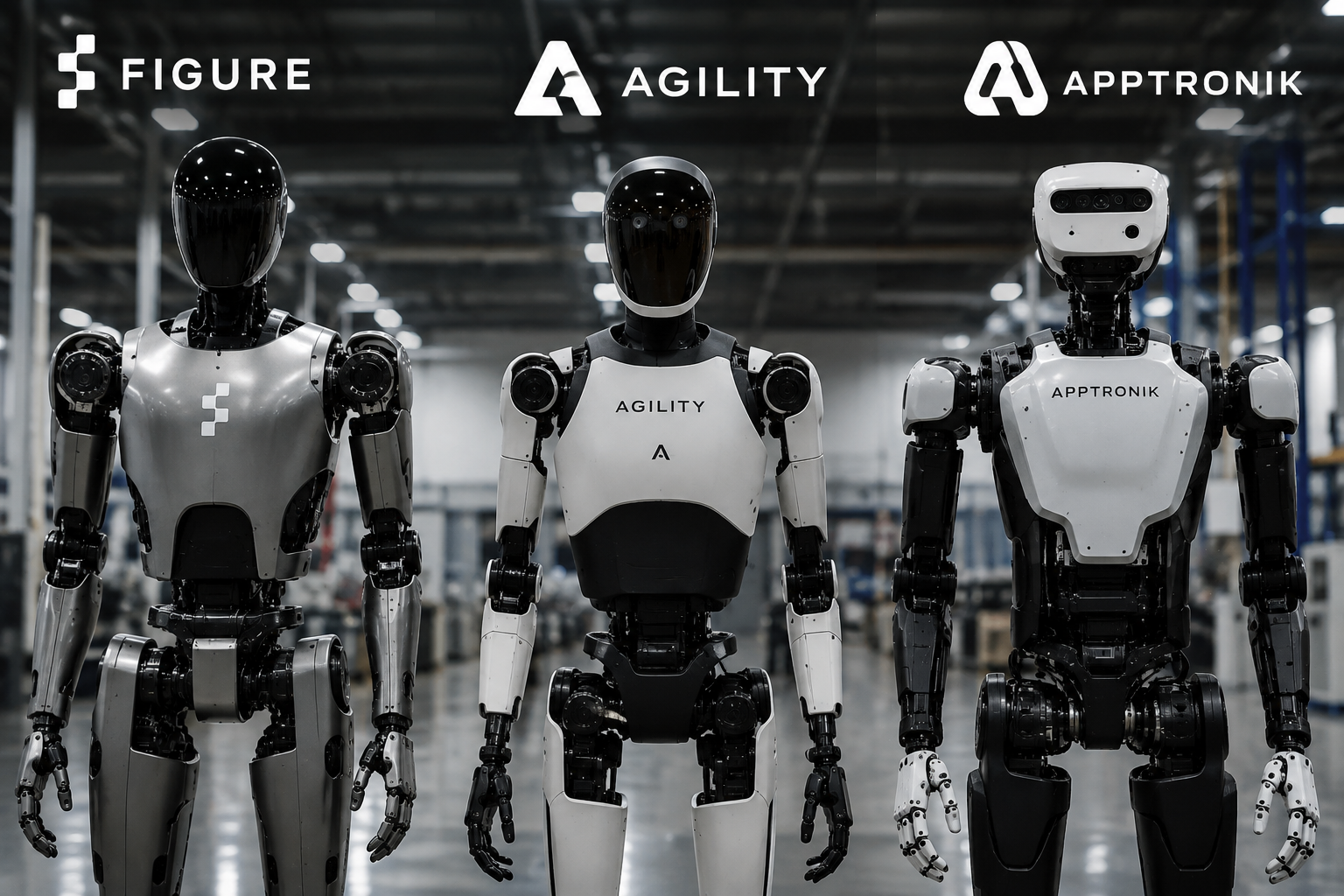
The race to build commercially viable humanoid robots is burning through billions in venture capital, and the numbers have moved fast enough to catch most coverage flat-footed. Comparing Agility, Figure, Apptronik funding as of mid-2026 tells a genuinely different story than it would have told even a year ago.
As recently as early 2024, Figure AI was the funding leader at a $2.6 billion valuation, Agility was the steady operator, and Apptronik was the disciplined underdog running on a comparatively tiny budget. The humanoid robot funding picture no longer looks like that at all. Figure AI is now valued at $39 billion. Apptronik has raised nearly a billion dollars with Google as a new backer. Agility just announced it’s going public.
This piece breaks down where the funding actually stands today, what the investor rosters signal, and which company is best positioned to survive the capital-intensive slog toward real commercial scale.
Key Takeaways on Agility Figure Apptronik Funding
- Figure AI’s September 2025 Series C valued the company at $39 billion, roughly 15 times its 2024 valuation, on close to $1.9 billion raised total.
- Apptronik closed a roughly $935 million round in early 2026 at a $5–5.5 billion valuation, with Google joining as a backer alongside a new Google DeepMind partnership.
- Agility Robotics announced on June 24, 2026 that it’s going public via a SPAC merger with Churchill Capital Corp XI, at a valuation near $2.5 billion.
- Agility remains furthest along commercially, with roughly 100 Digit units deployed and low tens of millions in annual run-rate revenue.
- Apptronik is no longer the capital-constrained underdog in this story — it’s now the second-best-funded of the three.
How the Humanoid Robot Funding Numbers Stack Up in 2026
Investor Composition Behind Agility, Figure, Apptronik Funding
Capital Efficiency and Runway Across Agility, Figure, Apptronik Funding
Deployment Timelines: Agility, Figure, Apptronik Funding vs. Revenue
How Big Tech Capex Connects to Agility, Figure, Apptronik Funding
How the Humanoid Robot Funding Numbers Stack Up in 2026
Each of these three companies has taken a genuinely distinct path through the funding, and the gaps between them have only widened.
Figure AI moved fastest and furthest in the Agility, Figure, Apptronik funding race. Founded in 2022, Figure raised a $675 million Series B in February 2024 at a $2.6 billion valuation, with Microsoft, OpenAI’s Startup Fund, Nvidia, and Jeff Bezos among the backers. That was just the beginning. In September 2025, Figure closed a Series C of over $1 billion, led by Parkway Venture Capital with Brookfield, Nvidia, Macquarie, and others participating, pushing its valuation to $39 billion. Total funding now sits around $1.9 billion.
Agility Robotics has been part of the funding story the longest. Founded in 2015, the company built its Digit robot over nearly a decade of iteration before raising a $150 million Series B in 2024. It followed that with a $400 million Series C in March 2025, bringing total funding to roughly $641 million. Then, on June 24, 2026, Agility announced a definitive agreement to go public through a SPAC merger with Churchill Capital Corp XI, at a valuation of roughly $2.5 billion.
Where Apptronik Fits Into Agility, Figure, Apptronik Funding Now
Apptronik’s part of the funding story has changed the most. Founded in 2016, the Austin-based company spent years on a comparatively modest budget after its original $14 million Series A. That changed in early 2026, when Apptronik closed a round of roughly $935 million at a $5 to $5.5 billion valuation, with Google joining as a backer alongside Mercedes-Benz, GXO Logistics, and Jabil. The round came alongside a new strategic partnership with Google DeepMind to build Apptronik’s next-generation robot on Gemini Robotics.
Here’s how the humanoid robot race funding compares as of mid-2026: Figure has raised roughly $1.9 billion total, most recently at a $39 billion valuation. Agility has raised roughly $641 million total and is now proceeding toward a public listing at around a $2.5 billion valuation. Apptronik has raised roughly $935 million total, most recently at a $5 to $5.5 billion valuation.
Figure AI still commands the highest valuation in the Agility, Figure, Apptronik funding race by a wide margin, which says something about how AI hype continues to reshape hardware investment logic. But the real shift is Apptronik’s leap from also-ran to genuine second-place contender on both funding and valuation.
Investor Composition Behind Agility, Figure, Apptronik Funding
Who writes the checks matters as much as how large they are, and the cap tables behind the funding tell three distinct stories.
Figure AI’s investor list reads like a tech all-star roster, and it’s the clearest signal in the Agility, Figure, Apptronik funding story of where AI-native capital is flowing. Microsoft, Nvidia, and OpenAI’s Startup Fund backed its 2024 round, and its 2025 Series C added Brookfield, Macquarie, Intel Capital, LG, Salesforce, and Qualcomm Ventures. That composition signals Figure is positioned at the intersection of AI infrastructure and robotics, not just another hardware play.
How Google’s Entry Changes Agility, Figure, Apptronik Funding
Apptronik’s investor base transformed with its 2026 round, reshaping the funding hierarchy. Google’s participation, paired with the Google DeepMind partnership for Gemini Robotics, gives Apptronik a strategic AI relationship that rivals Figure’s Microsoft and OpenAI ties. Mercedes-Benz, GXO Logistics, and Jabil round out a roster focused on manufacturing and logistics deployment rather than pure AI research.
Agility Robotics brings a different kind of backing to the Agility, Figure, Apptronik funding comparison. Amazon participated in Agility’s earlier rounds and has been testing Digit robots in its fulfillment centers, while Nvidia’s venture arm, NVentures, joined more recently. The SPAC route to going public also brings in an entirely new category of investor: public markets. That’s a structurally different path than either Figure or Apptronik has taken, and it comes with its own disclosure requirements and quarterly scrutiny that private companies don’t face.
Each company is essentially courting a different version of the future in the Agility, Figure, Apptronik funding story: Figure toward general-purpose AI-native robotics, Apptronik toward Google-backed industrial deployment, and Agility toward public-market validation of its commercial traction.
Capital Efficiency and Runway Across Agility, Figure, Apptronik Funding
Raising money is one thing. Spending it wisely is another, and this is where the Agility, Figure, Apptronik funding story runs into the harder question of capital efficiency.
Hardware companies burn cash faster than software startups, a fact every part of the humanoid robot funding equation has to account for. Building prototypes, standing up pilot production lines, and recruiting specialized robotics engineers all cost far more than spinning up cloud instances. A single experienced robotics engineer with a relevant PhD commands $250,000 to $350,000 in total annual compensation in the current market — multiply that across a 200-person technical team and the burn adds up before a single actuator gets machined.
Runway Looks Very Different Across the Funding Now
With roughly $1.9 billion raised, Figure carries the most substantial runway in the Agility, Figure, Apptronik funding comparison, even accounting for the sharp cost increases that come with scaling from pilot batches to full production runs. Agility’s $641 million in total funding, combined with its RoboFab factory in Salem, Oregon, gives it real manufacturing capacity already on the books, though going public will add new reporting obligations and investor scrutiny of burn rate specifically.
Apptronik’s roughly $935 million round fundamentally resets its runway picture from where it stood even a year ago. The company that once had to be extremely capital-efficient or risk falling behind now has a war chest closer to Agility’s than the thin budget the earlier funding numbers suggested.
That said, all three companies will likely need additional capital before reaching profitability. Humanoid robots remain among the most capital-intensive hardware categories in tech, and manufacturing scale-up costs tend to spike sharply once volume production begins.
Deployment Timelines: Agility, Figure, Apptronik Funding vs. Revenue
Billions in the humanoid robot race funding mean nothing without a path to revenue, and this is where the gaps between the three companies are still widest, even after the 2025 and 2026 funding shifts.
Agility remains furthest along commercially. Digit robots have been piloted inside Amazon warehouses since 2023, and as of early 2026, roughly 100 units were deployed generating low tens of millions in annual run-rate revenue at an estimated $30-per-hour robots-as-a-service rate. That’s still a small fraction of Agility’s roughly $641 million in cumulative capital raised, but it’s real, named-customer revenue that neither competitor has matched at the same scale.
Figure AI has strong partnerships — including with BMW for manufacturing deployment — and has replaced its earlier OpenAI collaboration with its own in-house model, called Helix, powering the robot’s reasoning and manipulation. On the deployment side of Agility, Figure, Apptronik funding, though, Figure’s commercial scale still trails Agility’s.
Apptronik’s Apollo robot has real partnerships with Mercedes-Benz, GXO Logistics, and Jabil, and its new Google DeepMind collaboration on Gemini Robotics is aimed at a next-generation robot debuting in 2026. Apptronik’s dramatically larger war chest, the newest shift in the Agility, Figure, Apptronik funding picture, now gives it room to scale deployment faster than its previous funding level would have allowed, though it’s still working from an earlier commercial base than Agility.
The pattern across the funding and revenue is consistent with the broader market: the global humanoid robotics market is projected to grow from roughly $3 billion in 2025 to as much as $38 billion by 2035, according to industry estimates. That’s the scale of bet investors across all three companies are making.
How Big Tech Capex Connects to Agility, Figure, Apptronik Funding
The humanoid robotics funding surge behind the funding doesn’t exist in a vacuum. It’s directly connected to broader Big Tech capital spending, and understanding that connection changes how you read these rounds.
Microsoft’s and Nvidia’s continued involvement in Figure AI signals a bet that humanoid robots become physical endpoints for AI models and simulation platforms — a thesis that now runs through most of the Agility, Figure, Apptronik funding story. Nvidia’s robotics logic is straightforward: every humanoid robot that trains in Isaac Sim and runs inference on Jetson hardware is a recurring chip customer, and that logic now extends to Agility through NVentures’ investment too.
Google’s entry into Apptronik’s round follows a similar logic to Microsoft’s Figure bet, just arriving later and larger in the Agility, Figure, Apptronik funding timeline. Pairing capital with the Gemini Robotics partnership means Google isn’t just writing a check — it’s betting that humanoid robots become a genuine deployment surface for its foundation models, the same way OpenAI positioned itself with Figure back in 2024.
Amazon’s relationship with Agility follows a different logic entirely within the Agility, Figure, Apptronik funding picture. Amazon already runs hundreds of thousands of robots across its warehouses, and Digit represents the next step: machines that can work in spaces built for humans without costly facility changes. Even capturing a small fraction of Amazon’s 1,000-plus global fulfillment facilities would represent thousands of units and meaningful recurring service revenue.
These connections show why Agility, Figure, Apptronik funding matters well beyond the robotics industry itself — each round is also a proxy for how seriously a different corner of Big Tech takes embodied AI as the next deployment layer.
Conclusion: What Agility, Figure, Apptronik Funding Reveals
The Agility, Figure, Apptronik funding picture in mid-2026 looks almost nothing like it did two years ago. Figure AI leads decisively on valuation at $39 billion. Apptronik has closed the funding gap dramatically with its roughly $935 million round and new Google partnership. Agility is taking the most structurally different path of the three by going public.
A few things worth watching next in the Agility, Figure, Apptronik funding story. Track Figure’s Helix model and BMW deployment numbers, since that’s the clearest signal of whether its valuation is backed by real commercial traction. Watch Apptronik’s Gemini Robotics-powered robot when it debuts, since that will show whether the Google partnership translates into a genuine product advantage. Follow Agility’s SPAC process closely, since a successful public listing would make it the first pure-play humanoid company with real public-market price discovery.
No single company has this locked up. Agility, Figure, Apptronik funding numbers will keep moving, and the capital allocation patterns forming right now will likely determine which company, if any, builds the first truly commercial humanoid robot at real scale.
FAQ About Agility, Figure, Apptronik Funding
How Much Has Figure AI Raised Compared to Agility and Apptronik?
As of mid-2026, the Agility, Figure, Apptronik funding scoreboard shows Figure AI having raised roughly $1.9 billion total, most recently valued at $39 billion after its September 2025 Series C. Agility Robotics has raised roughly $641 million, and Apptronik has raised roughly $935 million after its early-2026 round. Figure still leads by a wide margin on total capital raised and valuation.
Why Is Figure AI Valued So Much Higher Than Agility or Apptronik?
Figure AI’s $39 billion valuation, the highest in the Agility, Figure, Apptronik funding comparison, reflects its star-studded investor base, its AI-native positioning, and a broader market repricing of humanoid robotics that lifted the entire sector’s valuations through 2025 and 2026. Agility’s roughly $2.5 billion SPAC valuation and Apptronik’s $5 to $5.5 billion valuation are both smaller, though Apptronik’s number has grown dramatically since its earlier funding rounds.
What Changed for Apptronik in 2026?
Apptronik closed a round of roughly $935 million in early 2026 at a $5 to $5.5 billion valuation — the single biggest jump in the funding story this year — with Google joining as a backer alongside existing partners Mercedes-Benz, GXO Logistics, and Jabil. The round came with a new strategic partnership with Google DeepMind to build Apptronik’s next-generation robot on Gemini Robotics, debuting later in 2026.
Why Is Agility Robotics Going Public?
Agility announced on June 24, 2026 that it’s going public through a SPAC merger with Churchill Capital Corp XI, at a valuation of roughly $2.5 billion — the most structurally different move in the funding story so far. Going public gives Agility access to public markets for future capital and creates the humanoid robotics sector’s first direct, liquid public proxy, built on its multi-year commercial deployment track record with Amazon and other enterprise customers.
Which Humanoid Robot Company Is Closest to Generating Real Revenue?
Agility Robotics remains closest to meaningful revenue in the Agility, Figure, Apptronik funding comparison. As of early 2026, roughly 100 Digit units were deployed generating low tens of millions in annual run-rate revenue through a robots-as-a-service model. That’s still small relative to its total funding, but it represents more sustained, named-customer commercial activity than either Figure or Apptronik has publicly demonstrated at the same scale.
Will These Companies Need to Raise More Funding Before Becoming Profitable?
Almost certainly, yes, for all three sides of the Agility, Figure, Apptronik funding story. Hardware companies typically need multiple funding rounds before reaching profitability, and humanoid robots are among the most capital-intensive hardware categories in tech. Even with Figure’s $1.9 billion raised, Apptronik’s $935 million, and Agility’s public-market access, manufacturing scale-up costs and ongoing R&D will likely require additional capital from all three companies before any reaches sustainable profitability.
Keep reading
Here are the latest posts from the blog.

The Anthropic copyright settlement just became the largest class-action copyright settlement in history — and the reason is more precise than most headlines suggest. Anthropi…
Custom silicon’s rise changes the Trainium TPU Nvidia margins conversation in a way market-share numbers never could. Most coverage frames AWS Trainium and Google TPU as a sh…
The irony here is almost too good: Google TPU Anthropic now depends on are the same chips Google’s own researchers are queuing to use. Google designed these Tensor Processing…