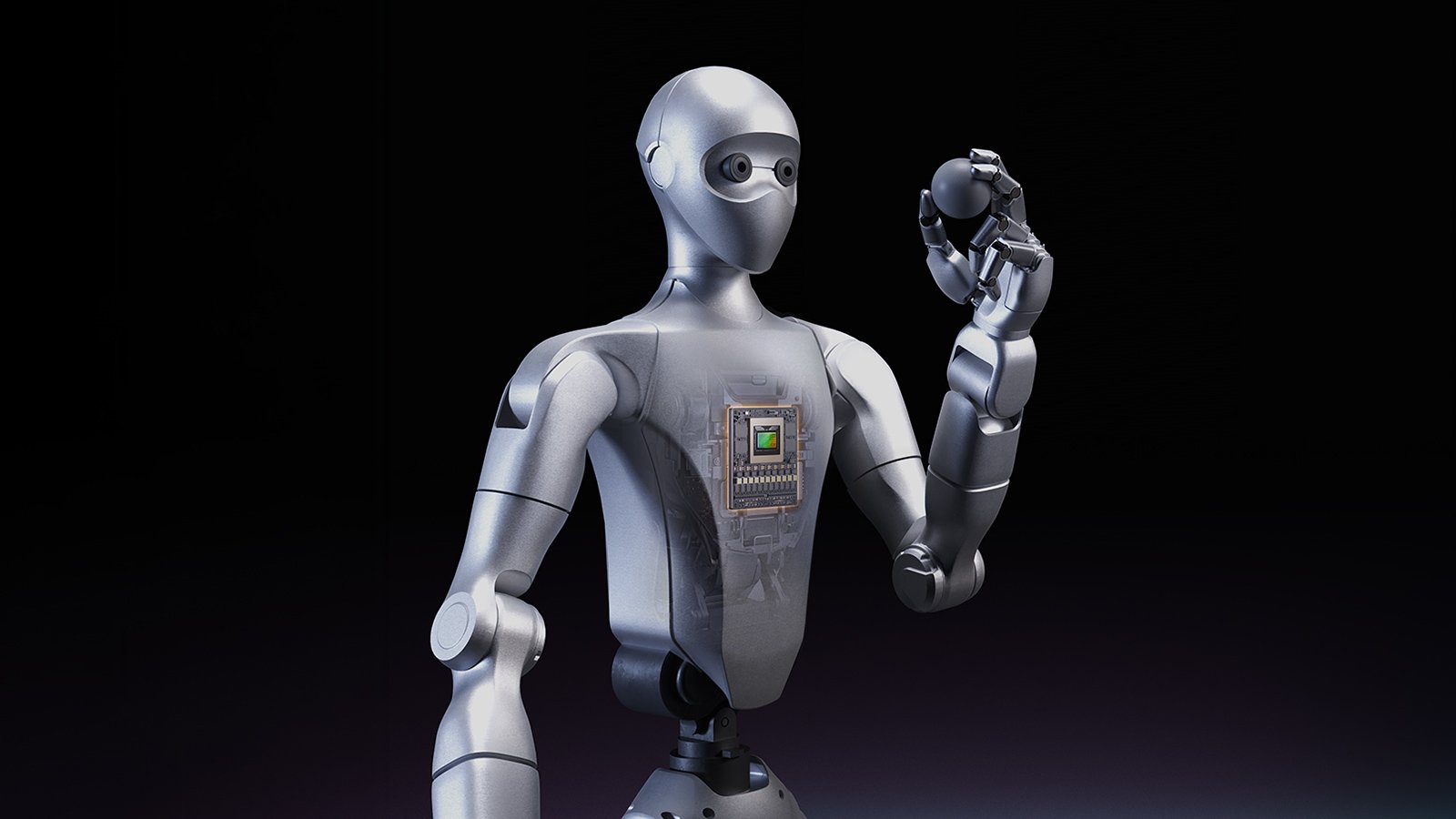
At this point Nvidia Isaac GR00T humanoid robot capabilities specifications 2026 could be the most audacious investment in modern robotics . I don’t say that lightly – I’ve seen lots of “revolutionary” platforms fizzle away over the previous decade. But Nvidia is more than simply a chip vendor now. They’re constructing the whole AI stack to educate humanoids how to move, reason and truly work next to humans without damaging anything around them.
The platform is being taken seriously by commercial buyers, robotics startups and researchers alike. And if that weren’t enough, it’s arriving at a time when companies like Humanoid Inc., Amazon Vulcan and Rhoda are all rushing to figure out what embodied AI means in practice. As we approach toward 2026, it’s more important than ever to understand where GR00T fits — and what makes it different, technically.
In this post we cover the architecture, training approach, hardware integration and deployment strategy. Whether assessing platforms for business deployment, or just attempting to get a handle on the technological landscape, I’ll offer you the honest answers.
What Is Nvidia Isaac GR00T and Why It Matters
Nvidia Isaac GR00T (Generalist Robot 00 Technology) is a standard architecture and foundation model framework for humanoid robots. It was shown out by Nvidia at GTC 2024, but it’s only now becoming commercially relevant in 2025 and further into 2026.
The fact is, GR00T is not a single robot. It’s a software and AI stack designed to work on a wide variety of humanoid hardware systems – the OS layer for humanoid embodied intelligence. Specifically, it offers:
- A foundation model trained on diverse human motion data
- Isaac Sim Simulation environment for synthetic training
- Hardware Acceleration CUDA and Jetson Orin modules
- A multi-modal learning pipeline integrating vision, language and proprioception
The capability specs 2026 roadmap for the Nvidia Isaac GR00T humanoid robot emphasises dexterous manipulation, whole-body movement and natural language task following. Those are not incremental improvements — these are paradigm breakthroughs in what a robot can truly perform on a factory floor.”
The collaboration between Nvidia and Boston Dynamics, Figure AI, Agility Robotics and 1X Technologies is particularly noteworthy as they aim to test GR00T on actual hardware. That range of hardware relationships is a signal to watch for itself. For those who wish to go deeper, the latest docs and partner announcements may be found on Nvidia’s official Isaac platform page.
I’ve been watching platform launches long enough to know that partner breadth at launch is a better indicator of ecosystem durability than raw specs. This one is a bit different from your average vapourware.
GR00T’s AI Stack and Training Methodology
Before getting into the capabilities characteristics of the Nvidia Isaac GR00T humanoid robot 2026, it’s important to understand how the model actually learns. The training process proceeds through three very different phases – and each addresses a specific difficulty the previous generation of robotics couldn’t conquer.
Phase 1: Pretraining on Human Video Data
GR00T ingests huge datasets of human motion – films, motion capture and teleoperation demonstrations. It observes humans and studies body mechanics, hand-eye coordination, and task sequencing. It’s similar in spirit to the way huge language models learn from text. But the kind of data is fundamentally different – robots have to learn physics, not just patterns. That distinction counts for more than most people realise.
Phase 2: Generate Synthetic Data with Isaac Sim
Nvidia Isaac Sim is a GPU-accelerated simulation environment based on the Omniverse platform. It creates photorealistic, physics-accurate training environments at scale. As a result, robots may learn millions of manipulation jobs without any physical trials, which significantly reduces the cost and time for data collecting. I’ve seen teams take six months only to collect real-world training data for specific jobs. This changes the calculus altogether.
Phase 3: real world fine tuning with imitation learning
Following synthetic pre-training, GR00T is transferred to the real world using imitation learning, a process called Action Chunking with Transformers (ACT). Human operators illustrate a task via teleoperating the robot, from which the robot learns a policy. GR00T also enables reinforcement learning (RL) loops for continued improvement post-deployment. Fair warning: The fine-tuning step still needs trained operators and that’s a big bottleneck for smaller teams.
This three-stage strategy addresses a fundamental difficulty in robotics, the sim-to-real gap. Models trained primarily on simulation typically fail on physical hardware because the real world is messier than any sim. GR00T’s fine-tuning stage fills that gap – not perfectly, but to a much greater extent than its predecessors.
Moreover, the model is built on the basis of cognitive science using a dual system design. The low level motor control is handled by a rapid reactive system. High level task planning is handled by slower reasoning system. When I first got into this I was startled to learn how that’s really basically how human cognition works, it’s quick instinct plus conscious deliberation, applied to robotics. Simple notion, truly difficult to get out.
Hardware Integration: CUDA, Jetson, and the Nvidia Stack
Nvidia Isaac GR00T humanoid robot capabilities specs 2026 is not just a software narrative. Hardware integration is just as important – and to be honest, this is where you see Nvidia’s vertical control the most.
Jetson Orin on the edge
Nvidia Jetson Orin is the onboard compute module for most of the humanoid robots running GR00T. Jetson Orin provides up to 275 TOPS (tera-operations per second) of AI capabilities in a small, power-efficient physical factor. That’s enough to conduct inference on GR00T’s perception and control models in real time — which is the real kicker, because edge inference latency may make or break a dexterous task.
CUDA acceleration of training
Training GR00T’s foundation models takes enormous GPU clusters. Nvidia provides the CUDA framework to do parallel processing over thousands of cores on a GPU. That means training runs that would take weeks complete in hours. That’s not a small advantage for speed of development iteration – it’s a cumulative advantage.”
Isaac Perceptor – perception
GR00T is integrated with Isaac Perceptor, a multi-camera 3D perception pipeline that simultaneously processes depth, RGB and semantic data. In this manner, robots can sense their environment with enough information to accomplish dexterity tasks like picking up small parts, handling irregular items, and maneuvering through crowded environments.
Here is what the full hardware stack looks like:
| Layer | Component | Function |
|---|---|---|
| Cloud training | DGX H100 clusters | Foundation model training |
| Simulation | Isaac Sim on Omniverse | Synthetic data generation |
| Edge inference | Jetson Orin | Real-time robot control |
| Perception | Isaac Perceptor | 3D scene understanding |
| Connectivity | Metropolis SDK | Fleet management and telemetry |
This vertically integrated stack is a deliberate strategy. Nvidia controls the training environment, the inference hardware, and the developer tools — and that gives them enormous leverage. However, it also creates vendor lock-in concerns that enterprise buyers are already raising. I’ve heard this comparison made more than once: it’s the Apple model applied to robotics, for better and worse.
GR00T vs. Humanoid Inc., Amazon Vulcan, and Rhoda
The capabilities specs for the Nvidia Isaac GR00T humanoid robot 2026 aren’t in a vacuum. There are major competitors in this area, but with quite diverse methods. Here’s how they really stack up.
Humanoid Inc
Humanoid Inc. is creating a vertically integrated robot — hardware and software created in tandem from the ground up. Their technique is optimizing proprietary hardware. GR00T on the other hand is deliberately hardware-agnostic and intended to run on many robot bodies. That makes GR00T more adaptable but perhaps less optimized for any one platform. It’s a genuine compromise, not just commercial posturing.
Amazon Vulcan
Amazon’s Vulcan robot is not a general purpose humanoid, but rather is intended for warehouse fulfillment. Vulcan is optimized for force-sensitive picking in structured situations, while GR00T is for more general application in unstructured environments. Likewise, Vulcan’s AI stack is proprietary and tightly integrated with Amazon’s logistics infrastructure. GR00T, however, is available to third-party developers in the Nvidia ecosystem. The bottom line is that if your entire deployment is warehouse picking, Vulcan may beat GR00T on that activity. But when your requirements grow, the comparison turns.
Rhoda
Rhoda is a newer player that is focused on human-robot collaboration in healthcare and elder care. GR00T’s architecture emphasizes safety restrictions and natural language interaction while supporting language-conditioned task execution. But Rhoda’s safety-first design philosophy is fundamentally different from GR00T’s performance-first mindset. I would follow this space closely as healthcare deployment guidelines will inform many platform decisions in the next two years.
Comparison side-by-side:
| Feature | Nvidia GR00T | Humanoid Inc. | Amazon Vulcan | Rhoda |
|---|---|---|---|---|
| Hardware agnostic | Yes | No | No | Partial |
| Foundation model | Yes | Partial | No | Yes |
| Sim-to-real pipeline | Isaac Sim | Proprietary | Proprietary | Limited |
| Target environment | General/industrial | General | Warehouse | Healthcare |
| Developer ecosystem | Open (Nvidia) | Closed | Closed | Semi-open |
| Edge compute | Jetson Orin | Custom | Custom | ARM-based |
| Language conditioning | Yes | Partial | No | Yes |
The primary advantage for GR00T nevertheless is its open development ecosystem. Nvidia provides SDKs, pre-trained model weights, and simulation tools for third parties to build upon. “Like Android scaled by opening up a developer ecosystem rather than controlling every device. If you are seriously considering this, it is worth reading a number of papers published by the IEEE Robotics and Automation Society on this ecosystem-based approach to robot platform development.
No single platform wins on all dimensions.” Enterprise buyers have to map the platform to their own individual deployment situation. GR00T’s generality is powerful but may be excessive for narrowly defined applications where Vulcan type specialization triumphs.
Enterprise Deployment Roadmap and Real-World Applications
What are the Nvidia Isaac GR00T humanoid robot capabilities specs 2026? In an enterprise context, understanding this requires looking at where it’s really being deployed — and what the path to scaling really looks like.
Current areas of deployment
Moving forward, Nvidia and its hardware partners are focusing on three main verticals:
- Manufacturing and assembly: Assembling activities including cable routing, component insertion, and quality inspection
- Logistics and warehousing: Semi-structured settings for picking, packing and inventory management
- Research and development: Universities and labs adopting GR00T as a platform for new robotics research
The enterprise deployment stack
The use of GR00T in an actual facility has a few layers:
- Creation of digital twins using Isaac Sim to simulate the actual space
- Task programming through natural language commands or teleoperation demos
- Fleet management with the Metropolis SDK for multi-robot systems monitoring
- Continuous learning loops that propagate better model weights to the fleet over time
This is very different from typical industrial automation based on fixed programs and hard fixtures. The fundamental value for enterprise buyers is the adaptability of GR00T-powered robots, which can adjust to variation. “Adaptability” sounds great, but nevertheless has practical limitations — especially with items that the model has never seen during training.
Roadmap to 2026
- 2024: Foundation model release, integrations with hardware partners, developer preview
- 2025: Production deployments with select production partners, Isaac Sim tooling expansion
- 2026: Commercial availability, multi-robot coordination, improved language grounding
Nvidia has made it clear that 2026 is the target year for meaningful commercial scale. MIT Technology Review has examined the wider humanoid rollout schedule, saying the majority of platforms remain in pilot phases. GR00T’s major advantage on that approach is its simulation infrastructure—it reduces the timetable from pilot to production in ways that manual data collecting can’t.
Remaining key challenges:
- Reliability in Unstructured Environments: New things and unexpected situations are still a challenge for robots
- Cost of deployment: Extensive investment needed for full GR00T stacks
- Regulatory clarification: Safety requirements for humanoid robots in shared workspaces are continually evolving; OSHA’s robotics guidance advice addresses current US workplace safety standards relevant to deployment considerations
- Robots gathering video data at work present serious compliance worries over data privacy
But the enterprise desire is real — I’ve met with procurement teams at mid-sized manufacturers that are currently doing pilots. The question is when humanoid robots will come to factories. When they do it’s which platform wins.
Conclusion
Nvidia Isaac GR00T humanoid robot capabilities specs 2026 is a major architectural shift in how we create and deploy embodied AI. Its three-phase training process, vertically integrated hardware stack and open developer ecosystem provide it structural advantages over more closed competitors. Also, its simulation-first paradigm drastically reduces the cost to get production-ready performance – which is a huge deal when you’re talking about enterprise procurement processes.
But GR00T is not a finished product. It’s a platform. Success comes from the ecosystem of hardware partners, enterprise deployers and developers who build on top of it. The comparison with amazon vulcan and rhoda clearly illustrates that different use cases will benefit different architectures. The strength of GR00T is its generality – and the biggest barrier it faces in communicating with buyers who want a specific response to a specific problem.
If you’re considering this space, here are actionable next steps:
- Visit the Nvidia Isaac developer portal for GR00T model weights and Isaac Sim tools
- Test your target environment in a digital twin pilot in Isaac Sim prior to hardware deployment
- Consider Jetson Orin for your real-time inference needs
- Get in touch with Nvidia’s enterprise team for specific vertical deployment roadmap discussions
- Track changing IEEE and OSHA recommendations on humanoid robot safety requirements until 2026
The robotics landscape will appear significantly different in 2026 than it does today. The capability specs for the Nvidia Isaac GR00T humanoid robot 2026 will be a significant part of that story, either as the dominating platform or as the benchmark against which all else is assessed. Either way, it’s good to know now.
FAQ
What is Nvidia Isaac GR00T designed to do?
Nvidia Isaac GR00T is a foundation model and reference architecture for humanoid robots. It’s designed to let robots perform dexterous manipulation, whole-body locomotion, and language-conditioned task execution. Specifically, it provides a pre-trained AI model, simulation tools, and hardware integration layers that robot manufacturers can build on. The Nvidia Isaac GR00T humanoid robot capabilities specifications 2026 target general-purpose performance across manufacturing, logistics, and research environments.
How does GR00T’s training differ from traditional robot programming?
Traditional robots are programmed with fixed instructions for specific tasks. GR00T, conversely, learns from human motion data, synthetic simulations, and real-world demonstrations. This means it can generalize to new situations rather than failing when something unexpected happens. The three-phase training pipeline — pre-training, synthetic generation, and real-world fine-tuning — produces a model that adapts rather than just executes.
What hardware does Nvidia Isaac GR00T run on?
GR00T is designed to be hardware-agnostic at the robot body level. However, it’s optimized for Nvidia Jetson Orin as the onboard compute module for real-time inference. Training runs on Nvidia DGX H100 clusters using CUDA acceleration. The platform integrates with Isaac Perceptor for multi-camera 3D perception. Multiple humanoid robot manufacturers — including Figure AI and Agility Robotics — have integrated GR00T into their hardware platforms.
How does GR00T compare to Amazon Vulcan?
Amazon Vulcan is purpose-built for warehouse picking tasks and is highly optimized for that specific use case. Nvidia Isaac GR00T humanoid robot capabilities specifications 2026, conversely, target general-purpose performance across diverse environments. Vulcan’s AI stack is proprietary and closed, whereas GR00T is open to third-party developers through Nvidia’s ecosystem. If your use case is narrowly defined warehouse logistics, Vulcan may outperform GR00T in that specific context. For broader deployment flexibility, GR00T has the edge.
When will Nvidia Isaac GR00T be commercially available at scale?
Nvidia has targeted 2026 as the milestone for meaningful commercial scale. Developer previews and select production deployments are happening through 2024 and 2025. The full commercial rollout — including multi-robot coordination features and enhanced language grounding — is on the 2026 roadmap. Enterprise buyers should plan pilot deployments now to be ready for scale when the platform matures.
What are the biggest challenges for GR00T deployment in enterprise settings?
Several real challenges exist. First, reliability in unstructured environments remains a work in progress — robots still struggle with novel objects and unexpected situations. Second, deployment costs are significant, including hardware, integration, and ongoing model management. Third, regulatory clarity for humanoid robots in shared workspaces is still developing. Additionally, data privacy concerns arise when robots collect video data in facilities. Nevertheless, enterprises running pilots today are building the operational knowledge they’ll need when the platform reaches full maturity.
References
Keep reading
Here are the latest posts from the blog.

The Apple TV+ sci-fi series 2026 releases plan is shaping up to be the platform’s most ambitious year ever. Returning fan favorites, bold new originals, and a clear editorial…

The race to turn nanorobots drug delivery targeted therapy clinical trials 2026 from science fiction to real-life medicine is accelerating faster than most people know — and…

An important milestone has now been passed in the attempt to simulate quantum systems on classical hardware. Quantum computing simulation of classical supercomputers 2026: it…