Specifications and prices checked against Anthropic’s documentation on 11 November 2026.
Claude Fable 5.2 charges $8 per million input tokens and $40 per million output tokens. That is exactly twice the price of Claude Opus 5.5 and four times Sonnet 5.5. Yet in Anthropic’s own coding tests, Fable 5.2 at High effort matched Opus 5.5’s best score for about half the cost per task.
Both facts are true at once, and the gap between them is the story. The price list tells you what a token costs. It doesn’t tell you how many tokens a model needs to finish a job, how often it gets the job right, or which effort setting you chose. This article works through the evidence Anthropic has published, the independent measurements available so far, and where the information stops.
Key Takeaways
- Claude Fable 5.2 is Mythos 5.2 with stronger safeguards. Anthropic says the two are the same underlying model; Mythos access requires verification.
- Its architecture is undisclosed. Anthropic publishes no parameter count, dense or mixture-of-experts design, or training compute.
- It costs 2x Opus 5.5 and 4x Sonnet 5.5 per token, but cache reads cost the same $0.20 on Fable and Opus.
- Fable 5.2 is 20% cheaper than Fable 5.1 on every standard rate, with fast mode newly available at double price.
- Effort settings matter as much as the model. At High, Fable matched Opus’s best FrontierCode score for $6.72 against $12.82 per task. Max cost $44.70 and scored lower than Xhigh.
- Retention is a deployment question. Fable 5.2 requires 30-day data retention unless Anthropic authorises zero retention.
- Judge models on cost per successful task. Token price ignores attempts, effort, caching and human review.
Quick Navigation
- What Claude Fable 5.2 actually is
- What Anthropic has disclosed about Claude Fable 5.2's architecture
- Claude Fable 5.2 safety, refusals and data retention
- What changed in Claude Fable 5.2 from Fable 5.1
- Claude Fable 5.2 vs Opus 5.5 vs Sonnet 5.5
- What the Claude Fable 5.2 benchmarks show
- The Claude Fable 5.2 effort cost curve
- Claude Fable 5.2 cost per task: token price is not task price
- Which Claude model should you use?
- FAQ
- What is Claude Fable 5.2?
- How much does Claude Fable 5.2 cost?
- What is the difference between Claude Fable 5.2 and Mythos 5.2?
- Is Claude Fable 5.2 better than Opus 5.5?
- Is Claude Fable 5.2 worth the additional cost?
- What is the context window of Claude Fable 5.2?
- What is adaptive thinking in Claude Fable 5.2?
- Does Claude Fable 5.2 support prompt caching?
- Is Claude Fable 5.2 available through the API?
- Which Claude model should developers choose in 2026?
What Claude Fable 5.2 actually is
Claude Fable 5.2 is Anthropic’s most capable generally available model, released on 9 November 2026 alongside Claude Mythos 5.2. Anthropic positions both for “the most ambitious, open-ended technical work”, and it is available today on the Claude API, Amazon Bedrock, Google Cloud and Microsoft Foundry under the model ID claude-fable-5-2.
The relationship with Mythos is the first thing to understand. In its launch announcement, Anthropic says “Claude Fable and Claude Mythos are the same underlying model.” Fable carries stronger cybersecurity and biology safeguards, which is why Anthropic can offer it to everyone. Mythos 5.2 has fewer of those restrictions and is limited to organisations approved through Anthropic’s Cyber Verification Program or Life Sciences Verification Program. Enterprise customers can also reach it through Claude Security.
So Mythos is not a bigger model or a different architecture. It is the same model with a different safety envelope and a different access agreement. For most developers, that means Fable 5.2 is the whole model. For security researchers and biology labs, it means some legitimate work will hit Fable’s safeguards and may justify applying for Mythos access.
What Anthropic has disclosed about Claude Fable 5.2’s architecture
Very little, and it is worth being plain about that. The 260-page system card does not state a parameter count, does not say whether the model is dense or a mixture-of-experts design, and does not disclose training compute. Any figure you see for Fable 5.2’s size is speculation.
What the card does describe is training data: “a proprietary mix of publicly available information from the internet”, plus public and private datasets, user data where users permitted training, and synthetic data from other models. Its knowledge cutoff is June 2026. That cutoff is about what the model learned during training. Anything more recent depends on web search or retrieval tools in the application around it.
Claude Fable 5.2 specifications
The model documentation lists a 1-million-token context window and a maximum output of 128,000 tokens. It accepts text and images and produces text. Its reliable knowledge cutoff and training data cutoff are both June 2026.
There are a few API differences to plan for. Forced tool use, through tool_choice set to any or tool, returns an error. Sampling parameters such as temperature, top_p and top_k should be left out.
How Claude Fable 5.2 handles thinking and effort
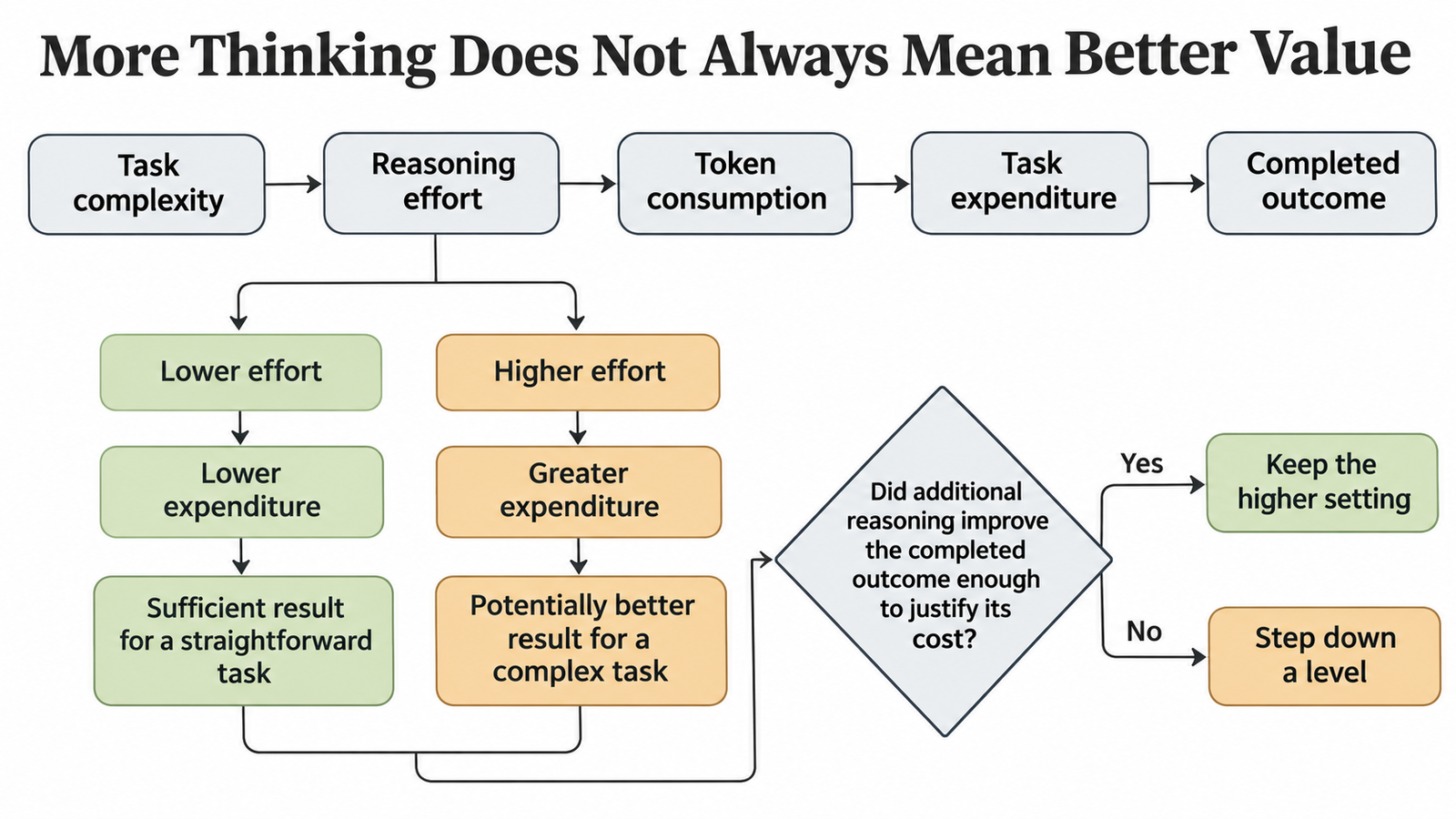
Fable 5.2 uses adaptive thinking, and it is always on: the model decides how much to reason before answering, and developers can’t turn it off. What developers control is the effort parameter, which runs from low through medium, high and xhigh to max. Higher effort lets the model spend more tokens thinking and working.
The defaults differ by product. On the Claude API, Fable 5.2 defaults to high, according to Anthropic’s effort documentation. The launch post says Medium is the default in the Claude apps and Claude Code. Opus 5.5 defaults to medium on the API, and Sonnet 5.5 to high. A team that moves from Opus to Fable without setting effort explicitly is changing two things at once.
Claude Fable 5.2 safety, refusals and data retention
Fable 5.2 sits behind classifiers: separate systems that inspect traffic and block requests in sensitive areas. The system card describes a three-stage pipeline for cybersecurity. A probe reads the model’s internal activations on all traffic, a lightweight classifier scores anything flagged, and a trained language-model classifier makes the final call. When a request is blocked, it isn’t simply refused. Anthropic routes cybersecurity requests to Opus 4.8 and biology requests to Opus 5, and a small set of AI-development topics also fall back to Opus 5.
False positives are the practical problem. A penetration tester asking about an exploit chain, or a researcher asking about protein structure, can look like misuse to a classifier. Anthropic says that in early testing across claude.ai, Claude Code and Cowork, it saw “about 55% fewer blocks with Fable 5.2 compared with Fable 5.1”, including about 60% fewer in cybersecurity and 40% fewer in biology. Those are Anthropic’s figures from its own products, not an independent audit.
The system card adds a less flattering detail. On a model-level test of harmful requests, Fable 5.2’s harmless-response rate on the API was 93.74%, against 94.71% for Fable 5.1, and 96.49% against 99.41% on claude.ai. Its over-refusal rate on benign claude.ai prompts fell from 0.34% to 0.19%. Fewer blocks and slightly lower model-level caution arrive together. Anthropic’s position is that the classifier layer remains “as robust as” Fable 5.1’s.
Why the 30-day retention rule matters
The documentation is direct: “Claude Fable 5.2 requires 30-day data retention and isn’t available under zero data retention unless expressly authorized by Anthropic.” Anthropic says the retention supports safety monitoring.
For teams under zero-data-retention agreements, this is a procurement issue, not a footnote. Proprietary code, customer records and confidential documents sent to Fable 5.2 are retained for 30 days unless Anthropic authorises otherwise. The launch post mentions Enterprise Frontier Safeguards, a private-beta option that runs monitoring inside a customer’s own infrastructure. Legal and security teams should read the terms themselves rather than assume an existing agreement covers the new model.
What changed in Claude Fable 5.2 from Fable 5.1
The headline change is price. Every standard rate fell by 20%, and fast mode, which Anthropic’s pricing page doesn’t list for Fable 5.1, is now available.
| Area | Fable 5.1 | Fable 5.2 |
|---|---|---|
| Input / output per million tokens | $10 / $50 | $8 / $40 |
| Cache read | $0.25 | $0.20 |
| 5-minute / 1-hour cache write | $12.50 / $20 | $10 / $16 |
| Fast mode | Not listed | $16 / $80, up to 2.5x output speed |
| Output speed | Baseline | Up to 30% faster (Anthropic, from testers) |
| Context / max output | 1M / 128K | 1M / 128K |
| FrontierCode 2.0 (Xhigh) | 32.4% | 49.1% |
| Rate limit bucket | Shared with Fable 5 | Separate, same size |
Fast mode deserves care. The fast mode documentation says it runs the same model with a faster inference configuration, and raises output tokens per second, not time to first token. It doubles every price, isn’t available with the Batch API, and doesn’t share cached prefixes with standard-speed requests.
Claude Fable 5.2 vs Opus 5.5 vs Sonnet 5.5
The three models share more than their prices suggest. All have a 1-million-token context window, 128,000-token output and a June 2026 knowledge cutoff, according to Anthropic’s models overview.
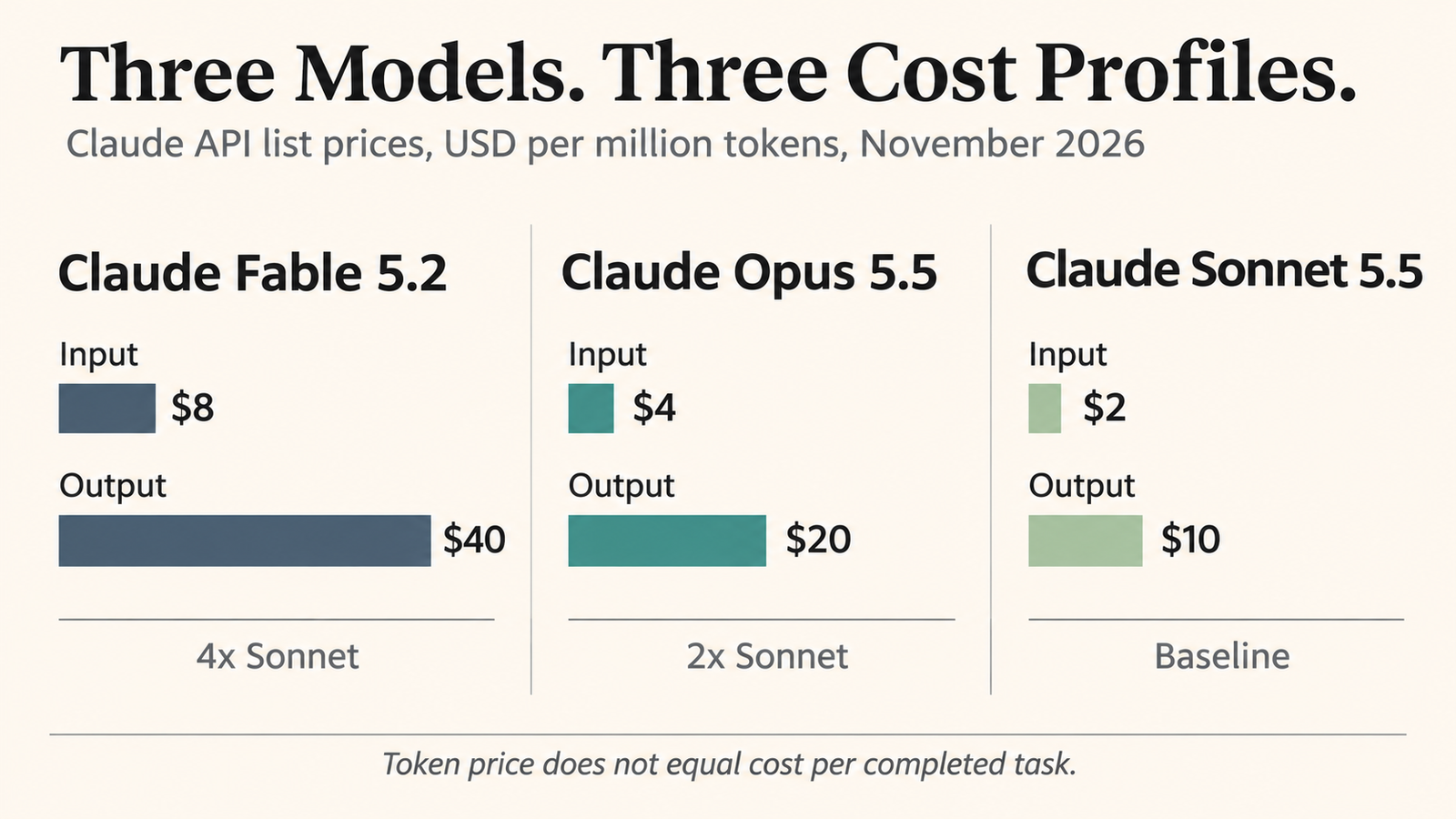
| Fable 5.2 | Opus 5.5 | Sonnet 5.5 | |
|---|---|---|---|
| Released | 9 Nov 2026 | 22 Sep 2026 | 28 Sep 2026 |
| Input / output per million | $8 / $40 | $4 / $20 | $2 / $10 |
| Cache read per million | $0.20 | $0.20 | $0.10 |
| 5-minute cache write | $10 | $5 | $2.50 |
| Thinking | Adaptive, always on | Adaptive, always on | Adaptive |
| API default effort | High | Medium | High |
| Anthropic’s latency rating | Moderate | Moderate | Fast |
| Input tokens per minute (Start tier) | 500,000 | 2,000,000 | 2,000,000 |
Two rows change the economics. Cache reads cost $0.20 per million on both Fable 5.2 and Opus 5.5, so the 2x gap narrows for agents that reuse a large prompt. And Fable 5.2’s Start-tier rate limit is a quarter of Opus 5.5’s, which matters more than price for high-volume work. Our comparison of Claude Opus and Sonnet covers the two cheaper models in more depth.
Anthropic’s own advice is to “start with Claude Opus 5.5”, which it calls its “strongest daily driver”. It suggests moving up to Fable for scope and complexity, or down to Sonnet or Haiku for speed and cost. That recommendation is a useful corrective to the idea that the newest, most expensive model is the default upgrade.
What the Claude Fable 5.2 benchmarks show
Anthropic’s launch table compares Fable 5.2 with Fable 5.1, Opus 5.5 and rival models. It reports each model’s highest available effort unless noted, and it gives no Sonnet 5.5 scores. The selection below uses the published figures.
| Benchmark (what it measures) | Fable 5.2 | Fable 5.1 | Opus 5.5 |
|---|---|---|---|
| FrontierCode 2.0: whether code patches would be merged | 49.1% (Xhigh) | 32.4% (Xhigh) | 45.5% |
| FrontierSWE v2: ultra-long engineering tasks | 69.9% | 56.3% | 62.3% |
| OSWorld 2.1: operating a computer (offline, partial) | 89.3% | 83.5% | 87.2% |
| AutomationBench: business workflows across 47 apps | 51.4% | 31.4% | 42.5% |
| Humanity’s Last Exam with tools: expert questions | 74.2% | 65.6% | 67.7% |
| AA-Briefcase: knowledge work (rubric / Elo) | 66.1% / 1,785 | 61.5% / 1,669 | 61.2% / 1,800 |
The detail behind the numbers matters. FrontierCode 2.0 is run by Cognition on 132 tasks taken from real pull requests, scored on whether the model produces a diff a maintainer could merge without edits. FrontierSWE v2, from Proximal, has 34 tasks with a 20-hour budget per attempt. OSWorld’s figure is a partial score; Fable 5.2’s strict pass rate on the same set is 54.6%. These are all third-party benchmarks, but the results in the table were reported by Anthropic.
Fable 5.2 doesn’t win everywhere. On AA-Briefcase it leads on the rubric score but trails Opus 5.5 on the Elo rating. Google’s Gemini 4 Carbon beats both on AutomationBench, at 53.9%.
What independent testing adds
Artificial Analysis, which runs its own evaluations through Anthropic’s API, places Fable 5.2 at Max effort first of 74 models on its Intelligence Index, with 65 points. Opus 5.5 at Max scores 59, and Sonnet 5.5 at Max scores 55.
Its cost figures are more revealing. Fable 5.2 at Max cost $26.54 per index task and generated 275 million output tokens across the run. At High effort, it scored 62 for $9.08 per task, less than Opus 5.5 at Max ($10.04). Sonnet 5.5 at Max cost $10.02 per task, almost the same as Opus, because it produced 335 million output tokens to Opus’s 218 million. These independent results use a different methodology from Anthropic’s, so the two sets should not be merged into one ranking.
The Claude Fable 5.2 effort cost curve
The clearest evidence that effort is a budget decision comes from section 8.4 of the system card, where Cognition reports FrontierCode 2.0 results at every effort level. The card doesn’t explain how cost per task is calculated, so treat the cost column as Anthropic’s reported average.
Effort | Score | Cost per task | Cost per score point |
|---|---|---|---|
| Fable 5.2 Low | 34.2% | $2.10 | $0.06 |
| Fable 5.2 Medium | 37.6% | $2.48 | $0.07 |
| Fable 5.2 High | 45.3% | $6.72 | $0.15 |
| Fable 5.2 Xhigh | 49.1% | $14.19 | $0.29 |
| Fable 5.2 Max | 45.7% | $44.70 | $0.98 |
| Opus 5.5, best setting | 45.5% | $12.82 | $0.28 |
Moving from High to Xhigh adds 3.8 points for 2.1 times the cost. Moving from Xhigh to Max triples the cost and lowers the score. The card notes that 22 of 660 Max attempts timed out, and counting those as failures puts Max at 44.4%. Artificial Analysis found a similar plateau: Fable 5.2 scored 62 at both High and Xhigh, with Xhigh costing 63% more per task.
That makes effort a resource-allocation choice. A request to explain a 40-line function gains nothing from deep reasoning, and Low or Medium on Sonnet or Opus is enough. A production bug that spans services may justify High. A multi-week migration, where a failed patch costs hours of engineering review, is the case where Xhigh earns its price. Using one effort setting for all three wastes money on the first and may underserve the third.
Claude Fable 5.2 cost per task: token price is not task price
A simple formula keeps the comparison honest:
Total task cost = input + output + cache writes + cache reads + any premium (fast mode, US-only inference)
Cost per successful task = total spend ÷ tasks completed successfully
The denominator is the part most comparisons skip. A model that needs fewer attempts can cost less per finished task, even at a higher price per token.
A worked example
Take an illustrative agent session. A 100,000-token prompt is written to the cache once and then read on each of 50 turns. Each turn also caches 3,000 new tokens and generates 2,000 output tokens. Assume, unrealistically, that both models use the same number of tokens.
On Fable 5.2, the session costs $7.50: $1.00 for the first cache write, $1.00 for cache reads, $1.50 for new cache writes and $4.00 for output. On Opus 5.5 it costs $4.25. The gap is 1.76x, not 2x, because cache reads cost the same on both. Output makes up more than half of Fable’s bill, so output-heavy work feels the full doubling.
Now add the denominator. Suppose, hypothetically, that a migration step costs $10 per attempt on Opus 5.5 with a 50% success rate, and $20 on Fable 5.2 with an 80% success rate. Expected model spend per success is $20 on Opus and $25 on Fable. But if each failed attempt costs 30 minutes of engineer review at $100 an hour, the totals become $70 for Opus and $37.50 for Fable. These success rates are invented for illustration. The point is that human review time can outweigh token prices, and only your own evaluations can supply real success rates. Our guide to calculating LLM cost per task sets out the method in more detail, and our prompt caching guide shows how the cache terms change these totals.
Which Claude model should you use?
There is no single answer, but the evidence supports a sensible starting map.
| Workload | Start by evaluating | Why |
|---|---|---|
| Everyday coding and code review | Sonnet 5.5 or Opus 5.5 at Medium | Capable and cheaper; Opus is Anthropic’s recommended default |
| Complex debugging | Opus 5.5 at High, then Fable 5.2 at High | Fable High matched Opus’s best FrontierCode score for about half the cost per task |
| Long agentic coding and migrations | Fable 5.2 at High or Xhigh | Largest measured gains (FrontierSWE v2, FrontierCode); failures are expensive |
| Difficult technical research | Fable 5.2 | Strongest Humanity’s Last Exam and science results |
| High-volume applications | Sonnet 5.5, or Haiku 5.5 | Unit costs and rate limits; Fable’s limits are a quarter of Opus’s |
| Regulated or confidential data | All three, after legal review | Fable 5.2’s 30-day retention requirement |
The final choice depends on task complexity, how costly a failure is, latency needs, rate limits, the tools in the loop and how much human supervision is available. Anthropic also describes using Fable 5.2 as an orchestrator or adviser over cheaper models, which can capture some of its judgement without paying its rates on every token.
FAQ
What is Claude Fable 5.2?
Claude Fable 5.2 is Anthropic’s most capable generally available model, released on 9 November 2026 for complex reasoning and long-horizon agentic work.
How much does Claude Fable 5.2 cost?
$8 per million input tokens and $40 per million output tokens on the Claude API. Cache reads cost $0.20, and fast mode costs $16 and $80.
What is the difference between Claude Fable 5.2 and Mythos 5.2?
They are the same underlying model with different safeguards. Mythos 5.2 has fewer cybersecurity and biology restrictions and is available only to verified organisations.
Is Claude Fable 5.2 better than Opus 5.5?
On most of Anthropic’s published benchmarks, yes, including FrontierCode 2.0 and FrontierSWE v2. Opus 5.5 still edges it on AA-Briefcase’s Elo rating, and Anthropic recommends Opus as the starting model.
Is Claude Fable 5.2 worth the additional cost?
It depends on the task and the effort setting. It is most likely to pay off on long, complex work where failed attempts are expensive.
What is the context window of Claude Fable 5.2?
One million tokens, with up to 128,000 output tokens per response.
What is adaptive thinking in Claude Fable 5.2?
It is the model’s built-in reasoning mode, which is always on. Developers control its depth with the effort parameter, from Low to Max.
Does Claude Fable 5.2 support prompt caching?
Yes. Cache reads cost $0.20 per million tokens, five-minute writes $10 and one-hour writes $16.
Is Claude Fable 5.2 available through the API?
Yes, as claude-fable-5-2 on the Claude API, Amazon Bedrock, Google Cloud and Microsoft Foundry. Bedrock and Google-managed Google Cloud set their own prices.
Which Claude model should developers choose in 2026?
Anthropic recommends starting with Opus 5.5 and moving to Fable 5.2 or Sonnet 5.5 based on your own evaluations of quality, cost and speed.
Keep reading
Here are the latest posts from the blog.

Claude Fable 5.2 vs Opus 5.5: Is the Higher Price Worth It?

Your AI API Is Reprocessing the Same Tokens. Stop Paying for It.

Anthropic IPO: The $895 Billion Question Behind Its Valuation
