Last verified: 8 November 2026. All prices are Anthropic’s standard first-party API rates in US dollars per million tokens. They aren’t Claude Pro or Max subscription prices, and partner platforms can price differently.
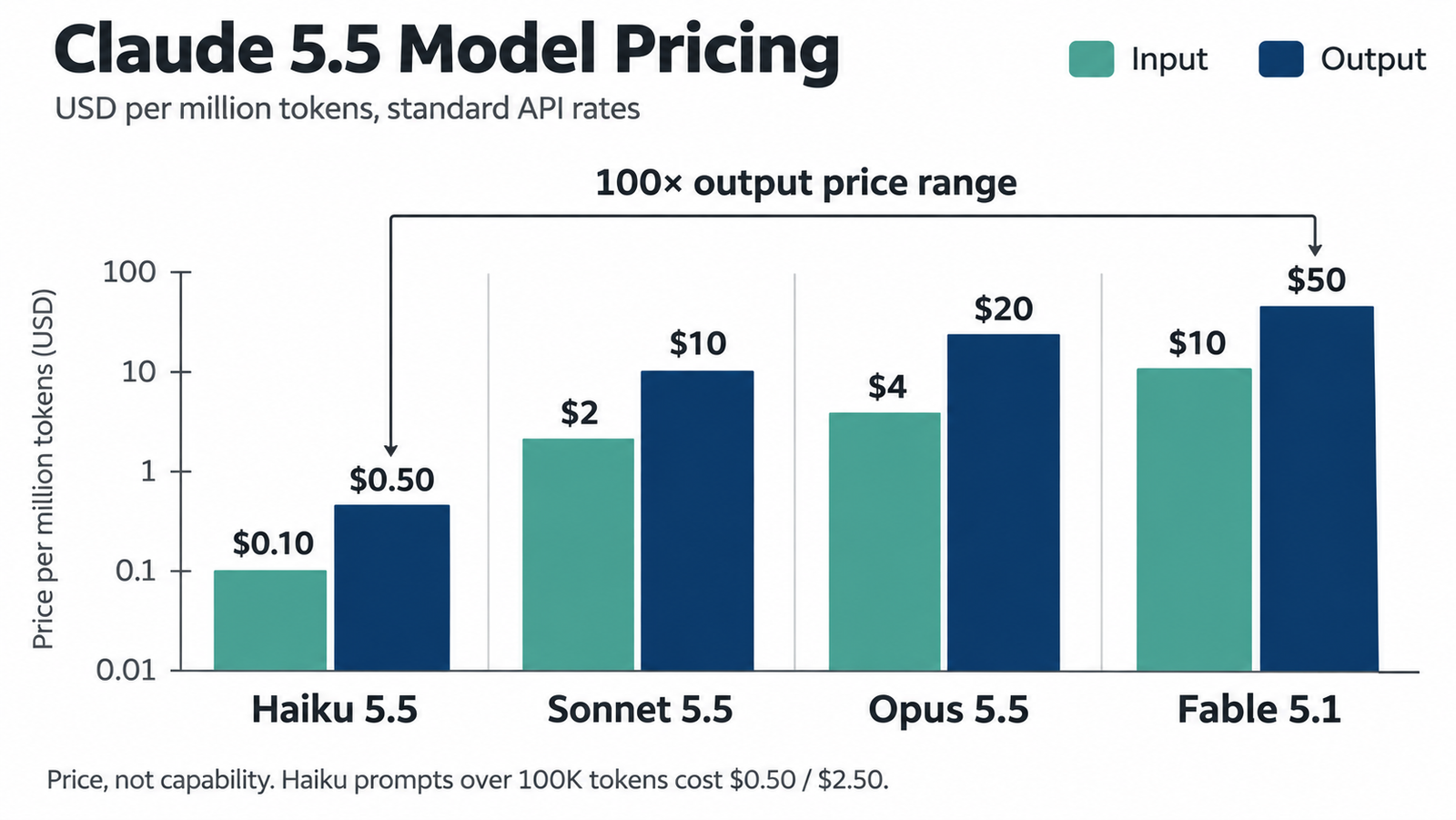
A million output tokens from Claude Haiku 5.5 costs $0.50. The same million from Claude Fable 5.1 costs $50. That 100x spread across Anthropic’s four current models makes Claude Opus vs Sonnet only part of the decision, and price alone a poor guide to which model is the bargain.
The gap doesn’t mean Fable is 100 times more capable. It doesn’t even mean a task costs 100 times more, because input prices, long-prompt surcharges, caching and the number of attempts a task takes all change the bill. With all four Claude models compared on Anthropic’s API pricing, this guide shows what each costs and which workloads each one suits.
Key Takeaways
- Output prices span 100x, from Haiku 5.5’s $0.50 to Fable 5.1’s $50 per million tokens. Opus 5.5 is exactly twice Sonnet 5.5.
- Haiku 5.5 has a cliff at 100K tokens. Above it, the whole request is billed at five times the rate, cached tokens included.
- List prices overstate the saving from a new model. Haiku 5.5 is 90% cheaper per token than Haiku 4.5, but Anthropic estimates about 75% cheaper per task.
- Sonnet 5.5 is the everyday default for well-scoped coding, bug fixes and documents.
- In Claude Opus vs Sonnet terms, Opus 5.5 earns its premium on hard, long-running work, where fewer retries can offset the higher price.
- Fable 5.1 is Mythos 5.1 with safeguards. Mythos is restricted to vetted organisations; Fable blocks exploit development and redirects some security and biology work.
- Caching can cut agent input costs by about three-quarters, leaving output as the bigger cost.
- Choose by workload. Cost per successful task matters more than price per token.
Quick Navigation
- Claude Opus vs Sonnet: four models, four jobs
- Claude Opus vs Sonnet: what the API prices reveal
- Claude Haiku 5.5: why cheap tokens aren't always cheap tasks
- Claude Opus vs Sonnet for everyday work: where Sonnet 5.5 fits
- Claude Opus vs Sonnet: when Opus 5.5 is worth twice the price
- Claude Fable 5.1 and the Mythos connection
- Claude Opus vs Sonnet: how caching changes the economics
- Claude Opus vs Sonnet: rate limits and throughput
- Claude Opus vs Sonnet vs Haiku vs Fable: which model to use
- FAQ
- Claude Opus vs Sonnet: what's the difference?
- Claude Opus vs Sonnet: is Opus 5.5 worth the higher price?
- Is Claude Haiku 5.5 the cheapest Claude model?
- What is the difference between Claude Haiku and Sonnet?
- What is Claude Fable 5.1?
- Is Claude Mythos 5.1 publicly available?
- Does Claude Haiku charge more for long prompts?
- How much does Claude prompt caching save?
- What is Claude Opus Fast Mode?
- Claude Opus vs Sonnet: which is best for coding?
Claude Opus vs Sonnet: four models, four jobs
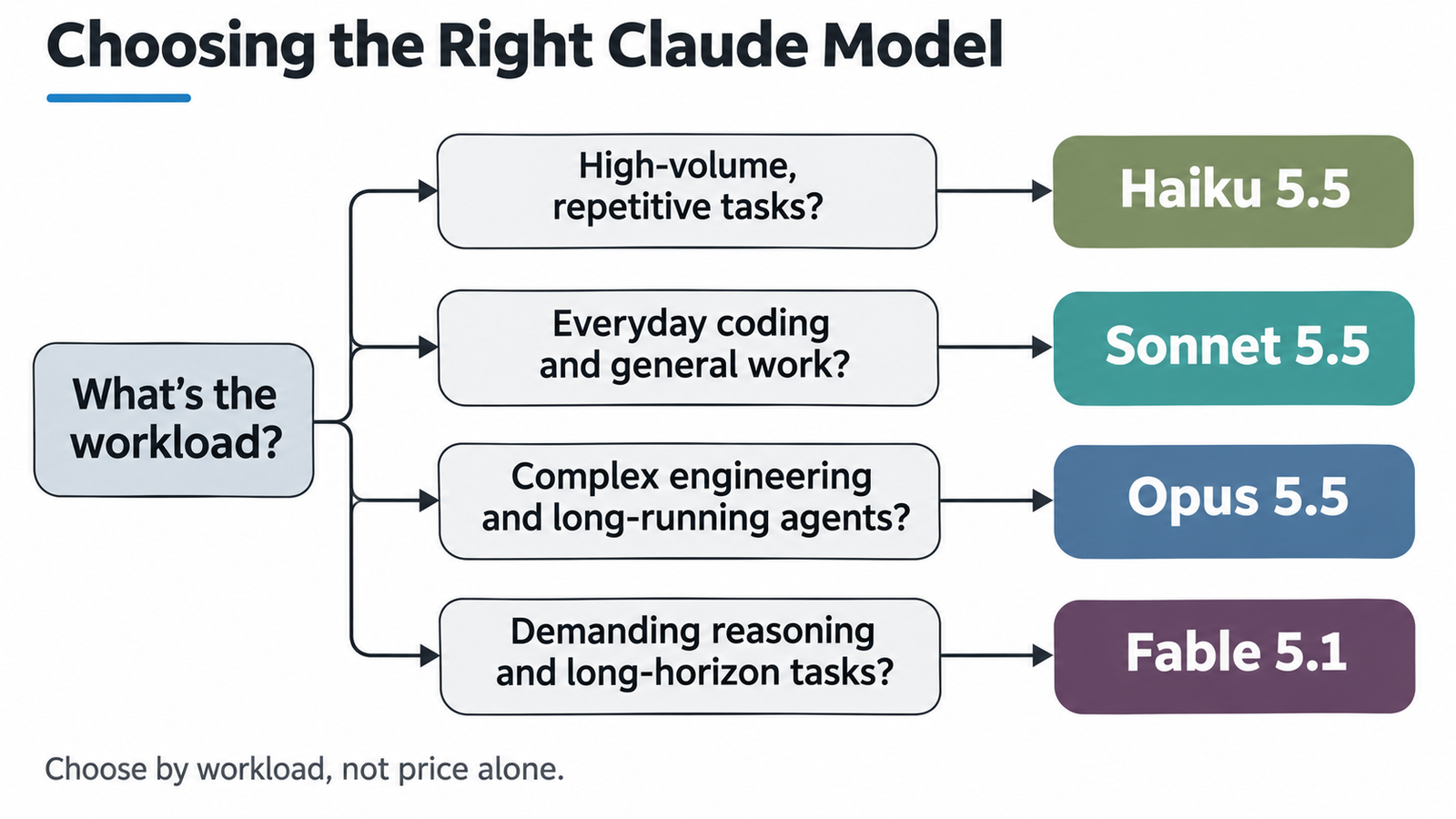
Anthropic’s model overview positions each model for a different kind of work:
- Claude Haiku 5.5 (released 7 October 2026) is for “high-volume, latency-sensitive tasks such as classification, extraction, and routing”. Anthropic describes it as its fastest model.
- Claude Sonnet 5.5 (28 September) is billed as “the best combination of speed and intelligence”.
- Claude Opus 5.5 (22 September) is for “long-running agentic coding and knowledge work”.
- Claude Fable 5.1 (1 September) is for “demanding reasoning and long-horizon agentic work”. It’s also for cases where your evaluations of Opus 5.5 at higher effort still fall short.
All four are active and share more than the pricing suggests. Each has a 1-million-token context window, a 128,000-token maximum output, adaptive thinking and a June 2026 knowledge cutoff. The differences are speed, depth of reasoning and price. Opus and Fable have thinking always on; Sonnet and Haiku can run without it.
Claude Opus vs Sonnet: what the API prices reveal
Here are the standard rates from Anthropic’s pricing page:
| Model | Input | Output | Cache read | 5-minute cache write | 1-hour cache write |
|---|---|---|---|---|---|
| Haiku 5.5 (prompts up to 100K tokens) | $0.10 | $0.50 | $0.01 | $0.125 | $0.20 |
| Haiku 5.5 (prompts over 100K tokens) | $0.50 | $2.50 | $0.05 | $0.625 | $1.00 |
| Sonnet 5.5 | $2 | $10 | $0.10 | $2.50 | $4 |
| Opus 5.5 | $4 | $20 | $0.20 | $5 | $8 |
| Fable 5.1 | $10 | $50 | $0.25 | $12.50 | $20 |
Opus costs exactly twice Sonnet on every line, caching included. Sonnet’s input and output cost 20 times Haiku’s short-prompt rates. Fable costs 2.5 times Opus. The Batch API halves input and output prices for work that can wait, and US-only inference adds a 10% premium.
For a quick sense of scale, take an illustrative short request: 8,000 input tokens (a file plus instructions) and 2,000 output tokens. Every model here uses the same newer tokenizer, so the same text gives roughly the same count on each.
| Model | Input cost | Output cost | Total |
|---|---|---|---|
| Haiku 5.5 | $0.0008 | $0.0010 | $0.0018 |
| Sonnet 5.5 | $0.016 | $0.020 | $0.036 |
| Opus 5.5 | $0.032 | $0.040 | $0.072 |
| Fable 5.1 | $0.080 | $0.100 | $0.180 |
At that size, even Fable’s request costs 18 cents. The differences only matter at volume, or when a long-running agent multiplies the calls.
Claude Haiku 5.5: why cheap tokens aren’t always cheap tasks
Haiku 5.5 is the most interesting pricing story in the lineup, for two reasons.
The first is the 100,000-token threshold. Up to that size, Haiku costs $0.10 input and $0.50 output. Above it, every token in the request is billed at $0.50 and $2.50, including any cached tokens. Anthropic’s pricing page says a request over the threshold “pays the higher prices even when part of its prompt is a cache hit”.
That creates a cliff. On our arithmetic, a 90,000-token prompt with 2,000 tokens of output costs about $0.010. A 110,000-token prompt with the same output costs about $0.060, six times more for 22% more input. For long-document work, splitting inputs to stay under 100K tokens can matter more than the choice of model. Our comparison of LLM context windows and long-context pricing covers how other providers handle the same trade-off.
The second reason is the tokenizer. Haiku 4.5 was priced at $1 input and $5 output, so Haiku 5.5’s list prices are 90% lower. But Anthropic says the new model costs “around 75% less to run” on average. Two things close the gap.
Anthropic’s token-counting docs say Claude 4.7 and later models use a newer tokenizer that produces about 30% more tokens for the same text. That alone turns a 90% input-price cut into about 87% for the same document. Anthropic’s Haiku 5.5 page adds that the model “uses slightly more tokens per task”, which pushes the average saving down further.
The lesson applies to every model change. Price per million tokens and cost per task are different numbers, and the only reliable way to compare them is to count real prompts against the model you plan to use. The token-counting endpoint is free.
Within those limits, Haiku 5.5 is a large step up. Anthropic reports it scoring 72.4% on its offline subset of OSWorld 2.1, against 15.7% for Haiku 4.5. It suggests using it for summaries, classification, live customer support and as a subagent alongside Opus or Sonnet in coding work.
Claude Opus vs Sonnet for everyday work: where Sonnet 5.5 fits
Sonnet 5.5 kept Sonnet 5’s per-token price but, according to Anthropic, does the work more efficiently. The company says it “generates outputs 30%+ faster than Sonnet 5” and, in its testing, costs “up to 30% less per task”. The saving comes from needing fewer tokens for the same work, not from a lower price, so results will vary by workload.
Anthropic positions it for well-scoped everyday tasks: bug fixing, routine development and polished documents, slides and spreadsheets. It also says Sonnet 5.5 can follow slide templates closely enough that decks need little editing. Effort settings run from low to max. Lower effort answers faster with fewer tokens, which suits routine work.
Anthropic is also clear about where Claude Opus vs Sonnet tips the other way. It says Opus 5.5 “remains clearly stronger” at complex, open-ended work that needs sustained judgment. That’s the honest Claude Opus vs Sonnet line: Sonnet for work you can describe clearly, Opus for work where the model has to figure out what the problem is.
Claude Opus vs Sonnet: when Opus 5.5 is worth twice the price
Opus 5.5 is cheaper than the model it replaced. Its rates are $4 and $20, down from Opus 5’s $5 and $25, and Anthropic says it costs “40% less than Opus 5 on typical workloads” at default settings. That’s Anthropic’s measurement, and it depends on default effort.
In Claude Opus vs Sonnet decisions, paying twice Sonnet’s price makes sense in a few situations:
- Long-running coding agents working across a large codebase for hours, where one wrong turn wastes everything after it.
- Complex debugging and architectural changes where the model has to hold many interacting parts in mind.
- Large migrations and repository analysis. Anthropic cites a tester completing a 680,000-line migration in under a day.
- Tasks where retries are expensive, because each failed attempt repeats a large context.
The last point is where the economics can flip. If Sonnet needs three attempts at a hard task and Opus needs one, Opus can be cheaper overall. That’s a possibility to test, not a rule: on tasks Sonnet handles first time, Opus simply costs twice as much.
Claude Opus vs Sonnet speed: what Opus Fast Mode changes
Opus 5.5 also offers Fast Mode at $8 input and $40 output, twice the standard rate. Anthropic says it delivers “up to 2.5x higher output tokens per second”. It’s the same model on a faster serving configuration: “no change to intelligence or capabilities”.
The speed-up applies to output generation, “not time to first token”. If a request spends most of its time thinking before it answers, Fast Mode won’t remove that wait. For a long streamed answer, it can. A response that streams for 60 seconds might, at best, finish streaming in about 24, at double the cost. Our analysis of how Claude’s reasoning settings affect response speed found effort level usually matters more than model choice.
Fast Mode has its own rate limits, doesn’t work with the Batch API, and is available on the Claude API, Google Cloud (Anthropic managed) and Microsoft Foundry.
Claude Fable 5.1 and the Mythos connection
Fable 5.1 is the most capable model most developers can use, and the hardest to explain. Anthropic says Fable 5.1 and Claude Mythos 5.1 are “the same model, but with different levels of safeguards”.
Mythos 5.1 isn’t generally available. It’s offered to vetted organisations through trusted access programmes: a Cyber Verification Program for defensive security teams and a Life Sciences Verification Program for researchers. Anthropic says these are currently limited to US organisations, with plans to expand.
Fable 5.1 is the version with safeguards. According to Anthropic’s Fable and Mythos 5.1 announcement, it can identify software vulnerabilities in source code but won’t develop exploits. Penetration testing, exploit generation and binary-based vulnerability scanning are redirected to Opus models. Some life-sciences research questions are also routed to Opus, though Anthropic says biology safeguards now trigger 85% less often on benign questions. Opus 5.5 has its own cyber safeguards: Anthropic says cybersecurity tasks on it are mostly rerouted to Opus 4.8.
So Fable and Mythos share underlying capability but behave differently in deployment. For most coding, research and reasoning work, the safeguards won’t come up. For security work, they will.
At $10 and $50, Fable is 2.5 times the price of Opus. Anthropic’s own guidance is to reach for it when evaluations show Opus 5.5 at higher effort still isn’t good enough. Fable 5.1 did cut its cache-read price by 75% to $0.25, and Anthropic says that lowers typical workload costs by about 25%, and highly agentic ones by up to about 45%.
Claude Opus vs Sonnet: how caching changes the economics
Prompt caching stores a stable part of your prompt, such as a system prompt, tool definitions or a repository snapshot, so later requests can reuse it. You pay a premium to write the cache, 1.25 times the input price for five minutes or twice it for an hour, and then a fraction of the price to read it.
That fraction varies, which is the hidden pricing story in Claude Opus vs Sonnet comparisons. According to Anthropic’s prompt caching docs, cache reads cost 10% of input on Haiku 5.5, 5% on Sonnet and Opus, and 2.5% on Fable. The more expensive the model, the more caching saves in percentage terms.
Here’s an illustrative agent session with assumed numbers. An agent makes 40 calls in a short burst. Each call sends the same 60,000-token repository context plus 3,000 new tokens, and returns 1,500 tokens. With caching, the context is written once to the five-minute cache and read 39 times. For simplicity, the conversation history isn’t growing between calls.
| Model | Without caching | With caching | Output’s share of the cached cost |
|---|---|---|---|
| Haiku 5.5 | $0.28 | $0.07 | 41% |
| Sonnet 5.5 | $5.64 | $1.22 | 49% |
| Opus 5.5 | $11.28 | $2.45 | 49% |
| Fable 5.1 | $28.20 | $5.54 | 54% |
The formula behind it: total API cost = input cost + output cost + cache-write cost + cache-read cost. Caching cut each session by roughly three-quarters. It doesn’t touch output, so after caching, output becomes about half the bill. At that point the model that writes less, or finishes in fewer steps, wins on cost.
Caching won’t help much for one-off prompts or ones that change every time, or when calls are spread out beyond the cache lifetime. It also has a minimum: prompts under 512 tokens on these models aren’t cached.
Claude Opus vs Sonnet: rate limits and throughput
Price isn’t the only constraint in Claude Opus vs Sonnet planning. Anthropic’s rate limits cap requests per minute (RPM), input tokens per minute (ITPM) and output tokens per minute (OTPM) by usage tier:
| Tier | Haiku, Sonnet and Opus 5.5 (each) | Fable 5.x |
|---|---|---|
| Start | 4,000 RPM, 2M ITPM, 400K OTPM | 4,000 RPM, 500K ITPM, 100K OTPM |
| Build | 10,000 RPM, 5M ITPM, 1M OTPM | 10,000 RPM, 1.5M ITPM, 300K OTPM |
| Scale | 13,000 RPM, 10M ITPM, 2M OTPM | 13,000 RPM, 4M ITPM, 800K OTPM |
Fable gets a quarter of the others’ token throughput at the Start tier, and its limit is shared between Fable 5.1 and Fable 5. Opus 5.5 and Sonnet 5.5 each have their own budget. A high-volume service could hit Fable’s output ceiling long before its budget.
One useful detail: cache reads don’t count toward input-token limits, so caching raises effective throughput as well as cutting cost. Limits also differ by organisation, so check your actual numbers in the Anthropic Console. Our guide to Claude API rate limits and concurrent request capacity goes deeper into how many parallel sessions those limits allow.
Claude Opus vs Sonnet vs Haiku vs Fable: which model to use
The right Claude Opus vs Sonnet comparison isn’t cost per million tokens. It’s cost per completed task, and ultimately cost per successful production outcome, which includes retries, human review and failures. A cheaper model that needs more attempts can cost more than a dearer one that gets it right.
| Model | Use this for | Why | Cost consideration |
|---|---|---|---|
| Haiku 5.5 | Classification, routing, extraction, summaries, subagents, simple code | Fastest, cheapest per token, strong for its size | Stay under 100K-token prompts, or the whole request costs 5x more |
| Sonnet 5.5 | Everyday coding, bug fixes, documents and slides, general agents | Best speed-to-intelligence balance, per Anthropic | Usually the default; drop effort for routine work |
| Opus 5.5 | Long-running coding agents, complex debugging, architecture, large refactors, hard knowledge work | Stronger sustained judgment on open-ended tasks | Twice Sonnet’s price; justified when it saves retries |
| Fable 5.1 | Demanding reasoning, long-horizon agents, complex research | Most capable generally available model | 2.5x Opus and lower throughput; use when evaluations show Opus isn’t enough |
Many teams will end up using more than one. A common pattern is Opus or Sonnet planning and checking work while Haiku subagents handle the high-volume steps. Whatever the mix, test on your own workload. When it comes to Claude Opus vs Sonnet, the right answer depends on how often Sonnet gets your hardest tasks right first time.
FAQ
Claude Opus vs Sonnet: what’s the difference?
Opus 5.5 is Anthropic’s model for long-running agentic coding and complex knowledge work, at $4 input and $20 output per million tokens. Sonnet 5.5 is faster and half the price, aimed at everyday development and documents.
Claude Opus vs Sonnet: is Opus 5.5 worth the higher price?
It is for complex, open-ended tasks where it avoids retries. For well-scoped tasks Sonnet handles first time, it just costs twice as much.
Is Claude Haiku 5.5 the cheapest Claude model?
Yes, at $0.10 input and $0.50 output per million tokens for prompts up to 100,000 tokens. Longer prompts are billed at $0.50 and $2.50.
What is the difference between Claude Haiku and Sonnet?
Haiku 5.5 is the fastest and cheapest model, built for high-volume tasks like classification and routing. Sonnet 5.5 handles more complex reasoning and everyday development, at 20 times Haiku’s short-prompt price.
What is Claude Fable 5.1?
Claude Fable 5.1 is Anthropic’s most capable generally available model, priced at $10 input and $50 output per million tokens. It shares its underlying model with Mythos 5.1 but adds cybersecurity and biology safeguards.
Is Claude Mythos 5.1 publicly available?
No. Mythos 5.1 is available only to vetted organisations through Anthropic’s cyber and life-sciences verification programmes, which are currently limited to US organisations.
Does Claude Haiku charge more for long prompts?
Yes. If a Haiku 5.5 prompt exceeds 100,000 tokens, the entire request is billed at $0.50 input and $2.50 output, cached tokens included.
How much does Claude prompt caching save?
Cache reads cost 10% of the input price on Haiku 5.5, 5% on Sonnet and Opus 5.5, and 2.5% on Fable 5.1. Caching doesn’t reduce output costs, so total savings depend on how much context you reuse.
What is Claude Opus Fast Mode?
Fast Mode runs Opus 5.5 on a faster serving setup for up to 2.5x higher output speed, at twice the standard price. It doesn’t shorten time to first token or change the model’s intelligence.
Claude Opus vs Sonnet: which is best for coding?
Sonnet 5.5 suits most everyday coding and bug fixing. Opus 5.5 is better for long-running agents, large refactors and hard debugging, according to Anthropic.
Keep reading
Here are the latest posts from the blog.

Anthropic IPO: The $895 Billion Question Behind Its Valuation

Claude Opus vs Sonnet: What the 2026 Price Gap Actually Buys

Did AI Break RSA? What DeepMind Actually Found