The NeurIPS 2026 camera-ready deadline is 6 November 2026, Anywhere on Earth, for both main track and Datasets and Benchmarks papers. The 40th conference runs 6 to 12 December in Sydney, with satellite events in Atlanta and Paris from 9 to 13 December.
Last verified: 5 November 2026 against neurips.cc. Some third-party deadline trackers list a different camera-ready date, so we checked the official Dates page directly.
Key Takeaways
- The NeurIPS 2026 camera-ready deadline is 6 November 2026 at 23:59 AoE, which is 11:59 UTC on 7 November.
- Upload one PDF in OpenReview with up to 10 content pages, plus references, appendices and the completed checklist.
- Add a funding statement and a competing-interests disclosure, both covering the 36 months before submission.
- You may reorder authors but not add or remove them, and title or abstract edits must stay close to the submission.
- Code release is strongly encouraged, not required by default. Every paper still needs a reasonable way to reproduce its results.
- Replace anonymised links with real ones, and check the commands and licenses they point to.
- Workshop papers follow each workshop’s own deadline and don’t appear in the proceedings.
- At least one author must register in person, and each paper must be presented in Sydney or at a satellite site.
Quick Navigation
- Quick answers
- NeurIPS 2026 at a glance
- NeurIPS 2026 key dates
- What "Anywhere on Earth" means for your deadline
- What the NeurIPS 2026 camera-ready version must include
- Code and data requirements
- Workshop deadlines are separate
- Why code release matters
- Frequently asked questions
- Can I add an author at camera-ready?
- What time zone is the NeurIPS deadline in?
- Do I need a new OpenReview submission for the camera-ready?
- Will my reviews become public?
- Is releasing code mandatory for NeurIPS 2026?
- Does the extra page apply to Datasets and Benchmarks papers?
- Can I present my paper online instead of in person?
- Are NeurIPS workshop papers published in the proceedings?
- Keep reading
Quick answers
These are the questions authors ask most this week, answered from official NeurIPS pages.
- When is the NeurIPS 2026 camera-ready deadline? 6 November 2026 at 23:59 Anywhere on Earth, according to the official Dates page.
- What is that in UTC? 11:59 UTC on Saturday 7 November.
- Where do I upload it? In OpenReview, by editing your existing submission and choosing the camera-ready version, as the Main Track Handbook describes.
- Is code release mandatory? No. The paper checklist guidance encourages it but says “no is an acceptable answer.”
- Can I add an author? No. The handbook allows reordering but not adding or removing authors.
- Do workshop papers share this deadline? No. Each workshop sets its own timeline, according to the workshop guidance.
NeurIPS 2026 at a glance
Table: scroll sideways to view all columns when needed.
| Item | Detail | Source |
|---|---|---|
| Edition | 40th Annual Conference on Neural Information Processing Systems | neurips.cc |
| Main conference | Sydney, 6 to 12 December 2026 | neurips.cc |
| Satellite events | Atlanta and Paris, 9 to 13 December 2026 | neurips.cc |
| Camera-ready deadline | 6 November 2026, 23:59 AoE | Dates page |
| Camera-ready page limit | 10 content pages (9 at submission, plus 1) | Main Track Handbook |
| Required disclosures | Funding statement and competing interests | Main Track Handbook |
| Code release | Strongly encouraged, not required by default | Paper checklist guidance |
| Presentation | In person in Sydney or at a satellite site | Main Track Handbook |
NeurIPS 2026 key dates
All dates below come from the official NeurIPS 2026 Dates page. Status is as of 5 November 2026.
Table: scroll sideways to view all columns when needed.
| Milestone | Date | Status |
|---|---|---|
| Abstract submission deadline | 4 May 2026 (AoE) | Passed |
| Full paper submission deadline | 6 May 2026 (AoE) | Passed |
| Reviews released to authors | 22 July 2026 (AoE) | Passed |
| Author notifications | 24 September 2026 (AoE) | Passed |
| Presentation site preference form | 30 September 2026 (AoE) | Passed |
| Paper location assignment notifications | 6 October 2026, 17:00 UTC | Passed |
| Early registration deadline | 30 October 2026 (AoE) | Passed |
| Last chance for a registration refund | 4 November 2026 (AoE) | Passed |
| Camera-ready deadline (main track and Datasets and Benchmarks) | 6 November 2026 (AoE) | Upcoming |
| Child care registration deadline (Sydney and Atlanta) | 7 November 2026, 01:00 UTC | Upcoming |
| Poster topics deadline | 15 November 2026 (AoE) | Upcoming |
| Last chance to move session without affecting poster groupings | 15 November 2026 (AoE) | Upcoming |
| Sydney main conference | 6 to 12 December 2026 | Upcoming |
| Atlanta and Paris satellites | 9 to 13 December 2026 | Upcoming |
Two dates fall close to the camera-ready deadline. The child care registration deadline for Sydney and Atlanta lands just hours later, at 01:00 UTC on 7 November. The poster topics deadline and the last chance to move your session without breaking up poster groupings both fall on 15 November.
Day-by-day schedule in each city
Each city runs its own programme. The Dates page gives this schedule:
Table: scroll sideways to view all columns when needed.
| City | Dates | What happens |
|---|---|---|
| Sydney | 6 December | Expo day |
| Sydney | 7 December | Tutorial day |
| Sydney | 8 to 10 December | Main conference (exhibit hall open 7 to 10 December) |
| Sydney | 11 and 12 December | Workshops and competitions |
| Atlanta | 9 December | Main conference and tutorials |
| Atlanta | 10 and 11 December | Main conference (exhibit hall open 9 to 12 December) |
| Atlanta | 12 and 13 December | Workshops |
| Paris | 9 to 11 December | Main conference and tutorials (exhibit hall open) |
| Paris | 12 and 13 December | Workshops |
If you were assigned to a satellite site, plan travel around that city’s dates rather than Sydney’s. Your location assignment arrived on 6 October.
What “Anywhere on Earth” means for your deadline
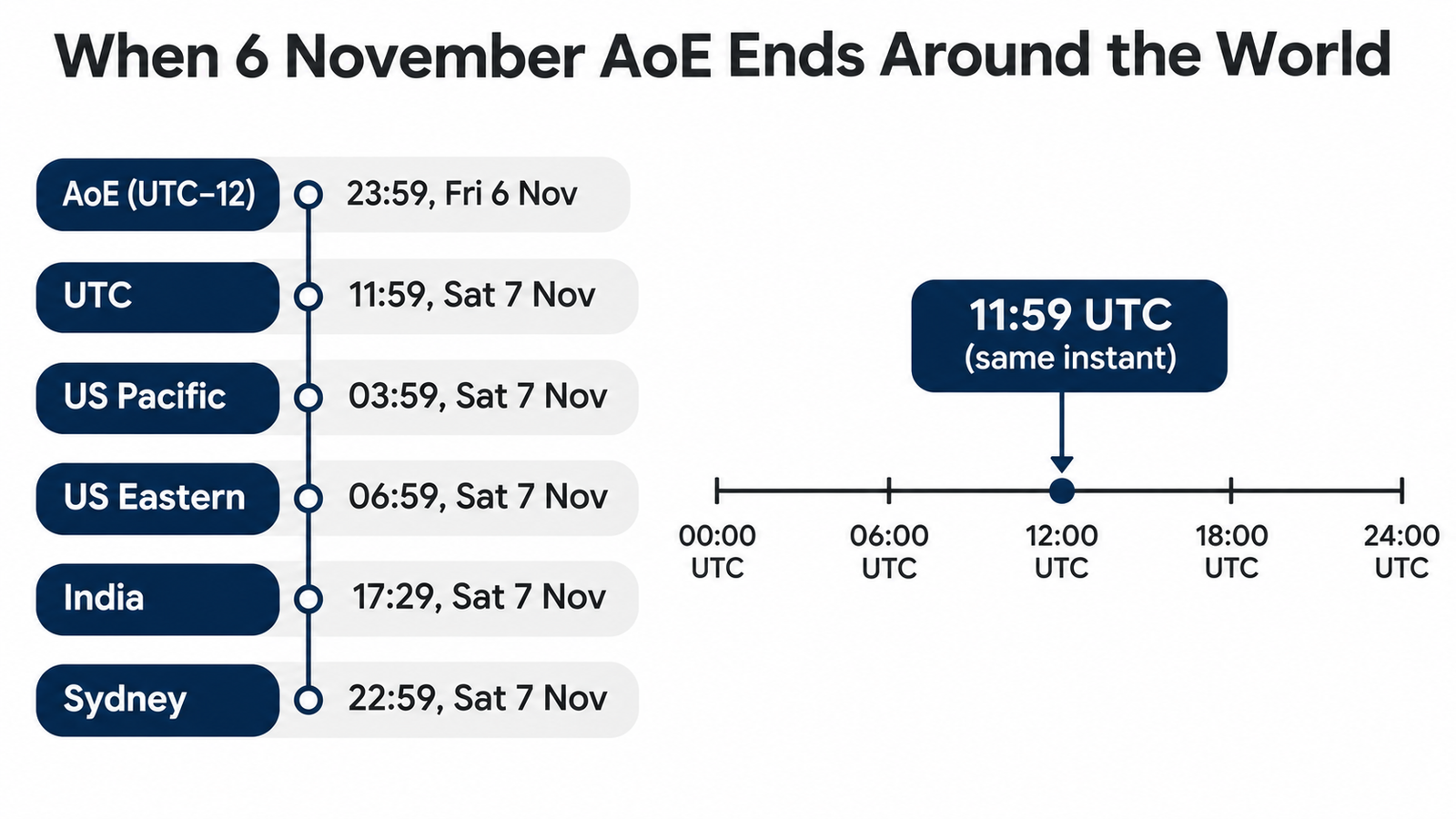
Anywhere on Earth (AoE) is UTC−12, the last time zone on the planet to reach the end of each day. A deadline of 23:59 AoE on 6 November passes at 11:59 UTC on 7 November. If it’s still 6 November anywhere on the planet, you’re on time.
Table: scroll sideways to view all columns when needed.
| Location | Deadline in local time |
|---|---|
| UTC | 11:59, Saturday 7 November |
| London (GMT, UTC+0) | 11:59, Saturday 7 November |
| Paris (CET, UTC+1) | 12:59, Saturday 7 November |
| US Pacific (PST, UTC−8) | 03:59, Saturday 7 November |
| US Eastern (EST, UTC−5) | 06:59, Saturday 7 November |
| India (IST, UTC+5:30) | 17:29, Saturday 7 November |
| Sydney (AEDT, UTC+11) | 22:59, Saturday 7 November |
US daylight saving ended on 1 November, and the UK and Europe changed clocks on 25 October, so those regions are now on standard time. Sydney has been on daylight time since early October. In every location listed, the deadline falls on Saturday 7 November, local time.
The extra hours are a safety margin, not a plan. OpenReview can slow down near a major deadline, and a failed upload at the last minute leaves no time to fix it. Aim to upload a complete version a day early, then replace it if you make final edits.
What the NeurIPS 2026 camera-ready version must include
The Main Track Handbook sets out the camera-ready rules. In short, you upload one PDF in OpenReview that contains the final paper, the required disclosures and the completed checklist.
How to upload in OpenReview
Open your paper’s page in OpenReview and select Edit in the top right corner. Then choose the camera-ready version and upload your files there. You’re editing the existing submission, so the paper keeps its ID, reviews and discussion history.
One PDF, with an extra page
Upload a single PDF combining the paper, references, any text appendices and the completed paper checklist. Submissions had a nine-page content limit, and accepted papers get one extra content page. References, appendices and the checklist don’t count toward that limit. Use the current NeurIPS 2026 style file, which also contains the checklist instructions.
The extra page is meant for changes requested in review. The handbook asks authors to update the main paper in response to reviewer comments and the discussion period.
Funding and competing interests
The handbook asks every camera-ready paper for a funding statement and a list of competing interests. Both cover the 36 months before submission.
- Funding: list all third-party support for the work, including grants, donated compute and programming support.
- Competing interests: list paid relationships that could be seen to sway the work, even if they didn’t fund it. Include all revenue paid or promised. You don’t need to repeat the group already named as your main employer.
These two statements are easy to miss because the anonymous submission didn’t need them. Draft them before you start final formatting, so you can confirm details with co-authors in time.
What you can and can’t change
According to the handbook, you may edit the title, keywords and abstract, as long as they don’t differ substantially from the submission. You may reorder authors freely, but you can’t add or remove anyone.
A change of title that keeps the same meaning is fine. A new title describing a different contribution is not, because it would differ substantially from what reviewers assessed.
A lay summary
The handbook also asks for a lay summary: one paragraph for the general public, written without jargon. Write it for a curious reader with no machine learning background. Say what problem the paper tackles, what you found and why it matters.
Registration and in-person presentation
At least one author must register for the main conference, and the handbook states that “a ‘Virtual Only Pass’ is not sufficient.” A student author needs only a student registration, and one registration can cover several accepted papers.
Each accepted paper must be presented in person in Sydney or at a satellite site. The handbook warns that a paper can lose its accepted status if no author registers and presents.
Your reviews will become public
For accepted papers, the handbook says reviews, meta-reviews and author discussion are made public. Reviewer, area chair and senior area chair identities stay anonymous. If your rebuttal promised changes, readers will be able to see whether the camera-ready made them.
A last-hour checklist
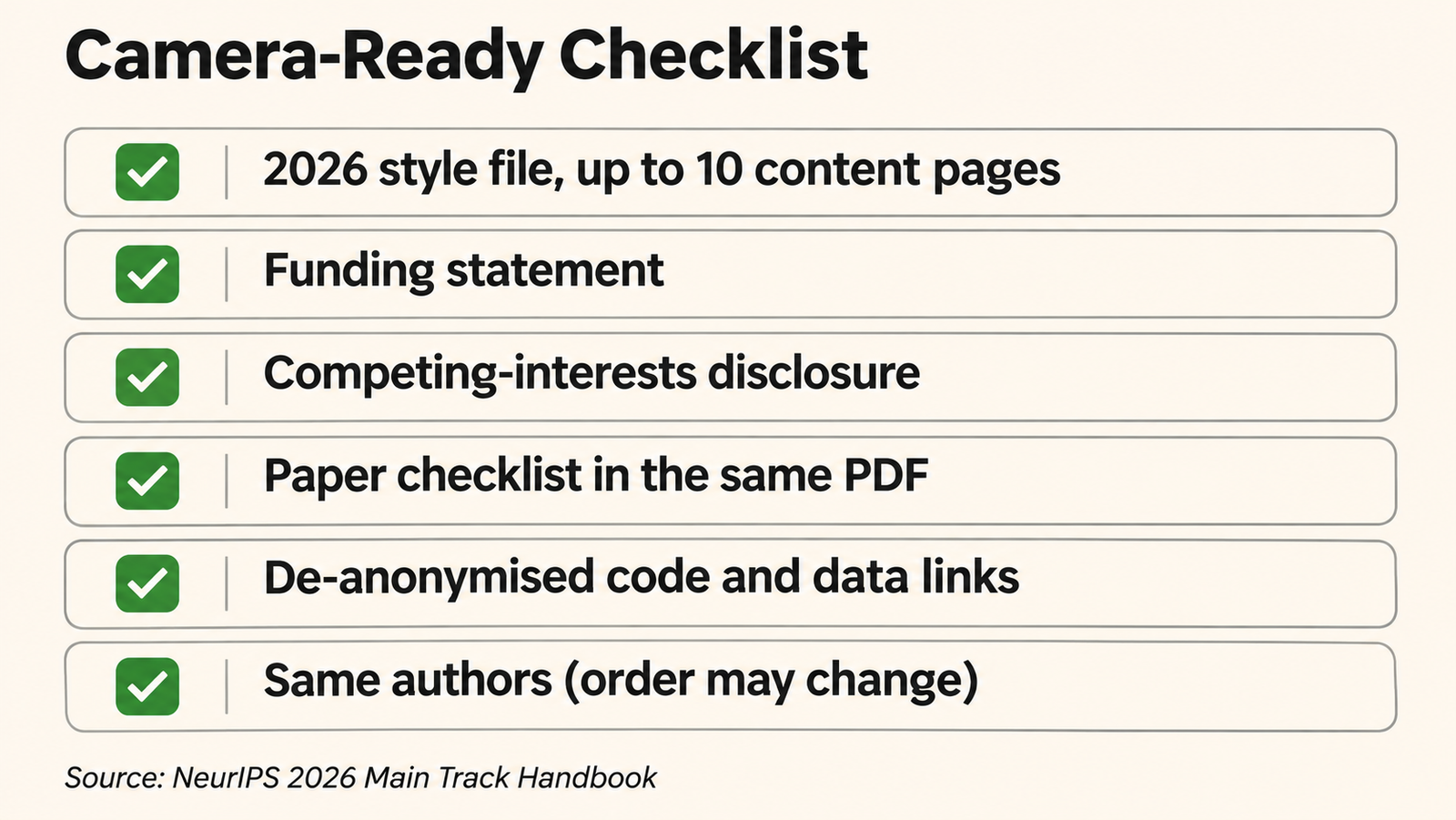
Before you press submit, run through the points the handbook and checklist guidance cover:
- The PDF uses the 2026 style file and stays within 10 content pages.
- The funding statement and competing-interests disclosure are both in the paper.
- The paper checklist is filled in and included at the end of the same PDF.
- Repository links are de-anonymised and point to the version you want readers to use.
- The author list matches the submission, even if the order has changed.
- The lay summary is uploaded, and at least one author holds a full registration.
If you’re unsure about a rule, the handbook is the place to check. Emails and forum posts from earlier years may describe policies that no longer apply.
Code and data requirements
NeurIPS 2026 encourages code release but doesn’t make it a blanket requirement. The official paper checklist guidance and the Main Track Handbook set the rules. The Call for Papers itself doesn’t contain code rules.
What is required
- A completed paper checklist. The guidance says papers without it “will be desk rejected.”
- “Some reasonable avenue for reproducibility.” The guidance notes that NeurIPS “does not require releasing code,” but every paper needs some way for others to reproduce or verify its results. For a new algorithm, the paper should make clear how to reproduce it.
- Citations and license names for existing code, data or models you used, including the version of each asset. For scraped data, state the source’s copyright and terms of service.
- Documentation for any new assets you release, covering training, license and limitations, and how consent was obtained from people whose data is used.
What is encouraged
- Releasing code, data and instructions to reproduce the main results, including “the exact command and environment needed.”
- De-anonymised links in the camera-ready. The handbook says accepted papers “should provide de-anonymized links for reproducibility.”
When “no” is an acceptable answer
The checklist is explicit that “no is an acceptable answer” to the code question. Papers can’t be rejected simply for not including code, unless code is central to the contribution, as with a new open-source benchmark. The guidance gives proprietary code as an example of a valid reason for answering no.
More broadly, the guidance says that answering “no” or “n/a” is “not grounds for rejection.” What matters is an honest answer with a brief justification.
Updating links for the camera-ready
At submission, the checklist asked authors to share anonymised versions of code and assets. For the camera-ready, replace any anonymised repository links with your real ones. Check that each link opens, that the repository’s README gives the commands the checklist describes, and that the license file matches what the paper states.
Workshop deadlines are separate
Workshop papers follow each workshop’s own timeline, not the main camera-ready date. The workshop guidance lets organisers set their own schedules. The only fixed dates are the suggested submission date of 29 August and the mandatory notification date of 29 September, both listed on the Dates page.
The guidance also states that “all NeurIPS workshop papers are non-archival and therefore do not appear in proceedings.” Organisers decide whether to share accepted papers, for example through OpenReview. Check your workshop’s website or OpenReview page for its camera-ready date, format and any poster requirements.
Why code release matters
A result that others can rerun is easier to trust and build on. Released code lets reviewers, readers and later authors check a claim, rather than relying on the paper’s description alone.
Benchmark numbers show why this matters. Scores depend on prompts, versions and settings, which is why our comparison of LLM benchmark scores treats them as evidence rather than a leaderboard. Even the same prompt can produce different outputs from one run to the next, as our explainer on LLM determinism shows. Released code, pinned versions and the exact environment narrow that gap.
The checklist’s requests line up with this. It asks for the exact command and environment, the version of each asset and the license for each dataset. Those details are what another lab needs to get the same numbers.
The AI Reviewing Experiment
Peer review itself is under study this year. NeurIPS is running a voluntary AI Reviewing Experiment to study how reviewers use large language models. Reviewers were randomly assigned, per paper, to no language-model help, open-ended help or structured help. Only papers whose authors opted in at submission were included.
NeurIPS says the tool is meant to help reviewers understand submissions, not to write reviews for them. It also says participation “will have no bearing on paper decisions,” and area chairs assessed reviews without knowing each review’s condition.
Frequently asked questions
Can I add an author at camera-ready?
No. The handbook allows reordering but not adding or removing authors, so anyone missing from the submission can only be thanked in the acknowledgements.
What time zone is the NeurIPS deadline in?
Anywhere on Earth, which is UTC−12. If any place on the planet is still on 6 November, the deadline hasn’t passed.
Do I need a new OpenReview submission for the camera-ready?
No. You edit the existing submission and choose the camera-ready version, so the paper keeps its ID and review history.
Will my reviews become public?
Yes, for accepted papers. Reviews, meta-reviews and author discussion are published, while reviewer and area chair identities stay anonymous.
Is releasing code mandatory for NeurIPS 2026?
No, unless the code is central to the contribution, such as a new open-source benchmark. You still need some reasonable way for others to reproduce your results.
Does the extra page apply to Datasets and Benchmarks papers?
The extra content page is described in the Main Track Handbook. Datasets and Benchmarks authors share the same 6 November deadline, but should check their own track’s guidance for formatting rules.
Can I present my paper online instead of in person?
No. Each accepted paper must be presented in person in Sydney or at a satellite site, and a virtual-only pass doesn’t meet the registration requirement.
Are NeurIPS workshop papers published in the proceedings?
No. The workshop guidance states that all NeurIPS workshop papers are non-archival and don’t appear in the proceedings.
Keep reading
Here are the latest posts from the blog.

NeurIPS 2026 Camera-Ready and Code Requirements

Claude API Rate Limits in 2026: How Many Requests Can You Run?

Enterprise AI Spending Hit $177B. Agents Are Driving the Bill