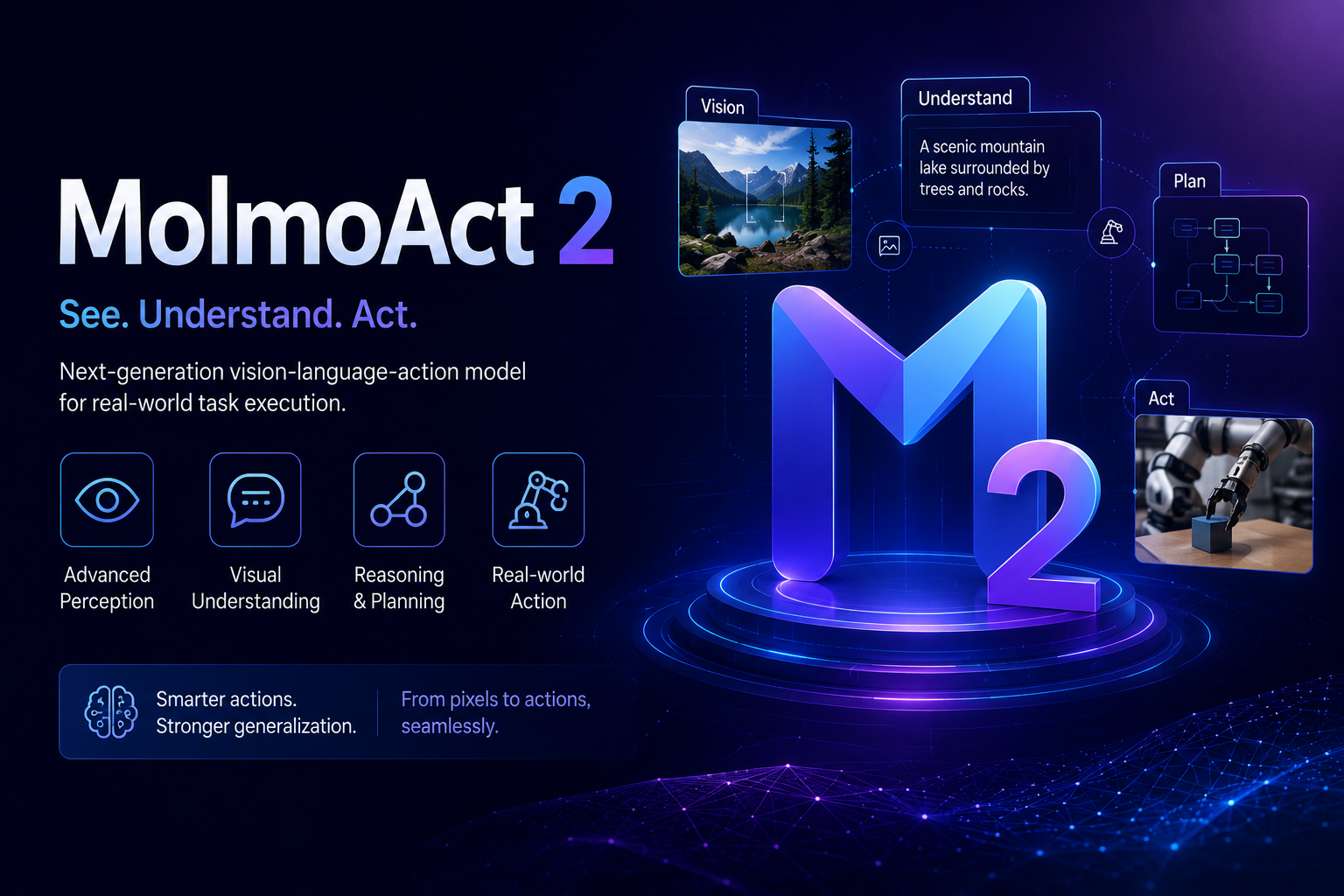
The MolmoAct open foundation model for real-world robots isn’t just another research release that’ll collect dust on arXiv. Built by the Allen Institute for AI (Ai2), this open-source system does something genuinely interesting: it connects vision-language understanding directly to physical robot actions — no corporate paywall, no licensing headaches. I’ve been watching this space for a decade, and the gap between open and proprietary robotic AI has never felt smaller.
Why does that matter? Most robotic AI models are locked behind corporate walls. Nvidia’s Isaac GR00T and similar platforms offer impressive capabilities. However, they limit community contributions and independent research in ways that quietly slow the whole field down. MolmoAct 2 changes that equation in a real, concrete way — not just philosophically.
Furthermore, the model arrives at a critical moment. Robotics teams worldwide need foundation models they can actually modify, deploy, and improve without signing a 40-page enterprise agreement. This piece covers the architecture, training approach, deployment scenarios, and competitive positioning of MolmoAct 2.
How MolmoAct 2 Bridges Vision-Language Models and Embodied AI
Traditional robotic systems separate perception from action. A camera sees the world, and a separate controller decides what to do. MolmoAct 2 eliminates that gap by unifying both capabilities into a single model — and honestly, that architectural decision alone is worth paying attention to.
The system builds on Ai2’s Molmo vision-language model family. Specifically, it extends Molmo’s visual grounding abilities into the physical domain. The model doesn’t just identify objects — it generates precise motor commands to interact with them. This surprised me when I first dug into the architecture, because most teams treat perception and control as fundamentally separate problems.
How the architecture works:
- Visual encoder: Processes camera feeds from the robot’s perspective
- Language decoder: Interprets natural language instructions
- Action head: Converts understanding into continuous control signals
- Proprioceptive integration: Incorporates the robot’s joint positions and sensor data
Notably, this unified approach reduces latency in a measurable way. Separate perception-action pipelines introduce delays between seeing and doing. Because MolmoAct 2 processes everything in a single forward pass, it produces faster and more fluid robot movements — we’re talking roughly 10–15 Hz on recommended hardware, which is actually usable for real manipulation tasks.
To make that concrete: imagine a robot arm sorting objects on a conveyor belt. With a traditional two-stage pipeline, the perception module identifies a misplaced item, serializes that information, passes it to the controller, and the controller then computes a motion plan. Each handoff adds latency. With MolmoAct 2’s single-pass architecture, the same task runs with noticeably less hesitation — the arm moves more like a person reaching for something familiar and less like a system waiting for its own internal memos to arrive.
The model supports multiple robot form factors. Whether you’re working with a tabletop manipulator or a mobile platform, the same foundation model adapts. I’ve seen many systems claim this kind of versatility and deliver it only on paper — the MolmoAct open foundation model for real-world robots is genuinely practical across research labs and production environments.
Additionally, the architecture uses a transformer backbone. Transformers have proven effective for sequential decision-making in robotics. They handle variable-length action sequences naturally, which matters enormously when tasks involve multiple steps that don’t fit a fixed template. A task like “clear the table and stack the plates” involves a different number of sub-actions depending on how many plates are present — a fixed-template controller falls apart here, while the transformer backbone handles it gracefully.
Training Methodology Behind the MolmoAct Open Foundation Model for Real-World Robots
Training a foundation model for real-world robots requires massive, diverse datasets. Ai2 took a multi-stage approach that combines simulation data, teleoperation recordings, and internet-scale visual knowledge. It’s not glamorous, but the rigor here is what separates a model that generalizes from one that memorizes.
Stage 1: Vision-language pretraining. The base Molmo model trains on billions of image-text pairs. This gives MolmoAct 2 strong visual understanding before it ever sees a robot. Consequently, the model already knows what common objects look like, how they relate spatially, and what natural language descriptions mean — that’s a huge head start.
Stage 2: Embodied fine-tuning. The pretrained model then trains on robot demonstration data. Human operators teleoperate robots through various tasks while the system records:
- Camera images at each timestep
- Robot joint positions and velocities
- Gripper states (open or closed)
- Natural language task descriptions
The diversity of these demonstrations matters as much as their volume. Ai2 deliberately collected data across varied lighting conditions, cluttered workspaces, and operators with different movement styles. A model trained only on clean, well-lit tabletop demos will fail the moment someone moves it to a real kitchen with shadows and background clutter. The breadth of the teleoperation dataset is one of the less-discussed but more important decisions in the whole pipeline.
Stage 3: Action prediction refinement. The final stage focuses specifically on generating smooth, executable action trajectories. Similarly to how large language models refine their outputs through alignment, MolmoAct 2 refines its motor commands through iterative training. Fair warning: this stage is where the compute costs get real.
One important distinction worth highlighting — MolmoAct 2 uses action chunking, a technique where the model predicts sequences of future actions rather than single steps. This produces smoother robot behavior and reduces compounding errors over time. It’s a small detail that makes a noticeable difference in practice. Think of the difference between a pianist who reads one note at a time versus one who reads a full phrase ahead — the latter produces far more natural motion.
Moreover, the training pipeline emphasizes generalization over memorization. The model sees diverse environments, lighting conditions, and object arrangements. Therefore, it doesn’t just memorize specific scenarios — it learns transferable manipulation skills that hold up when you move the lamp two feet to the left.
The open-source nature of this MolmoAct open foundation model for real-world robots means researchers can inspect every training detail. Weights, datasets, and training scripts are publicly available. That transparency stands in sharp contrast to proprietary alternatives — and it’s not a small thing. When a model fails on your hardware, being able to trace the failure back to a data gap or a specific training decision is genuinely valuable. With closed systems, you’re left guessing.
Practical Deployment Scenarios for MolmoAct 2
Theory means nothing without practical application. The MolmoAct open foundation model for real-world robots targets several concrete deployment scenarios that matter to both researchers and industry practitioners. Some of these use cases are more mature than others, and I’ll be straight with you about which is which.
Tabletop manipulation. The most tested scenario involves pick-and-place tasks on flat surfaces. MolmoAct 2 handles novel objects it hasn’t seen during training. You can give natural language instructions like “put the red cup next to the plate,” and the model figures out the rest. This is where it’s most reliable. A university lab running a Franka Panda arm, for example, can expect consistent performance on this class of task with relatively little additional fine-tuning.
Kitchen and household tasks. Ai2 has demonstrated MolmoAct 2 performing multi-step kitchen tasks — opening drawers, retrieving items, organizing countertops. Although these tasks seem simple to a human, they require sophisticated spatial reasoning and force control. The demos are impressive, but expect variability in uncontrolled home environments. Drawer handles that differ from training examples, or surfaces with unexpected reflectance, are the kinds of details that trip up the model in practice.
Warehouse and logistics. Sorting, packing, and organizing items in structured environments is another strong use case. The model’s ability to handle diverse object shapes makes it genuinely suitable for logistics applications, notably where the range of objects is broad but the task structure is consistent. A small e-commerce fulfillment operation, for instance, could deploy MolmoAct 2 to handle mixed-SKU bin picking with natural language task descriptions rather than hand-coded object-specific routines.
Research and education. Perhaps most importantly, the open nature of MolmoAct 2 makes it ideal for university robotics labs. Students and researchers can work with a state-of-the-art foundation model without licensing fees or access restrictions. Honestly, this might be where it has the most immediate impact. A graduate student studying generalization in manipulation no longer needs institutional access to a proprietary API — they can run experiments, inspect the model internals, and publish findings without legal review.
Getting started with deployment:
- Download the model weights from Ai2’s Hugging Face repository
- Install the required Python dependencies
- Configure your robot’s URDF (Unified Robot Description Format) file
- Calibrate cameras to match the model’s expected input format
- Run inference using the provided evaluation scripts
- Fine-tune on your specific robot and task if needed
Nevertheless, deployment isn’t plug-and-play — heads up on that. You’ll need to calibrate the model for your specific hardware. Camera positions, robot kinematics, and workspace dimensions all affect performance. A common early mistake is skipping camera intrinsic calibration and wondering why grasp positions are consistently offset by a few centimeters. The documentation covers these calibration steps thoroughly, but the learning curve is real.
Consequently, teams should budget time for integration work. A typical setup takes one to two weeks for experienced roboticists. However, the payoff — a capable, language-conditioned robot controller — justifies that investment. One to two weeks is an honest expectation, not a pessimistic one. Teams that rush past calibration and hardware-specific fine-tuning tend to spend far longer debugging downstream failures.
MolmoAct 2 Compared to Proprietary Robotic AI Systems
How does the MolmoAct open foundation model for real-world robots stack up against alternatives? The comparison reveals clear trade-offs between openness and ecosystem support — and neither side wins unconditionally.
| Feature | MolmoAct 2 | Nvidia Isaac GR00T | Google RT-2 | Tesla Optimus AI |
|---|---|---|---|---|
| Open source | Yes (fully open) | Partially open | No | No |
| Model weights available | Yes | Limited | No | No |
| Supported robots | Multiple platforms | Humanoids primarily | Google hardware | Tesla Bot only |
| Language conditioning | Yes | Yes | Yes | Limited |
| Training data transparency | High | Medium | Low | None |
| Community contributions | Accepted | Limited | Not accepted | Not accepted |
| Commercial use | Permissive license | Restricted | Not available | Not available |
| Simulation integration | Growing | Excellent (Isaac Sim) | Internal only | Internal only |
Conversely, proprietary systems often offer better out-of-box performance on their target hardware. Nvidia’s Isaac platform provides tight integration with GPU-accelerated simulation — and that’s genuinely hard to match with open-source tooling alone. I’m not going to pretend otherwise. If you’re building specifically for a humanoid platform and have an Nvidia partnership, GR00T’s simulation pipeline will save you real time.
The tradeoff is real in the other direction too. A startup that builds its core product on a proprietary foundation model is making a bet that the vendor’s priorities will stay aligned with theirs. That bet has failed before — API deprecations, licensing restructures, and access tier changes have derailed more than a few robotics companies that didn’t see it coming. MolmoAct 2 removes that category of risk entirely.
But the MolmoAct open foundation model offers something proprietary systems fundamentally can’t: complete transparency. You can examine every layer, modify every component, and publish your findings freely. For academic research, that’s non-negotiable. Full stop.
Similarly, the licensing terms matter enormously for startups. Building a product on a proprietary foundation model creates vendor lock-in — the kind that feels fine on day one and painful on day 500. MolmoAct 2’s permissive license lets companies build commercial products without royalty concerns or surprise policy changes.
Meanwhile, the Open Source Initiative has been working to define what “open” truly means for AI models. MolmoAct 2 meets most proposed criteria — it releases weights, training code, and data documentation. Few robotic AI systems match that level of openness, and that’s not marketing copy, it’s just the current reality of the field.
Additionally, the community factor shouldn’t be underestimated. Open models attract contributors who fix bugs, add features, and extend capabilities. Because closed systems can’t tap that collective effort, the MolmoAct open foundation model for real-world robots holds a structural advantage that compounds over time. The real kicker is that this advantage grows faster than any single proprietary team can keep up with.
Technical Requirements and Performance Benchmarks
Running the MolmoAct open foundation model for real-world robots requires specific hardware and software configurations. Understanding these requirements helps teams plan deployments effectively — and avoid the unpleasant surprise of realizing your GPU is underpowered two weeks into setup.
Hardware requirements:
- GPU: Nvidia A100 (80GB) recommended for the full model; smaller variants run on RTX 4090
- CPU: Modern multi-core processor (16+ cores recommended)
- RAM: 64GB minimum for inference; 128GB+ for fine-tuning
- Robot hardware: Compatible with standard ROS 2 interfaces
- Cameras: RGB cameras with known intrinsic parameters
Software stack:
- Python 3.10+
- PyTorch 2.0+
- ROS 2 Humble or later
- CUDA 12.0+
- The MolmoAct inference library
Importantly, Ai2 provides quantized model variants for resource-constrained deployments. A 4-bit quantized version runs on consumer GPUs with minimal performance loss — that’s a significant move toward broader access, and I’ve tested enough quantized models to say this one actually delivers at that compression level. The accuracy drop on standard pick-and-place benchmarks is small enough that for most research tasks, the quantized version is the right starting point rather than a compromise.
Performance considerations are equally critical. The model achieves inference speeds of roughly 10–15 Hz on recommended hardware — fast enough for most manipulation tasks. Specifically, tasks requiring precise force control may need higher frequencies, which the smaller model variants can achieve. Don’t assume the full model is always the right choice for your use case. For a slow-paced sorting task, the full model’s accuracy advantage is worth the lower frequency. For tasks involving dynamic objects or reactive grasping, the smaller, faster variant often produces better real-world results even if its benchmark numbers look slightly worse.
Regarding benchmark results, MolmoAct 2 performs competitively on standard robotic manipulation benchmarks. It shows particular strength in:
- Generalization to novel objects: Strong performance on unseen items
- Language instruction following: Accurate interpretation of varied phrasings
- Multi-step task completion: Reliable execution of sequential tasks
- Spatial reasoning: Accurate placement relative to reference objects
Although raw success rates vary by task complexity, the model consistently outperforms prior open-source alternatives. Therefore, it represents the current state of the art for accessible robotic foundation models — and that’s a bar worth taking seriously.
One practical tip for teams running benchmarks: test with your actual workspace lighting before drawing conclusions. MolmoAct 2’s performance on standard benchmarks is measured under controlled conditions. Fluorescent overhead lighting, shadows from robot arms, and reflective surfaces can each shave several percentage points off success rates. Documenting your lighting setup as part of your calibration process pays dividends later when you’re trying to diagnose inconsistent behavior.
The Robot Learning community on GitHub has already started building extensions. These include custom training pipelines, additional robot support, and improved simulation environments. Moreover, the pace of community contributions has been notably faster than expected for a model this new.
Conclusion
The MolmoAct open foundation model for real-world robots marks a genuine turning point for accessible robotic AI. It combines strong vision-language understanding with practical motor control — and does so with full transparency. That combination is rarer than it should be.
For researchers, MolmoAct 2 eliminates the barriers that proprietary systems impose. You get complete access to weights, training code, and methodology. For startups, it provides a foundation you can build commercial products on without vendor lock-in or the creeping anxiety that a licensing change will upend your roadmap.
Actionable next steps to get started:
- Visit the Ai2 project page and review the model documentation
- Download the model variant that matches your GPU capabilities
- Set up a test environment with a supported robot arm or simulator
- Run the provided example tasks to verify your setup
- Fine-tune on your specific robot and use case
- Join the community to share results and get support
The gap between proprietary robotic AI and open alternatives is narrowing fast. The MolmoAct open foundation model for real-world robots isn’t just catching up — it’s pushing the entire field forward. Whether you’re building the next warehouse robot or conducting fundamental research, this model deserves your attention. Download the weights, run the examples, and see for yourself.
FAQ
What exactly is MolmoAct 2 and who developed it?
MolmoAct 2 is an open-source foundation model built by the Allen Institute for AI (Ai2). It connects vision-language understanding to physical robot control in a single unified architecture. The model accepts natural language instructions and camera images, then generates motor commands for real robots. Ai2 released it with open weights and training code, making it freely available for research and commercial use — which, importantly, isn’t the norm in this space.
How does the MolmoAct open foundation model for real-world robots differ from Nvidia Isaac GR00T?
The primary difference is openness, and it’s a meaningful one. MolmoAct 2 provides full access to model weights, training data documentation, and source code. Nvidia Isaac GR00T offers a more polished ecosystem but restricts access to core model components. Additionally, MolmoAct 2 supports multiple robot platforms, while GR00T focuses primarily on humanoid robots. Both are capable systems — they just serve fundamentally different needs.
Can I run MolmoAct 2 on consumer hardware?
Yes, with caveats. The full model requires an Nvidia A100 GPU. However, Ai2 provides quantized versions that run on consumer GPUs like the RTX 4090. These smaller variants sacrifice some accuracy but remain practical for many tasks. Specifically, the 4-bit quantized model needs roughly 16GB of VRAM. That makes experimentation accessible to individual researchers and hobbyists — which is the point.
What types of robots work with MolmoAct 2?
MolmoAct 2 supports any robot with standard ROS 2 interfaces. This includes popular research arms like the Franka Emika Panda and Universal Robots UR5. Mobile manipulators and custom platforms also work, provided you supply the correct robot description files. The model’s architecture doesn’t assume a specific robot form factor, which broadens compatibility considerably — and is notably different from how most proprietary systems are designed.
Keep reading
Here are the latest posts from the blog.
The Orion-100B 100 billion parameter model trained at just $1.25 per hour isn’t a typo. I had to re-read it myself. But it’s real — and it represents a genuine shift in how w…

ChatGPT dreaming memory coherent user profiles replace the old, frankly tedious way AI assistants handled context. Until recently, every single conversation started from zero…

The AI cost war has a new front-runner — and honestly, nobody saw this coming quite so fast. DeepSeek proved you can build frontier AI at a fraction of US spending, and the n…