Understanding agentic AI vs. generative AI what’s difference is no longer something you can put off. These two paradigms are actively reshaping how companies operate, compete, and deliver value — and most decision-makers still mix them up, or worse, treat them as the same thing.
Here’s the thing: they’re fundamentally different tools built for fundamentally different jobs. Generative AI creates. Agentic AI acts. Your business probably needs both, but deploying them requires distinct strategies, distinct budgets, and very different expectations.
This breakdown covers what actually separates these paradigms, where each one earns its keep, and how to build an ROI framework that holds up under scrutiny. Whether you’re evaluating Claude, GPT-4, or one of the newer autonomous platforms, you’ll walk away with a real deployment roadmap — not just buzzword soup.
Defining the Core Difference Between Agentic AI and Generative AI
How Each Paradigm Works Under the Hood
Side-by-Side Comparison: Agentic AI vs. Generative AI
Business Use Cases Where Each Paradigm Excels
Building an ROI Framework for Both Paradigms
Strategic Deployment: Choosing the Right Paradigm for Each Use Case
Defining the Core Difference Between Agentic AI and Generative AI
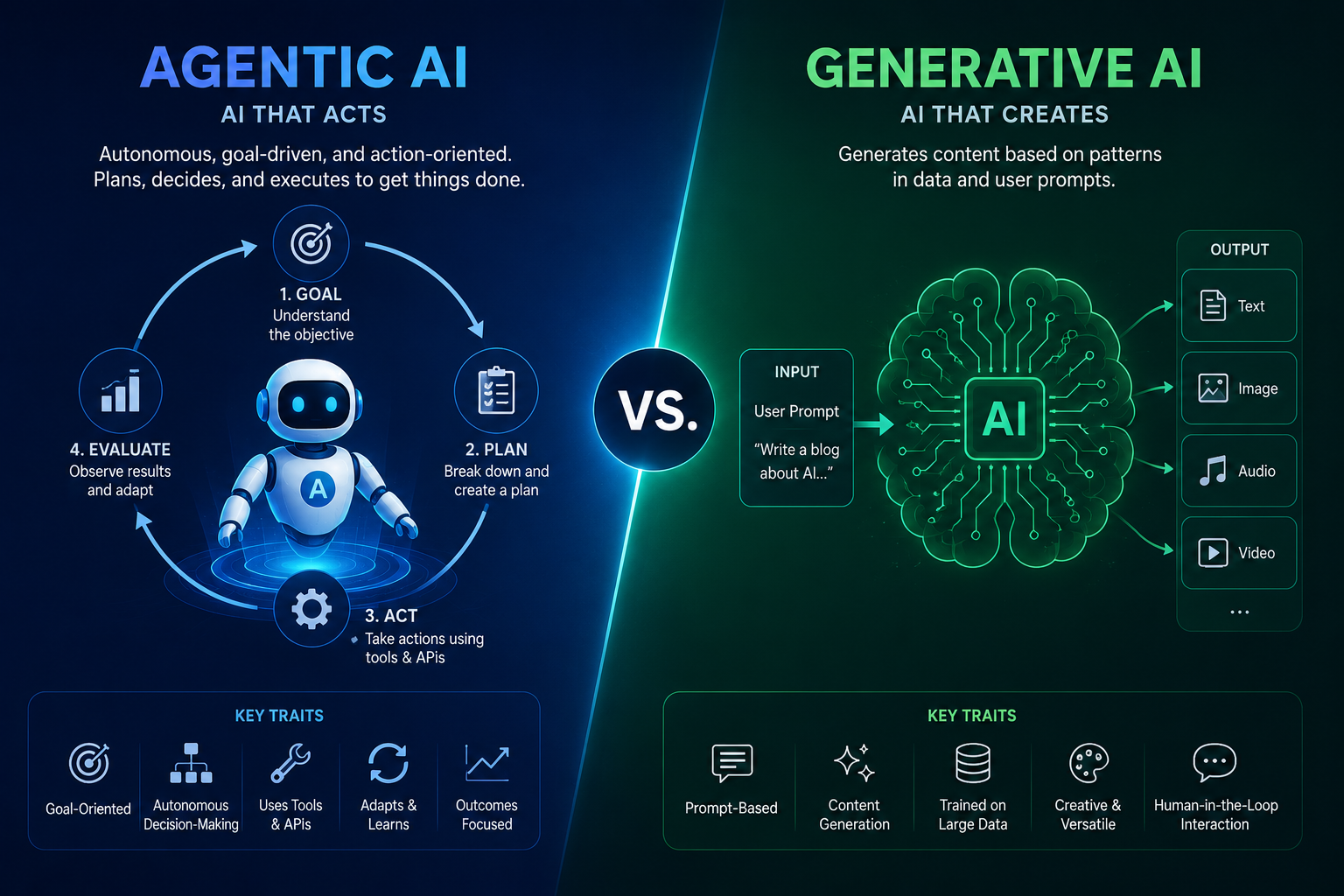
Before comparing anything, nail down the definitions. The agentic AI vs. generative AI distinction comes down to two things: purpose and autonomy.
Generative AI produces new content — text, images, code, music, video — based on patterns learned from training data. It responds to prompts. You ask, it generates. Tools like OpenAI’s ChatGPT, Anthropic’s Claude, and Google’s Gemini are the obvious examples. They’re genuinely powerful. However, they’re fundamentally reactive — they wait for you to drive.
Agentic AI goes further. It pursues goals on its own, makes decisions, uses tools, and adjusts its approach based on outcomes. Specifically, an agentic system doesn’t just answer your question — it breaks a complex goal into subtasks, runs them, monitors results, and course-corrects without someone holding its hand through every step.
Think of it this way:
- Generative AI is a brilliant assistant waiting for instructions
- Agentic AI is a capable colleague who takes initiative and follows through
Consequently, the difference between agentic AI and generative AI isn’t just technical — it’s operational. Generative systems need a human in the loop at every step. Agentic systems can run with human oversight at key checkpoints instead. That’s a meaningful shift in how work actually gets done.
Moreover, agentic AI often uses generative AI as one of its tools. An autonomous agent might use a large language model to draft an email, then call an API to send it, check for a response, and follow up — all without being told each step. The generative part handles content creation. The agentic layer handles orchestration. I’ve seen this combo described a dozen different ways, but that framing is the clearest one I’ve come across.
How Each Paradigm Works Under the Hood
Understanding agentic AI vs. generative AI what’s difference at a technical level helps you make smarter buying decisions. You don’t need a PhD — but you do need the basics, because vendors will absolutely gloss over the parts that matter.
How generative AI works:
- A model trains on massive datasets (text, images, code)
- It learns statistical patterns and relationships
- When prompted, it predicts the most likely next token (word, pixel, etc.)
- Output quality depends heavily on prompt quality
- Each interaction is typically stateless — it doesn’t remember past sessions unless given context
The Stanford HAI research group has published extensively on how foundation models learn and generalize. Notably, generative models excel at creative tasks but struggle with multi-step reasoning without careful prompting. That limitation trips up a lot of teams who assume the model will “figure it out.”
How agentic AI works:
- A goal or objective is defined (by a human or another system)
- The agent creates a plan, breaking the goal into subtasks
- It picks and uses the right tools (APIs, databases, web search, generative models)
- It runs each step, checks results, and adapts
- It keeps memory and state across interactions
- It can loop, retry, and escalate when needed
Frameworks like LangChain and Microsoft’s AutoGen let developers build agentic systems today. Nevertheless, the technology is still maturing — reliability and safety remain active research areas, and anyone who tells you otherwise is selling something.
Key architectural differences:
- Memory: Generative AI is mostly stateless. Agentic AI maintains persistent memory.
- Tool use: Generative AI produces content. Agentic AI calls external tools and services.
- Planning: Generative AI responds. Agentic AI plans multi-step workflows.
- Feedback loops: Generative AI delivers output once. Agentic AI iterates based on results.
Therefore, when you’re sizing up the difference between agentic and generative AI, focus on autonomy level. Can it act on its own? Can it recover from errors? Can it chain multiple actions together? If the answer is yes across the board, you’re looking at real agentic capabilities — not just a chatbot with a fancier UI.
Side-by-Side Comparison: Agentic AI vs. Generative AI
A clean comparison table cuts through the noise faster than paragraphs of explanation. Here’s how agentic AI vs. generative AI stack up across the dimensions that actually matter for deployment decisions:
| Dimension | Generative AI | Agentic AI |
|---|---|---|
| Primary function | Content creation and transformation | Goal pursuit and task execution |
| Autonomy level | Low — requires human prompts | High — operates independently |
| Decision-making | Single-turn responses | Multi-step reasoning and planning |
| Memory | Limited to context window | Persistent across sessions |
| Tool usage | Generates output only | Calls APIs, databases, and services |
| Error handling | Produces best guess | Detects errors, retries, adapts |
| Human involvement | Every interaction | Checkpoints and escalations |
| Maturity | Production-ready | Rapidly emerging |
| Risk profile | Hallucination, bias | Unintended actions, safety concerns |
| Example tools | ChatGPT, Claude, Midjourney, DALL-E | AutoGPT, Devin, Microsoft Copilot Studio |
Additionally, cost structures differ significantly — and this is where budgets go sideways. Generative AI costs scale with token usage: more content, more cost. Agentic AI costs scale with action complexity: more steps, more tool calls, more compute. That’s a fundamentally different billing model, and your finance team will want to understand it before you’re three months into a pilot.
Similarly, talent requirements diverge. Generative AI deployment needs prompt engineers and content strategists. Agentic AI deployment needs systems architects and workflow designers. Both need strong governance frameworks to function safely at scale. Quick note: “governance” isn’t just a compliance checkbox here — it’s what keeps an autonomous system from doing something expensive and irreversible.
This comparison makes one thing clear about agentic AI vs. generative AI what’s difference: they complement rather than compete. Smart enterprises will layer them strategically.
Business Use Cases Where Each Paradigm Excels
Abstract comparisons only go so far. Real business value shows up in specific workflows — and I’ve seen enough enterprise deployments to know that matching the right paradigm to the right use case is where most teams either win or waste six months.
Where generative AI wins:
- Content marketing: Blog posts, social copy, ad variations, email campaigns — high volume, fast turnaround
- Product design: Concept art, UI mockups, rapid prototype generation
- Software development: Code generation, documentation, code review assistance
- Customer communication: Chatbot responses, FAQ generation, personalized messaging at scale
- Data analysis: Summarizing reports, pulling insights from documents, translating content across formats
Generative AI shines when the task is well-defined and output-focused. You need something created — it creates it. The McKinsey Global Institute estimated that generative AI could add trillions in value across industries, primarily through productivity gains in knowledge work. I’ve tested dozens of these tools across content workflows, and the time savings are real — though the quality still needs human review more often than vendors admit.
Where agentic AI wins:
- Sales pipeline management: Researching leads, qualifying prospects, scheduling demos, and following up — without a rep touching each step
- IT operations: Monitoring systems, diagnosing issues, applying fixes, and documenting resolutions end-to-end
- Supply chain optimization: Tracking inventory, predicting shortages, reordering supplies, and rerouting shipments in real time
- Financial compliance: Scanning transactions, flagging anomalies, generating reports, and filing with regulators
- Customer success: Monitoring account health, triggering interventions, escalating risks, and tracking outcomes across the full lifecycle
Agentic AI excels when tasks require multiple steps, tool integration, and adaptive decision-making. Importantly, the ROI often comes from cutting manual labor in repetitive workflows rather than creative output. That distinction matters when you’re building the business case.
Where you need both:
Consider a marketing campaign. Generative AI creates the ad copy, images, and landing page content. Agentic AI then deploys the campaign across channels, monitors performance metrics, A/B tests variations, adjusts budgets, and reports results. Neither paradigm alone delivers the full workflow. This surprised me when I first mapped it out — the handoff point between the two is actually where the most interesting automation happens.
Consequently, the real question isn’t agentic AI vs. generative AI — it’s how to orchestrate them together well.
Building an ROI Framework for Both Paradigms
Knowing the difference between agentic AI and generative AI is step one. Justifying the investment to a skeptical CFO is step two. Here’s a practical ROI framework that accounts for both paradigms without glossing over the hard parts.
Step 1: Map your workflows. Identify every business process that involves content creation, decision-making, or multi-step execution. Tag each as primarily creative (generative AI candidate) or operational (agentic AI candidate). This exercise alone usually surfaces problems nobody had formally acknowledged.
Step 2: Quantify current costs. For each workflow, calculate the total cost — labor hours, error rates, cycle times, and opportunity costs. Be honest. Many organizations dramatically underestimate how much manual coordination actually costs them. It’s spread across dozens of people doing small, annoying tasks all day.
Step 3: Estimate AI-assisted performance. For generative AI tasks, measure time savings per content unit. For agentic AI tasks, measure end-to-end cycle time reduction and error rate improvement. Use conservative estimates — you’ll be closer to reality.
Step 4: Account for implementation costs. Include these line items:
- Platform licensing and API costs
- Integration and development effort
- Training and change management
- Ongoing monitoring and governance
- Safety and compliance infrastructure
Step 5: Calculate net value.
- Generative AI ROI = (Time saved × hourly cost) – (API costs + implementation costs)
- Agentic AI ROI = (Full workflow cost reduction + error reduction value) – (Platform costs + governance overhead)
Furthermore, consider second-order benefits. Generative AI often improves content quality and consistency beyond just speed. Agentic AI frequently exposes process problems that weren’t visible before automation forced you to document them. These indirect benefits compound — and they’re worth including in your model.
Although exact figures vary by industry, the National Institute of Standards and Technology (NIST) provides solid frameworks for judging AI system trustworthiness — a critical factor in any ROI calculation. An unreliable system costs more than no system at all. That’s not a hypothetical; I’ve watched teams spend more cleaning up agentic misfires than the automation ever saved them.
Common ROI mistakes to avoid:
- Comparing agentic AI costs against a single employee instead of the full workflow
- Ignoring governance and safety costs for autonomous systems (the real kicker in most budgets)
- Overestimating generative AI accuracy without human review factored in
- Underestimating change management timelines — people resist this stuff, full stop
- Treating pilot results as guaranteed production outcomes
Meanwhile, early adopters are already reporting strong results. Companies using generative AI for content production consistently report meaningful productivity improvements. Organizations piloting agentic workflows in IT operations and customer service are seeing real reductions in resolution times. The data is encouraging — but the gap between a good pilot and a scaled deployment is wider than most teams expect.
Strategic Deployment: Choosing the Right Paradigm for Each Use Case
Now that you understand agentic AI vs. generative AI what’s difference at both a technical and business level, deployment strategy is where most enterprises actually stumble. The conceptual clarity disappears fast when you’re staring at a vendor shortlist and a Q3 deadline.
Start with generative AI. It’s more mature, lower risk, and delivers faster wins. Use it to build organizational AI literacy and governance muscle. Specifically, target high-volume content creation tasks where human review is straightforward. Fair warning: the learning curve is real even here — but it’s manageable.
Graduate to agentic AI carefully. Autonomous systems need stronger guardrails. Start with low-stakes, well-defined workflows. Monitor closely. Expand gradually. I’ve seen teams skip this step and regret it every single time.
A practical maturity model:
- Level 1 — Assisted: Generative AI helps humans create content faster
- Level 2 — Augmented: Generative AI handles first drafts; humans refine and approve
- Level 3 — Semi-autonomous: Agentic AI runs defined workflows with human checkpoints
- Level 4 — Autonomous: Agentic AI manages end-to-end processes with exception-based human oversight
- Level 5 — Orchestrated: Multiple agents work together across functions, using generative models as needed
Most enterprises today sit at Level 1 or 2. Levels 3 and 4 are where significant competitive advantages emerge — and that’s not hype, it’s where the labor economics genuinely shift. Level 5 remains largely aspirational, although platforms like Salesforce’s Agentforce are pushing hard toward it.
Governance considerations for each level:
- Levels 1–2 need content review policies and brand guidelines
- Levels 3–4 need action authorization frameworks and rollback capabilities
- Level 5 needs full AI governance, audit trails, and regulatory compliance
Conversely, organizations that skip governance end up with expensive cleanup projects. I’m not talking about theoretical future risk — this is happening right now at companies that moved too fast. Don’t rush autonomy without building the safety infrastructure first. It’s not optional.
Alternatively, some businesses will find that generative AI alone meets their needs — and that’s perfectly valid. Not every organization needs autonomous agents. The key is making that choice on purpose, not by default because nobody stopped to ask the question.
Conclusion
The question of agentic AI vs. generative AI what’s difference ultimately comes down to creation versus action. Generative AI produces content. Agentic AI pursues goals. Both deliver real value, but they serve different purposes and need different strategies — and mixing them up is how budgets get wasted and expectations get mismanaged.
Here are your actionable next steps:
- Audit your workflows to identify which ones need content creation (generative) versus autonomous execution (agentic)
- Start with generative AI for quick wins and organizational learning
- Pilot agentic AI on low-risk, well-defined operational workflows
- Build governance frameworks before scaling either paradigm
- Measure ROI rigorously using the framework outlined above
- Plan for convergence — the future belongs to organizations that orchestrate both paradigms together
The difference between agentic AI and generative AI isn’t academic — it’s strategic. Companies that understand it will deploy the right tool for the right job. Those that don’t will keep spending budget on mismatched solutions and wondering why the ROI never shows up.
Your competitive advantage doesn’t come from picking one paradigm over the other. It comes from knowing exactly when and where each one delivers maximum impact — and building the organizational capability to act on that knowledge before your competitors do.
FAQ
What is the main difference between agentic AI and generative AI?
Generative AI creates content like text, images, and code based on prompts. Agentic AI independently pursues goals by planning, using tools, and adapting to results. The core difference between agentic AI and generative AI is autonomy. Generative systems wait for instructions. Agentic systems take initiative and run multi-step workflows on their own.
Can agentic AI and generative AI work together?
Absolutely. In fact, they work best together. Agentic AI often uses generative AI as one of its tools. For example, an autonomous agent might use a generative model to draft customer emails, then send them, track responses, and follow up — all without human intervention. The combination of both paradigms creates more powerful end-to-end automation than either achieves alone.
Is agentic AI ready for enterprise deployment?
Agentic AI is maturing quickly but is still earlier in its lifecycle than generative AI. Several platforms offer production-ready agent frameworks. However, enterprises should start with well-defined, lower-risk workflows and build solid governance before scaling. Additionally, human oversight at key decision points remains essential for most business-critical processes.
Which paradigm delivers faster ROI?
Generative AI typically delivers faster ROI because it’s more mature and easier to deploy. Content creation use cases often show measurable productivity gains within weeks. Agentic AI ROI takes longer to show up but can be substantially larger because it automates entire workflows rather than individual tasks. Consequently, generative AI wins on speed while agentic AI wins on scale.
What are the biggest risks of each approach?
Generative AI’s main risks include hallucination (producing false information), bias in outputs, and intellectual property concerns. Agentic AI’s main risks involve unintended autonomous actions, security gaps from tool access, and difficulty predicting system behavior. Nevertheless, both risks are manageable with proper governance, monitoring, and human oversight frameworks.
How should a business decide which type of AI to implement first?
Start by mapping your highest-cost workflows. If your biggest pain points involve content creation, communication, or data summarization, generative AI is your entry point. If your bottlenecks involve multi-step processes, manual coordination, or repetitive operational tasks, agentic AI may deliver more value. Most organizations benefit from starting with generative AI to build internal expertise, then moving to agentic capabilities as their understanding of agentic AI vs. generative AI deepens.
References
Keep reading
Here are the latest posts from the blog.

The ideogram best open weight image model dropped news landed like a thunderclap in the AI community this week. And honestly? It deserves the hype. Ideogram 4.0 isn’t just an…

The multi-model strategy has crossed the line from interesting theory to genuine survival tactic. Teams still running a single large language model (LLM) in production are bl…

The numbers are staggering. 192,000 tech jobs gone in just five months — and for once, companies aren’t hiding behind vague corporate-speak about it. Between January and May…