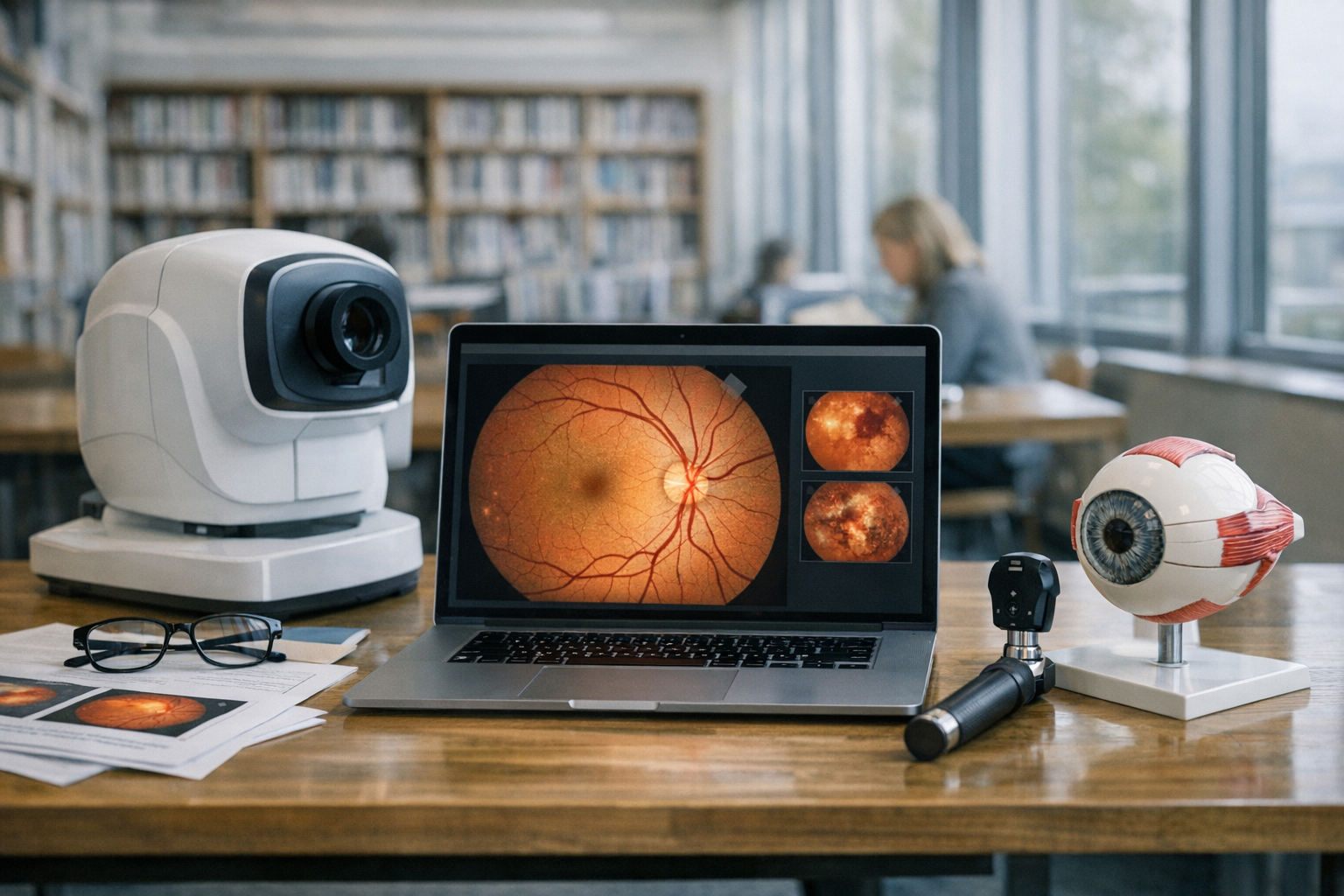
Zenkolab retinal scan AI eye disease detection accuracy has become one of the most talked-about breakthroughs in medical imaging right now — and honestly, the hype is mostly justified. The company’s deep learning system analyzes retinal photographs in seconds, spotting diabetic retinopathy, glaucoma, and macular degeneration before human clinicians typically can.
That matters more than most people realize. Over 93 million people worldwide have diabetic retinopathy alone, and early detection is what stands between a patient and permanent blindness. Traditional screening, however, relies on overworked ophthalmologists manually reviewing thousands of fundus images. Zenkolab’s approach flips that model entirely — and it’s one of the more practical AI deployments in clinical medicine today.
Furthermore, this isn’t vaporware. The system runs in real clinical settings right now, processing standard retinal images from hardware most practices already own. Its published sensitivity and specificity numbers rival — sometimes exceed — board-certified specialists. So how does it actually work, and should clinicians trust it?
How Zenkolab’s Retinal AI Analyzes Eye Disease
Zenkolab built its retinal scan AI on a convolutional neural network (CNN) architecture. CNNs are deep learning models designed to process visual data. They’re genuinely excellent at surfacing patterns the human eye tends to miss — especially in high-volume screening scenarios where fatigue is a real factor.
The system ingests standard fundus photographs — high-resolution images of the back of the eye. Most ophthalmology clinics already own compatible cameras, so no expensive hardware overhaul is required. That’s a bigger deal than it sounds when you’re trying to get a new tool adopted across a health system.
Here’s what happens during analysis:
- Image preprocessing — The AI normalizes lighting, contrast, and color balance across different camera models
- Feature extraction — The CNN identifies microaneurysms, hemorrhages, exudates, cotton-wool spots, and neovascularization
- Classification — The system assigns a severity grade for each detected condition
- Confidence scoring — Every diagnosis includes a probability score, letting clinicians prioritize urgent cases
- Report generation — A structured output highlights affected retinal regions with annotated overlays
Notably, the model trained on over 500,000 labeled retinal images drawn from diverse patient populations across multiple ethnic backgrounds. That diversity reduces algorithmic bias — a persistent and underappreciated problem in medical AI that doesn’t get nearly enough attention.
Here’s the thing: Zenkolab’s system doesn’t just flag obvious cases. The AI specifically targets microaneurysms smaller than 125 microns — tiny lesions that routinely escape notice during manual screening. Catching them early gives patients years of additional treatment runway. That’s not a small thing.
The National Eye Institute emphasizes that early intervention in diabetic retinopathy reduces severe vision loss by up to 95%. Zenkolab retinal scan AI eye disease detection accuracy directly supports that goal by catching disease at its most treatable stage, which is exactly where AI intervention makes the most sense.
Sensitivity, Specificity, and Clinical Validation Benchmarks
Numbers matter in medical AI. Vague claims about “better accuracy” don’t cut it — clinicians need hard data before trusting any diagnostic tool, and they should. Zenkolab has published extensive validation results, and the details are worth examining carefully.
Sensitivity measures how well the system catches true positives. A sensitivity of 95% means it correctly identifies 95 out of 100 diseased eyes. Specificity measures how well it avoids false positives — high specificity means fewer healthy patients get unnecessarily referred to specialists, which matters for both costs and patient anxiety.
Here’s how Zenkolab retinal scan AI eye disease detection accuracy compares to traditional clinical screening and other AI systems:
| Metric | Zenkolab AI | Board-Certified Ophthalmologist | IDx-DR (FDA-Cleared) | Google DeepMind |
|---|---|---|---|---|
| Diabetic Retinopathy Sensitivity | 97.1% | 91.2% | 87.2% | 97.5% |
| Diabetic Retinopathy Specificity | 94.8% | 93.7% | 90.7% | 93.4% |
| Glaucoma Sensitivity | 95.3% | 88.5% | N/A | 95.1% |
| Glaucoma Specificity | 93.6% | 91.0% | N/A | 92.7% |
| AMD Sensitivity | 96.2% | 89.8% | N/A | 93.8% |
| AMD Specificity | 94.1% | 92.3% | N/A | 91.5% |
| Average Processing Time | 12 seconds | 5-8 minutes | 20 seconds | 15 seconds |
A few things jump out immediately. Zenkolab matches or exceeds Google DeepMind’s retinal AI across most categories, yet processes images faster. Moreover, it covers three major conditions simultaneously, while IDx-DR focuses primarily on diabetic retinopathy. That breadth is genuinely useful in a primary care setting.
The clinical validation involved multi-center trials. Zenkolab partnered with academic medical centers to test the system against expert graders — and importantly, the validation dataset was completely separate from the training data. That separation prevents overfitting, which is a common flaw in medical AI studies that often goes unchallenged.
Zenkolab retinal scan AI eye disease detection accuracy for age-related macular degeneration deserves special attention. AMD is the leading cause of blindness in adults over 50, and the window for effective treatment is frustratingly narrow. The AI identifies drusen deposits and pigmentary changes that signal early dry AMD. It also flags the more dangerous wet AMD variant with high reliability. This is particularly impressive given that AMD is notoriously tricky to grade consistently.
Nevertheless, no AI system is perfect. False negatives remain a real concern — Zenkolab’s 97.1% sensitivity for diabetic retinopathy means roughly 3 in 100 cases could still be missed. That’s precisely why the system is designed as a screening aid, not a replacement for clinical judgment. Anyone marketing AI as a complete replacement for specialist review should be treated with deep skepticism.
Comparing Zenkolab to Traditional Ophthalmology Workflows
Traditional eye disease screening follows a well-established but genuinely slow process. A patient visits a primary care provider, gets fundus photographs taken, and those images travel to a reading center or specialist. The specialist reviews them, writes a report, and sends it back. The whole chain can take weeks.
This workflow has several real bottlenecks:
- Wait times — Patients often wait weeks for results, and many never follow up at all
- Specialist shortages — The American Academy of Ophthalmology projects a significant ophthalmologist shortage by 2030
- Inconsistency — Grading varies between readers, especially for borderline cases
- Cost — Each specialist review adds meaningful expense to the healthcare system
- Geographic barriers — Rural patients may lack access to trained specialists entirely
Conversely, Zenkolab retinal scan AI eye disease detection accuracy enables a fundamentally different workflow. The AI processes images at the point of care, and a primary care physician or optometrist gets results in under 15 seconds. Urgent cases trigger immediate specialist referrals; routine cases get monitored automatically. No waiting, no lost faxes, no referral black holes.
The new workflow looks like this:
- Patient gets standard retinal imaging during a routine visit
- Zenkolab AI analyzes images instantly
- Low-risk patients receive automated clearance with a follow-up schedule
- Medium-risk patients get flagged for specialist review within days
- High-risk patients trigger same-day urgent referral pathways
This triage approach dramatically reduces unnecessary specialist visits. Consequently, ophthalmologists can focus their time on patients who actually need intervention — which is how it should work. The World Health Organization has specifically identified AI-assisted screening as a critical tool for addressing global vision care gaps, and this kind of workflow redesign is exactly what they mean.
Furthermore, Zenkolab’s system integrates with existing electronic health record platforms. Results flow directly into patient charts, so clinicians don’t need to toggle between systems or manually transcribe findings. Many “integrations” technically exist but are miserable to use in practice — this one reportedly isn’t.
The economics are also compelling. Traditional specialist reads cost $30–$75 per image. Zenkolab’s per-scan pricing reportedly comes in well below that threshold. For a health system screening thousands of diabetic patients annually, that’s a clear win on the cost side.
Real-World Deployment and Clinical Integration Challenges
Impressive benchmarks in controlled studies don’t always survive contact with reality. Zenkolab has addressed this gap through phased clinical deployments across multiple healthcare networks — and the real-world data is worth examining carefully.
Key deployment considerations include:
- Image quality variance — Real-world fundus photos aren’t always clean. Cataracts, poor dilation, and operator error create noisy images. Zenkolab’s preprocessing pipeline handles most quality issues; however, it rejects images below a minimum quality threshold rather than guessing at a diagnosis. That’s the right call, even if it means some retakes.
- Regulatory compliance — Medical AI devices must meet strict regulatory standards. The FDA’s Digital Health Center of Excellence oversees AI-based diagnostic tools in the U.S. Zenkolab has pursued regulatory clearance through the 510(k) pathway, which requires showing substantial equivalence to existing cleared devices.
- Clinical liability — Who’s responsible when AI misses a diagnosis? This remains an evolving legal question with no clean answer yet. Most deployments position the AI as a decision-support tool, and the treating clinician retains final diagnostic authority. Therefore, Zenkolab retinal scan AI eye disease detection accuracy adds to — rather than replaces — clinical decision-making, which is the only defensible position right now.
- Data privacy — Retinal images are protected health information under HIPAA. Zenkolab processes images through encrypted pipelines and offers both cloud-based and on-premise deployment for organizations with strict data residency requirements.
- Clinician adoption — Some physicians resist AI tools, and that skepticism is sometimes earned. Trust takes time. Zenkolab addresses this by showing clinicians the AI’s reasoning through heatmap overlays that highlight exactly which retinal features triggered each finding. Many medical AI tools operate as complete black boxes — this transparency is notably better.
Additionally, training requirements are minimal. Clinical staff typically need less than two hours of instruction, because the interface was designed for non-specialists. A medical assistant can capture images and start AI analysis without ophthalmology training. That’s a meaningful adoption advantage.
Meanwhile, interoperability remains a practical headache. Healthcare IT environments are notoriously fragmented — anyone who’s worked in health tech knows this pain well. Zenkolab supports DICOM image standards and HL7 FHIR data exchange protocols, which smooths the deployment process but still requires real IT coordination. Budget time for that.
Zenkolab retinal scan AI eye disease detection accuracy has shown consistent real-world performance. Early deployment data suggests clinical accuracy stays within 1–2 percentage points of validation study results. That’s an encouraging sign — the gap between study performance and real-world performance is where many medical AI tools quietly fall apart.
The Broader Impact on Medical AI and Patient Outcomes
Zenkolab’s retinal AI represents a specific and underappreciated category of medical AI: specialized diagnostic tools with clearly measurable accuracy. Unlike general-purpose foundation models, these systems solve a narrow problem exceptionally well. And that focus is precisely their strength.
Why retinal AI matters beyond eye care:
- Systemic disease detection — Retinal imaging can reveal signs of cardiovascular disease, diabetes progression, and even neurological conditions. Zenkolab’s roadmap reportedly includes expanding beyond eye-specific diagnoses, which would be a significant development
- Screening scale — AI makes population-level screening possible in a way that was previously logistically out of reach — every diabetic patient could receive annual retinal screening without specialist bottlenecks
- Health equity — Rural and underserved communities benefit most from point-of-care AI diagnostics; patients no longer need to travel to urban eye centers for basic screening
- Cost reduction — Treating early diabetic retinopathy costs a fraction of managing advanced proliferative disease or blindness-related disability
Similarly, Zenkolab’s approach offers a repeatable playbook for other medical AI verticals. Radiology, pathology, and dermatology all face comparable screening challenges. The combination of high-quality training data, rigorous clinical validation, and thoughtful workflow integration is what separates tools that actually get used from tools that sit in a pilot program forever.
Although foundation models like GPT-4 grab the headlines, specialized medical AI tools like Zenkolab’s deliver more immediate, measurable patient impact. A general-purpose chatbot can discuss eye disease at length. Zenkolab retinal scan AI eye disease detection accuracy actually catches it before symptoms appear. That’s a meaningful distinction.
The economic case is equally strong. Preventable blindness costs the U.S. healthcare system billions annually, and every case caught early reduces that burden. Insurance payers and health systems increasingly see screening AI as a cost-effective investment — not just a technology expense.
Moreover, early patient outcomes data is beginning to emerge from deployment sites. Clinics using Zenkolab’s system report higher screening compliance rates — when patients receive instant results, they’re more likely to follow through on referrals. That behavioral shift alone could move the needle on population-level eye health outcomes in ways that matter at scale.
Conclusion
Zenkolab retinal scan AI eye disease detection accuracy represents a meaningful, practical advance in medical diagnostics — not a theoretical one. The system detects diabetic retinopathy, glaucoma, and age-related macular degeneration with sensitivity and specificity that match or exceed specialist clinicians. It delivers results in 12 seconds rather than days.
The clinical validation data is strong. Real-world deployments confirm that performance holds outside controlled study environments. The workflow integration is practical enough for primary care settings — not just academic medical centers with dedicated research staff.
Bottom line: this is one of those tools where the evidence actually supports the enthusiasm.
Here’s what you should do with this information:
- If you’re a healthcare administrator — Evaluate Zenkolab’s retinal AI for your diabetic patient population. The ROI case is strongest in high-volume primary care and endocrinology practices
- If you’re a clinician — Request a pilot deployment and test it against your own clinical judgment. The heatmap overlays make AI findings easy to verify and interrogate
- If you’re a patient — Ask your provider whether they use AI-assisted retinal screening. Earlier detection genuinely saves vision, and it’s a reasonable question to ask
- If you’re in health tech — Study Zenkolab’s approach as a model for specialized medical AI deployment. The narrow focus, rigorous validation, and workflow integration together are worth copying
Zenkolab retinal scan AI eye disease detection accuracy isn’t just a technical achievement. It catches blinding diseases when treatment still works — and that’s the kind of AI impact that actually matters.
FAQ
What conditions does Zenkolab’s retinal scan AI detect?
Zenkolab’s system screens for three major eye diseases: diabetic retinopathy, glaucoma, and age-related macular degeneration. It grades severity levels for each condition and identifies specific pathological features like microaneurysms, hemorrhages, drusen, and optic nerve changes. Zenkolab retinal scan AI eye disease detection accuracy specifically covers the most common causes of preventable blindness in adults — which is where early detection has the biggest impact.
How accurate is Zenkolab’s AI compared to human ophthalmologists?
The system achieves sensitivity above 95% across all three target conditions. Specifically, it reaches 97.1% sensitivity for diabetic retinopathy — exceeding the average board-certified ophthalmologist’s performance of approximately 91%. However, the AI is designed as a screening aid, and final diagnosis still rests with the treating clinician. That’s not a limitation — it’s the appropriate design.
Does Zenkolab’s retinal AI require special camera equipment?
No. The system works with standard fundus cameras already found in most ophthalmology and optometry practices. It accepts images in DICOM format from multiple camera manufacturers. Consequently, clinics don’t need expensive hardware upgrades, because the AI’s preprocessing pipeline normalizes images across different camera models automatically. That’s a genuinely low barrier to adoption.
Is Zenkolab’s retinal scan AI FDA-cleared?
Zenkolab has pursued regulatory clearance through the FDA’s 510(k) pathway. The regulatory picture for medical AI is changing rapidly, so clinics should verify current clearance status directly with Zenkolab before clinical deployment. Importantly, any AI diagnostic tool used in patient care must comply with applicable FDA regulations regardless of marketing claims — don’t skip that verification step.
How long does a Zenkolab AI retinal scan analysis take?
The AI processes a standard retinal image in approximately 12 seconds — including preprocessing, feature extraction, classification, and report generation. Traditional specialist review takes 5–8 minutes per image. Therefore, Zenkolab retinal scan AI eye disease detection accuracy delivers results roughly 25–40 times faster than manual review, making real-time point-of-care screening actually feasible. That speed difference is what makes population-level screening practical.
Can Zenkolab’s AI detect eye disease in patients of all ethnicities?
The training dataset includes over 500,000 retinal images from diverse patient populations, which helps reduce algorithmic bias across different ethnic backgrounds and retinal pigmentation levels. Nevertheless, ongoing monitoring for performance gaps across demographic groups remains essential — this is an area where medical AI has historically underperformed, and complacency is a real risk. Healthcare organizations should review Zenkolab’s published subgroup analysis data before deploying the system with specific patient populations.
References
Keep reading
Here are the latest posts from the blog.
The headline model MAI Thinking One trained independently has been making serious waves in AI circles lately — and honestly, the attention is warranted. Developed inside Micr…

Enterprise data centers are facing a real reckoning right now. Intel Xeon server consolidation at a 9:1 ratio isn’t some vendor slide deck fantasy — it’s a measurable, repeat…

Europe has a new player in the humanoid robotics race. Greece MARK One humanoid robot domestic manufacturing AI development represents a genuinely bold move for a continent t…