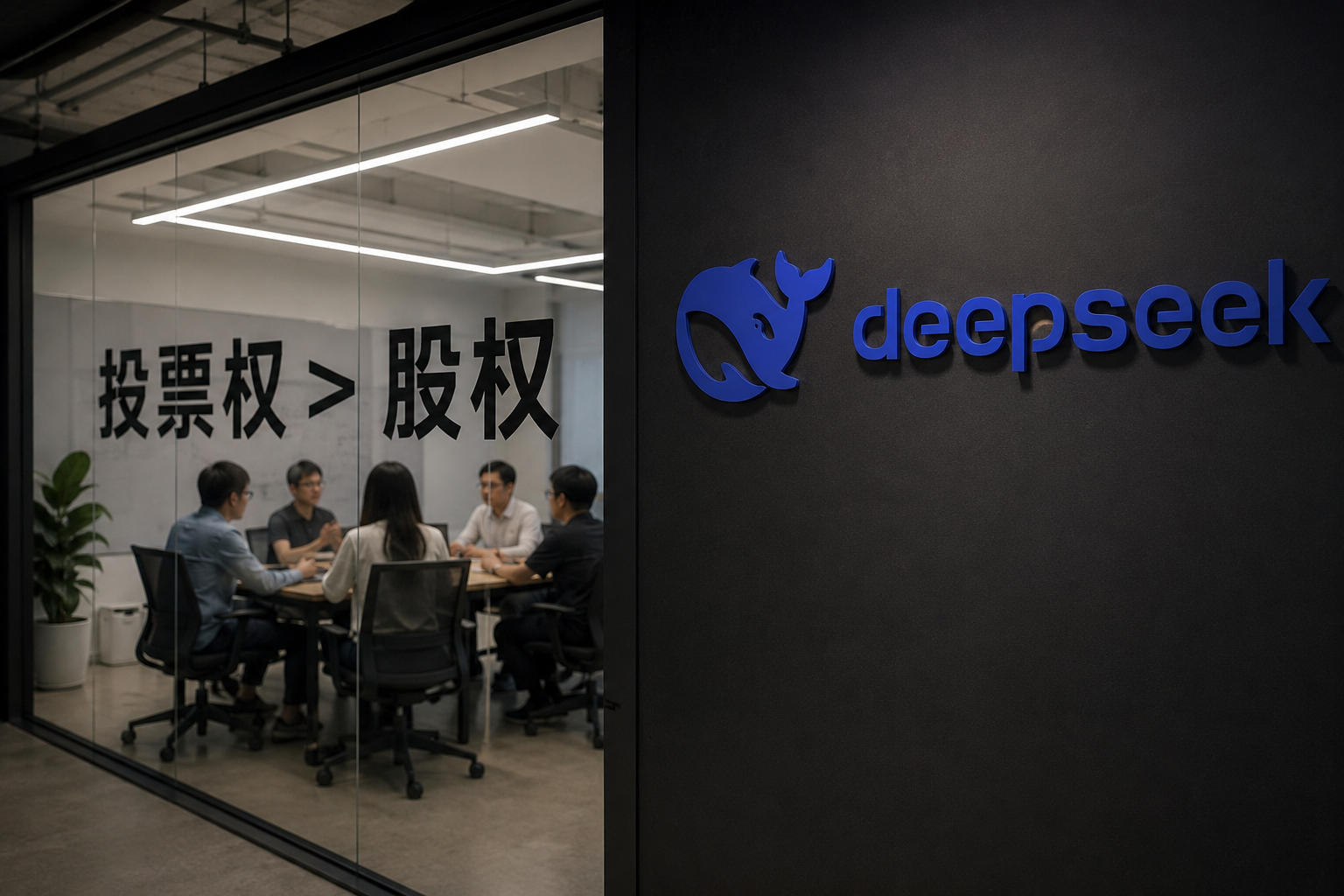
The question of voting rights vs capital in DeepSeek’s unusual funding structure isn’t just a corporate finance curiosity. It’s a window into how the world’s most powerful AI systems get controlled — and by whom. When a Chinese hedge fund billionaire quietly builds one of the most capable open-weight AI models on Earth, the governance details matter enormously.
DeepSeek burst onto the scene in early 2025 with models rivaling OpenAI and Google. However, almost nobody was talking about who actually calls the shots. The answer lies in a dual-class share structure that separates economic ownership from decision-making power — and that distinction carries massive implications for AI safety, geopolitics, and the future of frontier model development.
I’ve been covering AI governance for years, and I’ll be honest: this one caught me off guard.
How DeepSeek’s Dual-Class Share Structure Actually Works
DeepSeek is a subsidiary of High-Flyer Capital Management, a quantitative hedge fund founded by Liang Wenfeng. Importantly, it doesn’t operate like a typical AI lab. No nonprofit board oversees its mission. No public benefit corporation charter exists. Instead, it runs on a dual-class share structure that concentrates voting power in a way I haven’t seen applied to a frontier AI lab quite like this before.
Here’s what that means in practice:
- Class A shares carry enhanced voting rights — held by Liang Wenfeng and a small group of insiders
- Class B shares represent capital investment with limited or no voting power
- Consequently, outside investors can fund DeepSeek’s compute and talent costs without influencing strategic direction
- The founder retains near-total control over research priorities, model releases, and safety decisions
To make this concrete: imagine a sovereign wealth fund or a major Western tech company deciding to invest in DeepSeek’s next training run. Under a traditional equity arrangement, that investment would come with board representation, information rights, and at minimum the ability to ask hard questions about safety protocols. Under DeepSeek’s structure, they’d be writing a large check and then sitting quietly in the corner while Liang Wenfeng decides what to build next. That’s not a hypothetical — it’s the actual deal on offer.
This surprised me when I first dug into it. Dual-class structures aren’t unique to tech — Facebook (now Meta) and Google (Alphabet) both use them. Nevertheless, applying this model to a frontier AI lab raises distinct concerns. Specifically, voting rights vs capital in DeepSeek’s unusual funding setup means the person directing AI development answers to almost nobody.
Furthermore, DeepSeek operates with minimal public transparency about its governance. No published charter. No independent safety board with veto power. The Chinese regulatory environment adds another layer of complexity. China’s AI governance regulations impose content-level restrictions but don’t typically require internal corporate governance reforms for AI labs. So externally, the pressure just isn’t there.
Comparing AI Lab Governance: DeepSeek vs. OpenAI, Anthropic, and Others
To understand why voting rights vs capital in DeepSeek’s unusual funding model matters, you need to see how other AI labs handle governance. The differences are striking — and honestly, none of them are perfect.
OpenAI started as a nonprofit, then created a “capped-profit” subsidiary. The nonprofit board technically retained control until the November 2023 board crisis involving Sam Altman’s brief firing. That episode showed how fragile governance structures become under commercial pressure — I’d argue it was the most important AI governance stress test we’ve seen so far. The five-day saga revealed that even a carefully designed nonprofit structure can buckle when hundreds of millions of dollars in Microsoft investment and hundreds of employees threatening to quit are on one side of the scale. OpenAI has since restructured toward a for-profit model, which has notably weakened the nonprofit board’s authority.
Anthropic took a different path. It created a Long-Term Benefit Trust (LTBT) designed to hold voting power separate from capital investors. Similarly, this separates money from control — but Anthropic’s LTBT specifically prioritizes safety. DeepSeek’s dual-class structure prioritizes founder control. That’s a crucial difference, and it’s one worth sitting with for a moment.
Google DeepMind operates as a division within Alphabet. Consequently, its governance follows Alphabet’s corporate structure, which itself uses dual-class shares favoring Larry Page and Sergey Brin. Meanwhile, Meta AI sits within Meta’s dual-class framework, where Mark Zuckerberg holds roughly 61% of voting power — a number that still surprises people when they hear it.
Here’s a complete governance comparison:
| Company | Structure Type | Who Holds Voting Control | Safety Oversight Body | Open/Closed Models | Funding Source |
|---|---|---|---|---|---|
| DeepSeek | Dual-class shares | Liang Wenfeng (founder) | None publicly known | Open-weight | High-Flyer Capital |
| OpenAI | Capped-profit (transitioning) | Board + CEO | Safety Advisory Board | Closed (API access) | Microsoft, venture capital |
| Anthropic | Public Benefit Corp + LTBT | Long-Term Benefit Trust | Responsible Scaling Policy | Closed (API access) | Google, venture capital |
| Google DeepMind | Corporate division | Alphabet dual-class holders | DeepMind Ethics Board | Mixed | Alphabet revenue |
| Meta AI | Corporate division | Zuckerberg (dual-class) | Internal review teams | Open-weight (Llama) | Meta revenue |
| Mistral AI | Traditional equity | Founders + investors | None publicly known | Open-weight + API | Venture capital |
| Hugging Face | Traditional equity | Founders + investors | Community governance | Open-source platform | Venture capital |
| Sarvam AI | Traditional equity | Founders + investors | None publicly known | Open (India-focused) | Venture capital |
| xAI | Private company | Elon Musk | None publicly known | Open-weight (Grok) | Musk + investors |
| Cohere | Traditional equity | Founders + investors | Responsible AI team | API-based | Venture capital |
Notably, this table reveals a clear pattern. Most AI labs either use traditional equity — where investors get proportional votes — or they build special governance mechanisms to compensate. DeepSeek stands alone in using a hedge-fund-derived dual-class structure with no publicly stated safety mandate. That’s the real kicker here.
One practical implication worth spelling out: when Anthropic’s LTBT holds voting power, there is at least a named body that safety researchers, journalists, and regulators can address. They can ask what the Trust’s criteria are, who its members are, and how it reached a particular decision. When voting power sits entirely with a single founder inside a private subsidiary of a hedge fund, there is no equivalent address. The accountability chain simply ends.
The G7 Governance Debate and Why Funding Structures Matter Now
The timing of this governance discussion isn’t accidental. Throughout 2024 and into 2025, Sam Altman and Dario Amodei have been active participants in G7 and OECD discussions about AI governance frameworks — focused on voluntary commitments, safety testing, and international coordination.
However, these discussions largely assume a Western corporate governance model. One where boards, shareholders, and regulators can exert meaningful pressure on AI labs. Voting rights vs capital in DeepSeek’s unusual funding arrangement challenges that assumption directly — and I don’t think policymakers have fully reckoned with it yet.
Here’s why this matters for global AI governance:
- Voluntary commitments require accountable decision-makers. If one person holds all voting power, voluntary commitments are only as strong as that person’s word.
- International safety agreements need enforcement mechanisms. Dual-class structures can shield founders from investor pressure to comply.
- Capital providers lose leverage. Normally, investors can threaten to pull funding. Because they hold non-voting shares, that threat carries far less weight.
- Regulatory arbitrage becomes easier. A founder with total control can quickly shift operations across jurisdictions.
- Incident response becomes opaque. If a DeepSeek model is implicated in a serious misuse event, there is no board to convene, no independent safety officer to brief, and no investor group to demand answers. The response — or non-response — is entirely at the founder’s discretion.
Additionally, the Amodei-Altman dynamic shows the tension perfectly. Amodei left OpenAI partly because he wanted stronger safety governance — he built Anthropic’s LTBT structure specifically to prevent the kind of board crisis OpenAI experienced. Altman, conversely, has pushed for governance structures that balance safety with rapid commercial scaling. Neither approach is obviously right. But both approaches at least engage with the question.
DeepSeek sidesteps this entire debate. Its governance model doesn’t pretend to balance competing interests — it simply gives the founder control. That’s refreshingly honest. It’s also potentially dangerous. Importantly, those two things can both be true at once.
Open-Weight Models and the Governance Gap
Here’s the thing: one argument genuinely does favor DeepSeek. It releases open-weight models. Specifically, DeepSeek-V3 and DeepSeek-R1 are available for anyone to download, inspect, and modify. This transparency arguably reduces some governance risks — because the model weights are public, the community can audit capabilities and identify problems independently.
But open-weight release doesn’t solve the governance problem. It actually creates new ones.
What open-weight release does well:
- Enables independent safety research and red-teaming
- Reduces monopoly risk by distributing capabilities broadly
- Allows downstream developers to fine-tune for specific use cases
- Creates competitive pressure that ultimately benefits consumers
What open-weight release doesn’t address:
- Who decides when to release a model — and whether safety testing was actually adequate
- Who controls the training data pipeline and the biases baked into it
- Who determines research direction for next-generation models
- Who bears responsibility when open-weight models get misused downstream
To put a face on that last point: within weeks of DeepSeek-R1’s release, security researchers had documented jailbreaks enabling the model to produce detailed instructions for dangerous activities. With a closed model, the developer can push a patch. With an open-weight model, the weights are already on thousands of servers worldwide. The governance question — who decided the model was ready to release, and on what safety evidence — becomes permanently unanswerable after the fact. That’s not an argument against open-weight models in general; it’s an argument for making sure the decision to release is made by someone with real accountability, not just unchecked authority.
Furthermore, companies like Hugging Face and Sarvam AI also champion open models — but their governance structures are fundamentally different. They use traditional equity arrangements where investors hold proportional voting rights, board members can be replaced, and strategic direction requires something resembling consensus. Fair warning: that doesn’t make them perfect either, but it’s a meaningful structural difference.
Voting rights vs capital in DeepSeek’s unusual funding model means that even if the community spots serious safety issues in an open-weight release, no governance mechanism exists to force a response. The founder decides. Period. I’ve covered a lot of tech governance stories, and that sentence still gives me pause.
Meanwhile, Meta’s open-weight approach with Llama models operates under Zuckerberg’s dual-class control. Although the structural similarity to DeepSeek is notable, Meta faces far more public scrutiny, regulatory pressure, and reputational risk as a publicly traded US company. DeepSeek, as a private Chinese subsidiary, faces comparatively little external accountability. So the structural similarity is real — but the practical accountability gap is enormous.
What Policymakers and Investors Should Watch For
Understanding voting rights vs capital in DeepSeek’s unusual funding structure isn’t just an academic exercise. It carries practical implications for anyone involved in AI policy, investment, or development — and I’d argue it should be required reading for anyone writing AI regulation right now.
For policymakers:
- Existing AI governance frameworks — like the EU AI Act — focus on model capabilities and deployment contexts. They don’t adequately address the corporate governance structures of AI developers, and that’s a significant blind spot.
- International agreements need provisions that account for concentrated voting power in frontier AI labs.
- Safety commitments should be legally binding, embedded in corporate charters rather than press releases that can disappear overnight.
- Cross-border enforcement mechanisms must account for dual-class structures that shield founders from outside pressure.
- Regulators should consider requiring any frontier AI lab seeking market access in their jurisdiction to disclose its full voting rights structure as a precondition — not as a burden, but as basic transparency hygiene comparable to what public companies already provide.
For investors:
- Non-voting capital positions in AI labs carry unique risks. You’re funding capability development without influencing safety decisions — that’s a tradeoff worth pricing explicitly. A pension fund or university endowment that invests in a dual-class AI lab and later faces reputational fallout from a misuse incident will find it very difficult to explain why it accepted non-voting terms.
- Due diligence should explicitly cover governance structures, not just technical benchmarks and team credentials.
- Portfolio risk assessments should account for the regulatory exposure of concentrated-control AI companies, particularly as international scrutiny grows.
- Negotiating for observer board seats or information rights — even without voting power — provides at least a minimum level of visibility that pure Class B positions don’t.
For the AI research community:
- Governance structure analysis should become standard practice when assessing AI labs — not an afterthought.
- Open-weight releases from concentrated-control companies deserve extra scrutiny regarding safety testing adequacy.
- Community-driven governance models — like those explored by Partnership on AI — offer alternative frameworks that are genuinely worth developing further.
Importantly, the trend toward founder-controlled AI labs isn’t limited to DeepSeek. Elon Musk’s xAI similarly concentrates decision-making authority, though structured differently. The question isn’t whether founder control is always bad — sometimes decisive leadership genuinely speeds up progress, and I’ve seen that firsthand. The question is whether frontier AI development, with its potential for catastrophic misuse, requires stronger checks and balances than a dual-class share structure provides. Bottom line: I think it does.
Conclusion
The debate over voting rights vs capital in DeepSeek’s unusual funding structure reveals something fundamental about where we are right now. We’re building increasingly powerful AI systems inside corporate structures designed for hedge funds, social media companies, and search engines — none of which were built for the unique risks of frontier AI.
DeepSeek’s dual-class arrangement concentrates control in a single founder. OpenAI’s governance nearly collapsed under commercial pressure. Anthropic’s LTBT remains untested at scale. Google DeepMind operates within a corporate conglomerate built to sell advertising. Moreover, no current model is clearly adequate for the moment we’re actually in.
Therefore, here are actionable next steps:
- Policymakers should require frontier AI labs to disclose governance structures as part of safety reporting requirements — not optional, not voluntary
- Investors should demand voting rights proportional to their capital contributions, or at minimum, safety-related veto powers
- Researchers should build standardized governance assessment frameworks for AI labs the way we have technical evaluation benchmarks
- The public should pay attention to who controls AI development, not just what AI can do
The conversation about voting rights vs capital in DeepSeek’s unusual funding model is ultimately a conversation about power. Who gets to decide how the most transformative technology in human history develops? Right now, the answer is a surprisingly small number of people, operating under governance structures that weren’t designed for this moment. Additionally, the longer we treat that as someone else’s problem, the fewer good options we’ll have left. That needs to change — and it needs to change soon.
FAQ
How does DeepSeek’s governance differ from OpenAI’s?
OpenAI originally operated under a nonprofit board that theoretically prioritized safety over profits. Although that structure has weakened significantly, OpenAI still maintains a board with independent directors and published governance principles. DeepSeek, conversely, operates as a subsidiary of a hedge fund with no publicly known independent safety oversight. The founder holds concentrated voting power through the dual-class structure, while OpenAI’s control is distributed — albeit imperfectly — across board members and Microsoft’s significant investment.
Why does AI governance structure matter for safety?
Governance structure determines who makes critical decisions about model training, safety testing, and release timing. Specifically, when one person holds all voting power, safety decisions rest entirely on their judgment. There’s no institutional check if that person prioritizes speed over caution. Furthermore, governance structures determine how companies respond to external pressure from regulators, researchers, or the public. Concentrated control can mean faster decisions — but also far less accountability. A useful analogy: pharmaceutical companies are required to separate the executive team making commercial decisions from the clinical teams certifying drug safety. No equivalent separation requirement exists for AI labs, and governance structures like DeepSeek’s make that gap more visible.
Are open-weight AI models safer from a governance perspective?
Not necessarily. Open-weight releases provide transparency into model capabilities, which helps independent researchers spot risks. Nevertheless, open-weight release doesn’t address governance questions about who decides what to build, when to release, and how much safety testing is enough. Additionally, once an open-weight model is released, the developer loses control over how it gets used. Governance matters most before release — and that’s exactly where concentrated voting power creates the greatest risk.
How do Chinese AI regulations affect DeepSeek’s governance?
China’s AI regulations, managed through the Cyberspace Administration of China, primarily focus on content moderation, algorithmic transparency, and data protection. They impose requirements on what AI models can output. However, they don’t typically require specific internal corporate governance structures like independent safety boards or distributed voting rights. Therefore, voting rights vs capital in DeepSeek’s unusual funding arrangement faces minimal regulatory pressure from Chinese authorities regarding governance reform.
Keep reading
Here are the latest posts from the blog.

When researchers gave top AI models classic attention tests borrowed from psychology labs, the results were genuinely surprising — and a little unsettling. Models like GPT-4…
OpenAI hit with 42-state investigation days confidential IPO filing — and the timing couldn’t be more dramatic. A coalition of 42 state attorneys general just launched a swee…
When Trump adviser David Sacks revealed the trigger discovery behind new AI safety concerns, the tech world paid very close attention. Sacks disclosed on X that Fable 5 — the…