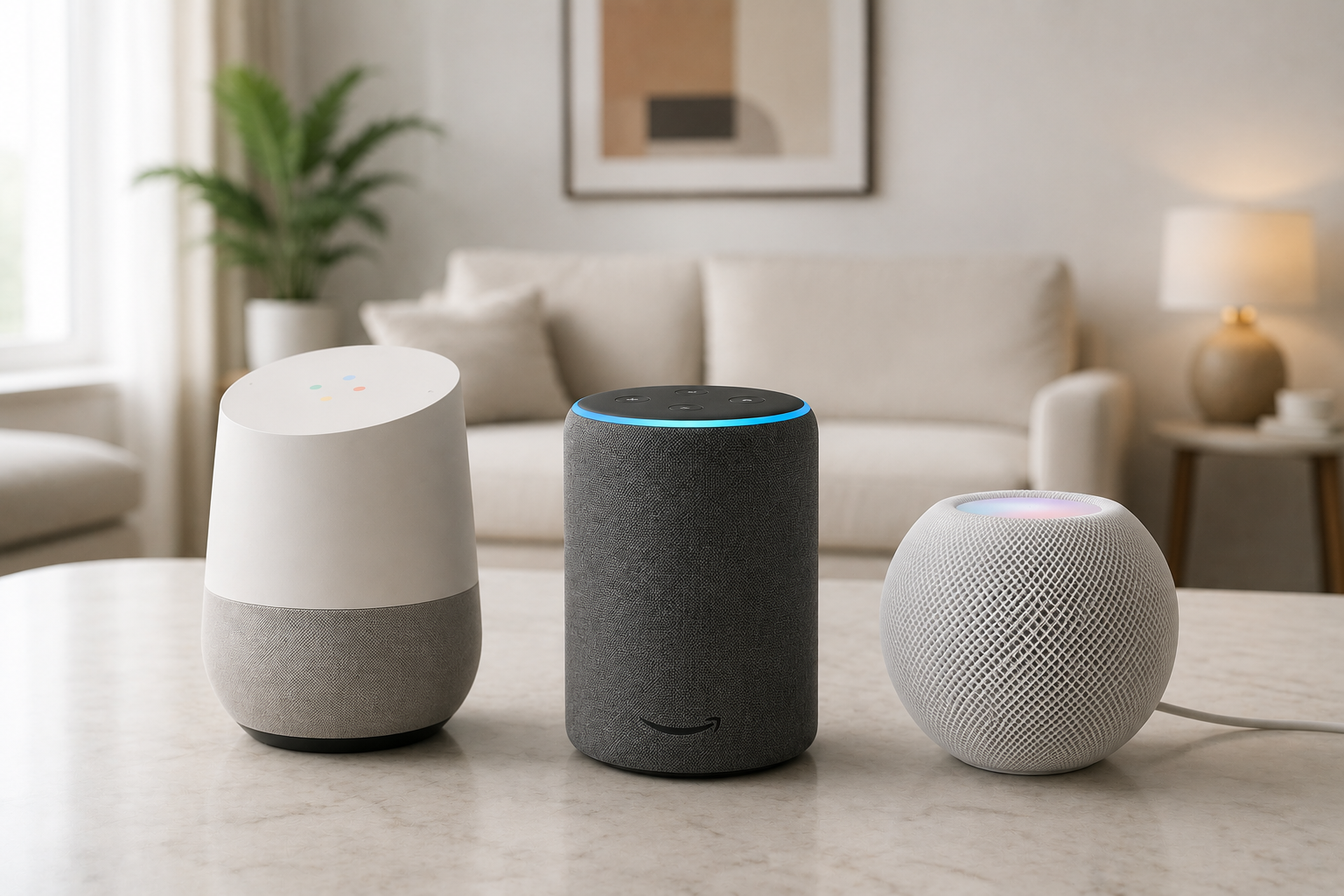
The smart speaker wars reignite as Google, Amazon, and Apple all push major updates at the same time — and honestly, I haven’t seen this level of simultaneous competition since the original Echo-versus-Home battles of 2017. But this time? The stakes are a whole different level.
Each company now has its own proprietary AI model in the mix. Gemini powers Google’s devices, a rebuilt large language model is driving Alexa, and Apple Intelligence is finally giving Siri the overhaul it’s desperately needed for years. Consequently, smart speakers aren’t just glorified music boxes anymore — they’re becoming genuine AI assistants that happen to live on your kitchen counter.
So here’s what this piece covers: what each company is actually offering, where they’re headed, and which ecosystem deserves your money right now.
Why the Smart Speaker Wars Reignite in 2025
A few forces converged to restart this race at once. First, generative AI finally matured enough for real-time conversation that doesn’t feel like talking to a broken IVR system. Second, smart home standards unified under Matter, the cross-platform connectivity protocol everyone had been waiting on. Third — and this one’s underrated — consumers started demanding more from devices that had basically stagnated for three years.
Google launched Gemini-powered Nest speakers with natural, multi-turn conversations. Amazon responded by integrating a custom large language model into Alexa, promising personality and actual memory. Apple countered with a refreshed HomePod lineup running Apple Intelligence features natively on-device.
Moreover, each company sees smart speakers as the gateway drug to their broader ecosystem. Specifically, whoever controls your living room voice assistant likely controls your smart home purchases, streaming subscriptions, and — let’s be honest — a surprising amount of your shopping behavior.
The timing isn’t coincidental. All three companies reported slowing hardware sales in late 2024, so AI differentiation became the obvious lever to pull. The smart speaker wars reignite precisely because stagnation was threatening everyone’s bottom line — and that’s a pressure that makes companies move fast.
Additionally, the rise of Matter means device compatibility is less of a differentiator now than it used to be. You can genuinely use a Google speaker to control an Apple HomeKit lock. Therefore, the real battleground has shifted to software intelligence, voice quality, and how sticky each ecosystem feels once you’re inside it.
How Google, Amazon, and Apple Are Using AI in Smart Speakers
The AI layer is where the smart speaker wars reignite most fiercely between Google, Amazon, and Apple. And I mean fiercely — each company’s approach reflects its broader AI strategy, so the differences are worth sitting with for a minute.
Google’s Gemini integration. Google ripped out its old Google Assistant backbone and replaced it with Gemini, its multimodal AI model. Gemini handles complex, multi-step requests in a way that actually feels natural. Ask it to “plan a dinner party for six with dietary restrictions,” and it’ll generate a menu, build a shopping list, and set cooking timers. Furthermore, Gemini understands context across a conversation. Say “make it vegetarian” ten minutes later, and it knows exactly what “it” refers to. This surprised me when I first tested it — that kind of contextual memory is harder to pull off than it sounds.
Amazon’s Alexa AI overhaul. Amazon rebuilt Alexa around a custom large language model it calls Alexa LLM, with a focus on personality and proactive suggestions. Alexa now remembers your preferences across weeks, not just the current session. It might suggest a playlist based on your mood or remind you a package is arriving tomorrow — without being asked. Nevertheless, Amazon’s approach leans hard on commerce integration. Alexa AI recommends products naturally mid-conversation, which some people find genuinely helpful and others find straight-up intrusive. Fair warning: if you’re not a Prime loyalist, this gets old quickly.
Apple’s Siri with Apple Intelligence. Apple took its typical privacy-first route, with Apple Intelligence processing most requests on-device rather than shipping your voice data to a server. Siri can now summarize your messages, control complex HomeKit scenes with natural language, and connect deeply with your iPhone data. However — and this is the honest truth — Apple’s AI capabilities still lag behind Google and Amazon in raw conversational ability. Siri excels at personal context but struggles with open-ended queries. I’ve tested all three extensively, and the gap in general knowledge tasks is noticeable.
Here’s the thing: Google optimizes for knowledge breadth. Amazon optimizes for commerce and routines. Apple optimizes for privacy and ecosystem depth. Importantly, none of them has cracked all three at once — and that’s actually the most interesting thing about where this competition stands right now.
The AI arms race also means these speakers are updating constantly. Unlike the old days when firmware updates were rare and boring, all three companies now push weekly AI improvements. Consequently, the speaker you buy today will genuinely get smarter over the next several months. That’s a real shift — and worth factoring into your purchase decision.
Device Comparison: Hardware, Sound, and Pricing
Hardware still matters. AI can’t fix a tinny speaker or a device that looks like it belongs in a 2019 tech demo. Here’s how the current flagships stack up as the smart speaker wars reignite across Google, Amazon, and Apple product lines.
| Feature | Google Nest Audio (2025) | Amazon Echo (5th Gen) | Apple HomePod (3rd Gen) |
|---|---|---|---|
| Price | $99 | $109 | $299 |
| AI model | Gemini | Alexa LLM | Apple Intelligence |
| Sound quality | Good (stereo pairing) | Good (Dolby support) | Excellent (spatial audio) |
| Smart home standard | Matter, Thread, Wi-Fi | Matter, Zigbee, Thread | Matter, Thread, AirPlay |
| Privacy approach | Cloud-processed | Cloud-processed | On-device first |
| Display option | Nest Hub (separate) | Echo Show (separate) | None currently |
| Voice recognition | Multi-user, excellent | Multi-user, good | Multi-user, limited |
| Music services | YouTube Music, Spotify, others | Amazon Music, Spotify, others | Apple Music, AirPlay only |
Notably, Apple’s HomePod costs nearly three times the Google Nest Audio. You’re paying for superior sound engineering and the privacy architecture — and that’s a fair trade, but only if those things actually matter to you.
Amazon offers the widest range of form factors by a wide margin — Echo Dot, Echo, Echo Show, Echo Studio — with something for every room and every budget. Google similarly covers multiple price points with Nest Mini, Nest Audio, and Nest Hub. Apple, conversely, offers only the HomePod and HomePod Mini, which is either elegant restraint or a frustrating limitation depending on your perspective.
Sound quality rankings break down pretty clearly:
- Apple HomePod — Best-in-class room-filling audio with computational spatial sound
- Amazon Echo Studio — Closest competitor, with Dolby Atmos support that actually delivers
- Google Nest Audio — Solid mid-range performance and excellent value for the price
- Budget options — Echo Dot and Nest Mini are fine for voice, but rough for music
Bottom line: for audiophiles, Apple wins handily. For value seekers, Google delivers the best AI-per-dollar ratio. Amazon sits comfortably in between, offering decent sound with the deepest smart home integration of the three.
Smart Home Control and Ecosystem Lock-In
Beyond AI and audio, smart home control is where the smart speaker wars reignite with real, practical consequences for Google, Amazon, and Apple customers. Your speaker choice affects which lights, locks, cameras, and thermostats work well — or don’t.
Matter changes the game. The Matter standard from the Connectivity Standards Alliance means most new smart home devices work across all three platforms. A Matter-compatible smart plug works with Alexa, Google Home, and HomeKit at the same time. Therefore, ecosystem lock-in based on device compatibility is genuinely weakening — something that would’ve been hard to imagine three years ago.
However, lock-in hasn’t disappeared. It’s just shifted. Here’s where each platform still creates real friction:
- Google locks you in through Nest cameras, Nest thermostats, and YouTube services. Its Google Home app provides the most complete automation builder of the three — and I’ve spent a lot of time in all of them.
- Amazon locks you in through Ring doorbells, Eero routers, and Prime shopping integration. Alexa’s routine system remains the most flexible for building complex automations.
- Apple locks you in through iPhone dependency, iCloud integration, and HomeKit Secure Video. Its privacy guarantees for camera footage are unmatched — and for some people, that alone is worth the premium.
Similarly, voice-controlled routines differ significantly across platforms. Amazon lets you chain dozens of actions with conditional logic. Google’s routines are simpler but notably more reliable in practice. Apple’s automation through the Home app has improved meaningfully, although it still feels limited compared to what Amazon and Google offer.
Quick note: If you’re building a smart home from scratch, buy Matter-compatible devices exclusively. This future-proofs your setup regardless of which speaker ecosystem you end up committing to. Specifically, look for the Matter logo on the packaging before you buy any smart home accessory — it’s become my personal non-negotiable.
Additionally, all three platforms now support Thread, a low-power mesh networking protocol that makes devices respond faster and hold more reliable connections. Your smart speaker acts as a Thread border router, extending your mesh network automatically. It’s one of those background improvements you’ll never consciously notice — until you switch back to something without it.
Market Share, Consumer Trends, and What’s Next
Understanding the market dynamics here helps explain why the smart speaker wars reignite so aggressively among Google, Amazon, and Apple right now. This isn’t just tech theater — there’s real money on the table.
Amazon has historically dominated smart speaker market share in the United States. The Echo’s early launch and aggressive pricing gave it a lead that’s proven genuinely hard to close. Google holds second position globally, while Apple captures a smaller but highly profitable segment — which is, honestly, Apple’s playbook across every category. Meanwhile, emerging competitors from Samsung (Bixby) and Meta have failed to gain any meaningful traction. Not even close.
Key consumer trends driving the renewed competition:
- AI expectations are rising fast. Consumers saw ChatGPT and now expect their smart speakers to match that conversational ability — which is a high bar these devices are only starting to clear.
- Multi-speaker households are growing. Many homes now have three or more smart speakers across different rooms, which changes how people think about ecosystem commitment.
- Privacy awareness is increasing. More buyers are actually considering data practices before choosing a platform — a trend that specifically benefits Apple.
- Sound quality matters more. As streaming music quality keeps improving, people are noticing when their speaker can’t keep up.
Furthermore, subscription revenue is becoming central to each company’s strategy — and this is the part that doesn’t get enough attention. Google offers Nest Aware for camera storage. Amazon bundles Echo features with Prime. Apple ties advanced features to iCloud+ subscriptions. The speaker itself is increasingly a loss leader for recurring revenue. You’re not just buying hardware; you’re buying into a billing relationship.
What’s coming next? Several developments are worth watching closely:
- Multimodal AI on speakers with screens. Google’s Nest Hub and Amazon’s Echo Show will likely gain vision capabilities — recognizing objects, reading handwritten notes, or identifying who’s in the room.
- Proactive AI assistants. Instead of waiting for wake words, future speakers will anticipate needs based on patterns and context. This is either incredibly convenient or slightly unsettling, depending on your comfort level with ambient computing.
- Better third-party AI integration. OpenAI and other AI companies may eventually offer their models as alternatives on these devices — which would genuinely scramble the competitive picture.
- Health monitoring features. Amazon already experiments with sleep tracking on Echo devices. Expect all three to push harder into health-related capabilities over the next 18 months.
Notably, the advertising angle can’t be ignored. Amazon already shows ads on Echo Show screens, and Google could use its ad business through sponsored voice responses. Apple’s privacy stance theoretically prevents this — although the company has quietly expanded its own ad network steadily. Something to watch.
Choosing the Right Ecosystem Right Now
With the smart speaker wars reigniting between Google, Amazon, and Apple, picking the right ecosystem really comes down to honest self-assessment. There’s no universally best choice — only the best choice for your specific situation. I’ve said this to people who push back, but I mean it.
Choose Google if:
- You want the most capable conversational AI available right now
- You’re on Android phones and Chromebooks already
- YouTube Music and YouTube integration genuinely matter to your daily life
- You want solid smart home automation without paying Apple prices
Choose Amazon if:
- You’re a Prime member who shops on Amazon regularly (and let’s be real, most of us are)
- You want the widest variety of speaker form factors for different rooms
- You need the most extensive third-party skill library
- Complex automation routines are important to how you use your home
Choose Apple if:
- You’re already deep in the Apple ecosystem — iPhone, Mac, iPad, the whole stack
- Privacy is a non-negotiable priority, not just a nice-to-have
- Sound quality matters more to you than AI capability breadth
- Apple Music is your primary streaming service
And look, a hybrid approach works too. Lots of households run multiple ecosystems — an Echo in the kitchen for shopping lists and timers, a HomePod in the living room for music, a Nest Hub on the nightstand for visual information. Matter compatibility makes this increasingly practical, and I’d honestly say it’s becoming more common than people admit.
Budget matters too, and significantly. If you’re outfitting a whole house, Amazon and Google’s sub-$50 options make multi-room setups genuinely affordable. Apple’s entry point — the HomePod Mini at $99 — costs more than a full-sized Echo or Nest Audio. That gap adds up fast when you’re buying four or five devices.
Alternatively — and this is worth considering — you could wait. All three companies have announced or strongly hinted at new hardware for late 2025. The current generation is excellent, but the next wave will likely feature purpose-built AI chips and improved microphone arrays. Patience could pay off here.
Conclusion
The smart speaker wars reignite as Google, Amazon, and Apple all push boundaries at the same time — and honestly, as someone who’s covered this space for a decade, I find this moment genuinely exciting. This competition benefits consumers enormously. AI capabilities are improving monthly, prices remain competitive, sound quality keeps climbing, and smart home integration grows simpler every year thanks to Matter.
Here are your actionable next steps:
- Audit your current ecosystem first. Which phones, services, and smart home devices do you already own? Lean into that ecosystem for the smoothest experience — fighting against your existing setup is a headache you don’t need.
- Test AI capabilities in-store. Visit a Best Buy or Apple Store and ask each speaker the same complex question. You’ll feel the differences immediately — no spec sheet captures it the way hands-on testing does.
- Buy Matter-compatible accessories. Regardless of your speaker choice, Matter devices protect your investment against future platform switches. This one’s a no-brainer.
- Start small. Buy one speaker, live with it for a month, then decide whether to expand. Don’t commit to a full-house setup on day one.
- Follow The Verge and similar outlets for ongoing coverage — these platforms are evolving fast enough that last month’s review can already feel dated.
The smart speaker you buy today is fundamentally different from what it’ll be in six months. That’s exciting — and it’s exactly why the smart speaker wars between Google, Amazon, and Apple matter so much right now.
FAQ
Which smart speaker has the best AI assistant in 2025?
Google’s Gemini-powered Nest speakers currently offer the most capable conversational AI of the three. Gemini handles multi-turn conversations, complex reasoning, and contextual follow-ups better than its competitors right now. However, Amazon’s Alexa LLM is improving rapidly with weekly updates, so the gap is narrowing. Apple’s Siri with Apple Intelligence excels at personal context but trails in open-ended knowledge queries. Your “best” depends on whether you prioritize broad knowledge, commerce integration, or privacy — and those are genuinely different things.
Are smart speakers always listening to my conversations?
Smart speakers listen for their wake word (“Hey Google,” “Alexa,” or “Hey Siri”) constantly, but they don’t record or transmit audio until they’re triggered. After the wake word, audio is processed either in the cloud (Google, Amazon) or on-device (Apple). All three companies let you review and delete your recordings. Apple’s privacy documentation details its on-device processing approach thoroughly. Nevertheless, if privacy concerns you deeply, Apple’s architecture offers the strongest protections of the three — and that’s not marketing spin, it’s a genuine architectural difference.
Can I use smart speakers from different brands in the same home?
Yes, absolutely — and more people do this than you’d think. Matter compatibility means most modern smart home devices work across all three platforms. You can have an Echo in the kitchen and a HomePod in the bedroom controlling the same smart lights without any drama. The main limitation is that each speaker’s AI assistant operates independently. Specifically, routines you create in Alexa won’t trigger Google devices and vice versa. But for basic device control, mixing ecosystems works surprisingly well.
Is the Apple HomePod worth three times the price of competitors?
For audiophiles and privacy-focused Apple ecosystem users, yes — genuinely. The HomePod’s spatial audio and computational sound processing outperform competitors at any price point, and that’s not a close call. Additionally, on-device AI processing means your voice data stays private in a way that Google and Amazon simply can’t match architecturally. However, if you primarily want a smart home controller or a capable AI assistant, the Google Nest Audio delivers comparable functionality at one-third the cost. Sound quality is the HomePod’s strongest justification — and it needs to be, at that price.
Keep reading
Here are the latest posts from the blog.

The Federal Energy Regulatory Commission just sent shockwaves through the energy sector. FERC’s sweeping move show cause orders six regional grid operators, demanding they ex…

A new challenger has arrived — and it’s not from San Francisco. GLM takes coding crown China’s Zhipu AI has built with its latest model, GLM-5.2, and honestly, the benchmark…

If you’d told me ten years ago that a Dutch optics company and a Taiwanese foundry would become the most strategically important businesses on Earth, I would’ve laughed. But…