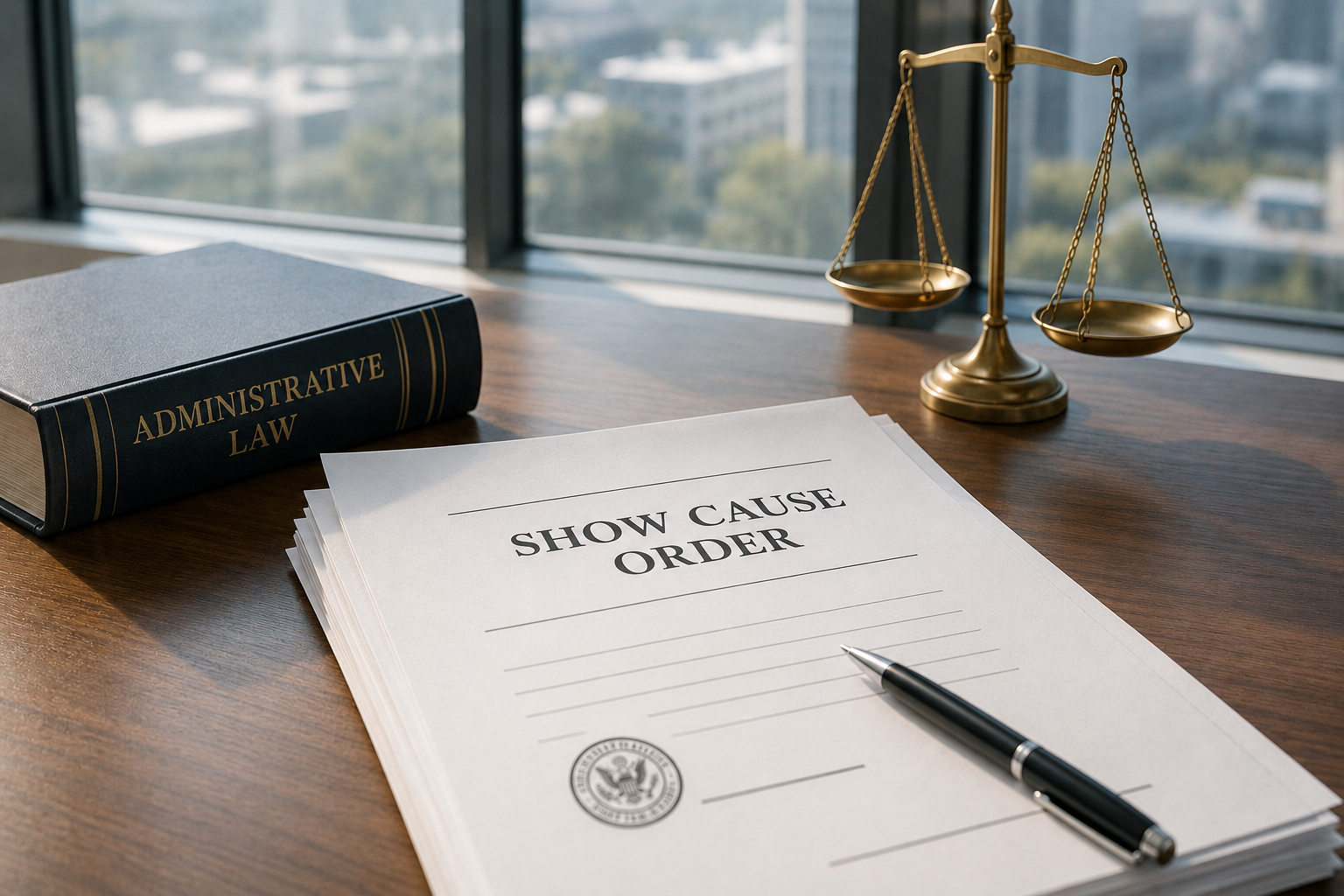
A ‘show cause’ order might be the most underestimated weapon in a regulator’s toolkit right now. I’ve spent a decade watching tech policy evolve, and honestly, this mechanism still surprises people who should know better. These orders flip the entire script on traditional enforcement — instead of an agency grinding through years of case-building, the target has to prove why it shouldn’t face penalties. Consequently, what normally takes three to five years can collapse into weeks.
For technology executives, compliance officers, and founders, this isn’t abstract legal theory. The Federal Trade Commission (FTC), Securities and Exchange Commission (SEC), and Bureau of Industry and Security (BIS) are increasingly deploying it against AI companies, chipmakers, and data-heavy platforms. Moreover, the pace is accelerating — fast.
How a ‘Show Cause’ Order Actually Works
At its core, a show cause order is a legal demand. A court or agency issues it, requiring a company to explain why a specific action shouldn’t be taken against it. The burden of proof shifts immediately — and that’s the whole ballgame.
Traditional enforcement follows this sluggish path:
- Agency identifies a potential violation
- Investigators spend months or years gathering evidence
- Lawyers draft complaints and negotiate internally
- The agency files a formal action
- Years of litigation follow before any resolution
A show cause order compresses that timeline dramatically:
- Agency identifies an urgent concern or clear violation
- A judge or commissioner issues the order
- The company has days or weeks — not years — to respond
- Failure to respond adequately triggers immediate consequences
Specifically, the order assumes the agency’s position is correct unless the company proves otherwise. Therefore, companies can’t simply stall with procedural motions. The clock starts the moment the order lands on your desk.
Here’s the thing: traditional regulatory timelines gave companies room to operate in gray areas. A startup could launch an AI model, hoover up massive datasets, or export restricted chips while regulators slowly built their case. Show cause orders eliminate that cushion entirely. Notably, the FTC’s enforcement actions page shows a clear and growing reliance on these accelerated mechanisms.
Furthermore, courts grant these orders when they see potential irreparable harm. An AI model trained on stolen data can’t be “untrained.” Exported chips can’t be recalled from adversary nations. Those realities make show cause orders particularly well-suited to technology enforcement — and that’s not an accident.
To make the mechanics concrete: imagine a mid-sized AI startup that quietly scraped copyrighted medical records to train a diagnostic model, then marketed it to hospital systems. Under traditional enforcement, the FTC might spend two years subpoenaing records, consulting technical experts, and drafting a formal complaint — during which the startup signs dozens of hospital contracts and embeds itself deeply into clinical workflows. A show cause order changes that calculus entirely. The agency presents its initial evidence of the scraping, issues the order, and the startup has three weeks to prove its data sourcing was lawful. If it can’t, the agency can move immediately to restrict the product’s distribution. The hospitals haven’t yet built two years of dependency on a tool that may need to be pulled.
Why Regulators Are Turning to Show Cause Orders Against Tech Companies
The traditional regulatory playbook wasn’t built for technology’s speed. A three-year investigation into a social media company’s data practices feels almost comically slow when the platform adds 100 million users during that period. Similarly, investigating chip export violations over multiple years means thousands of restricted processors reach foreign military programs before any penalty arrives.
I’ve followed enforcement trends across multiple agency cycles, and the shift here is real — this isn’t just regulatory posturing.
Several forces are driving this change:
- AI development speed. Models go from training to deployment in months. Regulators can’t afford multi-year timelines when a potentially dangerous system is already public and scaling.
- Data breach urgency. When a breach exposes millions of records, waiting years for traditional enforcement means affected consumers get essentially no relief.
- Export control violations. The Bureau of Industry and Security faces enormous pressure to stop restricted technology transfers quickly — not eventually.
- Political pressure. Lawmakers on both sides demand faster accountability from the agencies they fund.
- Precedent from financial regulation. The SEC has used show cause mechanisms for decades, and other agencies are finally adopting the playbook.
Additionally, the sheer complexity of technology cases paradoxically favors show cause orders. In traditional litigation, tech companies can bury regulators in technical arguments for years. A show cause order, however, forces the company to organize its defense immediately. Consequently, the information gap that usually benefits well-funded tech firms shrinks considerably — and that’s exactly the point.
There’s a practical asymmetry worth naming here. A large tech company with a hundred-person legal department can sustain years of discovery disputes and procedural motions almost indefinitely. A regulatory agency working the same case with a fraction of those resources often finds itself outgunned on process alone, even when its underlying legal position is strong. Show cause orders largely neutralize that advantage by collapsing the timeline to a window where raw headcount matters less than the quality of the substantive response.
Meanwhile, international regulatory speed creates real domestic pressure. The European Union’s AI Act moves faster than most U.S. enforcement. When foreign regulators act swiftly, American agencies face legitimate criticism for sluggishness. Show cause orders help close that gap. The European Commission’s digital strategy shows just how quickly peer regulators now move — and U.S. agencies are watching.
Real Case Studies: ‘Show Cause’ Orders in Tech Enforcement
Understanding how a regulator can bypass years of process requires looking at actual examples. Although agencies don’t always publicize their use of show cause mechanisms, several recent cases illustrate the pattern clearly.
AI model enforcement. In 2023 and 2024, the FTC ramped up scrutiny of AI companies making deceptive claims about their models’ capabilities. Rather than launching traditional investigations — which can drag on for years — the agency used compulsory process orders (close cousins of show cause orders) to demand companies justify their marketing claims within weeks. Companies that couldn’t show their AI actually performed as advertised faced immediate consent orders. This surprised me when I first started tracking these cases; the speed was genuinely jarring compared to historical FTC timelines. One pattern that emerged repeatedly: companies that had been claiming specific accuracy rates for their models — say, 95% diagnostic accuracy in clinical settings — couldn’t produce the underlying validation studies when pressed on a short deadline. The absence of documentation was itself damning.
Data breach responses. After major breaches at healthcare and fintech companies, regulators issued orders requiring companies to show cause why they shouldn’t face emergency data protection requirements. The Department of Health and Human Services’ breach portal tracks incidents that increasingly trigger accelerated enforcement. Importantly, these orders bypassed the usual notice-and-comment rulemaking that can take years under normal circumstances.
Chip export violations. The BIS has used temporary denial orders — functionally similar to show cause mechanisms — against companies suspected of routing restricted semiconductors to sanctioned entities. These orders can freeze a company’s export privileges within days. The company must then prove compliance to restore operations. The real kicker? Your entire business can stall while you scramble to respond. A distributor that moves $40 million in chips annually can find its export license suspended on a Tuesday and face an existential cash-flow crisis by Friday — all before any formal finding of wrongdoing.
| Enforcement Type | Traditional Timeline | Show Cause Timeline | Key Difference |
|---|---|---|---|
| AI deceptive practices | 2–4 years | 2–8 weeks | Burden shifts to company |
| Data breach penalties | 1–3 years | Days to weeks | Emergency authority invoked |
| Chip export violations | 1–2 years | Days | Immediate privilege suspension |
| Securities fraud (AI claims) | 3–5 years | 4–12 weeks | Expedited hearing required |
| Antitrust (tech mergers) | 12–18 months | Weeks for preliminary relief | Injunctive power used |
Nevertheless, not every case suits a show cause approach. Agencies typically reserve these orders for situations involving clear evidence, urgent public harm, or flight risk. A speculative concern about an AI model’s future behavior probably won’t trigger one. A documented case of an AI company lying about safety testing? That’s a different story entirely.
How Tech Companies Should Prepare for Accelerated Enforcement
If you’re building or running a technology company, the growing use of ‘show cause’ orders — and how a regulator can bypass years of traditional process — should genuinely reshape your compliance strategy. Fair warning: most companies aren’t remotely ready for this.
Build a rapid-response legal framework. You can’t assemble a defense team in 48 hours without planning ahead. Identify outside counsel experienced with administrative enforcement before you need them. Specifically, look for lawyers who’ve actually handled FTC or SEC show cause proceedings — not just general regulatory attorneys. The distinction matters more than most founders realize; an attorney who has navigated the FTC’s administrative process knows which procedural arguments actually buy time and which ones simply annoy the commissioners reviewing your file.
Document everything proactively. Show cause orders demand that you prove compliance, and you can’t do that without records. Therefore, maintain detailed logs of:
- AI model training data sources and licensing agreements
- Safety testing results and methodologies
- Export compliance checks for every hardware shipment
- Data protection measures and breach response plans
- Marketing claim substantiation files (this one gets people caught)
A practical tip on documentation: don’t just maintain the records — make sure someone outside your legal team can locate and explain them quickly. In a 72-hour response window, a compliance file that only your departing general counsel understood is functionally useless.
Run internal audits every quarter. Don’t wait for a regulator to ask the hard questions — find problems yourself first. The National Institute of Standards and Technology (NIST) AI Risk Management Framework provides a solid baseline for AI-specific audits, and I’d genuinely recommend starting there. One underrated benefit of quarterly audits: they create a paper trail showing ongoing good-faith compliance efforts, which carries real weight when you’re negotiating the terms of a consent order.
Monitor regulatory signals. Agencies often telegraph their priorities through speeches, guidance documents, and enforcement trends. The SEC’s Division of Examinations publishes annual priorities. Similarly, FTC commissioners regularly signal upcoming focus areas in public remarks. Read those signals — they’re not subtle.
Establish a “war room” protocol. When a show cause order arrives, you need a pre-planned response:
- Immediately notify general counsel and outside regulatory counsel
- Preserve all potentially relevant documents — destroying records after receiving an order is catastrophic
- Assemble a cross-functional team (legal, engineering, compliance, communications)
- Begin drafting a response timeline within 24 hours
- Assess honestly whether negotiation or full defense is the smarter strategy
Importantly, the worst response to a show cause order is silence. Companies that ignore deadlines or provide thin responses face default judgments — and those judgments can include massive fines, product bans, and forced divestitures. I’ve seen legal teams underestimate this and pay dearly for it.
Conversely, companies that respond thoroughly and quickly sometimes negotiate genuinely favorable outcomes. Regulators often prefer a cooperative resolution over prolonged proceedings. Showing good faith in your response can dramatically affect what you’re ultimately facing. The tradeoff worth understanding: a thorough, cooperative response may surface additional issues the agency hadn’t yet identified. That’s a real risk. But in most cases, the alternative — appearing evasive or disorganized — produces worse outcomes than the incremental exposure from transparency.
The Constitutional and Legal Limits of Show Cause Orders
Show cause orders aren’t unlimited power. Although they let a regulator bypass years of traditional enforcement, significant legal guardrails exist. Understanding these limits matters as much as understanding the mechanism itself.
Due process requirements. The Fifth and Fourteenth Amendments guarantee due process. A show cause order must provide adequate notice and a real chance to respond. Courts have overturned orders that gave impossibly short response windows or failed to spell out the alleged violations clearly — so this protection is real, not theoretical.
Jurisdictional boundaries. An agency can only issue show cause orders within its statutory authority. The FTC can’t issue one related to securities fraud, and the SEC can’t issue one about consumer data practices. Alternatively, agencies sometimes coordinate, with each issuing orders within their own domains at the same time — which is genuinely concerning from a compliance standpoint.
Judicial review. Companies can challenge show cause orders in court. Federal judges evaluate whether the agency had enough basis for the order and whether the process was fair. The Administrative Procedure Act sets baseline requirements for agency actions, and it’s not toothless.
Proportionality. Courts increasingly scrutinize whether the relief sought actually matches the alleged harm. An order shutting down an entire AI platform over a minor labeling issue would likely face serious judicial pushback. However, an order halting a specific product that poses immediate safety risks stands on much stronger ground. This proportionality requirement creates a meaningful strategic option for companies: if the agency’s order is broader than the alleged harm reasonably justifies, a targeted court challenge on scope — rather than a full defense on the merits — can sometimes produce a faster and cheaper resolution.
Recent legal challenges worth watching:
- Tech companies arguing that AI regulation exceeds agency authority under the “major questions doctrine”
- Constitutional challenges to expedited timelines as violating due process
- First Amendment arguments about orders restricting AI-generated speech
- Challenges based on the Supreme Court’s 2024 Loper Bright decision limiting agency deference
The Loper Bright development deserves particular attention. By curtailing the judicial deference previously owed to agency interpretations of ambiguous statutes, the decision gives courts more room to second-guess whether an agency actually had the authority to issue a given show cause order in the first place. That’s a meaningful check — though its practical effect on expedited enforcement is still being litigated across multiple circuits.
These legal battles will meaningfully shape how aggressively agencies can use show cause mechanisms going forward. Nevertheless, the current trend clearly favors expanded use — notably in technology sectors where harm can scale faster than any traditional enforcement timeline can handle.
Conclusion
The ‘show cause’ order represents a fundamental shift in how regulators approach technology enforcement. Understanding how a regulator can bypass years of red tape in weeks isn’t optional for tech companies anymore — it’s essential survival knowledge, full stop.
Here’s what you should do right now:
- Audit your compliance posture against FTC, SEC, and BIS requirements relevant to your products
- Retain experienced regulatory counsel before you face a show cause order, not after
- Build documentation habits that let you prove compliance on short notice
- Monitor agency enforcement trends through official publications and industry legal alerts
- Create a rapid-response plan your team can execute within 24 hours of receiving any regulatory order
The era of multi-year regulatory timelines providing a comfortable buffer is ending. Show cause orders give agencies the speed to match technology’s pace — and they’re using it. Companies that prepare will handle these orders successfully. Those that don’t will learn about ‘show cause’ orders — and how a regulator can bypass years of process — the hard way. That’s not a lesson worth paying for.
FAQ
What exactly is a ‘show cause’ order in plain English?
A show cause order is a legal demand from a court or agency requiring a company to explain why it shouldn’t face a specific penalty or restriction. Think of it as “guilty until proven innocent” in regulatory terms — which is uncomfortable but accurate. Rather than waiting for the agency to build a full case, the company must justify its own actions immediately. Consequently, the entire enforcement timeline compresses from years to weeks.
How can a regulator bypass years of traditional enforcement using show cause orders?
Traditional enforcement requires agencies to investigate, build cases, file complaints, and litigate — often spanning three to five years. A ‘show cause’ order flips this process entirely. The agency presents its initial evidence, and the company must respond right away. Therefore, the regulator can bypass years of back-and-forth by shifting the burden of proof. Courts allow this specifically when there’s evidence of urgent harm or clear violations — it’s not a tool agencies can deploy casually.
Which federal agencies use show cause orders against tech companies?
Several agencies use these mechanisms. The FTC uses them for consumer protection and data privacy enforcement. The SEC uses them for securities violations, including misleading AI investment claims. The BIS uses temporary denial orders for export control violations. Additionally, the Federal Communications Commission and Department of Justice have similar accelerated tools available. Each agency operates strictly within its specific statutory authority — they can’t just issue these orders for anything they want.
Can a tech company fight a show cause order?
Absolutely — and sometimes successfully. Companies have several defense options: filing motions challenging the order’s legal basis, presenting evidence showing compliance, or arguing the timeline is unconstitutionally short. Moreover, they can negotiate with the agency for modified terms, which often produces better outcomes than full adversarial proceedings. However, ignoring the order is never a viable strategy. Courts treat non-response as an admission, which typically leads to default judgment and maximum penalties.
How much time does a company typically get to respond to a show cause order?
Response windows vary significantly depending on the agency and circumstances. Emergency orders related to data breaches might give only 48 to 72 hours — yes, really. Standard show cause orders from the FTC or SEC typically allow 14 to 30 days. Export control denial orders from BIS can take effect immediately, with the company petitioning for reversal afterward. Notably, courts can extend deadlines if the company shows good cause for needing more time, so that option is worth exploring early. The practical implication: if your legal team is scrambling to understand the order’s scope on day one, you’ve already lost meaningful response time. That’s precisely why pre-planning matters.
Keep reading
Here are the latest posts from the blog.

The smart speaker wars reignite as Google, Amazon, and Apple all push major updates at the same time — and honestly, I haven’t seen this level of simultaneous competition sin…
The Federal Energy Regulatory Commission just sent shockwaves through the energy sector. FERC’s sweeping move show cause orders six regional grid operators, demanding they ex…
A new challenger has arrived — and it’s not from San Francisco. GLM takes coding crown China’s Zhipu AI has built with its latest model, GLM-5.2, and honestly, the benchmark…