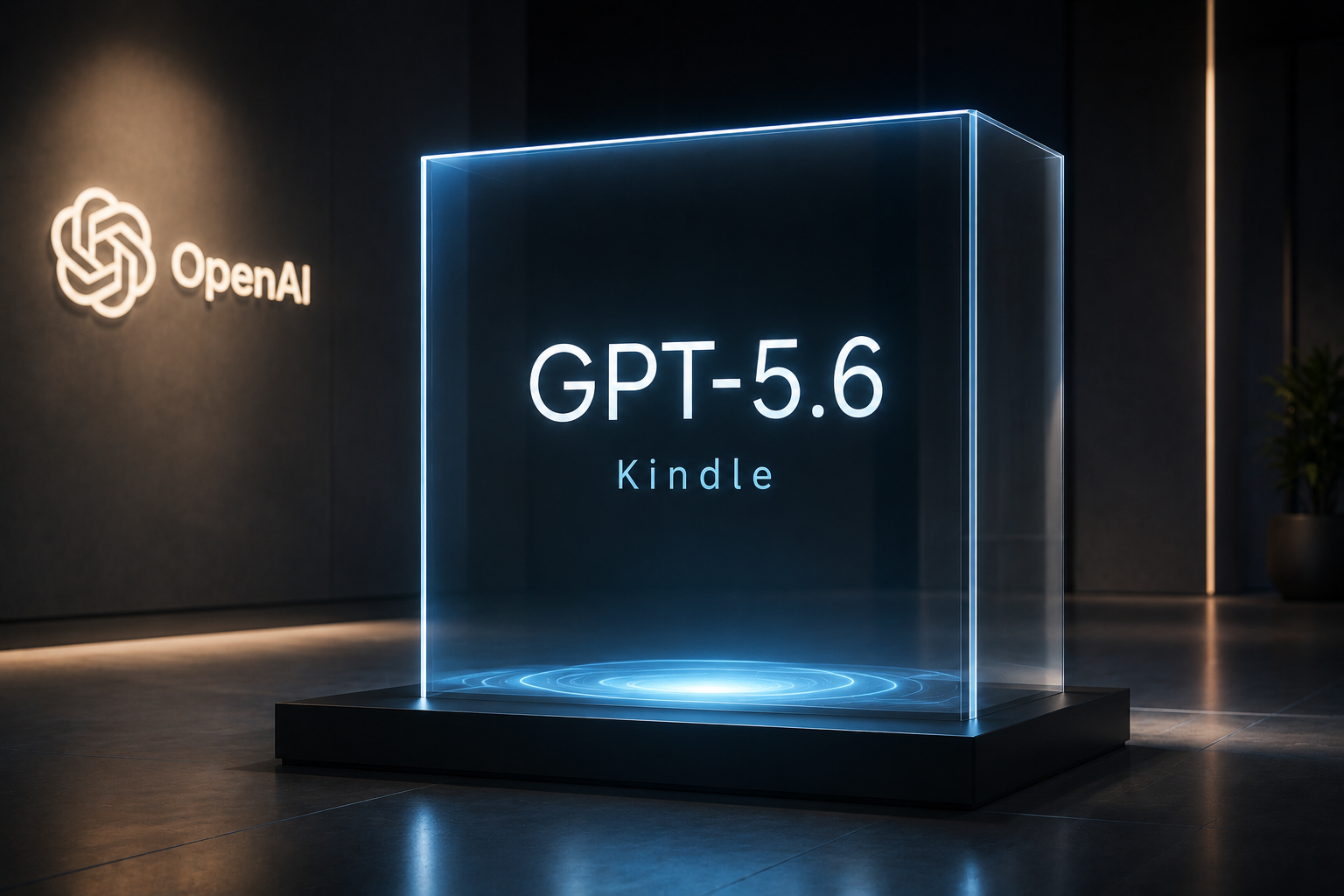
The AI world is buzzing right now — and honestly, for good reason. GPT Kindle chief scientist confirms it’s coming, and if you’ve been following the frontier model race, you know this changes the calculus considerably. OpenAI’s next-generation model, internally codenamed “Kindle,” isn’t just a minor bump. It’s shaping up to be a meaningful leap forward.
Specifically, OpenAI’s Chief Scientist has now signaled that GPT-5.6 “Kindle” is on the horizon. After months of speculation and community guessing games, this confirmation positions OpenAI to push back hard against Anthropic’s Claude and Google’s Gemini. For anyone who’s been asking when GPT-5 actually arrives — the answer is closer than most people expected.
The Chief Scientist Confirmation: What We Know
When the news broke that GPT Kindle chief scientist confirms it’s coming, the tech community immediately started asking the same question: okay, but what does that actually mean? Fair question. Let me break it down.
OpenAI’s leadership has been getting noticeably more transparent about their development roadmap lately. The “Kindle” codename fits their tradition of internal project names — notably, previous models carried similar working titles before going public. It’s a pattern worth paying attention to.
Key confirmed details include:
- GPT-5.6 “Kindle” is a distinct model iteration, not just a minor patch or fine-tune
- The model builds on the GPT-5 architecture with significant, targeted refinements
- Training has progressed well beyond early experimental stages
- Performance benchmarks reportedly exceed current GPT-4o capabilities by a wide margin
However, OpenAI hasn’t released an exact launch date — which is frustrating, but honestly par for the course. The confirmation still matters enormously, because it moves “Kindle” from rumor to acknowledged reality. Consequently, developers and businesses can actually start planning instead of just speculating.
Here’s the thing: the Chief Scientist’s role in this announcement carries real weight. This isn’t a marketing tease from a VP of Communications. It’s a technical leader vouching for the model’s progress, and that distinction means something in the AI research community. There’s a clear difference between a hype signal and a genuine readiness indicator — this reads like the latter.
Additionally, the timing is clearly strategic. OpenAI faces mounting pressure from Anthropic and Google DeepMind. Confirming Kindle’s development sends a clear signal to the market: OpenAI isn’t standing still.
The GPT-5 Release Roadmap and Timeline
Understanding the GPT-5.6 “Kindle” announcement requires some context about OpenAI’s broader release strategy. They’ve shifted to an iterative deployment approach for the GPT-5 family — which, honestly, makes a lot of sense given how fast the competition is moving.
The GPT-5 family rollout appears to follow this pattern:
- GPT-5 base model — Initial release with core architecture improvements
- GPT-5.1 through GPT-5.5 — Incremental refinements, safety tuning, and capability expansions
- GPT-5.6 “Kindle” — A major capability jump within the GPT-5 lineage
- Future iterations — Continued optimization before the eventual GPT-6 development
OpenAI CEO Sam Altman has consistently hinted at faster release cycles. Meanwhile, the company’s official blog has documented their shift toward more frequent model updates — mirroring what Google has done with Gemini’s rolling releases. It’s a smart approach, even if it makes versioning a bit confusing for end users.
Estimated timeline considerations:
- OpenAI typically needs 3–6 months between major model announcements and public availability
- Safety testing and red-teaming add additional weeks to any launch
- API access usually precedes consumer-facing ChatGPT integration
- Enterprise customers often get early access before general availability
Therefore, if the Chief Scientist’s confirmation reflects a model nearing completion, a late 2025 or early 2026 release window seems plausible. Nevertheless, OpenAI has surprised the industry before with accelerated timelines — so don’t treat that window as gospel.
The infrastructure demands are also substantial, and this part often gets underestimated. Each GPT generation requires significantly more compute. OpenAI’s partnership with Microsoft Azure provides the backbone. Specifically, their reported investment in custom AI chips and expanded data center capacity supports the Kindle timeline. Moreover, these aren’t small bets — we’re talking billions in committed infrastructure.
Feature Expectations and Technical Capabilities
Now that GPT Kindle chief scientist confirms it’s coming, the obvious question is: what will it actually do? Although official specs remain under wraps, several credible indicators point toward some genuinely exciting capabilities.
Reasoning and problem-solving improvements stand out as the primary focus area. GPT-5.6 “Kindle” reportedly shows stronger chain-of-thought reasoning. That means fewer embarrassing logical errors and more reliable outputs when you’re working through complex, multi-step problems. That’s the improvement that matters most for real-world use.
Expected capability improvements include:
- Extended context windows — Potentially exceeding 500,000 tokens, enabling analysis of entire codebases or book-length documents in a single pass
- Multimodal excellence — Tighter integration of text, image, audio, and video understanding
- Reduced hallucinations — A persistent problem that OpenAI has been aggressively targeting
- Real-time knowledge — Better mechanisms for accessing current information without stale cutoffs
- Agentic behavior — More reliable autonomous task completion across multiple steps
- Efficiency gains — Lower inference costs despite higher capability ceilings
Moreover, the “Kindle” codename itself might be telling. Some industry analysts think it references “kindling” new capabilities; others suggest it relates to knowledge synthesis. Either way, the naming suggests OpenAI views this as something more than an incremental update.
Importantly, the model’s training data likely includes significantly more recent information. Previous GPT models suffered real limitations from knowledge cutoffs — ask anyone who’s tried using GPT-4 for current events research. GPT-5.6 “Kindle” may incorporate retrieval-augmented generation (RAG) natively. That’s a technique that lets AI models pull in real-time information during responses rather than relying purely on baked-in training data. That’s the real kicker here, if it pans out.
The Stanford HAI research group has noted that each generation of large language models tends to improve most dramatically where the previous version was weakest. For GPT-5.6, that almost certainly means reliability and factual accuracy. Those are the two things that still make enterprise customers nervous about deploying these models at scale.
Competitive Positioning: Kindle vs. Claude vs. Gemini
The GPT Kindle chief scientist confirmation doesn’t exist in a vacuum. This is a fiercely competitive space right now — arguably the most competitive in a decade of tech coverage. Here’s how Kindle stacks up against its primary rivals.
| Feature | GPT-5.6 “Kindle” (Expected) | Claude 4 (Anthropic) | Gemini 2.5 Pro (Google) |
|---|---|---|---|
| Context window | 500K+ tokens (rumored) | 200K tokens | 1M+ tokens |
| Multimodal support | Text, image, audio, video | Text, image, code | Text, image, audio, video |
| Reasoning focus | Advanced chain-of-thought | Constitutional AI approach | Native code execution |
| Real-time data | Expected native RAG | Limited | Google Search integration |
| Pricing | TBD | Competitive | Aggressive free tier |
| Agentic capabilities | Strong focus area | Computer use features | Deep Google ecosystem ties |
| Safety approach | Iterative deployment | Safety-first design | Layered safety systems |
Where Kindle likely wins: Raw reasoning power and multimodal integration have historically been OpenAI’s strongest cards. Additionally, the ChatGPT user base gives any new model instant distribution at a scale neither Anthropic nor Google can currently match.
Where competitors hold real advantages: Google’s Gemini benefits from native search integration — that’s a structural moat that’s genuinely hard to replicate. Anthropic’s Claude has earned a well-deserved reputation for safety and nuanced, thoughtful responses. Consequently, Kindle needs to stand out on capability, not just claim incremental improvements and call it a day.
Similarly, the developer ecosystem matters enormously here. OpenAI’s API platform remains the most widely adopted in the industry. However, Anthropic and Google are closing that gap faster than most people realize. A strong Kindle launch could reinforce OpenAI’s developer loyalty — but a stumbled launch could accelerate the migration the other way.
The competitive dynamics also affect pricing directly. Each company is actively undercutting the others on inference costs. Therefore, Kindle’s efficiency improvements aren’t just technical achievements to brag about — they’re business necessities in a market where margins are razor thin.
Infrastructure Requirements and What Developers Should Prepare
Since GPT Kindle chief scientist confirms it’s coming, now is genuinely the right time to start preparing. The developers who scramble at launch day are the ones who end up with integration headaches for months afterward.
For API developers, preparation steps include:
- Review current API usage patterns and identify where Kindle’s improvements will matter most for your specific workflows
- Budget for potential pricing changes during the initial launch period — early access pricing can swing significantly
- Test existing prompts against GPT-5 base models to catch compatibility issues before they become production problems
- Build abstraction layers that allow easy model switching — this is non-negotiable if you’re running anything serious
- Monitor OpenAI’s status page for beta access announcements
For enterprise teams, the considerations are different:
- Check data governance policies before connecting sensitive data to new model versions
- Plan for employee training on new capabilities — the agentic features especially will require workflow rethinking
- Assess whether current AI workflows need architectural changes to take full advantage
- Consider hybrid approaches using multiple AI providers for redundancy and cost optimization
Furthermore, hardware requirements for self-hosted or fine-tuned versions will likely increase — sometimes substantially. Organizations running local AI infrastructure should plan for GPU upgrades ahead of time. NVIDIA’s developer resources provide useful benchmarking tools for capacity planning if you’re not sure where to start.
Notably, OpenAI has been steadily expanding its enterprise offerings. Custom model fine-tuning, dedicated instances, and enhanced security features all suggest Kindle will arrive with solid enterprise support from day one. That’s been a weak point in previous launches, so it’s good to see them getting ahead of it.
Also watch for changes to the tokenizer. New model generations sometimes introduce updated tokenization schemes. These can affect your prompt engineering strategies and — importantly — your cost calculations. Consequently, existing production systems may need adjustments before full migration. It’s an annoying problem to debug under pressure, and one that’s easy to overlook until it bites you.
Practical tips for immediate action:
- Start documenting your current AI costs and performance baselines right now, before Kindle arrives
- Join OpenAI’s developer forums to catch early announcements before they hit the tech press
- Experiment with GPT-5 base models to understand the architectural direction
- Build evaluation frameworks to quickly benchmark Kindle against your specific use cases
- Don’t over-commit to any single provider — maintain flexibility, because this market is still moving fast
What This Means for the Broader AI Industry
The confirmation that GPT Kindle chief scientist confirms it’s coming sends ripple effects well beyond OpenAI’s offices. The entire AI industry shifts when a major frontier player announces a flagship model.
Investment implications are significant. Venture capital flowing into AI startups tends to follow the release cycles of frontier models closely. A new GPT release creates genuine opportunities for companies building on top of the technology. Conversely, it threatens startups whose main value was filling gaps in current models — gaps that Kindle might simply close.
Open-source AI also responds to these announcements. Projects like Meta’s Llama and Mistral’s models typically speed up development when proprietary models advance. Although open-source models still trail frontier capabilities, the gap has been narrowing steadily — and faster than most people predicted. Kindle’s release will likely spark another wave of open-source innovation aimed at catching up.
Regulatory attention increases too. The National Institute of Standards and Technology (NIST) has been developing AI safety frameworks, and each new frontier model draws fresh scrutiny from policymakers. Therefore, Kindle’s launch will land in an increasingly complex regulatory environment across both the US and EU. That’s not necessarily a bad thing, but it’s a reality worth planning around.
Meanwhile, the workforce implications continue evolving in ways that are genuinely hard to predict. More capable AI models don’t simply replace tasks — they create new categories of work that didn’t exist before. Prompt engineering, AI auditing, and model evaluation are all growing fields right now. Kindle’s enhanced capabilities will likely expand these roles further, not eliminate them.
The education sector is watching closely as well. Universities and coding bootcamps are already restructuring curricula around AI tools. A major model release speeds that transformation up considerably — and notably, the institutions moving fastest are the ones whose students will have a real advantage.
Conclusion
The news that GPT Kindle chief scientist confirms it’s coming marks a significant moment in AI development. GPT-5.6 “Kindle” promises meaningful advances in reasoning, multimodal capabilities, and reliability — the three areas where current models still frustrate users most. And the competitive pressure from Claude and Gemini makes this release especially consequential for where the industry heads next.
Here are your actionable next steps:
- Stay informed — Follow OpenAI’s official channels for launch dates and access details; don’t rely on secondhand reporting
- Prepare your infrastructure — Audit current AI integrations and plan for upgrades before the launch crunch hits
- Experiment early — Use GPT-5 base models now to get familiar with the architectural direction
- Diversify your AI strategy — Don’t rely on a single provider, regardless of how strong Kindle performs at launch
- Budget accordingly — Set aside resources for testing and migration; early access periods always surface unexpected costs
Bottom line: the GPT Kindle chief scientist confirms it’s coming announcement transforms this from speculation into something you can actually plan around. Whether you’re a developer, a business leader, or just an AI enthusiast who follows this space closely — now is the time to get ready. Don’t be the person scrambling on launch day.
FAQ
When will GPT-5.6 “Kindle” be publicly available?
OpenAI hasn’t announced an exact release date. However, based on the Chief Scientist’s confirmation and typical development timelines, a late 2025 or early 2026 release window seems plausible. API access will probably arrive before consumer availability through ChatGPT — that’s been the pattern with recent releases. Keep watching OpenAI’s official blog for the definitive announcement rather than relying on rumor sites.
What does the “Kindle” codename mean for GPT-5.6?
The “Kindle” codename is an internal project name — OpenAI regularly uses working titles during development that don’t carry over to the public launch. Specifically, it may reference “kindling” new AI capabilities or knowledge synthesis. The final public name could differ entirely. Nevertheless, the codename has stuck firmly in industry discussions ever since GPT Kindle chief scientist confirms it’s coming broke as news.
How will GPT-5.6 “Kindle” differ from GPT-4o and GPT-5?
Kindle represents a substantial upgrade over both models. Expected improvements include larger context windows (potentially 500K+ tokens), better reasoning accuracy, meaningfully reduced hallucinations, and enhanced multimodal processing across text, image, audio, and video. Additionally, agentic capabilities should see major improvements — this is the area worth watching most closely. Think of Kindle as a refined, more reliable version of the GPT-5 architecture with targeted capability boosts throughout, rather than a ground-up rebuild.
Will GPT-5.6 “Kindle” be free to use?
OpenAI will almost certainly offer tiered access, as they’ve done with every recent model. Free ChatGPT users may get limited Kindle access, while ChatGPT Plus and Team subscribers will probably get fuller access sooner. Enterprise and API customers will have the most complete options available. Pricing details haven’t been confirmed yet. Moreover, OpenAI’s pricing strategy will depend partly on inference costs and how aggressively Anthropic and Google are pricing their competing models at that point.
How does Kindle compare to Google’s Gemini 2.5 and Anthropic’s Claude?
Each model has distinct strengths — and honestly, anyone claiming one model dominates across every category is oversimplifying. Gemini excels with its massive context window and deep Google ecosystem integration. Claude is known for safety and nuanced, thoughtful conversation. Kindle is expected to lead in raw reasoning power and multimodal integration. Importantly, the best choice genuinely depends on your specific use case. Test all three against your actual workflows rather than picking a winner from benchmark charts alone.
Should developers start preparing for GPT-5.6 “Kindle” now?
Absolutely. Since GPT Kindle chief scientist confirms it’s coming, preparation right now is time well spent. Start by documenting your current AI performance baselines and building abstraction layers in your code that allow easy model switching. Test your prompts on GPT-5 base models to understand the architectural direction. Furthermore, budget for potential migration costs — they always show up somewhere unexpected. Early preparation gives you a real competitive advantage when Kindle launches, and that window is shorter than it looks.
References
Keep reading
Here are the latest posts from the blog.

A ‘show cause’ order might be the most underestimated weapon in a regulator’s toolkit right now. I’ve spent a decade watching tech policy evolve, and honestly, this mechanism…
The smart speaker wars reignite as Google, Amazon, and Apple all push major updates at the same time — and honestly, I haven’t seen this level of simultaneous competition sin…

The Federal Energy Regulatory Commission just sent shockwaves through the energy sector. FERC’s sweeping move show cause orders six regional grid operators, demanding they ex…