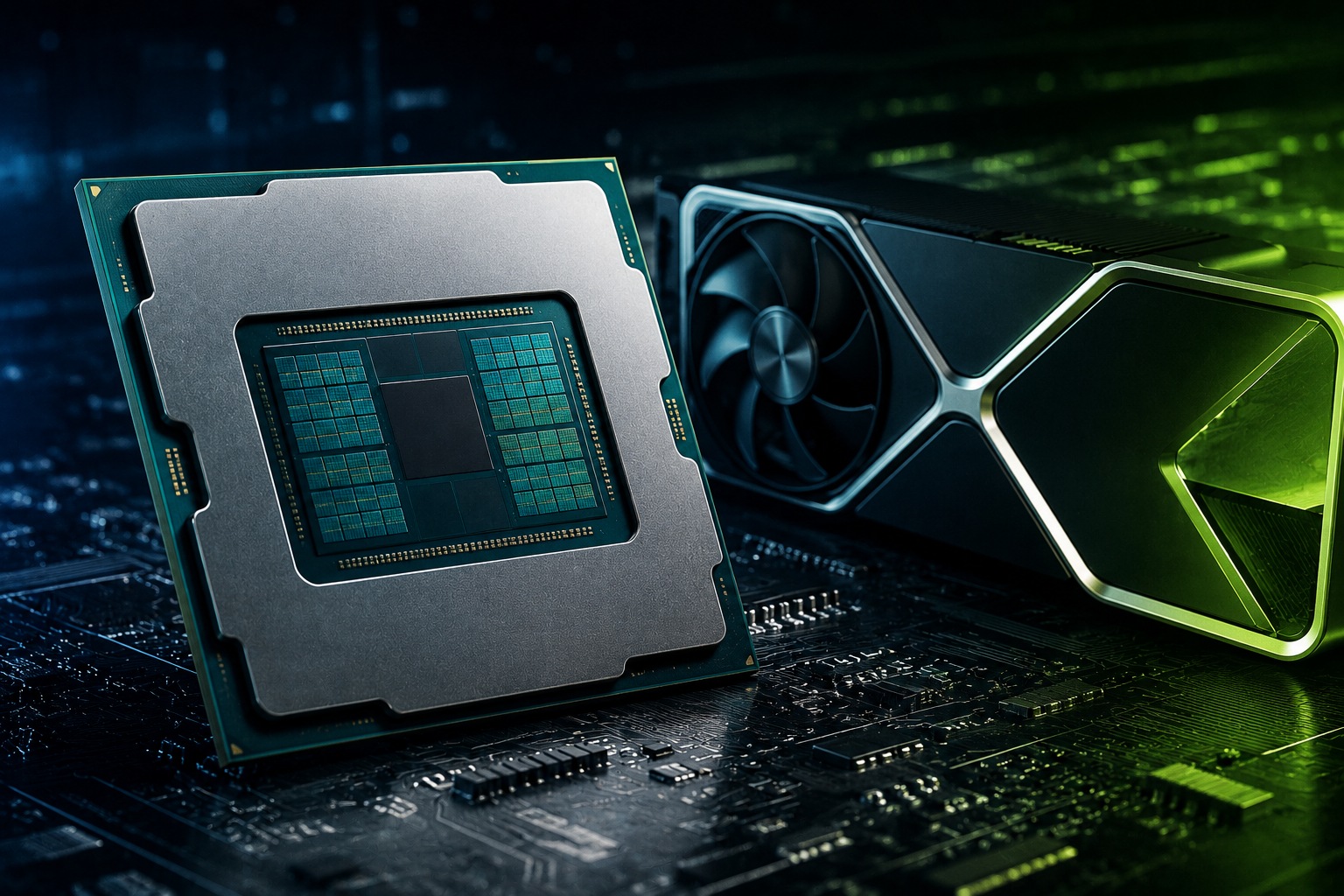
AMD Venice EPYC just beat Nvidia to the most advanced chip-making process on the planet, and the reaction online has been a strange mix of genuine excitement and “wait, why does this matter again?” The next-generation EPYC server processor, codenamed Venice, is set to ship on TSMC’s 2nm node — a first for any major data center chip. Nvidia’s Rubin GPU architecture, by contrast, isn’t expected on 2nm until sometime in 2026.
So does a 2nm CPU actually dent Nvidia’s GPU business? It depends entirely on what you’re running. AMD Venice EPYC isn’t going to replace an H200 cluster for training a 70-billion-parameter model. But for a surprising share of enterprise workloads, AMD Venice EPYC hitting 2nm before Nvidia changes the math on cost and power. Here’s where the line between “CPU territory” and “GPU territory” actually sits today.
Why AMD Venice EPYC Hitting 2nm Actually Matters
AMD Venice EPYC vs Nvidia H200: A Real Cost Comparison
Where AMD Venice EPYC Wins the Inference Battle
Why Enterprises Are Diversifying Beyond Nvidia With AMD Venice EPYC
How AMD Venice EPYC Stacks Up Against Intel and Nvidia
Conclusion: Does AMD Venice EPYC Matter for Your Infrastructure?
Why AMD Venice EPYC Hitting 2nm Actually Matters
Process node leadership sounds like bragging rights until you translate it into power efficiency and transistor density. TSMC’s N2 node is expected to deliver 10 to 15% faster performance at the same power draw, or roughly 25 to 30% lower power at the same speed. Multiply either number across a few thousand server racks and it stops being a rounding error.
Here’s the concrete version: a hyperscaler running 10,000 EPYC servers could retire 2,500 to 3,000 of them and keep the same total throughput — or keep every server running and cut the power bill by close to a quarter. At current power and cooling costs, that math gets attention fast.
AMD Venice EPYC is expected to pack up to 256 Zen 6 cores per socket, double the current Turin generation. The chip also brings CXL 3.0 memory expansion and DDR6 support, both of which open up memory bandwidth well beyond what’s available today. AMD’s EPYC line has climbed steadily since Naples, but this generation looks like the biggest jump yet.
What AMD Venice EPYC Means for Memory-Heavy Workloads
That core count and memory bandwidth combination matters most for a specific category of software: real-time databases, search indexing, and analytics pipelines. Picture a financial services firm running fraud-scoring models across millions of transactions a day — that workload depends on memory bandwidth and core count, not GPU-style parallel math. It’s exactly the kind of job AMD Venice EPYC was built for.
Nvidia’s current H200 runs on TSMC’s 4nm process, and the Blackwell B200 sits on a custom 4NP node. Nvidia’s first 2nm chips, under the Rubin name, aren’t due until late 2026. That gives AMD roughly a 12 to 18 month process advantage, which is close to forever in data center procurement terms. Budgets get approved and architecture decisions get locked in on timelines exactly this long.
AMD Venice EPYC vs Nvidia H200: A Real Cost Comparison
Total cost of ownership tells the real story here. Not every workload justifies an eight-GPU node priced north of $250,000 — though plenty of workloads do. Whether AMD Venice EPYC hitting 2nm matters for your infrastructure comes down to your specific workload mix, and it’s easy to get this wrong in either direction.
| Workload Type | Venice EPYC (2-Socket) | Nvidia H200 (8-GPU Node) | TCO Winner | Performance Edge |
|---|---|---|---|---|
| PostgreSQL / MySQL databases | ~$18,000 | ~$250,000 | EPYC by 13x | EPYC: 3x throughput/dollar |
| Elasticsearch / search indexing | ~$18,000 | ~$250,000 | EPYC by 13x | EPYC: 5x efficiency |
| LLM fine-tuning (70B+ params) | ~$18,000 | ~$250,000 | H200 by 40x | H200: 40x faster training |
| LLM inference (batch) | ~$18,000 | ~$250,000 | Depends on scale | H200: 8x at high batch |
| LLM inference (single query) | ~$18,000 | ~$250,000 | EPYC competitive | EPYC: 70% of H200 speed |
| Video transcoding | ~$18,000 | ~$250,000 | EPYC by 10x | EPYC: comparable speed |
| Web serving / microservices | ~$18,000 | ~$250,000 | EPYC by 13x | EPYC: better latency |
| Computer vision training | ~$18,000 | ~$250,000 | H200 by 25x | H200: 25x faster epochs |
A dual-socket AMD Venice EPYC server is projected to cost around $18,000, against roughly $250,000 for a fully loaded eight-GPU H200 node. For workloads that don’t need GPU-style parallelism, that gap is close to 13x. PostgreSQL and MySQL databases run about 3x the throughput per dollar on AMD Venice EPYC. Elasticsearch and search indexing see roughly 5x the efficiency. Video transcoding lands at around 10x the cost advantage with comparable speed, and web serving or microservices workloads come in at roughly 13x cheaper with noticeably better latency.
Put another way: the same $250,000 that buys one H200 node buys about thirteen dual-socket AMD Venice EPYC servers. A mid-sized e-commerce company running Elasticsearch for product search has no real reason to put that workload on GPU nodes — thirteen AMD Venice EPYC boxes handling search at five times the efficiency is a different infrastructure philosophy entirely.
Where AMD Venice EPYC Still Loses to Nvidia’s H200
None of that changes the training math. Fine-tuning a model with 70 billion or more parameters still favors the H200 by something like 40x, and computer vision training runs roughly 25x faster on GPUs. A 70-billion-parameter model that trains in three days across 256 H200 GPUs would take months on CPU cores alone. Anyone telling you AMD Venice EPYC changes that equation is selling you something.
Inference is genuinely more contested. According to Andreessen Horowitz’s compute spending analysis, inference already makes up more than 60% of total AI compute spend, and that share keeps climbing as models move from research into production. At low batch sizes, AMD Venice EPYC’s 256 cores handle a meaningful chunk of that workload efficiently. At high batch sizes, the H200 still wins by roughly 8x.
A rough rule holds up in practice: if a job runs for more than a few hours at a stretch, use GPUs. If you’re serving a model to live users at low latency, benchmark AMD Venice EPYC before assuming you need a GPU.
Where AMD Venice EPYC Wins the Inference Battle
Inference is where the AMD Venice EPYC 2nm advantage matters most, and the reasons go deeper than most coverage lets on.
CPU inference has already improved a lot. Earlier EPYC generations handle INT8 and BF16 inference workloads reasonably well, and Venice adds AVX-512 extensions built specifically for AI inference. Combine that with 256 cores of parallelism and you get real throughput without GPU overhead. Benchmark your own model before assuming anything, though the trend clearly favors CPUs for these jobs.
Five Places AMD Venice EPYC Has the Edge
- Low-latency, single-query inference is the clearest case. A chatbot serving one user at a time doesn’t need GPU batch processing. A support bot handling sequential conversations is a textbook example: requests arrive one at a time, so a GPU sitting mostly idle between them is pure waste. AMD Venice EPYC handles that pattern with lower tail latency and real cost savings.
- Small models are another strong fit. Anything under seven billion parameters runs efficiently on a high-core-count chip, and DDR6 bandwidth removes the memory bottleneck that held back earlier CPU generations.
- Retrieval-augmented generation pipelines fit well too, since they combine database lookups with model inference in the same request. AMD Venice EPYC handles both stages natively, while GPU setups need expensive data transfers between them. If your pipeline spends 60% of its time on retrieval anyway, putting everything on one CPU server removes a whole category of latency.
- Edge inference at scale is a fourth case worth naming. Retail locations, branch offices, and manufacturing floors often can’t support the power and cooling a GPU needs. A 700-watt card simply isn’t an option there, and AMD Venice EPYC’s efficiency at 2nm makes CPU-only edge deployment genuinely realistic.
- Quantized model serving rounds out the list. INT4 and INT8 quantization is now standard practice for production deployment, and the AVX-512 extensions in AMD Venice EPYC handle those formats well. A quantized Llama 3 8B model running on a 256-core AMD Venice EPYC box is a realistic production setup today, not a future promise.
Where GPUs Still Beat AMD Venice EPYC on Inference
Batch inference handling hundreds of simultaneous requests still favors GPUs, along with vision models processing high-resolution images and anything past 30 billion parameters. Any workload leaning on FP16 or FP8 matrix math at scale belongs on a GPU, full stop.
The MLPerf benchmark suite from MLCommons shows this split consistently. GPUs win throughput benchmarks by a wide margin, but CPUs hold their own on latency-sensitive, single-stream work. AMD Venice EPYC at 2nm should widen that CPU competitiveness further, before you even factor in the price difference.
Why Enterprises Are Diversifying Beyond Nvidia With AMD Venice EPYC
Nvidia’s dominance carries real supply chain risk. The company reportedly holds a backlog worth well over a trillion dollars for data center GPUs, with lead times running 6 to 12 months. That means enterprises often can’t get GPUs even when the budget is ready to spend.
Picture the common version of this: a team gets budget approval in Q1, places a GPU order, and watches delivery slip to Q4 while the product roadmap doesn’t move. Infrastructure teams everywhere have lived this scenario for two years, with little improvement.
That supply constraint is a big part of why AMD Venice EPYC hitting 2nm before Nvidia matters right now. Enterprises need alternatives, and building infrastructure around one vendor’s GPU supply is the kind of lock-in that should worry any procurement team.
Three Workload Tiers, and Where AMD Venice EPYC Fits
Smart infrastructure planning tends to split into three tiers. Tier one is GPU-essential: LLM training, vision model training, and large-scale batch inference, running on Nvidia H200/B200 or AMD’s own Instinct MI300X. Tier two is GPU-optional: medium-sized model inference, recommendation systems, and feature engineering, where AMD Venice EPYC handles the job cost-effectively. Tier three is CPU-optimal: databases, search, web serving, analytics, and small-model inference, where AMD Venice EPYC dominates outright.
Most enterprise workloads sit in tiers two and three. Gartner’s research puts more than 70% of enterprise compute spending toward traditional workloads that never touch a GPU, and infrastructure audits generally back that number up.
CXL 3.0 support lets a fleet of AMD Venice EPYC servers pool memory dynamically. A cluster could share 12TB of CXL-attached memory and allocate it based on active workloads, something GPU nodes don’t offer today. DDR6 roughly doubles the memory bandwidth of current DDR5 systems, which matters a lot for database and analytics work.
Practical Steps Before AMD Venice EPYC Ships
Power efficiency closes the argument. An H200 GPU draws 700 watts, and an eight-GPU node pulls past 10 kilowatts total. An AMD Venice EPYC server handling equivalent non-ML work might draw around 600 watts. In a power-constrained facility, that difference decides how many workloads actually fit — some colocation facilities are already turning away GPU-heavy customers because they can’t provision enough power per rack.
Three things are worth doing now, before AMD Venice EPYC actually ships. Move your top five CPU-optimal workloads off GPU instances today, freeing up capacity for jobs that actually need it. Benchmark ONNX Runtime and llama.cpp on your smallest production models to build a real baseline. Then negotiate GPU contracts with 90-day renewal windows instead of multi-year commitments, so you keep room to shift spend once AMD Venice EPYC ships.
How AMD Venice EPYC Stacks Up Against Intel and Nvidia
AMD isn’t only fighting Nvidia here. Intel’s Clearwater Forest Xeon processors are aimed at the same data center market, and while Intel has struggled with process delays, its disaggregated chiplet approach mirrors AMD’s own strategy. This is a three-way race, and the competition is pushing all three companies to move faster.
AMD still holds real advantages. Its chiplet design, refined across several EPYC generations, scales to high core counts better than Intel has managed — AMD Venice EPYC reportedly uses up to 16 compute chiplets on a single package, a density Intel hasn’t matched. That approach also gives AMD a yield advantage: a defect that would kill a monolithic die only damages one small chiplet, keeping manufacturing costs in check even at 2nm, where defect rates run higher.
AMD’s dual-track lineup helps its pitch too. The company sells both AMD Venice EPYC CPUs and Instinct MI300X GPUs, so it can offer a complete server solution — Venice for general workloads, MI300X for AI training, one vendor covering both chip types. That’s a genuinely appealing pitch to a procurement committee already frustrated with Nvidia’s lead times and pricing leverage.
AMD’s ROCm software stack has matured a lot too. PyTorch and TensorFlow now support AMD GPUs natively, lowering the switching cost away from Nvidia’s CUDA ecosystem. CUDA still leads on library depth, but the gap is closing faster than most people give it credit for.
The bigger market dynamics favor AMD as well. Hyperscalers like Microsoft, Google, and Meta are actively spreading their chip spending across multiple vendors, and they have the buying power to demand real alternatives. AMD Venice EPYC at 2nm gives them a strong reason to grow AMD’s share of their server fleets, right when the biggest buyers in the world are shopping for options.
Conclusion: Does AMD Venice EPYC Matter for Your Infrastructure?
So, does AMD Venice EPYC hitting 2nm before Nvidia matter for your infrastructure decisions? Yes — with a few caveats worth keeping in mind.
AMD Venice EPYC won’t replace H200 GPUs for training large AI models, and that was never really the point. Most enterprise workloads aren’t AI training at all — they’re databases, search engines, web applications, analytics pipelines, and a growing share of AI inference. For that category of work, a 256-core chip at 2nm delivers better performance per dollar and per watt than any GPU on the market, before factoring in GPU availability.
A few next steps worth taking now:
- Sort every application into GPU-essential, GPU-optional, and CPU-optimal buckets, regardless of AMD Venice EPYC’s timeline.
- Calculate real total cost of ownership, including power and cooling, since GPU nodes run 10 to 13x more than CPU servers for non-ML work.
- Start evaluation cycles now on current EPYC Turin hardware, and test CPU inference using ONNX Runtime or PyTorch’s CPU backend — the cost savings tend to surprise people.
- Diversify vendor strategy rather than betting everything on Nvidia GPU availability.
For most enterprise workloads, the answer is clear: AMD Venice EPYC hitting 2nm matters enormously, and the teams that act on it early will end up running leaner infrastructure than the ones still reaching for GPU instances.
FAQ: Your AMD Venice EPYC Questions Answered
Will AMD Venice EPYC Ship Before Nvidia’s 2nm GPUs?
Based on current roadmaps, yes. AMD Venice EPYC is expected in late 2025 or early 2026 on TSMC’s N2 node, while Nvidia’s Rubin architecture — its first 2nm GPU — isn’t expected until late 2026. That puts AMD roughly 12 to 18 months ahead in the data center. Roadmaps shift, but the gap looks wide enough to hold.
Can AMD Venice EPYC Replace GPUs for AI Inference?
It depends on model size and latency needs. Models under 7 billion parameters run well on AMD Venice EPYC’s high core count, and single-query, low-latency inference is another strong spot. Large batch inference and models past 30 billion parameters still favor GPUs by a wide margin, so benchmark your specific use case first.
How Many Cores Does AMD Venice EPYC Have?
AMD Venice EPYC is expected to offer up to 256 Zen 6 cores per socket, double the 128-core maximum on the current Turin generation. Each core also benefits from 2nm efficiency and clock speed gains. That “up to” is doing real work here, so wait for shipping silicon before locking in architecture decisions.
What Memory Technologies Does AMD Venice EPYC Support?
AMD Venice EPYC supports DDR6 memory, roughly doubling bandwidth versus current DDR5 systems, plus CXL 3.0 for disaggregated memory pooling. Together, those two features make AMD Venice EPYC well suited to memory-heavy work like databases and in-memory analytics — a combination GPU nodes can’t really replicate today.
Is AMD Venice EPYC a Real Threat to Nvidia?
For GPU-centric AI training, not really — Nvidia’s parallel processing advantage stays unchallenged there. But for the broader data center market, including databases, web serving, search, and CPU-based inference, AMD Venice EPYC’s 2nm lead creates real competitive pressure on infrastructure spending. That “broader market” happens to be most of the market.
How Does AMD Venice EPYC Compare to Intel’s Xeon Roadmap?
AMD Venice EPYC holds a significant process advantage over Intel’s Clearwater Forest Xeon chips, since Intel still relies on its own foundry processes, which trail TSMC’s leading nodes. AMD’s chiplet design also scales to higher core counts more efficiently. Intel is investing heavily to close that gap, but AMD Venice EPYC’s 2nm lead is substantial for now.
Keep reading
Here are the latest posts from the blog.

Three weeks into active proceedings, Judge Sidney Stein’s courtroom decisions in the OpenAI sanctions motion are sending signals that could reshape how every AI company handl…

Optimus Gen 3 production was supposed to start this week. It didn’t — and the reasons go a lot deeper than most coverage bothers to explain. Tesla’s humanoid robot program ha…

When Treasury Secretary Scott Bessent flew to Tokyo last month and sat down with Anthropic executives alongside officials from Japan’s three biggest banks, that wasn’t a cour…