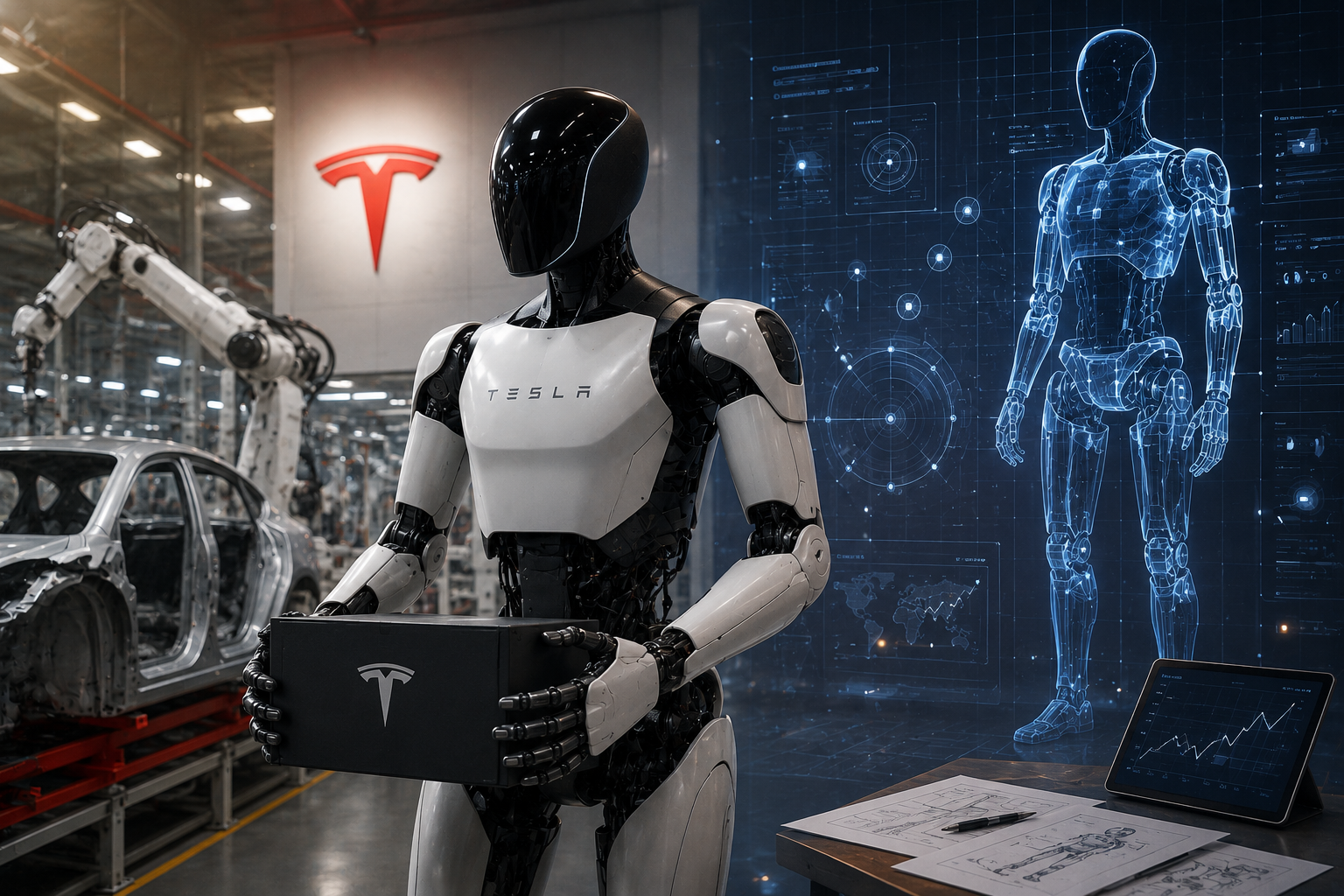
Optimus Gen 3 production was supposed to start this week. It didn’t — and the reasons go a lot deeper than most coverage bothers to explain. Tesla’s humanoid robot program has hit another delay, and while it’s tempting to treat this as just another Musk timeline slipping, the underlying story is bigger than one company’s ambitions. It’s a semiconductor story, a supply-chain story, and a competitive pressure story all layered on top of each other.
Understanding why Optimus Gen 3 keeps missing its dates actually tells you something genuinely useful about the entire AI hardware ecosystem right now, not just Tesla’s robotics division. This piece walks through the real reasons behind the delay, how it connects directly to the same chip bottleneck squeezing Nvidia and Intel, how competitors like Figure AI and Boston Dynamics are using this window to their advantage, the supply-chain failure modes unique to humanoid robots specifically, and the concrete signals worth watching instead of the next announcement.
Why Optimus Gen 3 Production Keeps Missing Its Targets
How the Chip Shortage Is Delaying Optimus Gen 3
Why Figure AI and Boston Dynamics Are Outpacing Optimus Gen 3
The Supply Chain Problems Unique to Optimus Gen 3
What to Watch Before Optimus Gen 3 Actually Ships
Conclusion: Final Thoughts on Optimus Gen 3 and What Comes Next
Why Optimus Gen 3 Production Keeps Missing Its Targets
Tesla has been announcing ambitious production goals for Optimus throughout 2024 and into 2025, with Musk projecting thousands of units working inside Tesla factories by now. The gap between that announcement and the current reality keeps widening, and it’s a pattern that becomes recognizable the longer you watch it play out.
A handful of interconnected factors explain why Optimus Gen 3 keeps slipping.
- Custom silicon shortages sit near the top — Tesla’s Full Self-Driving chip and its next-generation variants compete for the same advanced packaging capacity at TSMC that essentially every AI company on the planet is currently fighting over.
- Actuator manufacturing complexity adds another layer, since humanoid robots need dozens of precision actuators, and each one demands tight tolerances that simply don’t scale easily, no matter how skilled the engineering team behind them is.
- Software readiness matters just as much as hardware — the physical robot means nothing without reliable autonomy software, and Tesla’s end-to-end neural network approach still struggles with genuinely new environments, a bigger problem in practice than any demo suggests.
- And safety certification gaps remain real, since no regulatory framework yet fully exists for humanoid robots working directly alongside humans in factory settings.
Tesla’s vertical integration strategy — building most components in-house rather than outsourcing — creates bottlenecks that traditional contract manufacturing would likely sidestep entirely. Tesla insists this approach pays off at scale eventually, but that bet hasn’t paid off yet for Optimus Gen 3 specifically, and the timeline reflects it.
The pattern at this point is almost predictable. Musk sets an aggressive date, engineers work furiously toward it, the date passes quietly, and a new date takes its place. Tesla originally suggested Optimus would be doing useful factory work by the end of 2024, then quietly shifted that language to “limited production” in early 2025, and the goalposts have kept moving since. Optimus Gen 3 production was supposed to start this week specifically, but hardware startups almost never hit their first production timeline — even the genuinely great ones.
A useful comparison here is SpaceX’s early Starship schedule. Musk announced an orbital test for 2020; it didn’t actually happen until 2023. The program still succeeded in the end, but only after the team stopped treating Musk’s public dates as literal engineering targets and started treating them as aspirational pressure instead. The Optimus Gen 3 team appears to be living through that exact same dynamic right now.
How the Chip Shortage Is Delaying Optimus Gen 3
You can’t fully understand the Optimus Gen 3 delay without understanding the underlying chip supply chain, because this connects directly to both the Nvidia GPU backlog and Intel’s 18A process struggles — it’s all the same underlying constraint wearing different hats across different companies.
The core problem is straightforward once you see it: every advanced AI system, whether it’s a data center GPU, an autonomous vehicle, or a humanoid robot, needs chips built on the latest process nodes, and exactly two foundries in the world can manufacture at 3nm and below — TSMC and Samsung. That’s the entire list.
Optimus Gen 3 requires multiple custom chips working together:
- a main inference processor for real-time decision-making,
- motor controllers for each of its 28-plus actuators,
- sensor fusion chips for combining camera, lidar, and tactile data,
- and communication modules for fleet coordination.
Every one of those chip types needs its own wafer allocation, and each also needs advanced packaging — the same CoWoS capacity that Nvidia consumes at massive scale for its H100 and B200 GPUs. Nvidia is not a small customer in that queue.
The ripple effect plays out predictably:
- Nvidia books massive CoWoS capacity months in advance,
- Apple locks in priority allocation for iPhone processors,
- Tesla’s robotics division competes for whatever capacity remains after that, and smaller orders get pushed back repeatedly as a result.
TSMC’s CoWoS capacity was so constrained in 2024 that even well-funded AI chip startups reported 12-to-18-month lead times just for packaging slots. Optimus Gen 3, still in pre-production, sits well below Nvidia and Apple in TSMC’s customer priority queue — there’s no polite way to phrase it, Tesla simply isn’t TSMC’s most important phone call right now.
This is a major piece of the actual answer whenever people ask why Optimus Gen 3 production was supposed to start this week and didn’t: Tesla can’t yet secure enough advanced silicon at the volumes a real production ramp requires. It mirrors what happened with the Cybertruck, where 4680 battery cell production couldn’t scale fast enough to meet demand. Optimus Gen 3 faces its own version of that same component-scaling wall, just built from chips instead of batteries. The practical takeaway for anyone tracking this closely: watch TSMC’s quarterly capacity announcements as a leading indicator for Optimus Gen 3 production readiness, not Tesla’s own press releases.
Why Figure AI and Boston Dynamics Are Outpacing Optimus Gen 3
Tesla isn’t building humanoid robots in a vacuum, and competitors are making serious, tangible progress that makes every week of Optimus Gen 3 delay more costly than the last.
Figure AI raised over $675 million in a single funding round, and its Figure 02 robot already performs real warehouse tasks, with BMW deploying Figure robots inside its Spartanburg, South Carolina plant. That’s actual work happening in an actual facility, not a demo stage — Figure 02 handles parts bin tasks on the assembly line, picking components, transferring them between stations, and flagging anomalies along the way. It’s not glamorous work, but it’s exactly the kind of repetitive, structured task that proves a robot can function reliably outside a controlled lab environment.
Boston Dynamics brings decades of locomotion expertise that Optimus Gen 3 simply can’t match yet. Its Atlas platform moved from hydraulic to fully electric actuation, and it’s demonstrated manipulation capabilities Optimus hasn’t publicly matched — Atlas can recover from unexpected shoves, navigate cluttered floors, and handle objects with a dexterity built from years of iterative real-world testing rather than simulation alone. Agility Robotics, meanwhile, ships its Digit robot directly to Amazon warehouses, where it’s already doing genuine work with no caveats attached.
| Feature | Tesla Optimus Gen 3 | Figure 02 | Boston Dynamics Atlas | Agility Digit |
|---|---|---|---|---|
| Production status | Pre-production | Limited deployment | R&D / demos | Pilot production |
| Degrees of freedom | 28+ (claimed) | 16+ | 28+ | 16 |
| Manipulation capability | Demo-stage | Warehouse-ready | Advanced demos | Warehouse-ready |
| AI approach | End-to-end neural net | Foundation models + OpenAI | Model-based + learning | Reinforcement learning |
| Factory partnerships | Tesla internal only | BMW | Hyundai | Amazon |
| Estimated unit cost | $20,000–$25,000 (target) | Undisclosed | Undisclosed | ~$250,000 (lease model) |
| Locomotion maturity | Moderate | Moderate | Industry-leading | Strong |
Tesla’s biggest advantage over this field — cost — only actually matters once real scale is reached, and scale requires production that hasn’t arrived yet. Every week Optimus Gen 3 slips lets competitors lock in manufacturing partnerships and customer relationships that will be hard to unwind later. A company like BMW or Amazon that’s already integrated a competitor’s robot into its workflow has a strong operational reason not to switch, even if Tesla eventually ships a cheaper unit down the road.
Figure AI’s collaboration with OpenAI also gives it access to frontier language models for task understanding, while Tesla’s approach relies entirely on internal AI development for Optimus Gen 3. That’s a genuine strength if Tesla’s internal work pans out, and a real vulnerability if it falls behind the pace competitors are setting with outside partnerships. Which one it turns out to be is still an open question.
The Supply Chain Problems Unique to Optimus Gen 3
Building humanoid robots at scale introduces failure modes that simply don’t exist in car manufacturing, and even though Tesla carries deep automotive supply-chain expertise, robotics presents fundamentally different challenges that don’t get nearly enough attention in most coverage of Optimus Gen 3.
Actuator supply is the single biggest bottleneck. A single Optimus Gen 3 unit needs 28 or more actuators — electric motors with built-in gearboxes, encoders, and controllers — each of which must meet specific torque, speed, and precision requirements. These aren’t off-the-shelf components you can simply order more of on short notice.
A handful of specific supply-chain failure modes stand out. Harmonic drive shortages top the list: these precision gear reducers are essential for robot joints, only a handful of companies make them globally (including Harmonic Drive Systems in Japan), and lead times stretch to 6–12 months. If Tesla wants to build 10,000 Optimus Gen 3 units, it needs roughly 280,000 harmonic drives — an order that alone would strain current global supplier capacity. Force-torque sensor availability is another constraint, since each hand and foot needs multi-axis force sensing that has to be small, durable, and extremely accurate, with a genuinely short supplier list to source from. Battery thermal management adds its own difficulty, since a humanoid robot generates heat very differently than a car — the battery pack sits in the torso, surrounded by actuators that also generate heat, making thermal runaway a genuinely tricky engineering problem without an obvious cooling solution that doesn’t also add weight and cut into range.
Cable routing complexity is easy to underestimate too: running power and data cables through moving joints without fatigue failure is harder than it sounds, and automotive wiring harness suppliers don’t typically solve this specific problem, since it’s a different discipline entirely. And finally, there’s the robot’s exterior skin and protective covering — it needs to be flexible enough to be safe around humans, tough enough for factory work, and easy to service, and no established supply chain exists for that yet at all.
When people ask what actually went wrong with Optimus Gen 3’s promised start date, the honest answer isn’t any single thing — it’s dozens of component-level challenges compounding simultaneously. Tesla’s insistence on vertical integration means solving all of them at once internally, where traditional robotics companies like Boston Dynamics instead partner with specialist suppliers for exactly these problems. That ambition is admirable, but it’s also slow, and the current Optimus Gen 3 timeline reflects that tradeoff directly — vertical integration can eventually produce better margins and tighter quality control, but it front-loads enormous engineering cost and time, and Tesla is paying that cost right now in real delays.
What to Watch Before Optimus Gen 3 Actually Ships
Forget Musk’s social media posts. Here are the concrete signals that will actually tell you whether Optimus Gen 3 is approaching real production readiness, since boring indicators are consistently more reliable than flashy ones in hardware.
In the near term, over roughly the next three months, watch for supplier contract announcements — Tesla signing deals with actuator or sensor manufacturers, which sometimes surface through public filings and are worth more than any single tweet. Job postings matter too: Tesla’s careers page shows where the company is actually investing, and a surge in manufacturing engineer postings specifically for the Optimus program signals genuine production preparation rather than R&D theater. Look specifically for roles in process engineering, quality assurance, and supply-chain management — the unglamorous jobs that only appear once a real production line is actually being built. Factory floor sightings occasionally leak too, through employee or visitor photos; look for dedicated Optimus Gen 3 assembly lines, not just R&D labs with a few robots standing around.
Medium-term, over the next three to nine months, safety certification filings are worth tracking — Tesla will need to work with OSHA and potentially UL Solutions on workplace safety standards, and these filings are often public and a strong sign real deployment is genuinely close. Internal deployment numbers matter too, since Tesla has said Optimus will work in its own factories first; credible reports of robots doing real tasks, not just demos, matter enormously here. Component cost disclosures during earnings calls are worth watching as well — any mention of per-unit cost approaching the $20,000–$25,000 target signals real manufacturing maturity.
Longer-term, over nine to eighteen months, third-party customer announcements are the clearest signal of all — when Tesla starts actually selling or leasing Optimus Gen 3 to outside companies, production has genuinely arrived. Regulatory framework development matters too, since government agencies creating humanoid robot workplace standards suggests the industry expects real deployments soon. And competitor response is worth watching closely — if Figure AI or Boston Dynamics suddenly speeds up their own timelines, it likely means Tesla is closer than skeptics currently think.
The single most reliable signal across all of this is genuinely boring: consistent, incremental progress backed by third-party verification, not flashy demo videos or ambitious social posts. A useful habit is setting a quarterly calendar reminder to check Tesla’s job postings, TSMC’s capacity commentary, and any OSHA or UL filings related to autonomous industrial robots — fifteen minutes every three months will tell you more than following the daily news cycle around Optimus Gen 3 ever will. What matters more than any single missed date is whether the underlying manufacturing readiness indicators are trending in the right direction, and right now, that picture is genuinely mixed.
Conclusion: Final Thoughts on Optimus Gen 3 and What Comes Next
The delay isn’t surprising on its own, and it isn’t even particularly alarming in isolation — hardware production timelines slip, and that’s genuinely normal across the industry. What actually matters is the pattern and the underlying causes behind Optimus Gen 3’s repeated delays, and those deserve honest scrutiny rather than either blind optimism or reflexive dismissal.
The semiconductor bottleneck here is real and affects every AI hardware company trying to ship something physical right now, not just Tesla. The supply-chain challenges specific to humanoid robots are genuinely new territory — nobody has solved these problems at real scale before. And the competitive pressure from Figure AI, Boston Dynamics, and Agility Robotics grows every quarter Optimus Gen 3 stays delayed. Still, Tesla’s cost targets, if actually achievable, could change the entire equation on their own — a $20,000 humanoid robot is a fundamentally different product than a $250,000 leased unit, opening up markets that don’t currently exist, from mid-sized manufacturers to logistics companies that could never justify enterprise robotics pricing at today’s rates.
Practical next steps worth taking:
- Track the underlying signals, not the promises — use the timeline framework above to assess real progress, and revisit it regularly rather than reacting to each new headline.
- Watch the chip supply chain closely, since TSMC’s advanced packaging capacity directly limits Optimus Gen 3 production, and quarterly TSMC earnings reports are where the real story tends to surface.
- Monitor competitor deployments too — Figure 02 at BMW and Digit at Amazon have already set the real-world benchmark that Optimus Gen 3 needs to match or beat to matter in this market.
- And follow safety regulation developments, since OSHA and international standards bodies will ultimately shape when and how humanoid robots can realistically work alongside people at all.
Bookmark this, revisit the tracker in ninety days, and compare reality against whatever new promises surface between now and then. The truth about Optimus Gen 3 always shows up in the supply chain eventually, well before it shows up in a press release.
FAQ About Optimus Gen 3 and Tesla’s Robot Delays
Why was Optimus Gen 3 production supposed to start this week?
Tesla set aggressive internal timelines for Optimus Gen 3 throughout late 2024 and early 2025, with Musk publicly referencing production-ready units by mid-2025. Those timelines assumed semiconductor availability, actuator supply-chain readiness, and software maturity that simply haven’t arrived on schedule. The underlying pattern holds regardless: Tesla consistently sets aspirational dates and then quietly adjusts them once reality catches up.
How do chip shortages specifically affect Optimus Gen 3 production?
Optimus Gen 3 requires multiple custom chips for inference, motor control, and sensor fusion, and all of them compete for the same advanced manufacturing capacity at TSMC that Nvidia, Apple, and other major companies rely on. Tesla’s relatively smaller chip orders get lower priority than billion-dollar customers — that’s simply how foundry allocation works in practice. Advanced packaging capacity, specifically CoWoS, remains the single tightest bottleneck in the entire semiconductor industry right now.
Is Figure AI actually ahead of Tesla in real-world humanoid robot deployment?
In terms of real factory deployment, yes, and it’s not particularly close at the moment. Figure AI has robots operating inside BMW’s manufacturing facility, and Agility Robotics has Digit units working in Amazon warehouses. Optimus Gen 3 has only been shown in controlled settings and inside Tesla’s own facilities so far. Tesla’s cost targets and manufacturing scale ambitions could still leapfrog competitors if production eventually ramps as planned — that’s the underlying bet Tesla is making.
What makes humanoid robot manufacturing genuinely harder than car manufacturing?
Several factors combine to create real, new difficulty. Humanoid robots need precision actuators with harmonic drives that have very few global suppliers. Cable routing through moving joints, force-torque sensing in hands and feet, and flexible safety coverings all require components that simply don’t exist in existing automotive supply chains. Tesla carries deep manufacturing expertise generally, but robotics introduces fundamentally different engineering constraints that experience alone doesn’t automatically solve.
When will Optimus Gen 3 realistically enter real production?
Based on current supply-chain indicators and competitor timelines, limited production of Optimus Gen 3 likely won’t begin before late 2025 at the earliest, with meaningful volume — hundreds or thousands of units — probably extending into 2026. “Production” also means different things depending on who’s using the word: building 10 robots for demos is a completely different challenge than making 1,000 units monthly, and that distinction matters enormously when evaluating any announcement.
How does the Optimus Gen 3 delay connect to Nvidia’s GPU backlog?
Both problems share the exact same root cause: insufficient advanced semiconductor packaging capacity at TSMC. Nvidia’s massive demand for CoWoS packaging consumes capacity that other companies, including Tesla, also need for programs like Optimus Gen 3. Intel’s 18A process delays add further pressure to the broader chip ecosystem on top of that. Until global advanced packaging capacity expands significantly, every AI hardware program faces this same fundamental constraint, regardless of how strong the underlying technology actually is.
Keep reading
Here are the latest posts from the blog.
AI Capex: Microsoft, Meta, Apple, and Amazon are reporting earnings this week, and between the four of them, roughly $725 billion in AI capital expenditure needs to justify i…

Getty Images sued Stability AI in January 2023, accusing the company of scraping millions of copyrighted photos without permission. Then, in a move that surprised almost ever…

When OpenAI shipped GPT-5.6, codenamed “GPT Sol,” most of the coverage focused on benchmark scores. That missed the bigger story. What Sol actually locked in wasn’t a reasoni…