On June 1, 2026, the company behind Claude said something short and carefully lawyered. The Anthropic S-1 arrived as a confidentially submitted draft registration statement to the SEC for a proposed initial public offering of common stock.
That is the entire official record on the Anthropic S-1. The Rule 135 announcement ran a few sentences and stated that the number of shares and the price had not been set.
Almost everything else you have read — the ticker, the October date, the bank syndicate — is reporting, inference, or guesswork. None of it came from the Anthropic S-1, because nobody outside the SEC has read it.
So the useful question is not when the stock lists. It is what the law will force onto the page when the filing finally goes public. That answer is knowable today, and it is more interesting than the speculation.
Key Takeaways: The Anthropic S-1 in Brief
- A confidential draft Form S-1 was submitted on June 1, 2026. It creates an option to go public after SEC review, not a scheduled date.
- The draft and every SEC comment letter on it stay private for now. Comment letters reach EDGAR no earlier than 20 business days after the registration statement goes effective.
- The company almost certainly fails the Emerging Growth Company revenue test, so the Anthropic S-1 faces the full disclosure regime rather than the reduced JOBS Act version.
- The registration statement and all prior confidential drafts must be publicly filed at least 15 days before any roadshow. That is the only countdown grounded in an actual rule.
- Compute purchase obligations, customer concentration, related-party terms with Amazon and Google, and the Long-Term Benefit Trust are the four disclosures most likely to move the price.
Quick Navigation
- What the Anthropic S-1 Confidential Filing Actually Did
- Why the Anthropic S-1 Is Not an Emerging Growth Company Filing
- What the Anthropic S-1 Must Disclose About Money
- What the Anthropic S-1 Must Disclose About Compute
- Governance Disclosures That Set the Anthropic S-1 Apart
- The Risk Factors the Anthropic S-1 Cannot Avoid
- When the Anthropic S-1 Becomes Public: The 15-Day Rule
- What the Anthropic S-1 Still Will Not Tell You
- How the Anthropic S-1 Compares to SpaceX
- Conclusion: How to Read the Anthropic S-1 When It Lands
- Why the Anthropic S-1 Matters Beyond One Stock
- FAQ About the Anthropic S-1
What the Anthropic S-1 Confidential Filing Actually Did
A private draft is not a secret IPO. It sits at a paperwork stage. Most coverage missed that. First, a company hands SEC staff a draft. Staff reads it and sends comments. The company edits. All of it happens off EDGAR.
Still, three things about that draft matter here. It registered no shares. Nobody could buy stock. And it set no date.
Why the draft stayed off EDGAR
Secrecy here is a process, not a right. A company must ask for confidential treatment under Rule 83. They also flag every page.
Yet the SEC holds back its own letters too. Staff comments go public no sooner than 20 business days after the deal closes. So the tug-of-war over the Anthropic S-1 only shows up once the stock trades. That lag matters. You see the clean version long before long before you see what the regulator fought about.
The Anthropic S-1 notice leaned on Rule 135, and that choice was not decorative. The rule lets a company confirm a deal without making an offer.
But it also gags them. That is why the Anthropic S-1 notice named no value, no revenue, and no date. Anything more could have counted as jumping the gun. So read the silence as legal care, not coyness.
Why the Anthropic S-1 Is Not an Emerging Growth Company Filing
Plenty of write-ups called the Anthropic S-1 a routine JOBS Act move for emerging growth companies. That looks wrong. And the error changes what you should expect to read. An Emerging Growth Company must earn under roughly $1.235 billion a year. The lab reported a $9 billion run rate at the end of 2025. Later it passed $30 billion in 2026.
Even if you cut run rate down to booked revenue, that ceiling breaks. So the Anthropic S-1 is a full filing, not a light one. The private route still works. Since 2017 the SEC has let every company file drafts quietly, not just small ones. It widened those rules again in March 2025.
But the company loses those shortcuts. A small company can show two years of audited income instead of three. It can skip the long pay analysis. It can delay the auditor sign-off on controls under Sarbanes-Oxley 404(b).
None of that applies. So the Anthropic S-1 should carry three years of audited results, full pay data, and tighter controls than most AI listings. Now think about what three years means here. The lab started in 2021. Revenue grew roughly 80x in one year. The 2023 and 2024 numbers will sit right next to 2025.
What the Anthropic S-1 Must Disclose About Money
Run rate is the number everyone quotes. But run rate is not a GAAP measure. A prospectus cannot lead with it.
Regulation S-X rules the financial pages. So the Anthropic S-1 needs audited balance sheets, income statements, cash flow, and full notes. An audit firm signs them.
The gap the audited numbers close
Press reports in June put the run rate near $47 billion. The company’s own last public figure sat above $30 billion. At the end of 2025 it was near $9 billion.
Still, annualizing one good month is not the same as booking a year. The Anthropic S-1 will show what the company truly earned over a full period. That number always looks smaller and slower. In fact, I expect that single line to reprice the deal more than any other.
Use of proceeds, and what it signals
Item 504 asks a blunt question. What will the company do with the cash?
Vague answers are legal but telling. “General corporate purposes” reads very differently from a named compute build-out. So watch whether the Anthropic S-1 ties the raise to specific contracts. Item 506 then covers dilution. New buyers usually pay far more per share than insiders did. That table is short, and it stings.
Gross margin, and the line nobody can dodge
Cost of revenue is where an AI lab gets interesting. Outside analysts peg compute spend at well over half of sales. Yet those are guesses from the outside, not facts.
An audited line replaces those guesses. So you finally see three things: what serving a token costs, how training splits from inference, and how much model work the company books as an asset.
Item 303 also makes the Anthropic S-1 explain the trend, not just print it. Vague words draw SEC comment letters, and staff has been busy on AI language.
What the Anthropic S-1 Must Disclose About Compute
Here is the part I would read first. It is not the revenue line.
The company has already named huge multi-year compute buys. Reports put the AWS deal above $100 billion over ten years. Google and Broadcom add gigawatts of new TPUs from 2027. Azure reportedly adds $30 billion more.
Those are contracts, not plans. So the Anthropic S-1 must list them, plus the take-or-pay terms and the year-by-year schedule. Lease-like deals land in the notes under ASC 842.
Why compute deals drive the whole risk profile
Picture a ten-year, hundred-billion-dollar bill under a revenue line that grew 80x. That line could also stall. So the gap between fixed cost and moving revenue is the whole bear case, and the Anthropic S-1 finally sizes it.
Next, the related-party angle makes it worse. Amazon and Google hold stock, sell cloud, and move product. Item 404 forces the company to spell those deals out. Investors will ask the circular question straight out. How much revenue comes from partners who also invest and supply? We covered the Google TPU deal here, and the same questions return once audited numbers land beside them.
The FTC also probed those cloud ties in a January 2025 staff report. Live interest like that usually shows up in risk factors.
Governance Disclosures That Set the Anthropic S-1 Apart
Here the Anthropic S-1 stops looking like any tech listing before it.
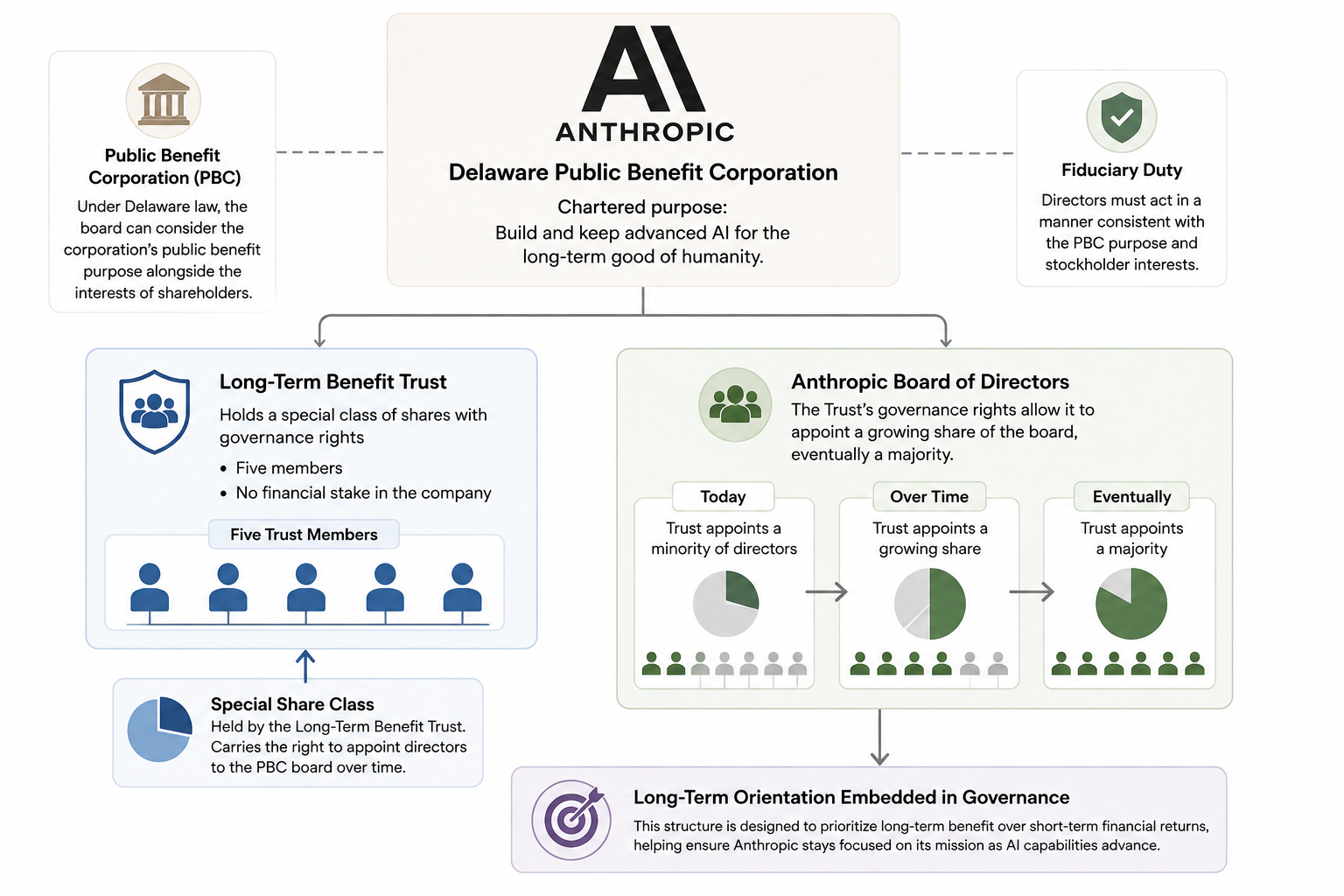
The issuer is a Delaware Public Benefit Corporation. Its charter names a purpose: build and keep advanced AI for the long-term good of humanity. Under Delaware law, a PBC board can weigh that purpose against shareholder money.
On top sits the Long-Term Benefit Trust. Five members hold a special share class. None of them holds a financial stake. Over time they pick a growing share of the board, and finally a majority.
The disclosure problem the Anthropic S-1 has to solve
Markets have priced founder control before. Meta and Alphabet use dual-class stock, and buyers understand it.
But an outside body with growing board power is new, and the Anthropic S-1 must explain it. Buyers of common stock take the money risk. Meanwhile a trust with no money at stake gains the votes.
So Item 403 covers who owns what. Item 407 covers board independence. And the capital stock pages of the Anthropic S-1 must say plainly what each class can do. Written honestly, that section reads like a risk factor. Index rules, proxy advisers, and big-fund voting policies all frown on odd control setups.
Of course the company will argue the trust is what makes its safety claim real. Whether that lands with a pricing committee is the open question of the deal.
The Risk Factors the Anthropic S-1 Cannot Avoid
Item 105 wants the Anthropic S-1 to name risks tied to this company, not stock phrases. SEC staff has said generic AI language fails. So six areas look unavoidable.
Legal and government exposure
Copyright. A landmark class-action settlement is already on the record, and Item 103 covers pending suits. We broke down that settlement separately. Still, the training-data fight does not end with one deal.
Washington. CNBC reported that defense contractors dropped the lab under a Pentagon order. It then sued to undo that call. A live case against the government belongs in the Anthropic S-1.
State law. New AI statutes now bind model builders and users. Colorado’s rules alone reshaped compliance planning, so the Anthropic S-1 must map that patchwork honestly.
Competition. OpenAI, Google, and a fast Chinese open-weight field all press on price. Model leads last months, not years. Any filing has to admit that plainly.
Business and capability exposure
Safety. A charter about responsible building raises a hard question. What happens if a model causes harm, or the company pauses a launch? Rivals do not carry that burden the same way.
Concentration. A few huge accounts drive revenue. Three vendors supply the compute. So the Anthropic S-1 must put a number on that double squeeze.
Claims. Since March 2024 the SEC has charged firms over AI hype, first two advisers and later Presto Automation. No AI-specific rule exists yet in mid-2026. Yet the agency does not need one, because fraud law already applies. So every claim in the Anthropic S-1 must hold up.
That last one cuts oddly. A lab that markets on evidence rather than superlatives starts ahead here.
One more line rewards a close read. The Anthropic S-1 names the audit firm, and that firm signs an opinion under PCAOB rules. Underwriters appear later, along with lock-up terms for staff and early backers. Those dates shape supply for months after the debut.
When the Anthropic S-1 Becomes Public: The 15-Day Rule
Want a date to watch? This is the only one tied to a rule.
A company using private review must promise one thing in writing. It will file the draft, and every later draft, at least 15 days before the roadshow. With no roadshow, the clock runs 15 days before the effective date.
So the Anthropic S-1 becomes readable about two weeks before management starts pitching. Not on listing day. Not at pricing.
What lands when the filing goes public
Everything at once, old drafts included. The rule sweeps in the first private draft and every edit after it.
People miss that detail. You will be able to compare the June draft against the version that survived review. Sometimes that diff says more than the final text.
Price and share count usually come later, near the roadshow. As of mid-July 2026, EDGAR showed no public Anthropic S-1 or S-1/A. No ticker, no exchange, no banks, no date. Reports point to a fall listing on Nasdaq with Goldman Sachs, JPMorgan, and Morgan Stanley. Treat that as rumour until a filing says otherwise.
What the Anthropic S-1 Still Will Not Tell You
The Anthropic S-1 will go deep on some things and stay quiet on others. Reading one well means knowing the quiet parts.
Model design, parameter counts, and training recipes stay out of the Anthropic S-1. Trade secrets survive an IPO, and no rule drags specs onto the page. Customer contract terms stay out too. Big contracts go in as exhibits, though companies redact the sensitive lines.
The safety debate stays open as well. The Anthropic S-1 can describe controls and review boards. Whether they work is not a question it can answer.
Finally, the Anthropic S-1 cannot promise the deal happens. The company can edit, delay, or pull it. Its own words tie the offering to market conditions.
How the Anthropic S-1 Compares to SpaceX
One useful yardstick already exists. SpaceX ran the same private route in April 2026, then filed publicly in May.
That gap ran about seven weeks. It is not a rule, but it shows the shape of a normal review.
SpaceX also published audited numbers, a price, and a ticker. Nothing like that exists here yet, so any side-by-side stays lopsided for now.
Conclusion: How to Read the Anthropic S-1 When It Lands
Skip the opening pages. The business section of the Anthropic S-1 will be marketing that passed legal review.
Go to the financials. Next, contractual obligations. After that, related-party deals. Finally, the capital stock pages. Those four sections of the Anthropic S-1 hold what private markets could never price. Carry three questions with you.
What did Anthropic truly earn, audited, against the run rates in the press? That gap tests the valuation first.
When do the compute bills come due, and how much can the company cancel? Fixed cost against moving revenue is the structural risk.
What can the Long-Term Benefit Trust actually do? Not what it aims to do. What the charter allows.
The Anthropic S-1 will be the first time a frontier lab answers those questions under securities law rather than in a blog post. Whatever the stock does, that part is new.
Why the Anthropic S-1 Matters Beyond One Stock
This filing sets a template. OpenAI filed its own draft days later, so whatever survives SEC review here shapes the next one.
Three norms are up for grabs. How a lab reports compute cost. How it words model-risk language. And how far a mission charter can bend before buyers discount it.
Regulators are watching too. A clean, specific filing makes the case that AI labs can report honestly under existing rules. A vague one invites a rulemaking push instead.
So read it as a precedent, not just a prospectus.
FAQ About the Anthropic S-1
What is the Anthropic S-1 and when was it filed?
The Anthropic S-1 is a draft registration statement on Form S-1 that Anthropic, PBC confidentially submitted to the SEC on June 1, 2026 for a proposed initial public offering of common stock. The company announced the submission under Rule 135 and stated that share count and offering price had not been determined.
Does the Anthropic S-1 mean an IPO is scheduled?
No. A confidential draft submission starts SEC review and preserves the option to go public. The Anthropic S-1 registers no securities, permits no sale, and sets no date. Anthropic has said timing depends on market conditions and other factors, and it retains the ability to amend, delay, or withdraw.
When will the Anthropic S-1 become public?
Under SEC staff policy, the registration statement and all previous nonpublic drafts must be publicly filed at least 15 days before a roadshow, or 15 days before the requested effective date if there is no roadshow. That window is the earliest reliable point at which the full Anthropic S-1 becomes readable.
What financial information will the Anthropic S-1 contain?
Because Anthropic almost certainly exceeds the Emerging Growth Company revenue threshold, the Anthropic S-1 should include three years of audited income statements, two years of audited balance sheets, full notes under Regulation S-X, MD&A explaining the trends, and complete executive compensation disclosure. Run-rate figures reported in the press are no substitute for audited trailing results.
How does the Long-Term Benefit Trust affect the Anthropic S-1?
Anthropic is a Delaware Public Benefit Corporation whose board may balance stockholder interests against a stated public benefit purpose. The Long-Term Benefit Trust is an independent five-member body holding a special share class with board-election rights that expand over time to a majority. The Anthropic S-1 must describe those rights precisely in the capital stock section and address them in risk factors.
Can retail investors buy Anthropic stock before the IPO?
Not through a standard brokerage account. Anthropic stock is not publicly traded, and pre-IPO access is generally limited to accredited investors through private secondary channels. Some exchange-traded funds hold pre-IPO positions in private companies, offering indirect and diluted exposure rather than a direct stake. This article is journalism, not investment advice.
Keep reading
Here are the latest posts from the blog.
AI Compliance Deadlines: What Applies, When, and to Whom
AI Agent Framework Security: 10 Frameworks Audited
Cluster Topology Decides What You Can Actually Run