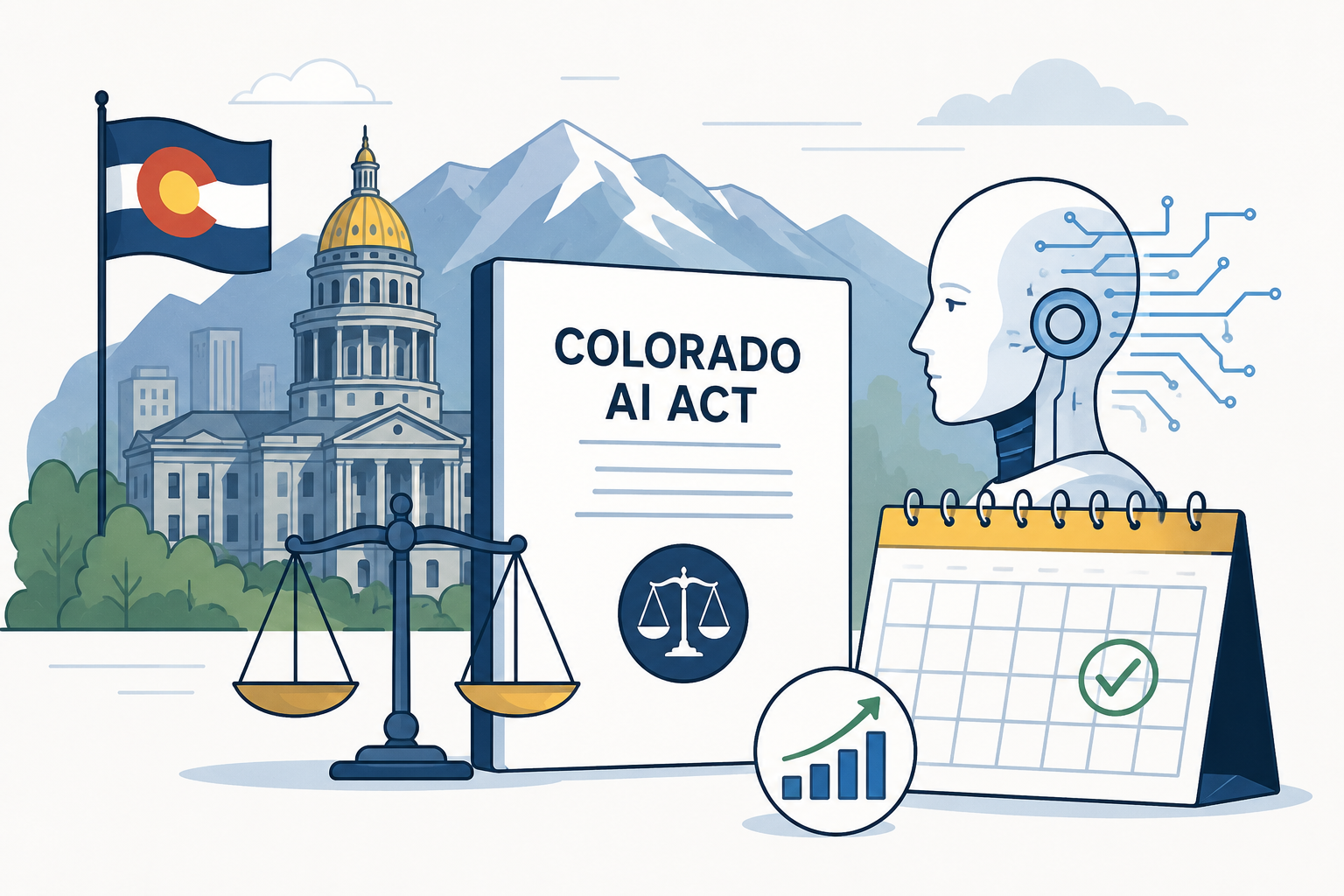
Colorado AI Act compliance one month in — has anything actually changed? Every product team, compliance officer, and in-house counsel I’ve talked to lately is asking exactly that. The short answer: yes. But the details matter far more than the headlines suggest.
Governor Jared Polis signed SB 24-205 into law in May 2024. The law takes effect February 1, 2026. The Colorado Attorney General’s office has already started shaping Colorado AI Act compliance expectations, and companies aren’t sitting on their hands. Things are shifting faster than most people predicted.
This piece goes beyond the “what is it” coverage. It breaks down Colorado AI Act compliance enforcement mechanisms, filing deadlines, penalty structures, and real compliance actions already underway. If you’re building AI products or advising teams that do, consider this your practical playbook.
Key Takeaways on Colorado AI Act Compliance
- Colorado AI Act compliance isn’t required until February 1, 2026, but enterprise companies are already acting on it.
- Vendor contracts, impact assessment templates, and internal governance teams are forming well ahead of the deadline.
- Violations can cost up to $20,000 each, and one systemic issue can multiply that into seven figures.
- An affirmative defense tied to the NIST AI RMF is the strongest protection currently offered.
- Companies outside Colorado aren’t exempt — the law applies to any business affecting Colorado residents.
What Colorado AI Act Compliance Actually Requires
What Colorado AI Act Compliance Has Changed Operationally
Colorado AI Act Compliance: Enforcement and Penalties
Colorado AI Act Compliance Case Studies: Early Movers vs. Wait-and-See
Your Colorado AI Act Compliance Checklist
How Colorado AI Act Compliance Compares to Other Regulations
What Colorado AI Act Compliance Actually Requires
Before digging into what’s changed, let’s get clear on what Colorado AI Act compliance actually demands. Colorado’s AI Act targets high-risk AI systems — systems making consequential decisions about real people. Think employment screening, lending, housing, insurance, and education.
Developers, meaning those who build or substantially modify AI systems, must provide documentation about training data and known limitations, share impact assessment results with deployers, publish a public statement describing high-risk AI systems, and report known discrimination or bias to the Attorney General within 90 days.
Deployers, meaning those using AI systems to make decisions, must set up a risk management policy, complete impact assessments before deploying high-risk AI, notify consumers when AI makes consequential decisions about them, and provide opt-out mechanisms where technically feasible.
Developers and Deployers Under Colorado AI Act Compliance
The law distinguishes between developers and deployers, and a single company can be both. The obligations differ significantly depending on which role you occupy, and that dual-role complexity is where most Colorado AI Act compliance confusion actually lives.
Consider a mid-size insurtech company that built its own underwriting model in-house and now deploys it to price policies for Colorado residents. That company is simultaneously a developer, responsible for training data documentation and bias reporting, and a deployer, responsible for consumer notifications and impact assessments. Each role carries its own checklist, deadlines, and exposure.
The National Conference of State Legislatures tracks AI legislation across all 50 states, and Colorado AI Act compliance remains the most complete approach to date.
What Colorado AI Act Compliance Has Changed Operationally
So what’s genuinely different now? Colorado AI Act compliance one month in shows that things have actually changed, though not always in the ways people expected.
Early compliance filings have started. Several enterprise software companies have begun publishing required public-facing AI system disclosures, even though these aren’t legally required until 2026. Companies are treating the pre-enforcement period as a dry run, and that’s smart — publishing early surfaces gaps you didn’t know existed. Several teams discovered, only after drafting their public statement, that they couldn’t adequately describe their training data sources.
Impact assessments are being drafted too. In-house legal teams at major HR tech firms have started building impact assessment templates, and fintech companies using AI for credit decisions are mapping their systems against the law’s requirements. These assessments take longer than most teams expect, since a single one can require input from data science, product, legal, and compliance.
Vendor contracts are changing, and this is perhaps the most tangible shift. Procurement teams now include Colorado AI Act compliance clauses in software agreements, requiring developers to provide the documentation the law mandates before the deadline arrives. Some vendors aren’t ready to provide it, forcing deployers to choose between delaying onboarding or accepting contractual risk they haven’t fully priced.
Internal governance structures are forming as well. Companies are appointing AI compliance leads and creating cross-functional teams spanning legal, engineering, and product. Several large employers have begun training programs for teams that interact with high-risk AI systems — the most effective versions are role-specific workshops, not hour-long legal overviews.
What Hasn’t Changed Yet in Colorado AI Act Compliance
No enforcement actions have been taken, since the law isn’t effective until 2026, and no formal guidance or standardized impact assessment templates exist from the state yet. Small and mid-size companies remain largely unaware of their Colorado AI Act compliance obligations — and that concerns me more than anything else on this list.
Colorado AI Act Compliance: Enforcement and Penalties
Understanding enforcement is critical. How penalties actually work determines whether Colorado AI Act compliance has real teeth, and it does.
The Colorado Attorney General holds exclusive enforcement authority over Colorado AI Act compliance. Private citizens can’t sue under this law — a deliberate design choice that prevents a flood of litigation while concentrating enforcement power in one office.
The law treats violations as unfair or deceptive trade practices under the Colorado Consumer Protection Act, with penalties up to $20,000 per violation. For systematic violations affecting many consumers, fines escalate rapidly. A mortgage lender running an AI-assisted underwriting tool that discriminates against 500 Colorado applicants isn’t looking at one $20,000 fine — the per-violation framing means exposure can reach seven figures.
The Affirmative Defense in Colorado AI Act Compliance
Companies that show reasonable care can raise an affirmative defense, and this is the law’s most important feature for compliance teams. Reasonable care requires compliance with a nationally recognized risk management framework, completion of impact assessments, timely discovery and response to discrimination, and reasonable disclosure practices.
The NIST AI Risk Management Framework is the most commonly referenced standard for Colorado AI Act compliance. Adopting it doesn’t guarantee immunity, but it significantly strengthens your affirmative defense position — right now, that’s the closest thing to a safety net the law offers.
Don’t just adopt the framework in name for Colorado AI Act compliance purposes. Document every governance decision against it, since an AG investigation will look for evidence the framework shaped actual behavior, not just a policy PDF sitting in a shared drive.
| Penalty Element | Details |
|---|---|
| Enforcing body | Colorado Attorney General |
| Private right of action | No |
| Penalty per violation | Up to $20,000 |
| Affirmative defense available | Yes — requires “reasonable care” |
| Framework alignment recommended | NIST AI RMF |
| Effective date | February 1, 2026 |
| Pre-enforcement guidance | Not yet issued |
| Reporting obligation (bias) | Within 90 days of discovery |
The Attorney General can also seek injunctive relief — a court order forcing a company to stop using a discriminatory AI system entirely. For many companies, that disruption is scarier than the fine itself. Imagine an HR platform whose resume-screening tool gets enjoined mid-hiring season for a major client — the downstream contract liability and reputational damage dwarfs any per-violation fine.
Colorado AI Act Compliance Case Studies: Early Movers vs. Wait-and-See
At the company level, the contrast between proactive and reactive organizations is striking, and it tells you everything about where Colorado AI Act compliance has actually moved the needle.
Several enterprise AI vendors have already published transparency statements, even though the law doesn’t require these until 2026. Workday, for instance, has been vocal about its approach to responsible AI governance, with public documentation addressing bias testing, training data descriptions, and system limitations that goes beyond what the law strictly requires.
Major cloud providers are updating their AI service terms too, adding contractual commitments that align with Colorado AI Act compliance obligations for developers. This protects deployers who rely on third-party AI tools, which is most companies.
One pattern worth noting: early movers use Colorado AI Act compliance as a forcing function to clean up documentation debt accumulated over years. A company that maps its training data sources to meet Colorado’s disclosure requirements often finds that same documentation helps it answer security questionnaires faster, satisfy EU AI Act requirements, and onboard new engineers more efficiently.
Many mid-market SaaS companies, meanwhile, haven’t started Colorado AI Act compliance work at all. Their reasoning varies: the law isn’t effective until 2026, they don’t operate in Colorado (though their customers might), their AI doesn’t make consequential decisions (often wrong), or they’re waiting for AG guidance first.
This wait-and-see approach carries real risk. Impact assessments take months to complete properly, and vendor documentation requirements mean you can’t comply overnight. The companies starting now will be ready; those waiting until late 2025 likely won’t be — the same story played out with GDPR and CCPA, and here we are again.
The “our AI doesn’t make consequential decisions” assumption deserves scrutiny. Product leaders who believed their tool was just a dashboard have discovered, after walking through the decision flow, that a hiring manager’s final call was almost entirely driven by a ranked list the AI generated. The AI didn’t technically decide, but it substantially contributed — and under Colorado AI Act compliance rules, that distinction may not protect you.
The Geographic Trap in Colorado AI Act Compliance
Some companies assume they’re safe from Colorado AI Act compliance because they’re headquartered outside Colorado. That assumption is wrong. The law applies to AI systems that affect Colorado residents, so any company with Colorado customers using high-risk AI should already be preparing. “We’re based in Texas” is not a compliance strategy.
Your Colorado AI Act Compliance Checklist
Colorado AI Act compliance work that actually matters must be concrete and measurable. Here’s a practical checklist organized by role, since specificity is what separates useful checklists from decorative ones.
For in-house counsel: classify your AI systems and map every tool your company builds or uses against the Act’s high-risk definitions. Assess dual-role exposure to determine whether you’re a developer, deployer, or both for each system. Adopt a risk management framework like NIST AI RMF or ISO 42001, and document your adoption thoroughly — vague references won’t hold up.
Draft impact assessment templates rather than waiting for state-issued ones. A useful starting structure covers system description, intended use cases, affected populations, known performance disparities across groups, and mitigation steps. Update vendor contracts to add compliance clauses requiring developer documentation and bias testing results. Set up a bias reporting protocol within the 90-day window, and train your teams so product managers, engineers, and data scientists understand their obligations.
For product teams: audit your models and document training data sources, known limitations, and performance metrics across demographic groups. Build consumer notification flows using UX patterns that tell users when AI makes consequential decisions about them — a plain-language banner works as a starting point, but test it with real users to confirm they understand it.
Create opt-out mechanisms where technically feasible, giving consumers pathways to request human review. Set up monitoring dashboards to track model performance for disparate impact across protected classes, and version your documentation to keep records of impact assessments, model changes, and compliance decisions.
A Colorado AI Act Compliance Timeline
AI system inventory and risk framework adoption should be critical priorities for Q3 2025. Impact assessment completion and vendor contract updates should follow by Q4 2025 as high priorities, alongside medium-priority consumer notification design work.
Public transparency statements and team training completion should target Q1 2026 on your Colorado AI Act compliance timeline, and your bias reporting protocol needs to be live by February 1, 2026 — a critical, non-negotiable deadline.
This isn’t a one-time exercise. Colorado AI Act compliance requires ongoing monitoring and updated impact assessments, treated as a continuous program rather than a project with a finish line. Build re-assessment triggers into your governance process — after any significant retraining, after major feature changes, and on a fixed annual schedule regardless of changes.
| Action Item | Recommended Deadline | Priority |
|---|---|---|
| AI system inventory | Q3 2025 | Critical |
| Risk framework adoption | Q3 2025 | Critical |
| Impact assessment completion | Q4 2025 | High |
| Vendor contract updates | Q4 2025 | High |
| Consumer notification design | Q4 2025 | Medium |
| Public transparency statements | Q1 2026 | Medium |
| Team training completion | Q1 2026 | High |
| Bias reporting protocol live | February 1, 2026 | Critical |
How Colorado AI Act Compliance Compares to Other Regulations
Understanding Colorado AI Act compliance requires broader context. Has anything actually changed in the wider regulatory environment? Absolutely, and the comparison is genuinely instructive.
| Feature | Colorado SB 24-205 | EU AI Act | NYC Local Law 144 |
|---|---|---|---|
| Scope | High-risk consequential decisions | All AI by risk tier | Employment decisions only |
| Applies to developers | Yes | Yes | No |
| Applies to deployers | Yes | Yes | Yes |
| Impact assessments required | Yes | Yes (high-risk) | Yes (bias audits) |
| Consumer notification | Yes | Yes | Yes |
| Private right of action | No | Limited | No |
| Affirmative defense | Yes | No | No |
| Effective date | Feb 2026 | Phased through 2027 | July 2023 |
The European Union’s AI Act takes a tiered approach based on risk levels. Colorado’s law is narrower, focusing on consequential decisions rather than sorting all AI by risk tier, though both share a clear emphasis on transparency and impact assessments. One concrete difference: the EU AI Act requires conformity assessments for certain high-risk systems before market placement, a pre-market gate Colorado’s law doesn’t replicate.
Illinois, Texas, and California have all introduced AI-related legislation, but none match Colorado AI Act compliance’s complete approach to both developers and deployers. New York City’s Local Law 144 covers automated employment decision tools but is far narrower in scope. Colorado is genuinely in a category of its own right now.
Colorado AI Act Compliance vs. the EU AI Act
Congress hasn’t passed comprehensive AI legislation yet, so state laws like Colorado’s are filling the vacuum, and filling it fast — which is part of why Colorado AI Act compliance now sets the bar other states are watching. The White House Executive Order on AI set federal principles but lacks direct enforcement mechanisms for private companies.
Some industry groups are pushing for federal preemption, arguing that a patchwork of state laws creates impossible compliance burdens. A single federal standard would reduce compliance costs for companies operating nationally, but it would likely produce a weaker baseline than Colorado AI Act compliance already requires. Don’t count on preemption saving you before 2026 — plan accordingly.
Conclusion: What Colorado AI Act Compliance Means for You
So, has anything actually changed with Colorado AI Act compliance one month in? The evidence says yes, though unevenly. Enterprise companies are moving; mid-market firms are lagging. The enforcement clock is ticking toward February 2026 regardless of where anyone stands.
The operational shifts are real. Vendor contracts now include AI compliance clauses, impact assessments are being drafted, and governance structures are forming. These changes aren’t theoretical — they’re happening in procurement offices and engineering standups right now.
Start your AI system inventory this quarter — you can’t comply with rules you haven’t mapped to your products. Adopt the NIST AI RMF immediately; it’s your strongest path to an affirmative defense. Update vendor agreements before Q4 2025, since negotiations take time and you need developer documentation flowing. Build cross-functional compliance teams now — legal can’t do this alone.
Colorado AI Act compliance proves that things actually change when legislation has teeth, even before enforcement begins. The companies preparing now will be ready. The rest will be scrambling.
FAQ About Colorado AI Act Compliance
Does Colorado AI Act Compliance Apply Outside Colorado?
Yes. The law applies to any developer or deployer whose AI systems affect Colorado residents, so your company’s location doesn’t matter. What matters is whether your high-risk AI makes consequential decisions about people in Colorado. If you have Colorado customers, you likely have Colorado AI Act compliance obligations.
What Qualifies as a High-Risk AI System Under Colorado AI Act Compliance?
Colorado AI Act compliance defines high-risk AI systems as those making or substantially contributing to consequential decisions about employment, education, financial services, housing, insurance, and legal services. The AI system must be a substantial factor in the decision, not merely a minor input. If your tool screens resumes, approves loans, or sets insurance rates, it almost certainly qualifies.
What’s the Colorado AI Act Compliance Deadline?
The law takes effect February 1, 2026. All obligations — impact assessments, consumer notifications, public disclosures, and risk management programs — must be operational by that date. Enforcement hasn’t started yet, but the preparation timeline is tight, and most compliance programs take six to twelve months to build properly.
Can Consumers Sue Under Colorado AI Act Compliance Rules?
Keep reading
Here are the latest posts from the blog.

Apple Amazon AI spending is the real story hiding behind today’s earnings reports, and the answer might genuinely surprise you. Both giants report today, and investors are wr…

Should every AI lab run an AI jailbreak bug bounty program the way traditional software companies handle security bounties? That question is genuinely splitting the AI safety…

The race to build humanoid robots at scale just split into two distinct lanes. Figure AI vs Optimus is the clearest divergence yet in how companies plan to manufacture humano…