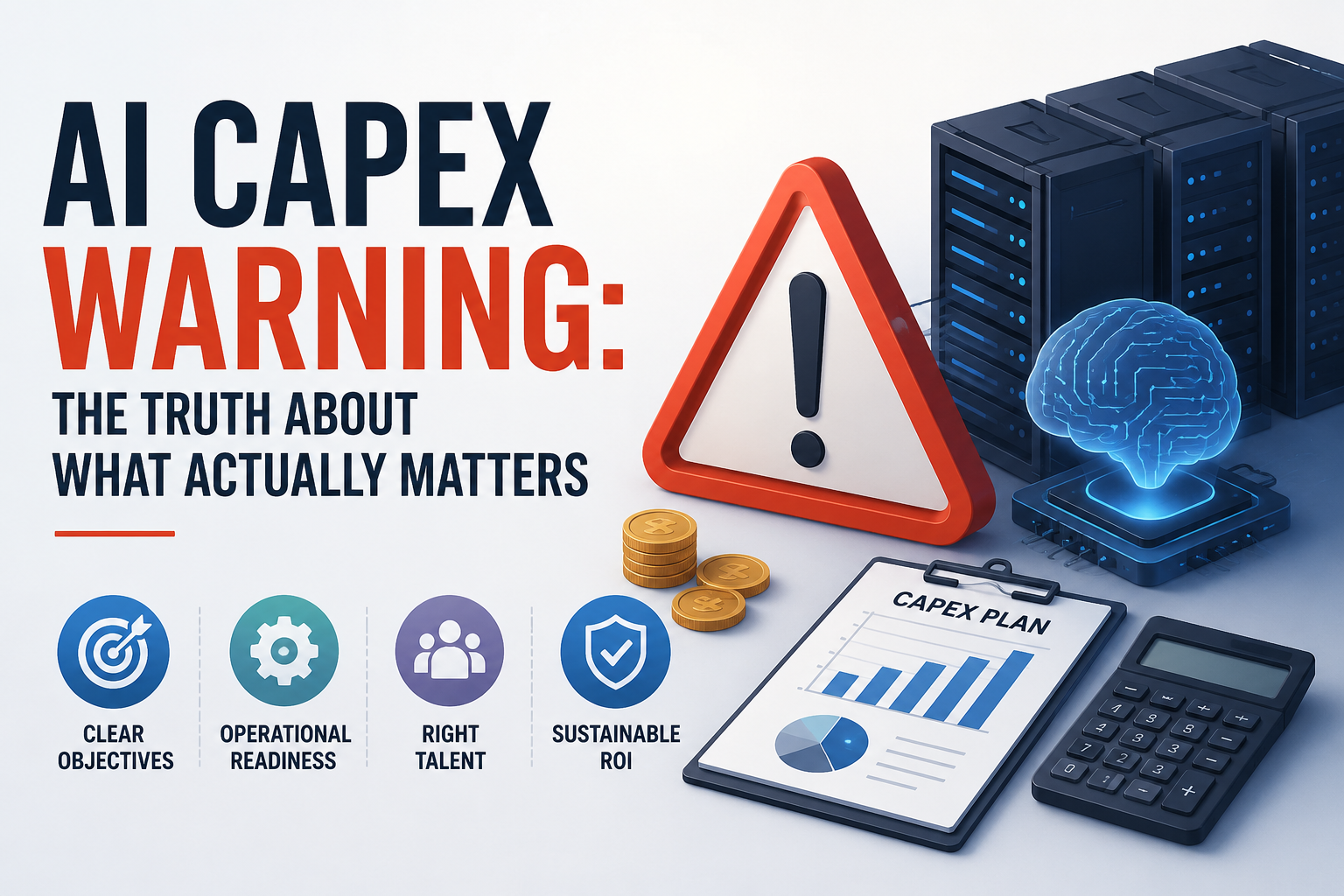
AI Capex: Microsoft, Meta, Apple, and Amazon are reporting earnings this week, and between the four of them, roughly $725 billion in AI capital expenditure needs to justify itself, fast. Investors aren’t just clapping for revenue beats anymore. They want receipts — proof that hundreds of billions poured into GPU clusters, custom chips, and half-built data centers are actually moving the needle rather than just generating impressive press releases.
This earnings season genuinely feels different. All four tech giants are simultaneously defending the largest corporate infrastructure buildout in history, and each one measures AI capex returns through a completely different lens, which makes any clean comparison genuinely difficult. This piece builds a framework for cutting through that noise: how each company justifies its AI capex, where inference costs are actually heading, whether more spending is translating into meaningfully better models, and what the real warning signs would look like if this entire bet doesn’t pay off the way everyone’s currently assuming.
How $725B in AI Capex Actually Breaks Down
Inference Cost Per Token: The AI Capex Metric That Matters Most
How Microsoft, Meta, Amazon, and Apple Measure AI Capex Returns
Does AI Capex Actually Buy Better Models?
What Happens If AI Capex Returns Don’t Materialize
How $725B in AI Capex Actually Breaks Down
The scale here is genuinely hard to sit with, even for people who follow this space closely. Across fiscal 2024 and projected 2025 budgets, these four companies have committed roughly $725 billion combined to AI-related capital expenditure — data center construction, GPU purchases, custom silicon, and networking infrastructure, the entire stack from the ground up. Every one of these companies’ spending trajectories has accelerated sharply over just the last 12 months.
Here’s where each stands individually.
- Microsoft guided approximately $80 billion in AI capex for fiscal 2025, nearly double its fiscal 2023 spending in just two years.
- Meta raised its 2025 guidance to $60–65 billion, up from an already-elevated $37 billion in 2024.
- Amazon committed over $100 billion in 2025 capex, with AWS infrastructure consuming the lion’s share of that total.
- Apple, by contrast, historically spends far less on raw compute but has quietly ramped up R&D spending on Apple Intelligence and on-device AI models instead.
Raw numbers don’t tell the whole story on their own, though. Revenue per AI capex dollar is one of the more useful lenses for actually comparing these companies. Microsoft generates roughly $2.40 in cloud revenue for every dollar of capex spent. Amazon’s ratio sits closer to $1.80, reflecting AWS’s lower-margin infrastructure business model. Meta’s ratio is harder to calculate cleanly, since its AI spending supports advertising rather than direct cloud sales — you can’t just divide one number by another and call it settled.
Apple’s approach is fundamentally different from the other three in a way that’s easy to overlook. Its AI capex focuses on device-side inference rather than cloud-scale training, which means Apple measures returns through device upgrade cycles and services revenue instead of raw compute throughput. It’s a quieter bet than what Microsoft, Meta, and Amazon are making — but potentially a smarter one if it plays out the way Apple is clearly hoping it will.
Inference Cost Per Token: The AI Capex Metric That Matters Most
Here’s the thing that gets lost in most coverage of this earnings season: when you look past the headline capex numbers, the real story increasingly comes down to inference economics. Training a frontier model is a one-time cost. Serving it to billions of users every single day is the ongoing expense that will actually determine who wins this entire race, and it’s the number that matters more than any single quarter’s AI capex figure.
Inference cost per token has dropped dramatically over the past 18 months, faster than most analysts predicted. Several forces are compounding at once here.
- Hardware improvements matter enormously — Nvidia’s H200 and B200 GPUs deliver two to four times better inference throughput per watt compared to the previous A100 generation.
- Model distillation helps too, with companies training smaller, faster models that approximate frontier quality at a fraction of the compute cost.
- Quantization techniques, running models at lower numerical precision like INT8 or INT4 instead of FP16, cut memory and compute requirements significantly on their own.
- And custom silicon — Amazon’s Trainium2, Google’s TPUs, Microsoft’s Maia chips — reduces dependence on Nvidia’s pricing power across the board.
OpenAI’s own API pricing history makes this trend concrete in a way abstract percentages don’t. GPT-4’s input token cost dropped from $30 per million tokens at launch to $2.50 for GPT-4o mini — a 92% reduction in roughly 18 months. That’s the kind of number that makes an entire industry’s AI capex bet look either brilliant or terrifying, depending on which side of the falling price curve you’re sitting on.
Meta’s open-source strategy with its Llama models creates a genuinely different cost dynamic worth understanding separately. By releasing model weights publicly, Meta effectively shifts inference costs onto the broader ecosystem rather than bearing them alone. That doesn’t reduce Meta’s own training capex, but it does generate goodwill, attract developer talent, and improve Meta’s own advertising models through community feedback loops it doesn’t have to fully fund itself. The real kicker is that Meta gets better models partly on someone else’s dime, which is a genuinely clever wrinkle in how its AI capex actually pays off.
The bottom line here is straightforward even if the mechanics aren’t: inference costs are falling fast, but total inference spending is still rising, because usage is growing even faster than costs are dropping. Every cost reduction unlocks new use cases, which drives more demand right back. The floor keeps dropping and the ceiling keeps rising at the same time.
How Microsoft, Meta, Amazon, and Apple Measure AI Capex Returns
As these four companies report this week on their combined AI capex, their return metrics diverge sharply enough that a genuine apples-to-apples comparison is close to impossible. Here’s how each one frames its own AI payoff.
Microsoft ties its AI capex returns directly to Azure consumption growth, and CEO Satya Nadella has hammered this point on every earnings call for two years running. The company tracks Azure AI services revenue run rate, GitHub Copilot subscriber count (now exceeding 1.8 million paid subscribers), Microsoft 365 Copilot enterprise seat adoption, and AI-driven Azure consumption per customer. Microsoft benefits from a genuine flywheel here — more Azure AI usage justifies more AI capex, which improves model hosting capability, which attracts more customers in turn, and the data so far backs up that cycle.
Meta’s AI spending serves one singular purpose: improving ad targeting and content recommendation, full stop. It measures returns through revenue per ad impression across Facebook and Instagram, Reels engagement driven by AI recommendation algorithms, advertiser return on ad spend improvements, and time spent on platform as a proxy for recommendation quality. Meta’s real advantage is direct attribution — every improvement in its recommendation models translates into measurable ad revenue gains almost immediately, which is why Meta can justify enormous AI capex despite lacking a cloud business like Microsoft’s to point to.
Amazon measures AI capex returns primarily through AWS: AI services annual revenue run rate reportedly exceeding $10 billion, Bedrock API usage growth, Trainium and Inferentia custom chip adoption rates, and overall AWS operating margin trends. Amazon also deploys AI extensively across its retail operations — warehouse robotics, demand forecasting, delivery route optimization — applications that reduce costs rather than generate direct revenue, which makes clean ROI calculations genuinely messier than Microsoft’s or Meta’s more direct stories.
Apple’s AI capex return metrics are the most indirect of the four, and arguably the most interesting to watch long-term: iPhone upgrade rates following Apple Intelligence features, Siri usage frequency and task completion rates, services revenue growth tied to AI features, and developer adoption of Core ML and Apple Intelligence APIs. Much like its privacy positioning, Apple treats AI as a product differentiator rather than a standalone revenue stream. Its absolute AI capex is smaller than the other three, but it could prove more capital-efficient per dollar spent if it drives meaningful upgrade cycles the way Apple is clearly betting it will.
| Company | Primary AI Metric | Estimated 2025 AI Capex | Revenue Attribution Model |
|---|---|---|---|
| Microsoft | Azure AI consumption | ~$80B | Direct cloud revenue |
| Meta | Ad revenue per impression | ~$60–65B | Advertising efficiency |
| Amazon | AWS AI services bookings | ~$100B+ | Cloud revenue + cost savings |
| Apple | Device upgrade cycles | ~$15–20B (est.) | Hardware + services bundle |
Does AI Capex Actually Buy Better Models?
A critical question sits underneath all of this earnings-season spending: does more compute actually produce meaningfully better AI? The honest answer is that it’s complicated, and it’s getting more complicated by the quarter.
Scaling laws still hold, mostly. Research from Epoch AI shows model performance keeps improving with more training compute, but the rate of improvement is slowing noticeably — doubling compute now yields roughly 10–15% improvement on standard benchmarks, down from the 20–30% improvements seen back in 2022–2023. That deceleration is real, and it directly complicates the simple story of “more AI capex equals proportionally better models.”
A few important caveats apply on top of that trend.
- Benchmark saturation is a real issue — models are hitting ceiling effects on older benchmarks like MMLU, while newer benchmarks like GPQA and ARC-AGI-2 show considerably more headroom, which is where the interesting signal actually lives now.
- Post-training gains matter too — reinforcement learning from human feedback and chain-of-thought reasoning are delivering real performance gains without proportional increases in AI capex.
- And data quality is increasingly outweighing data quantity — curating higher-quality training data produces better results than simply scaling dataset size further, and notably, that’s a labor cost more than a compute cost.
The relationship between AI capex and model quality isn’t linear, in other words. Companies that spend smarter, not just more, will see disproportionate returns going forward — which isn’t a comfortable message for the companies currently writing the biggest checks in history.
Inference-time compute is an emerging factor that’s arguably underpriced in most analyst models right now. Systems that spend more compute during inference to reason through hard problems shift the entire value equation. Rather than pouring billions into ever-larger training runs, companies can instead invest AI capex into inference infrastructure that makes existing models perform better on genuinely hard tasks. There’s also a real argument that architectural innovation may matter more than raw compute for the next generation of capability gains — meaning the company with the strongest research team, not necessarily the biggest GPU cluster, could end up winning the next round entirely.
For anyone tracking this from the outside, a few practical signals are worth watching:
- diminishing returns in benchmark performance relative to AI capex growth,
- inference cost per token as a leading indicator of capital efficiency,
- custom chip adoption rates as a signal of long-term cost structure improvement,
- and revenue per GPU hour rather than just raw GPU count.
What Happens If AI Capex Returns Don’t Materialize
Optimism dominates the current AI narrative, but $725 billion in combined AI capex carries real risk, and this week’s earnings calls will get scrutinized specifically on whether spending is outpacing revenue generation.
Historical precedent isn’t entirely reassuring here. The telecom industry spent over $500 billion on fiber optic infrastructure in the late 1990s, and much of that capacity sat dark for years afterward. The internet eventually justified the investment, but many of the companies that actually built the infrastructure went bankrupt before ever seeing the payoff themselves. That’s worth keeping in the back of your mind when evaluating today’s AI capex numbers.
Several factors do make the current AI buildout meaningfully different, though. There’s immediate revenue generation involved — unlike speculative fiber builds, AI infrastructure is already generating tens of billions annually through cloud services right now, not hypothetically someday. There are multiple simultaneous use cases too — AI compute serves training, inference, scientific research, and enterprise automation all at once, where fiber primarily served a single use case. And unit costs keep falling, since each hardware generation delivers more performance per dollar, improving the return on facilities that are already built and running.
The real risk here isn’t binary, though — it’s not a question of whether AI capex generates returns at all, because it clearly does already. The actual question is whether $725 billion generates enough returns to justify the opportunity cost, since that same money could otherwise fund buybacks, dividends, acquisitions, or other investments entirely. That opportunity cost calculation is what will ultimately define how this story reads in five years.
A handful of warning signs are worth watching closely from here: AI capex growth significantly outpacing AI revenue growth for more than two consecutive quarters, rising depreciation expenses compressing operating margins, customer concentration risk where a few large AI customers drive most incremental revenue, and inventory buildups of older GPU generations as newer chips keep arriving faster than the old ones can be absorbed.
Conclusion: Final Thoughts on the AI Capex Bet
The $725 billion in combined AI capex from Microsoft, Meta, Amazon, and Apple represents both the largest corporate infrastructure bet in history and a defining test of capital allocation discipline. Each company measures returns differently, and each is making a fundamentally different wager about where AI value ultimately ends up landing.
The evidence so far is cautiously encouraging. Inference costs are falling rapidly. AI revenue is growing at triple-digit rates for the cloud providers specifically. Model performance keeps improving, even at a decelerating pace. Custom silicon investments from Amazon and Microsoft should meaningfully improve cost structures over the next 12 to 24 months as those chips scale into wider deployment.
A few things worth tracking going forward:
- Compare each company’s AI revenue growth rate against its AI capex growth rate — the gap tells you whether spending is actually productive.
- Watch inference cost per token trends quarterly, since that single metric captures hardware efficiency, model optimization, and competitive positioning all at once.
- Keep an eye on custom chip adoption, since companies reducing their Nvidia dependence will likely have structurally better margins long-term.
- Monitor open-source model quality relative to proprietary models — if the gap narrows, Meta’s strategy looks smarter in hindsight; if it widens, Microsoft’s OpenAI partnership does.
- And don’t discount Apple’s quieter approach — on-device AI could prove the most capital-efficient strategy of the four if it drives the upgrade cycles Apple is clearly betting on.
This isn’t really a story about spending anymore. It’s a story about whether the largest companies on Earth can convert an unprecedented, coordinated AI capex bet into a genuinely sustainable competitive advantage — and this week’s earnings calls will offer the clearest evidence yet of how that bet is actually playing out.
FAQ About AI Capex and Big Tech Earnings
How much are these four companies actually spending on AI capex in 2025?
Combined, Microsoft, Meta, Amazon, and Apple are projected to spend approximately $725 billion on AI-related capital expenditure across fiscal 2024 and 2025. Microsoft leads with roughly $80 billion in fiscal 2025 guidance. Amazon follows with over $100 billion. Meta has guided $60–65 billion. Apple’s AI-specific spending is harder to isolate but likely falls in the $15–20 billion range once R&D and infrastructure are combined.
What does all this AI capex actually pay for?
AI capital expenditure covers several major categories. Data center construction represents the largest share — land, buildings, cooling systems, and power infrastructure. GPU and custom chip purchases come next, followed by networking equipment including the high-speed interconnects between servers. Companies are also increasingly investing in power generation agreements directly, sometimes building dedicated substations or negotiating nuclear power contracts to secure reliable electricity for AI workloads specifically.
Why are inference costs falling so quickly relative to AI capex spending?
Inference costs are dropping due to several compounding factors hitting at once: newer GPU architectures delivering more computation per watt, model distillation producing smaller models that approximate larger ones, quantization reducing numerical precision requirements, and custom chips from Amazon and Microsoft offering lower per-token costs than Nvidia GPUs for specific workloads. Altogether, these improvements have cut API pricing by over 90% for comparable model quality since early 2023.
Which company has the best return on its AI capex?
That depends entirely on how you define return, and no single company dominates across every metric. Meta arguably has the most direct attribution, since every AI improvement maps to measurable advertising revenue almost immediately. Microsoft benefits from high-margin Azure AI services with strong revenue visibility. Amazon generates returns through both AWS revenue and internal cost savings across its retail operations. Apple captures returns indirectly through device sales and services. The “winner” genuinely changes depending on which specific metric you prioritize.
Could all this AI capex spending lead to a bubble?
The comparison to the 1990s telecom bubble comes up often but isn’t a perfect fit. Unlike speculative fiber builds, AI infrastructure generates immediate, measurable revenue — cloud AI services are already a multi-billion-dollar business for Microsoft, Amazon, and Google right now. That said, the risk of overbuilding is real: if AI revenue growth slows while AI capex keeps accelerating, margins could compress meaningfully. Today’s tech giants also have far more diversified revenue streams and stronger balance sheets than the telecom companies of the late 1990s, which meaningfully reduces bankruptcy risk even in a slower-growth scenario.
How should investors evaluate AI capex during earnings calls?
Focus on a handful of specific data points: compare each company’s AI revenue growth rate against its AI capex growth rate, ask about inference cost per token trends, monitor customer adoption metrics like Azure AI consumption or AWS Bedrock usage, track operating margin trends to see whether AI-related depreciation is compressing profitability, and — often overlooked — listen for any guidance on when management expects AI investments to become self-funding through generated revenue. That last answer tends to reveal a lot about internal confidence levels.
Keep reading
Here are the latest posts from the blog.

Getty Images sued Stability AI in January 2023, accusing the company of scraping millions of copyrighted photos without permission. Then, in a move that surprised almost ever…
When OpenAI shipped GPT-5.6, codenamed “GPT Sol,” most of the coverage focused on benchmark scores. That missed the bigger story. What Sol actually locked in wasn’t a reasoni…
Elon Musk said Tesla would be selling humanoid robots to outside customers by 2025. That hasn’t happened, and every recent earnings call has leaned on the same phrase to expl…