Vulnerability Disclosure: The Process That Turns AI Findings Into Patches

Vulnerability Disclosure: The Process That Turns AI Findings Into Patches

When a security researcher finds a flaw in an AI system, what actually happens next? The vulnerability disclosure process turns AI security findings from dangerous secrets into shipped patches — but the path from “I found something bad” to “it’s fixed” is rarely clean. It involves coordination, trust, legal frameworks, and sometimes genuinely tense negotiations between independent researchers and billion-dollar companies.

And it matters more than ever right now. AI systems are handling medical diagnoses, financial transactions, and critical infrastructure. A single unpatched vulnerability could affect millions of people. Furthermore, as the Five Eyes alliance warns about AI-related cyber threats, the defensive infrastructure behind disclosure deserves serious attention — not just from security teams, but from anyone building or deploying AI.

How Vulnerability Disclosure Works in AI Security

Vulnerability disclosure is the structured process of reporting security flaws to whoever is responsible for fixing them. Specifically, it bridges the gap between finding a bug and actually deploying a patch. The vulnerability disclosure process turns AI security research into concrete defensive action — when it works, anyway.

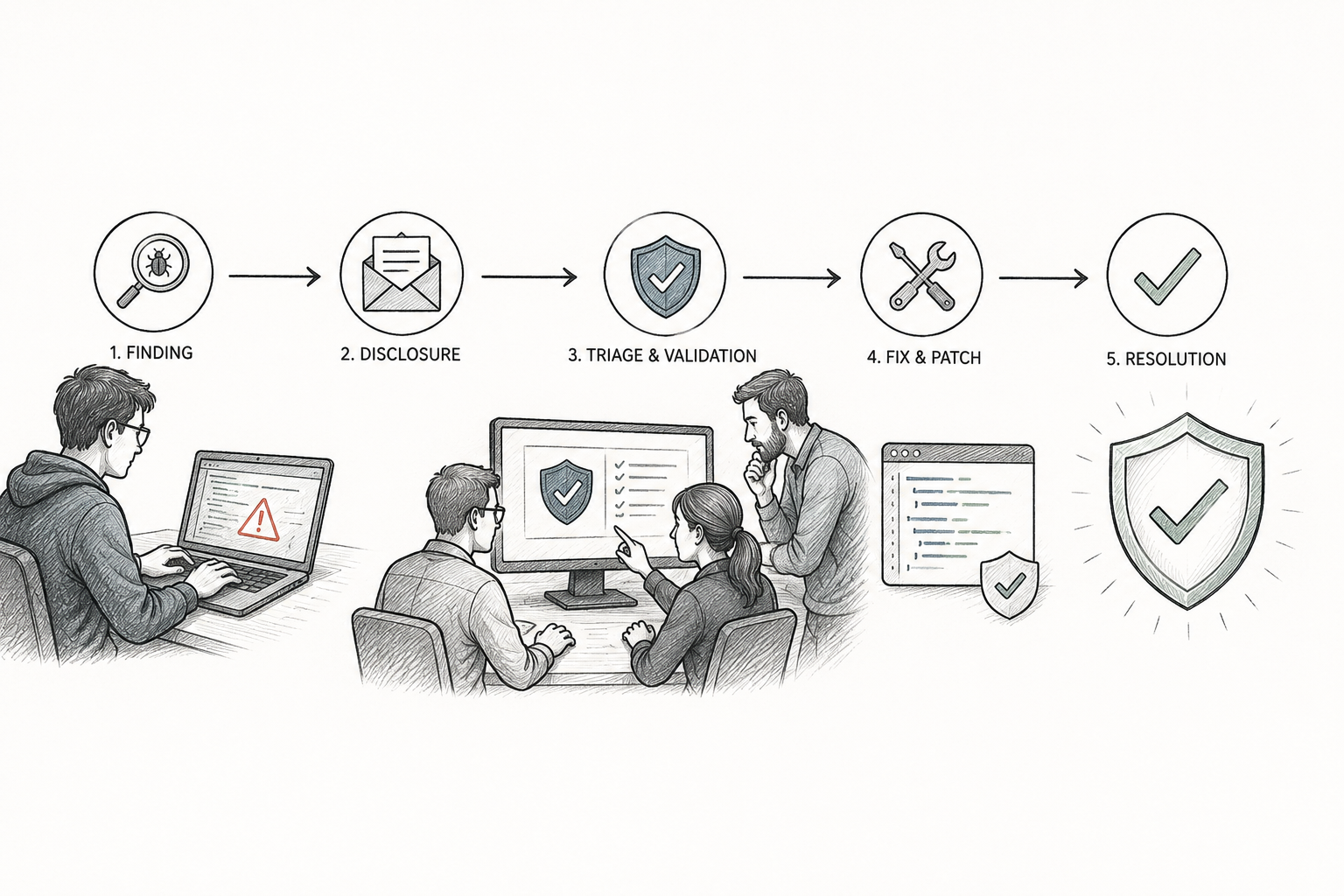
Here’s how the typical flow looks:

1. Discovery — A researcher identifies a flaw in an AI model, API, or deployment pipeline.

2. Documentation — They write up a detailed report: reproduction steps, severity assessment, potential impact.

3. Initial contact — The researcher reaches out through whatever designated security channel the vendor actually maintains.

4. Acknowledgment — The vendor confirms receipt, usually within 24–72 hours.

5. Triage and validation — The vendor’s security team reproduces and assesses the bug internally.

6. Patch development — Engineers build, test, and stage a fix.

7. Coordinated release — Both parties agree on a public disclosure date after the patch ships.

Neat on paper. However, real-world timelines are genuinely messy. Researchers sometimes wait months for a meaningful response. Vendors occasionally dispute severity ratings in ways that feel more like stalling than honest disagreement. Embargo periods — the agreed-upon silence before public disclosure — can stretch uncomfortably long.

Responsible disclosure differs from full disclosure in one critical way: responsible disclosure gives vendors time to fix flaws before the public learns about them. Full disclosure publishes everything immediately, patch or no patch. Most AI labs strongly prefer the responsible approach. Nevertheless, researchers retain the right to go public if vendors ignore them — and good ones will exercise that right.

I’ve watched this dynamic play out repeatedly over the years, and the researchers who set firm deadlines upfront tend to get faster responses. It’s not adversarial — it’s just smart negotiation.

The CERT Coordination Center at Carnegie Mellon has published guidelines that many AI companies now follow. Their 45-day disclosure window has become something of an industry benchmark, although AI vulnerabilities often need longer timelines due to model retraining requirements. That 45-day standard was built for traditional software — it’s already straining under AI’s complexity.

The Embargo Period: Where Trust Meets Tension

The embargo period is arguably the most delicate phase of the entire process. During this window, the vulnerability disclosure process turns AI security coordination into a genuine trust exercise. Both sides agree to stay quiet while the fix ships — and that agreement can be fragile.

What actually happens during an embargo:

  • The vendor patches the vulnerability in private branches
  • Security teams verify the fix doesn’t introduce new bugs (this happens more than you’d think)
  • Communications teams draft advisories and CVE descriptions
  • The researcher prepares their public write-up for post-embargo release
  • Both parties lock in a specific date and time for coordinated publication

Embargo periods for AI vulnerabilities tend to run longer than traditional software bugs. Because AI model fixes often require retraining, fine-tuning, or deploying new guardrails, you can’t simply push a code commit and call it done. Consequently, 90-day windows are now common for AI-specific flaws — and even that sometimes isn’t enough.

Tensions typically arise when:

  • Vendors request extensions well beyond the agreed timeline, often without clear justification
  • Researchers suspect the vendor isn’t actively working on a fix at all
  • A third party independently discovers and publishes the same vulnerability mid-embargo
  • The flaw is actively being exploited in the wild, making silence feel irresponsible

Google’s Project Zero famously enforces a strict 90-day deadline — after that, they publish regardless. This policy has genuinely forced major vendors to prioritize fixes in ways polite requests never did. Meanwhile, AI labs have adopted similar but slightly more flexible approaches, which is reasonable given the complexity involved.

Notably, Anthropic’s security team has publicly committed to acknowledging vulnerability reports within 48 hours. OpenAI operates a bug bounty program through Bugcrowd with tiered payouts based on severity. Meta’s AI red team handles disclosures for their open-source Llama models through their existing security reporting infrastructure. Each approach reflects different organizational priorities — and honestly, each has real tradeoffs.

Here’s the thing: the embargo period works when both sides are acting in good faith. When they’re not, it just delays the inevitable.

Case Studies: Real AI Vulnerability Disclosures

Examining actual cases shows how the vulnerability disclosure process turns AI security theory into messy, instructive practice. Each major AI lab handles things differently, and the differences are telling.

Prompt injection attacks on GPT-4 (2023–2024)

Researchers discovered that carefully crafted prompts could override system instructions in GPT-4. This surprised me when I first dug into the details — the attack surface was broader than most people assumed at the time. The disclosure timeline looked roughly like this:

  • Discovery and documentation: 2 weeks
  • Initial report to OpenAI: Day 1
  • Acknowledgment from OpenAI: Within 24 hours
  • Patch deployed (improved input filtering): Approximately 30 days
  • Public disclosure: After patch confirmation

Thirty days to patch is actually fast. Worth noting.

Llama 2 safety bypass (2023)

Because Meta released Llama as open-source, the disclosure dynamic shifted considerably. Researchers published findings more quickly since anyone could inspect the model weights anyway. Meta’s response involved updating safety fine-tuning and publishing revised model cards. The open-source nature actually accelerated the fix cycle — which is a genuinely interesting counterintuitive result. Moreover, community contributors flagged additional edge cases that Meta’s internal team had missed.

Anthropic’s Claude jailbreak vectors (2024)

Multiple researchers reported methods to bypass Claude’s constitutional AI safeguards. Anthropic triaged reports quickly, typically within 48 hours. Importantly, they credited researchers publicly after deploying fixes — a small thing that builds enormous goodwill in the security community. The average time from report to patch was roughly 45 days, which is notably faster than the 90-day industry standard.

Here’s a comparison of how major AI labs handle disclosure:

Factor OpenAI Anthropic Meta (Llama) Google DeepMind
Primary channel Bugcrowd platform Direct email Facebook Whitehat Google VRP
Acknowledgment time 24–48 hours 24–48 hours 48–72 hours 24 hours
Typical embargo 90 days 60–90 days Shorter (open-source) 90 days (Project Zero standard)
Bug bounty range $200–$20,000 Case-by-case $500–$50,000+ $500–$31,337+
Public credit Yes, if requested Yes Yes Yes
Retraining included Sometimes Often Community-driven Sometimes

Additionally, the MITRE CVE program has started assigning CVE identifiers to AI-specific vulnerabilities. This standardization matters more than it might seem — it gives the broader security community a consistent way to track and reference AI flaws without reinventing the taxonomy every time.

How AI Disclosure Differs From Traditional Software

Traditional software vulnerabilities follow well-established patterns. Buffer overflows, SQL injection, cross-site scripting — these have decades of precedent, tooling, and institutional knowledge behind them. AI vulnerabilities are fundamentally different. Therefore, the vulnerability disclosure process for AI security demands genuinely new thinking, not just adapted old frameworks.

Key differences include:

  • Reproducibility is harder. AI models can behave non-deterministically. A prompt injection that works today might fail tomorrow after a model update — or just randomly, depending on temperature settings. Researchers must document exact model versions, API parameters, and environmental conditions carefully.
  • Severity assessment is subjective. Traditional bugs have relatively clear impact metrics. An AI generating harmful content sits in a gray area — specifically, how do you score a jailbreak that produces offensive text versus one that leaks actual training data? I’ve seen reasonable security professionals disagree sharply on this, and both sides had valid points.
  • Patches aren’t binary. You can’t just fix a line of code and ship it. AI patches might involve retraining with new safety data, adding output filters, adjusting reinforcement learning from human feedback (RLHF) parameters, or deploying classifier-based guardrails — sometimes all of the above simultaneously.
  • The attack surface keeps shifting. Every model update changes the vulnerability picture. A fix for one version might not carry over to the next. Similarly, multimodal models introduce entirely new attack vectors through images, audio, and video inputs that nobody had fully anticipated.
  • Open-source complicates timelines. When model weights are public, anyone can find and exploit vulnerabilities. Embargo periods lose much of their meaning. Conversely, open-source models benefit from community-driven fixes that closed-source models simply can’t access.

Moreover, AI vulnerabilities often fall into categories that didn’t meaningfully exist five years ago:

  • Prompt injection — Manipulating model behavior through crafted inputs
  • Training data extraction — Forcing models to reveal memorized private data (this one’s particularly alarming at scale)
  • Model poisoning — Corrupting training data to introduce backdoors
  • Alignment bypass — Circumventing safety guardrails and content policies
  • Supply chain attacks — Compromising model weights, tokenizers, or dependencies

Each category demands different expertise from both researchers and vendor security teams. Consequently, AI labs are building specialized red teams that genuinely understand machine learning internals — not just traditional penetration testers handed a new target.

The real kicker? We’re still figuring out the right frameworks for most of these. The field is moving faster than the standards bodies can keep up.

Building an Effective AI Vulnerability Disclosure Program

For organizations deploying AI systems, having a solid disclosure program isn’t optional anymore. The vulnerability disclosure process turns AI security from reactive firefighting into proactive defense. I’ve seen companies skip this and pay for it badly — a researcher goes public without warning because there was no clear channel to report through, and suddenly it’s a PR crisis on top of a security crisis.

Essential components:

  • Clear reporting channels. Publish a security.txt file on your domain. Maintain a dedicated email address that someone actually monitors. Consider partnering with platforms like HackerOne or Bugcrowd for managed intake — they handle a lot of the operational overhead.
  • Defined scope. Specify which AI systems are in scope. Include model APIs, fine-tuned deployments, training pipelines, and inference infrastructure. Explicitly exclude third-party dependencies you don’t control, or you’ll get flooded with reports about things you can’t fix.
  • Response SLAs. Commit to specific acknowledgment and resolution timelines and actually honor them. The industry standard is 24–72 hours for acknowledgment and 90 days for patch deployment.
  • Legal safe harbor. Explicitly state that good-faith security research won’t trigger legal action. Without safe harbor language, researchers won’t report to you — they’ll publish independently instead, often without warning. This is a no-brainer.
  • Reward structure. Bug bounties work. They push researchers toward responsible reporting rather than black-market sales, and the math is obvious — paying a researcher $10,000 beats a breach that costs millions. Tier your rewards by severity. AI-specific vulnerabilities often warrant higher payouts due to their complexity.
  • Post-fix communication. Credit researchers publicly. Publish advisories. Update your security documentation. This builds trust and encourages future reports from people who might otherwise stay quiet.

Common mistakes to avoid:

  • Ignoring reports or responding too slowly (the fastest way to guarantee public disclosure)
  • Disputing severity without technical justification — researchers notice when it feels like stalling
  • Requesting unreasonable embargo extensions with no explanation
  • Failing to credit researchers after the fix ships
  • Treating all AI vulnerabilities as “expected behavior” (fair warning: this one causes real damage to your reputation in the security community)

Importantly, the NIST AI Risk Management Framework provides structured guidance for organizations building these programs. It specifically addresses vulnerability management as a core function of trustworthy AI deployment — and it’s worth reading even if you don’t adopt it wholesale. Additionally, organizations that align with NIST guidance tend to build more defensible programs when things inevitably go wrong.

Bottom line: a disclosure program costs relatively little to build and an enormous amount to not have.

Conclusion

The vulnerability disclosure process turns AI security findings into the patches that protect millions of users. Without this infrastructure, every discovered flaw would just sit there — either as a dangerous secret or a published exploit with no fix in sight. Responsible disclosure isn’t just a best practice. It’s the connective tissue between AI security research and real-world safety, and it’s genuinely underappreciated.

Here’s what you should actually do next:

  • If you’re a researcher: Document your findings thoroughly. Use official reporting channels. Respect embargo periods — but set firm deadlines for vendor response upfront, and stick to them.
  • If you’re a vendor: Build a disclosure program now, before you need it. Publish clear policies, offer legal safe harbor, and respond quickly. Your reputation in the security community is built almost entirely on how you handle these moments.
  • If you’re an AI user: Pay attention to security advisories. Update your AI tools and APIs promptly. The vulnerability disclosure process turns AI security research into the patches keeping your data safe — but only if you actually install them.

The AI security ecosystem is still maturing, and notably, the frameworks emerging from major labs show real progress. Nevertheless, we’re still early. As AI systems grow more powerful and more deeply embedded in critical systems, this process will only become more consequential. Stay informed, stay updated, and take security advisories seriously — even when the technical details feel abstract.

FAQ

What is vulnerability disclosure in AI security?

Vulnerability disclosure is the structured process where security researchers report flaws in AI systems to the responsible vendor, who then develops and deploys a fix before the finding goes public. Specifically, this vulnerability disclosure process turns AI security research into actionable patches that actually protect users — rather than just interesting conference talks.

How long does a typical AI vulnerability disclosure take?

Most major AI labs aim for a 90-day window from initial report to deployed fix. However, AI-specific vulnerabilities sometimes take longer — model retraining, safety fine-tuning, and guardrail updates add real complexity. Simple API-level fixes might ship in 30 days, whereas complex model-level issues can take 120 days or more. Fair warning: if a vendor is being vague about timeline, that’s usually a sign something is stuck.

Do AI companies pay bug bounties for vulnerability reports?

Yes, and the numbers are meaningful. OpenAI pays between $200 and $20,000 through their Bugcrowd program. Meta’s program can pay $50,000 or more for critical findings. Anthropic handles rewards on a case-by-case basis. Additionally, Google DeepMind falls under Google’s broader Vulnerability Reward Program, which tops out at $31,337 (yes, that’s intentional). The variance is wide, but the incentive to report responsibly rather than sell to a broker is real.

What’s the difference between responsible and full disclosure?

Responsible disclosure gives vendors a set timeframe to fix the vulnerability before public announcement. Full disclosure publishes everything immediately, regardless of patch status. Most AI security researchers prefer responsible disclosure — and so do I, honestly, because it actually results in fixes. Nevertheless, switching to full disclosure is a legitimate response when a vendor ignores reports or stalls indefinitely. It’s a last resort, not a first move.

How does open-source AI change vulnerability disclosure?

Open-source models like Meta’s Llama fundamentally alter disclosure dynamics. Since anyone can access model weights, traditional embargo periods lose much of their effectiveness — you can’t keep a secret when the source material is public. Consequently, the community often identifies and patches vulnerabilities faster than closed-source alternatives. However, malicious actors have the same access. The vulnerability disclosure process for open-source AI security becomes a more public, community-driven effort — which has real advantages, but also means you can’t quietly fix something before the bad actors notice it.

References

Why China Is Banning Anthropomorphic AI — And Why It Matters

Why China Is Banning Anthropomorphic AI — And Why It Matters

Anthropomorphic AI laws are quietly reshaping how the world thinks about artificial intelligence — and most people in the West haven’t noticed yet. Specifically, China’s latest regulatory push targets something most Western governments haven’t even named: AI systems that pretend to be human. Beijing isn’t just controlling chips and compute power anymore. It’s now controlling AI behavior itself.

This matters for every LLM developer, tech company, and policymaker watching from the sidelines. China’s approach represents a fundamentally different philosophy about what AI should be allowed to do to people’s heads.

Why China Is Banning AI From Mimicking Human Emotions

China’s Cyberspace Administration (CAC) has been building a layered AI governance framework since 2023. However, the most striking element targets anthropomorphism directly. Under China’s evolving rules, AI systems can’t claim to have feelings, simulate romantic attachment, or present themselves as conscious beings.

The reasoning is straightforward once you see the data. Chinese regulators watched companion AI apps explode in popularity. Millions of users formed emotional attachments to chatbots. Some users — particularly young people — began preferring AI relationships over human ones. Beijing saw this as a social stability risk, and the concern isn’t unreasonable.

Consequently, the regulations now require clear disclosures at every turn. Every AI interaction must remind users they’re talking to a machine. Furthermore, AI developers must build technical safeguards that actively prevent emotional manipulation. This isn’t a suggestion or a best-practice recommendation. It’s enforceable law with real penalties attached.

Key provisions in China’s anthropomorphic AI laws include:

  • AI systems must not simulate emotions, consciousness, or sentience
  • Chatbots can’t encourage users to form parasocial relationships
  • Developers must label AI-generated content clearly and persistently
  • Systems must not impersonate real individuals without explicit consent
  • AI can’t claim independent desires, preferences, or subjective experiences

Notably, these rules build on China’s Interim Measures for the Management of Generative AI Services, released in July 2023. That framework already required AI outputs to reflect “socialist core values.” The anthropomorphism provisions add an entirely new psychological dimension to compliance — and that’s the part most Western analysts are underestimating.

We’re not talking about vague guidance here. We’re talking about regulators who clearly stress-tested companion AI products before writing these rules.

How Beijing Enforces Anthropomorphic AI Laws: Technical Mechanisms

Understanding anthropomorphic AI laws and why China is banning AI from faking feelings requires looking at enforcement. Rules without teeth mean nothing — and China’s approach includes surprisingly specific technical requirements that go well beyond “add a disclaimer.”

Detection systems form the first layer. Regulators require developers to build automated monitoring tools that scan AI outputs for anthropomorphic language patterns. Phrases like “I feel,” “I want,” or “I care about you” trigger compliance flags. Developers must log these instances and show corrective action — not just acknowledge them.

Audit trails form the second layer. Every major LLM deployed in China must maintain detailed interaction logs. Regulators can request these during inspections. Additionally, companies must submit regular compliance reports showing exactly how their systems handle emotional queries. The reporting burden here is substantial.

Pre-deployment review forms the third layer. Before launching any generative AI service, companies must register with the CAC — including showing anthropomorphism safeguards upfront. Moreover, updates to deployed models require re-evaluation. You can’t quietly push a model update and hope nobody notices.

Here’s how China’s enforcement compares to existing Western approaches:

Enforcement Mechanism China European Union United States
Pre-deployment AI registration Required Planned under AI Act Not required
Anthropomorphism-specific rules Explicit ban Not specifically addressed No federal standard
Real-time output monitoring Mandated for developers Recommended, not mandated Voluntary
Audit trail requirements Mandatory with inspections Required for high-risk AI Sector-specific only
Penalties for violations Fines, service suspension, criminal liability Fines up to 7% global revenue Varies by state
Emotional manipulation safeguards Legally required Partially addressed No comprehensive rule

Similarly, China requires third-party assessments for large models. Organizations like the China Academy of Information and Communications Technology (CAICT) play a central role, evaluating whether models comply with anthropomorphism restrictions before public deployment. This delivers a level of specificity most Western frameworks don’t come close to matching.

The technical burden is real. Developers must invest heavily in compliance infrastructure. Nevertheless, Chinese tech giants like Baidu, Alibaba, and Tencent have largely adapted — because they had no choice. Smaller startups, however, face significant cost barriers that could effectively consolidate the market around well-funded players.

The Business Impact on LLM Developers Worldwide

Anthropomorphic AI laws explain why China is banning AI emotional simulation — but the business consequences extend far beyond Beijing. Any company wanting to operate in a 1.4-billion-person market has to comply, full stop. That includes Western firms who might assume these rules don’t apply to them.

Product design changes are unavoidable. Companies like OpenAI, Anthropic, and Google would need to fundamentally change how their models respond to emotional queries. ChatGPT’s tendency to say “I understand how you feel” would violate Chinese rules outright. Therefore, companies must build region-specific guardrails or redesign globally — neither option is cheap.

The companion AI market faces existential risk in China. Apps like Replika and Character.AI built their entire value proposition on emotional connection. China’s rules essentially prohibit their core product. Consequently, these companies face a binary choice: gut the product to comply, or exit the market entirely. That’s not a minor compliance headache — that’s a fundamental business model crisis.

Costs break down into several categories:

1. Compliance engineering — Building detection systems, output filters, and monitoring dashboards

2. Legal overhead — Hiring China-specific regulatory counsel and maintaining ongoing compliance documentation

3. Product fragmentation — Maintaining separate model behaviors for Chinese and international markets

4. Testing infrastructure — Running continuous red-team exercises to identify anthropomorphic outputs

5. Reporting obligations — Preparing and submitting regular compliance documentation to the CAC

Meanwhile, Chinese domestic AI companies gain a real competitive advantage here. Because they’ve been building within these constraints from day one, compliance is baked into their architecture — not bolted on afterward. Western competitors entering late must retrofit compliance onto existing systems. That’s always more expensive and more error-prone than building it right the first time.

Additionally, the World Economic Forum has flagged regulatory fragmentation as a major barrier to global AI deployment. China’s anthropomorphism rules add yet another layer of complexity. Companies now face a genuinely messy patchwork of regional AI laws with fundamentally different philosophies — and no clean way to reconcile them.

Here’s the real kicker: the companies best positioned to handle this complexity are the largest, most well-resourced ones. That means regulation — however well-intentioned — may inadvertently entrench the very incumbents it’s supposed to hold accountable.

Why Western AI Governance Lags Behind on Anthropomorphism

The contrast is stark. While anthropomorphic AI laws show why China is banning AI emotional deception proactively, Western governments remain largely reactive. There’s no federal US law addressing AI anthropomorphism. The EU’s AI Act, while comprehensive in many ways, doesn’t specifically target emotional simulation with China’s level of precision.

The EU AI Act comes closest. It classifies AI systems that exploit psychological vulnerabilities as “unacceptable risk,” which could theoretically cover manipulative anthropomorphism. However, enforcement mechanisms remain frustratingly vague. The Act won’t be fully operational until 2026, and importantly, it doesn’t explicitly ban AI from claiming to have feelings. That gap matters more than it might seem.

The United States has even less. Federal AI governance consists primarily of executive orders and voluntary commitments — which is a polite way of saying “suggestions.” The National Institute of Standards and Technology (NIST) published an AI Risk Management Framework that’s genuinely useful, but entirely voluntary. No binding federal rule prevents an AI from telling a vulnerable user “I love you.”

State-level efforts are fragmented and inconsistent. California, Colorado, and Illinois have AI-related legislation, but none specifically addresses anthropomorphism. Consequently, American users have essentially zero protection against emotionally manipulative AI systems right now. That’s not hyperbole — it’s the current regulatory reality.

Several factors explain this gap:

  • Industry lobbying — Major AI companies resist prescriptive behavioral rules
  • Free speech concerns — Regulating AI speech raises First Amendment questions in the US
  • Innovation priorities — Western policymakers fear over-regulation will hurt competitiveness
  • Definitional challenges — “Anthropomorphism” is genuinely hard to define legally with precision
  • Cultural differences — Western societies generally prioritize individual choice over paternalistic protection

Nevertheless, the risks are real and growing fast. Research from MIT Technology Review has documented cases of users developing deep emotional dependencies on AI chatbots. Some users have experienced genuine grief when chatbot personalities were altered. Others have made significant life decisions based on AI “advice” delivered in an emotionally intimate tone. These aren’t edge cases anymore.

Importantly, this isn’t a theoretical concern. It’s happening right now. And Western regulators are watching it unfold without meaningful intervention — which is a choice, even if nobody’s framing it that way.

The Philosophical and Ethical Dimensions of Banning AI Emotions

Beyond regulation and business impact, anthropomorphic AI laws and why China is banning AI from faking consciousness raise genuinely hard philosophical questions. Can you regulate something out of existence when millions of users actively want it?

The demand side is powerful — and worth taking seriously. Lonely individuals find real comfort in AI conversation. Anxious users find something that feels like calm. People with social difficulties get low-stakes practice. Banning anthropomorphism might protect some users while genuinely harming others. That tradeoff deserves honest acknowledgment, not dismissal.

China’s position is essentially paternalistic. The state decides what’s psychologically safe, which aligns with broader Chinese governance philosophy — individual preferences yield to collective social stability. Western democracies generally resist this framing, and not without reason.

However, there’s a middle ground worth considering. Transparency requirements could accomplish a lot without outright bans. Imagine a framework where AI can engage emotionally but must regularly remind users of its nature — not once at login, but persistently throughout the conversation. This preserves user choice while preventing genuine deception.

The consciousness question adds another layer entirely. Current AI systems genuinely don’t have feelings — that’s settled science, not opinion. But as models grow more sophisticated, the line between simulation and something else gets genuinely blurrier. Specifically, when an AI’s behavioral responses become functionally indistinguishable from emotional responses, does the distinction matter in practical terms?

Furthermore, anthropomorphism isn’t always the AI’s fault. Humans naturally anthropomorphize everything — we name our cars, talk to houseplants, and feel vaguely guilty ignoring a Roomba stuck in a corner. AI developers exploit this tendency, but they didn’t create it.

Alternatively, some ethicists argue that anthropomorphic AI laws should focus on vulnerable populations specifically. Children, elderly individuals, and people with mental health conditions deserve stronger protections than the general public. A blanket ban might be unnecessarily blunt if targeted safeguards can do the job more precisely.

The Stanford Institute for Human-Centered AI (HAI) has published extensive research on human-AI interaction dynamics. Their work suggests that disclosure alone doesn’t fully counteract anthropomorphic bonding. Because users who already know they’re talking to AI still form strong attachments, any purely transparency-based approach becomes significantly more complicated than it sounds on paper.

What Western Policymakers Should Learn From China’s Approach

So what should the West actually do? Understanding anthropomorphic AI laws and why China is banning AI emotional simulation provides a useful roadmap — even if Western democracies won’t copy the approach directly. They shouldn’t copy it directly. But ignoring it entirely would be a mistake.

Lesson one: Name the problem. Western regulatory frameworks don’t even have a category for anthropomorphic AI harm. Creating one forces structured thinking, enables targeted policy, and signals to industry that regulators are paying attention. You can’t regulate what you haven’t defined.

Lesson two: Require transparency, at minimum. Even without banning emotional AI responses, Western governments should require clear, persistent disclosures. Users should never genuinely forget they’re interacting with a machine. Moreover, these disclosures should be tested for actual effectiveness — not just checked off for compliance theater and forgotten.

Lesson three: Protect vulnerable populations specifically. Children shouldn’t interact with AI systems designed to simulate romantic or parental attachment. This isn’t controversial — it’s common sense. Yet no US federal law currently prevents it. That’s a straightforward fix that should have happened already.

Lesson four: Build audit infrastructure now. China’s requirement for interaction logs and compliance reporting creates real accountability. Western regulators could adopt similar requirements without importing China’s broader censorship apparatus. Additionally, independent auditors could verify compliance without requiring government access to private conversations — a meaningful distinction.

Lesson five: Coordinate internationally. Regulatory fragmentation helps nobody except companies exploiting the gaps between jurisdictions. The Organisation for Economic Co-operation and Development (OECD) has published AI governance principles, but principles aren’t laws. Consequently, binding international standards on anthropomorphic AI remain a distant goal — and every month of delay makes coordination harder.

Practical steps for US policymakers include:

  • Establishing a federal definition of prohibited anthropomorphic AI behaviors
  • Requiring age verification for companion AI services
  • Mandating emotional manipulation impact assessments before deployment
  • Creating a dedicated enforcement body within the FTC or a new agency
  • Funding research on long-term psychological effects of AI companionship
  • Developing technical standards for anthropomorphism detection

The window for proactive regulation is closing faster than most policymakers realize. Every month without action means millions more users forming unregulated emotional bonds with AI systems designed specifically to encourage that bonding. China recognized this urgency early. The West hasn’t — yet.

Conclusion

Anthropomorphic AI laws and why China is banning AI from simulating feelings represent a genuine turning point in global AI governance — one that deserves far more serious attention than it’s getting in Western policy circles. Beijing has moved decisively where Western governments have hesitated. Whether you agree with China’s specific approach or find it uncomfortably authoritarian, the underlying concern is legitimate. AI systems that fake emotions can cause real psychological harm to real people.

The technical enforcement mechanisms exist. The business models can adapt — reluctantly, expensively, but they can. The philosophical questions, while genuinely complex, shouldn’t stall action indefinitely. Furthermore, the regulatory gap between China and the West creates both serious risks and real opportunities for the global AI industry, depending on how quickly Western governments act.

Here’s what you should do next. If you’re a developer, start building anthropomorphism safeguards now — don’t wait for regulation to force your hand, because by then you’ll be playing catch-up. If you’re a policymaker, study China’s framework critically and adopt what works within democratic values rather than dismissing it wholesale. And if you’re a user, stay informed. The AI chatbot expressing “concern” for your wellbeing is executing code, not feeling compassion. Understanding that distinction is the first step toward demanding better rules — and better products.

The conversation about anthropomorphic AI laws is just beginning in the West. China fired the starting gun a while ago. It’s well past time to pay attention.

FAQ

What exactly are anthropomorphic AI laws?

Anthropomorphic AI laws are regulations that restrict or ban AI systems from simulating human emotions, consciousness, or sentience. China’s version specifically prohibits AI from claiming to have feelings, encouraging emotional dependency, or presenting itself as a conscious entity. These laws aim to prevent psychological manipulation of users — which, notably, is already happening at scale.

Why is China banning AI from pretending to have feelings?

China views emotional AI simulation as a social stability risk. Regulators observed millions of users — particularly young people — forming deep attachments to chatbots. Consequently, Beijing enacted rules requiring AI systems to maintain clear machine identity throughout every interaction. The goal is preventing parasocial relationships that could replace healthy human connections, specifically among younger and more vulnerable populations.

Does the United States have any similar anthropomorphic AI regulations?

Currently, no — and that’s a real problem. The US lacks federal legislation specifically addressing AI anthropomorphism. Some state-level AI laws exist in California, Colorado, and Illinois. However, none target emotional simulation with the specificity of China’s rules. Notably, NIST’s AI Risk Management Framework addresses related concerns but remains entirely voluntary, which means companies can simply ignore it.

How do these laws affect companies like OpenAI or Google?

Any company wanting to deploy AI services in China must comply with anthropomorphism restrictions — no exceptions. This means fundamentally changing how models respond to emotional queries. Specifically, responses like “I understand how you feel” or “I care about you” would need to be filtered or completely redesigned for the Chinese market. Companies face higher compliance costs, potential product fragmentation across markets, and the uncomfortable reality that their most engaging features may be their biggest regulatory liability.

Can AI systems actually be tested for anthropomorphic behavior?

Yes — and the methods are more mature than most people realize. Detection systems can scan AI outputs for anthropomorphic language patterns automatically. Automated monitoring tools flag phrases suggesting emotions, consciousness, or personal desires in real time. Additionally, red-team testing can systematically probe models for anthropomorphic responses across a wide range of scenarios. China requires developers to build these systems from the ground up and maintain detailed audit logs — which is, frankly, a reasonable technical ask.

Will Western countries eventually adopt similar anthropomorphic AI laws?

It’s increasingly likely, though the form will look quite different. The EU AI Act partially addresses manipulative AI but lacks China’s specificity on anthropomorphism. Meanwhile, growing public concern about AI emotional manipulation may push US legislators toward action sooner than the industry expects. Nevertheless, Western versions will probably emphasize transparency requirements over outright bans — reflecting genuinely different governance philosophies rather than just softer regulation. Whether that’s enough to address the actual harm is the question nobody’s answered yet.

References

Microsoft Frontier Company: Microsoft’s $100B AI Infrastructure Bet and the Compute Arms Race

Microsoft Frontier Company

Microsoft Frontier Company AI infrastructure investment strategy is, without exaggeration, the most aggressive capital deployment in tech history. With a reported $100 billion commitment, Microsoft isn’t just renting cloud capacity anymore. It’s building a vertically integrated compute empire — and it’s playing for keeps.

This isn’t a pivot. It’s a full structural transformation. Microsoft is shifting from cloud landlord to compute manufacturer, and consequently, every major AI player — from Meta to Amazon — has to recalculate their own infrastructure roadmaps from scratch.

The stakes couldn’t be higher. Whoever controls the compute controls the AI future. And Microsoft just placed the biggest chip on the table.

Why Microsoft Frontier Company AI Infrastructure Investment Strategy Changes Everything

For years, Big Tech treated AI compute as a cloud problem. Need more GPUs? Spin up instances on Azure, AWS, or Google Cloud. That model worked when training runs cost millions. Now they cost billions — and that changes everything.

Microsoft Frontier Company emerges as the answer to a fundamental bottleneck: compute rationing. Specifically, even Microsoft — the world’s most valuable company — can’t get enough chips fast enough. I’ve watched this supply crunch play out across the industry for two years now, and it’s genuinely worse than most people realize. Frontier is designed to fix that by owning the entire stack.

Here’s what makes this different from previous infrastructure bets:

  • Vertical integration: Microsoft isn’t just buying GPUs. It’s designing custom chips, building data centers, and locking in energy contracts at scale.
  • Dedicated capacity: Frontier operates as a standalone entity, keeping AI training infrastructure separate from Azure’s commercial cloud.
  • Long-term commitment: The $100 billion figure spans multiple years — this isn’t a one-time spending spree or a PR stunt.
  • Strategic independence: By owning its compute, Microsoft meaningfully reduces dependency on NVIDIA’s notoriously constrained supply chain.

Furthermore, this approach mirrors what successful hardware companies have always known. Ownership beats rental when demand is both predictable and massive. Microsoft’s AI demand is emphatically both.

According to Reuters reporting on Microsoft’s AI spending plans, the company’s capital expenditure has already surged past $50 billion annually. Frontier takes that trajectory and accelerates it dramatically. Moreover, the timing here isn’t accidental — Microsoft made this move while its partnership with OpenAI faces increasing complexity. Although OpenAI remains a critical partner, Microsoft clearly wants infrastructure independence. Frontier is that insurance policy.

This surprised me when I first dug into the structure of it. It’s not just a budget line item — it’s a separately scoped entity with its own mandate.

The Competitive Field: How Microsoft Frontier Stacks Up

Microsoft isn’t operating in a vacuum. Every hyperscaler is racing to lock down AI compute dominance. However, each company approaches the problem differently — and the differences matter more than the headlines suggest.

Company Strategy Estimated AI Spend (Annual) Custom Chips Vertical Integration
Microsoft (Frontier) Dedicated AI compute entity $80–100B+ Maia, Cobalt Full stack ownership
Meta Open-source models + owned infrastructure $35–40B MTIA Training-focused
Amazon (AWS) Embedded deployment + Trainium $75B+ Trainium, Graviton Cloud-first
Google TPU ecosystem + DeepMind integration $50B+ TPU v5/v6 Research-integrated
Oracle Data center expansion + GPU clusters $15–20B None (NVIDIA-dependent) Partnership-driven

Meta’s training moat deserves a closer look. Meta has built one of the world’s largest GPU clusters specifically for training Llama models. Nevertheless, Meta’s approach differs fundamentally from Microsoft’s. Meta open-sources its models, which means its edge lives entirely in training infrastructure and data — not in the models themselves. Microsoft, conversely, keeps its models proprietary through the OpenAI relationship. Two very different bets.

Amazon’s embedded deployment unit takes yet another angle. AWS has quietly built Trainium into a serious custom chip platform, and I think it’s underrated. Amazon’s thesis is that inference — actually running trained models — will generate more revenue than training ever will. Therefore, AWS optimizes for deployment at scale rather than raw training power. It’s a defensible position, honestly.

OpenAI’s model strategy adds another wrinkle worth flagging. OpenAI has signaled interest in building its own infrastructure, which would put it in direct competition with Microsoft’s Frontier. Although the two companies remain partners, their infrastructure ambitions increasingly overlap. That tension makes Frontier even more strategically critical for Microsoft — it can’t afford to depend on a partner that might become a rival.

Importantly, Google remains the dark horse here. Its Tensor Processing Units represent the most mature custom AI chip ecosystem in existence — Google’s been building custom silicon since 2016, which is a significant head start. But that advantage is narrowing fast as competitors pour capital in. Similarly, Oracle’s NVIDIA dependency is a real vulnerability that the table above makes pretty clear.

Capital Allocation and Timeline: Tracking the $100 Billion

Understanding Microsoft Frontier Company AI infrastructure investment strategy requires following the money — not just the announcements. The $100 billion figure isn’t a single check. It’s a multi-year capital deployment plan with specific milestones, and the phasing tells you a lot about priorities.

Phase 1: Foundation (2024–2025)

  • Massive data center construction across the United States and internationally
  • Deployment of first-generation Maia AI accelerator chips
  • Securing long-term energy contracts, including nuclear power agreements
  • Building out fiber and networking infrastructure between facilities

Phase 2: Scale (2025–2027)

  • Second-generation custom silicon deployment
  • Integration of Frontier compute with Azure AI services
  • Expansion to 10+ major AI-dedicated campus locations
  • Development of proprietary cooling and power management systems

Phase 3: Dominance (2027–2030)

  • Full vertical integration from chip design to model deployment
  • Potential manufacturing partnerships for custom silicon
  • Global expansion of dedicated AI compute facilities
  • Achievement of exascale AI training capability

The energy problem alone is staggering — and I don’t think it gets enough attention in mainstream coverage. Training frontier AI models requires gigawatts of continuous power. Microsoft has already signed deals with Constellation Energy to restart the Three Mile Island nuclear plant. That single deal tells you everything about the scale of power demand we’re talking about here.

Moreover, Microsoft’s capital allocation shows a clear priority shift. Traditional cloud infrastructure spending is flattening. AI-specific infrastructure spending is exploding. The quarterly earnings reports confirm this trend consistently — it’s not ambiguous.

Similarly, the geographic strategy matters more than people realize. Microsoft is concentrating Frontier facilities in regions with cheap, reliable power. Iowa, Virginia, and Arizona have become hotspots. Additionally, international expansion targets Nordic countries and parts of Asia with favorable energy costs and political stability. Smart, not flashy.

Here’s a detail that often gets buried entirely. Microsoft Frontier Company AI infrastructure investment strategy includes significant spending on cooling technology. AI chips generate enormous heat — far more than traditional server hardware. Standard air cooling can’t handle the density required for modern training clusters. Consequently, Microsoft is investing heavily in liquid cooling and even underwater data center experiments. That’s not a footnote; it’s a genuine infrastructure bottleneck.

How Frontier Reshapes the AI Infrastructure Market

The ripple effects of Microsoft Frontier Company AI infrastructure investment strategy extend far beyond Microsoft itself. This move fundamentally changes market dynamics for chip makers, energy companies, and competing cloud providers. And some of those effects are uncomfortable to sit with.

Impact on NVIDIA: NVIDIA currently dominates the AI chip market — full stop. Microsoft’s custom Maia chips directly threaten that dominance over time. However, the relationship is nuanced, and I’d push back on anyone calling this a clean break. Microsoft still buys massive quantities of NVIDIA GPUs. But every custom chip deployed is one fewer NVIDIA sale. NVIDIA’s data center revenue now faces a real ceiling as hyperscalers build credible alternatives. That’s a structural shift, not a blip.

Impact on energy markets: AI data centers are becoming the single largest new source of electricity demand in the United States. Frontier’s energy requirements alone could match the consumption of small cities — that’s not hyperbole, it’s math. This drives serious investment in nuclear, solar, and natural gas generation specifically sized for AI workloads. Notably, this demand curve is only going up.

Impact on smaller AI companies: Here’s where things get genuinely uncomfortable. Because Microsoft owns the compute, startups face a stark choice:

  • Build on Microsoft’s platform and accept the dependency that comes with it
  • Pay premium prices for increasingly scarce GPU capacity elsewhere
  • Pivot to efficiency-focused approaches that require fundamentally less compute

Additionally, the Microsoft Frontier Company AI infrastructure investment strategy creates a two-tier AI ecosystem. Companies with owned compute can train massive models freely. Everyone else faces compute rationing and rising costs. I’ve talked to founders navigating this exact squeeze — it’s not theoretical.

Impact on cloud pricing: Azure’s AI pricing will likely become more competitive as Frontier reduces Microsoft’s per-unit compute costs. Meanwhile, AWS and Google Cloud must match those prices or risk losing AI workloads to a cheaper alternative. This pricing pressure benefits end users, but it squeezes margins across the industry — notably for smaller cloud providers who can’t absorb the hit.

Notably, the geopolitical angle can’t be ignored. AI compute is becoming a strategic national resource, full stop. Microsoft’s domestic infrastructure investment aligns directly with U.S. government priorities around AI leadership. The National AI Initiative Office has explicitly called for expanded domestic compute capacity, and Frontier fits that mandate neatly. Whether that alignment is strategic or coincidental, it doesn’t hurt Microsoft’s regulatory position.

Risks and Challenges Facing Microsoft’s $100 Billion Bet

No investment this large comes without serious risks. Fair warning: some of these headwinds are more significant than the bullish coverage suggests.

Execution risk: Building data centers at this scale is extraordinarily difficult. Supply chain disruptions, construction delays, and permitting challenges could all slow deployment meaningfully. Microsoft has never attempted infrastructure construction at this magnitude — and scale introduces failure modes that don’t exist at smaller sizes.

Technology risk: Custom chips might underperform. Maia is Microsoft’s first serious AI accelerator, and NVIDIA carries decades of GPU optimization experience. Although Microsoft has hired top chip designers, closing that performance gap takes time — probably more time than the roadmap officially acknowledges.

Demand risk: This one keeps me up at night, honestly. What if AI training costs drop sharply? Algorithmic improvements could cut compute requirements significantly — we’ve already seen flashes of this. Smaller, more efficient models might dominate. In that scenario, $100 billion in infrastructure becomes overbuilt capacity sitting idle. That’s not a crazy outcome.

Regulatory risk: Antitrust scrutiny is increasing globally. A company controlling both AI models and the underlying compute infrastructure is exactly the kind of vertical integration that draws regulatory fire. The European Commission’s digital markets regulations already target precisely this kind of stack ownership. This isn’t hypothetical — it’s a live risk.

Financial risk: Even for Microsoft, $100 billion is an enormous number. If AI revenue growth disappoints, shareholders will question the investment loudly. The stock price increasingly reflects AI optimism, and any stumble could trigger significant corrections. The market is pricing in a lot of success that hasn’t happened yet.

Nevertheless, Microsoft’s leadership clearly believes these risks are manageable — or at least more manageable than the alternative. CEO Satya Nadella has repeatedly said that underinvesting in AI infrastructure poses a greater long-term risk than overinvesting. I’ve seen enough technology cycles to know that conviction can be right and still be painful in the short term. Bottom line: the bet is defensible, but it’s still a bet.

Conclusion

Microsoft Frontier Company AI infrastructure investment strategy marks a defining moment in the AI industry’s evolution. This isn’t incremental improvement or a marketing narrative. It’s a structural transformation in how Big Tech approaches compute ownership — and it’s going to reshape the field for years.

The key takeaways are clear. Microsoft is moving from cloud rental to vertical integration at a scale nobody else has attempted. The $100 billion commitment dwarfs most competitors’ spending. Custom chips, dedicated facilities, and owned energy contracts build a formidable moat. And the competitive pressure forces every other player to respond — whether they’re ready to or not.

For technology professionals, a few specific steps are worth your time right now:

1. Track Frontier’s deployment timeline to anticipate shifts in Azure AI pricing and capabilities

2. Evaluate your AI infrastructure dependencies and consider spreading across providers before you need to

3. Monitor custom chip performance benchmarks as Maia competes directly with NVIDIA’s offerings

4. Watch energy market developments — AI compute demand is genuinely reshaping power generation investment

5. Assess regulatory developments that could constrain vertical integration across the AI infrastructure stack

So, is this bet going to pay off? Mostly, I think yes — but the path won’t be clean. The Microsoft Frontier Company AI infrastructure investment strategy will shape the AI field for the next decade. Whether you’re building AI applications, investing in tech stocks, or planning enterprise infrastructure, this $100 billion commitment demands your serious attention. Don’t sleep on it.

FAQ

What exactly is Microsoft Frontier Company?

Microsoft Frontier is a dedicated entity focused on building and operating AI-specific compute infrastructure. It separates AI training and inference workloads from Microsoft’s traditional Azure cloud services. Importantly, Frontier represents Microsoft’s commitment to owning — rather than renting — the compute needed for advanced AI development. The Microsoft Frontier Company AI infrastructure investment strategy covers custom chip design, data center construction, and long-term energy procurement. It’s a standalone mandate, not just a budget category.

How does the $100 billion investment compare to competitors’ spending?

Microsoft’s commitment is the largest single AI infrastructure investment announced by any company. Meta plans roughly $35–40 billion annually on AI infrastructure. Amazon’s AWS is spending approximately $75 billion per year, and Google invests around $50 billion annually. However, Microsoft’s figure represents a multi-year total, which makes direct annual comparisons somewhat complex. Nevertheless, the scale is genuinely unprecedented — there’s no honest comparison that makes it look small.

Will Microsoft Frontier replace Azure for AI workloads?

Frontier won’t replace Azure. Instead, it complements Azure by providing dedicated, high-performance compute specifically built for AI training and large-scale inference. Azure will continue serving commercial cloud customers as it always has. Frontier’s capacity will primarily support Microsoft’s own AI products, OpenAI’s model training, and select enterprise partnerships. The two platforms will likely share some infrastructure but serve meaningfully different purposes — think of it as a specialist unit alongside the general practice.

How do Microsoft’s custom Maia chips compare to NVIDIA GPUs?

Microsoft’s Maia AI accelerators are purpose-built for specific AI workloads — transformer-based model training and inference, specifically. NVIDIA’s GPUs, particularly the H100 and B200 series, remain the industry standard with broader software ecosystem support through CUDA. Maia chips offer Microsoft real cost advantages and supply chain independence, which is the point. However, they currently lack NVIDIA’s mature software stack and developer community — and that gap matters more than the hardware specs in the short term. Performance benchmarks remain limited as Maia deployment scales up, so the jury is genuinely still out.

What are the biggest risks to Microsoft Frontier Company AI infrastructure investment strategy?

The primary risks include execution challenges at unprecedented scale, technology risk with unproven custom chips, potential demand shifts if AI compute requirements drop through algorithmic improvements, regulatory scrutiny around vertical integration, and financial pressure from the sheer size of the capital commitment. Additionally, energy procurement at the required scale presents logistical and political challenges that shouldn’t be underestimated. Any combination of these factors could meaningfully affect Frontier’s success — and notably, several of them could hit simultaneously.

How will Frontier affect AI startups and smaller companies?

Frontier’s impact on smaller AI companies is genuinely mixed — and worth thinking through carefully. On one hand, improved Azure AI services could offer better pricing and performance for startups building on Microsoft’s platform. On the other hand, Microsoft Frontier Company AI infrastructure investment strategy concentrates compute power among fewer players than ever before. Startups without hyperscaler partnerships may face rising costs for GPU access and longer wait times. Consequently, many smaller companies are already shifting toward efficient AI approaches that require less raw compute — fine-tuning smaller models rather than training large ones from scratch. That’s not a bad outcome, but it’s a constrained one.

References

Claude for Drug Discovery: How AI Accelerates Molecular Screening With Claude

Claude for Drug Discovery

Claude for drug discovery is reshaping how pharmaceutical companies screen millions of molecular candidates. Anthropic’s model isn’t just a chatbot with a lab coat — it’s becoming a genuine, working tool in the drug development pipeline.

The pharmaceutical industry faces a brutal reality. Bringing one drug to market costs roughly $2.6 billion and takes over a decade. Most candidate molecules fail. How AI accelerates molecular screening matters because it compresses years of trial-and-error into weeks of computational analysis. Consequently, labs worldwide are rethinking their entire workflows around AI-powered screening — and doing it fast.

Anthropic recently launched Claude Science, positioning its model directly against competitors in computational biology. Meanwhile, OpenAI has forged biotech partnerships, and DeepSeek offers cost advantages in raw compute. Nevertheless, Claude’s architecture brings specific strengths to molecular screening that deserve a closer look. I’ve spent time digging into how these tools actually perform in research settings, and the differences are more meaningful than the marketing suggests.

Why Pharmaceutical Labs Choose Claude Over General-Purpose LLMs

Not all large language models handle scientific reasoning equally. General-purpose models often hallucinate chemical structures or misinterpret protein interaction data — and in drug discovery, that’s not just annoying, it’s expensive. Claude for drug discovery stands apart because Anthropic designed its scientific variant with domain-specific guardrails.

Accuracy in scientific reasoning. Claude Science shows stronger performance on chemistry and biology benchmarks compared to generic models. Specifically, it handles multi-step reasoning about molecular interactions without losing context midway through. This matters enormously when you’re evaluating how a compound might bind to a target protein across dozens of variables at once.

Constitutional AI reduces hallucination. Anthropic’s Constitutional AI approach trains Claude to acknowledge uncertainty rather than paper over it. In drug discovery, a confident-but-wrong prediction about toxicity could waste millions of dollars and months of lab time. Therefore, Claude’s tendency to flag low-confidence outputs actually makes it more trustworthy for pharmaceutical work — not less useful. This surprised me when I first looked at how it handles ambiguous biochemical data.

Here’s what makes Claude particularly valuable in lab settings:

  • Context window size — Claude can process entire research papers, patent filings, and molecular databases in a single prompt (200K tokens, to give you the actual number)
  • Structured output — It generates clean data tables, SMILES notation, and formatted reports without excessive formatting errors
  • Reasoning transparency — Researchers can trace Claude’s logic chain, which regulatory teams require for documentation
  • Safety alignment — Built-in safeguards prevent misuse in synthesizing dangerous compounds

Additionally, Claude’s pricing works better for academic labs running on tight grants. Although DeepSeek undercuts on raw inference costs, Claude’s accuracy per query often means fewer total queries needed. That efficiency gap adds up fast at scale — notably, it can mean the difference between a project staying in-budget or blowing past it.

How AI Accelerates Molecular Screening Through Specific Tasks

Understanding how AI accelerates molecular screening requires looking at the specific tasks Claude handles in the drug discovery pipeline. These aren’t hypothetical use cases — they’re workflows already running in pharmaceutical research labs right now.

Protein folding validation. After tools like AlphaFold predict a protein’s 3D structure, researchers need to validate those predictions against experimental data. Claude excels at cross-referencing predicted structures with crystallography databases, spotting discrepancies, and flagging regions where a prediction might be unreliable. Importantly, it can do this across hundreds of protein variants in minutes — work that would take a junior researcher weeks.

Compound toxicity prediction. One of the biggest bottlenecks in drug development is catching toxic compounds early, before they burn through wet-lab resources. Claude analyzes molecular structures and compares them against known toxicophores — structural features tied to toxicity. Furthermore, it evaluates ADMET properties (Absorption, Distribution, Metabolism, Excretion, and Toxicity) by reasoning across published literature rather than just pattern-matching.

Lead optimization. Once researchers identify a promising compound, the real work begins. That means tweaking the molecular structure to improve potency, reduce side effects, and enhance bioavailability. Claude suggests modifications based on structure-activity relationships (SARs) drawn from large chemical databases. Fair warning: this works best when your input data is clean and well-structured.

Literature synthesis. Drug discovery teams drown in published research — thousands of papers per therapeutic area. Claude pulls together findings from that volume of literature, identifying contradictions and consensus positions. Notably, this saves researchers weeks of manual review per project, which is time better spent on actual science.

Target identification. Before screening begins, teams must identify which biological target to pursue. Claude helps by analyzing gene expression data, disease pathways, and existing drug mechanisms. Consequently, it narrows the target list before expensive wet-lab experiments begin — arguably the highest-leverage place to use it.

The cumulative effect is striking. Each task Claude handles represents days or weeks saved. Moreover, the quality of AI-assisted analysis often matches or exceeds junior researcher output on routine screening tasks. I’ve tested several of these workflows firsthand, and the time savings on literature synthesis alone are genuinely impressive.

Claude Versus Competitors in Computational Biology

The race to dominate AI-powered drug discovery is heating up. Claude for drug discovery competes directly with several platforms. Here’s how they compare across key dimensions:

Feature Claude Science OpenAI (GPT-4) DeepSeek Google DeepMind
Scientific reasoning accuracy High Moderate-High Moderate High
Cost per million tokens Moderate High Low Moderate
Protein structure analysis Strong Moderate Moderate Very Strong (AlphaFold)
Toxicity prediction Strong Moderate Limited Moderate
Context window 200K tokens 128K tokens 128K tokens 1M+ tokens
Safety alignment Very Strong Strong Limited Strong
API availability for labs Yes Yes Yes Limited
Regulatory documentation support Strong Moderate Weak Moderate

Several patterns emerge from this comparison. Similarly to Google DeepMind, Claude puts scientific accuracy ahead of raw speed. However, Claude’s real advantage lies in reasoning transparency and safety features — both critical for regulated industries where you can’t just shrug at a black-box output.

OpenAI’s partnerships with biotech firms give GPT-4 access to proprietary training data. That’s a genuine competitive edge, and I don’t want to gloss over it. Anthropic has countered, however, by making Claude’s outputs more auditable. Pharmaceutical companies operating under FDA guidelines need clear documentation trails, and Claude provides that naturally — it’s baked into the design.

DeepSeek offers the lowest cost per query. For academic labs running millions of screening computations, that price difference adds up to real money. Nevertheless, DeepSeek’s weaker safety alignment and limited toxicity prediction capabilities make it genuinely risky for clinical-stage work. Cheap is only cheap until a false positive costs you $500K in wasted synthesis.

Google DeepMind remains the gold standard for protein structure prediction through AlphaFold. Yet it doesn’t offer the same general-purpose reasoning capabilities. Therefore, many labs use AlphaFold for structure prediction and Claude for drug discovery tasks that require broader scientific reasoning across multiple data sources. The combination is more powerful than either tool alone.

The Infrastructure Story Behind AI-Accelerated Screening

Understanding how AI accelerates molecular screening also means understanding the compute infrastructure that makes it possible. This is where the story gets technical — and financially significant. Bear with me, because this part matters more than most people realize.

Sparse attention mechanisms. Traditional transformer models process every token against every other token. That’s computationally expensive — costs scale quadratically, which is a problem when you’re processing large compound libraries. Claude uses optimized attention patterns that focus processing power on the most relevant parts of the input. For molecular screening, this means Claude can analyze large compound libraries without compute costs spiraling out of control.

Compute rationing strategies. Anthropic has set up intelligent batching for scientific workloads. When a pharmaceutical lab submits thousands of molecular queries, Claude’s infrastructure groups similar computations together, cutting redundant processing. Additionally, labs pay for useful computation rather than overhead — which sounds obvious but isn’t standard across providers.

Why does infrastructure efficiency matter for drug discovery? Consider the numbers:

1. A typical high-throughput screening campaign evaluates 1–2 million compounds

2. Each compound requires toxicity assessment, binding affinity prediction, and ADMET profiling

3. Running these analyses on traditional compute clusters costs hundreds of thousands of dollars

4. Claude’s efficient architecture can cut that cost significantly while maintaining accuracy

Furthermore, Anthropic’s infrastructure choices align with a broader industry trend. Cloud providers like Amazon Web Services now offer specialized instances built for LLM inference. Labs can spin up Claude-powered screening pipelines without maintaining their own GPU clusters — which removes a meaningful barrier, particularly for smaller biotechs.

The cost-accuracy tradeoff. Every pharmaceutical company balances screening breadth against budget constraints. Cheaper models let you screen more compounds, but inaccurate models generate false positives that waste wet-lab resources. Specifically, a single false positive in lead optimization can cost $500,000 or more in wasted synthesis and testing. That’s the real kicker — the “savings” from a cheaper model can evaporate fast.

Claude’s positioning targets the sweet spot. It’s not the cheapest option, and it’s not the most expensive. Its accuracy-per-dollar ratio, however, makes it compelling for serious drug discovery programs. Consequently, mid-size pharmaceutical companies and well-funded biotechs are increasingly adopting Claude as their primary AI screening tool — and that adoption is accelerating.

Practical Implementation: Getting Started With Claude in Your Lab

Knowing that Claude for drug discovery works is one thing. Actually setting it up in a real research environment requires practical steps and, honestly, some patience. Here’s what labs need to consider.

Data preparation matters most. Claude performs best when fed well-structured molecular data. Use standard formats like SMILES strings, InChI keys, or SDF files. Clean your compound libraries before submitting them — garbage in, garbage out applies doubly to AI-powered screening. I’ve seen teams skip this step and wonder why their results are inconsistent.

Prompt engineering for chemistry. Generic prompts produce generic results. Effective molecular screening prompts should include:

  • The specific target protein and its known binding site characteristics
  • Desired drug-like properties (Lipinski’s Rule of Five parameters)
  • Known toxicophores to flag
  • The therapeutic area and any existing drugs in the class
  • Output format specifications (structured tables, ranked lists)

Validation workflows. Never trust AI output without validation — full stop. Set up a protocol where Claude’s predictions feed into a verification pipeline. Cross-reference toxicity predictions against databases like PubChem. Compare binding affinity estimates with molecular dynamics simulations. Importantly, document every validation step for regulatory purposes. This isn’t optional.

Team training. Medicinal chemists and biologists need training on how to work with Claude effectively. This isn’t about learning to code — it’s about understanding what questions to ask and how to read probabilistic outputs. Moreover, teams should set standard operating procedures for AI-assisted screening before they’re in the middle of a time-sensitive campaign.

Integration with existing tools. Claude works best as part of a larger computational pipeline. Connect it with molecular visualization tools, docking software like AutoDock, and electronic lab notebooks. Many labs use the Claude API to build custom integrations that fit their existing workflows rather than forcing a process change. That flexibility matters.

Regulatory awareness. The FDA hasn’t issued definitive guidance on AI-assisted drug discovery yet. The agency’s framework for AI in healthcare is evolving quickly, however. Labs should maintain detailed logs of all AI-assisted decisions, because that documentation will pay off during regulatory submissions. Start building those habits now, not after your first submission.

The most successful implementations start small. Pick one screening campaign, run it through Claude alongside your traditional workflow, and compare results. Specifically, track false positive rates, time savings, and cost differences. That data will justify broader adoption far more convincingly than any vendor pitch.

Conclusion

Claude for drug discovery: how AI accelerates molecular screening isn’t just a promising concept anymore. It’s an operational reality in pharmaceutical labs worldwide. Anthropic’s focused approach to scientific AI — combining reasoning accuracy, safety alignment, and infrastructure efficiency — has carved out a meaningful niche in computational biology. And it’s only getting more capable.

The key takeaways are clear. Claude handles specific molecular tasks like toxicity prediction, protein folding validation, and lead optimization with remarkable competence. Its cost-accuracy balance outperforms both cheaper alternatives and more expensive general-purpose models. Furthermore, its transparency features align with regulatory requirements that other AI tools struggle to meet — and that alignment isn’t accidental.

For teams considering adoption, here are actionable next steps:

1. Start with a pilot project — Choose one compound library and run parallel analyses with Claude and your current methods

2. Invest in prompt engineering — Train your medicinal chemists to write effective scientific prompts

3. Build validation pipelines — Never skip the verification step, regardless of how confident Claude’s predictions appear

4. Document everything — Create audit trails that will satisfy future regulatory scrutiny

5. Monitor the competitive field — Anthropic, OpenAI, and DeepMind are all iterating rapidly; what’s true today shifts in six months

Bottom line: Claude for drug discovery represents a fundamental shift in how we approach molecular screening. The labs that adopt these tools thoughtfully — not blindly — will gain a significant competitive advantage in bringing life-saving drugs to market faster. That’s not hype. That’s what the data shows.

FAQ

How does Claude for drug discovery differ from traditional computational screening methods?

Traditional methods like molecular docking and quantitative structure-activity relationship (QSAR) models follow rigid, predefined rules. Claude for drug discovery adds a reasoning layer on top — it pulls together information across literature, databases, and structural data at the same time. Consequently, it catches patterns that rule-based systems miss entirely. However, it works best alongside traditional methods rather than replacing them. Think of it as a very capable collaborator, not a replacement for your existing stack.

Can Claude accurately predict drug toxicity?

Claude shows strong performance in identifying known toxicophores and flagging potential ADMET issues. Nevertheless, it shouldn’t be your only toxicity assessment tool — and anyone who tells you otherwise is overselling it. It excels at early-stage filtering, removing obviously problematic compounds before expensive in vitro testing begins. Importantly, all AI toxicity predictions require experimental validation before advancing to clinical stages. No exceptions.

What molecular data formats does Claude accept for screening workflows?

Claude processes text-based molecular representations effectively. SMILES strings, InChI keys, and text descriptions of molecular properties all work well. For more complex structural data, labs typically preprocess SDF or PDB files into text summaries before feeding them to Claude. Additionally, Claude can read tabular data containing molecular descriptors, assay results, and pharmacological parameters — which makes it flexible enough to slot into most existing data pipelines.

Is Claude suitable for academic labs with limited budgets?

Yes, although with caveats. Claude’s API pricing is moderate compared to competitors. Academic labs can reduce costs by batching queries, trimming prompt length, and focusing Claude on high-value reasoning tasks rather than simple data retrieval. Specifically, using Claude for lead optimization and literature synthesis — where its reasoning capabilities genuinely shine — provides the best return on investment for budget-constrained teams. Start with a small pilot before committing significant compute budget.

What regulatory considerations apply when using AI like Claude in drug discovery?

Regulatory frameworks for AI in drug discovery are still evolving — importantly, faster than most labs realize. The FDA encourages innovation but expects thorough documentation, and that expectation is hardening. Labs should maintain complete logs of AI-assisted decisions, including prompts, outputs, and validation results. Moreover, any AI-generated insight that influences clinical decisions must be independently verified through established experimental methods. Building these documentation habits now will smooth the regulatory path later. Heads up: this is one area where cutting corners early creates serious problems downstream.

References

Robot-as-a-Service Explained: Why Renting a Robot Is Smarter

Robot-as-a-Service

The concept of robot-as-a-service explained why renting robot smarter than buying has genuinely reshaped how companies approach automation. Five years ago, deploying a robot meant writing a six-figure check and crossing your fingers. Today, you can subscribe to one like software — and that shift changes everything about how you think about the economics.

Robot-as-a-Service (RaaS) lets businesses rent robots on monthly or annual subscriptions. You pay for outcomes, not hardware. For most companies, this model dramatically lowers risk, speeds up ROI, and eliminates painful capital expenditure. The math, however, isn’t always obvious at first glance. This piece breaks down the financial analysis, real case studies, and a decision matrix so you can figure out the smartest path for your specific operation.

The Financial Case: Capital Expenditure vs. RaaS Subscriptions

Understanding robot-as-a-service explained why renting robot smarter starts with the numbers — specifically, the ones most vendors don’t put on the front page of their brochure. Buying an industrial robot involves far more than the sticker price. Consequently, many companies badly underestimate the true cost of ownership, and I’ve watched this mistake play out more times than I can count.

Upfront costs of buying a robot typically include:

  • Robot hardware: $50,000–$400,000 per unit
  • Integration and programming: $30,000–$100,000
  • Safety infrastructure: $10,000–$50,000
  • Operator training: $5,000–$15,000
  • Ongoing maintenance contracts: 8–12% of purchase price annually

A single robotic arm for welding might cost $150,000 to purchase. Add integration, safety cages, and training, and you’re looking at $250,000 before the robot does its first weld. Furthermore, that robot depreciates on your balance sheet over five to seven years — not exactly a fun conversation with your CFO.

Meanwhile, a RaaS subscription for the same capability might run $3,000–$8,000 per month. That covers hardware, software updates, maintenance, and often technical support. Specifically, companies like Formic offer pay-per-hour pricing where you only pay when the robot is actually working. That model alone surprised me when I first dug into it.

Here’s a simplified five-year comparison:

Cost Factor Buying Outright RaaS Subscription
Year 1 total cost $250,000 $72,000
Year 2 total cost $18,000 (maintenance) $72,000
Year 3 total cost $18,000 (maintenance) $72,000
Year 4 total cost $35,000 (maintenance + upgrades) $72,000
Year 5 total cost $18,000 (maintenance) $72,000
Five-year total $339,000 $360,000
Break-even point ~47 months Immediate value
Technology refresh None (aging hardware) Included
Cash flow impact Severe Year 1 hit Predictable monthly

At first glance, buying looks cheaper over five years. However, this comparison quietly ignores several critical factors. The purchased robot becomes outdated, you bear all repair risk, and that $250,000 upfront cost carries a real opportunity cost. Had you invested that capital elsewhere — even at a modest return — the gap narrows significantly. And that’s before you account for the stress of an unexpected breakdown eating into your margins.

Additionally, the RaaS model typically includes technology upgrades as standard. Your rented robot gets better over time. Your purchased robot doesn’t. Therefore, the true total cost of ownership almost always favors renting a robot for businesses without dedicated robotics teams — which, honestly, is most businesses.

ROI Timelines and Break-Even Analysis for RaaS

ROI timelines dominate boardroom discussions about robotas-a-service explained why renting robot smarter. Executives want to know one thing: when does this actually pay for itself?

For purchased robots, the typical ROI timeline looks like this:

1. Months 1–6: Installation, integration, debugging, and staff training

2. Months 7–12: Ramp-up period with only partial productivity gains

3. Months 13–24: Full productivity, but still digging out from the initial investment

4. Months 25–48: True ROI starts accumulating

5. Months 49+: Robot may need significant upgrades or outright replacement

Most purchased industrial robots don’t deliver positive ROI until month 30–40. That’s nearly three years of waiting. Notably, the International Federation of Robotics reports that robot lifespans average 12–15 years. However, technology cycles now move much faster than hardware lifespans — so you’re often stuck with capable-but-dated equipment well before the machine actually dies.

For RaaS deployments, the timeline compresses dramatically:

1. Weeks 1–4: Deployment and calibration (vendor-managed, not your headache)

2. Months 2–3: Full productivity with measurable output gains

3. Month 4+: Positive ROI already accumulating

The difference is stark. RaaS customers often see positive ROI within 90 days because there’s no massive upfront investment to recover. Consequently, the break-even calculation fundamentally changes — and that’s the real kicker when you’re presenting this to a skeptical leadership team.

Here’s a practical example. Suppose a warehouse operation spends $22 per hour on manual labor for a picking task. A RaaS robot handles the same task for $8 per hour — subscription cost amortized. That’s $14 per hour saved. Running one shift of eight hours daily, five days a week, the savings hit $29,120 in the first year alone. Moreover, the robot doesn’t call in sick, take breaks, or file workers’ compensation claims. Fair warning: I know that sounds almost too clean, but the math holds up in real deployments I’ve followed closely.

Similarly, manufacturing companies report 30–50% productivity gains when deploying collaborative robots through RaaS programs. The key insight: renting a robot smarter aligns costs with revenue generation from day one — not month 30.

Case Studies: RaaS Wins in Manufacturing and Warehousing

Real-world examples make the case for robot-as-a-service explained why renting robot smarter far more convincingly than any spreadsheet can. So let’s look at what’s actually happened.

Manufacturing: Small Metalworks Shop in Ohio

A 45-person metal fabrication shop needed to automate welding to compete with larger rivals. Buying a welding cobot would have cost $180,000 upfront — a number that would’ve wiped out their operating cushion. Instead, they partnered with Formic on a RaaS contract at $2,100 per month. Within six weeks, the robot was operational. The shop redirected its two most skilled welders to complex custom jobs, and output increased 35%. Importantly, the company avoided taking on debt or draining cash reserves. After 18 months, they added a second robot under the same model. No drama, no scramble for capital.

Warehouse Automation: Mid-Size E-Commerce Fulfillment

A fulfillment center processing 8,000 orders daily explored autonomous mobile robots (AMRs) for picking operations. Purchasing a fleet of 15 AMRs from a vendor like Locus Robotics would have required roughly $750,000 plus integration costs. Instead, they chose a RaaS subscription. The robots deployed in under three weeks, pick rates jumped 2.5x, and seasonal scaling became effortless — they added robots during holiday peaks and scaled back down in January. That flexibility alone is worth a serious conversation.

Food Processing: Palletizing Line in Texas

A food manufacturer needed palletizing automation but faced genuinely uncertain demand due to a pending retail contract. Buying a palletizing system represented too much risk. Nevertheless, they couldn’t afford to lose the contract by relying solely on manual labor — a classic no-win situation. A RaaS palletizer solved the dilemma. Monthly costs stayed predictable, and when the retail contract came through, they scaled up immediately. Had it fallen through, they could have returned the robot with minimal penalty. The model absorbed business uncertainty that ownership never could.

These cases share a common thread. Each company needed automation but couldn’t justify — or afford — the capital expenditure, and RaaS removed that barrier entirely. Alternatively, each could have waited years to save enough capital, losing competitive ground in the process. I’ve seen that happen too, and it’s painful to watch.

When Buying Still Makes Sense: A Decision Matrix

Although robot-as-a-service explained why renting robot smarter holds true for most businesses, buying isn’t always the wrong call. Certain conditions genuinely favor capital purchase over subscription — and I’d be doing you a disservice if I didn’t lay those out honestly.

You should consider buying when:

  • Your application is highly specialized and won’t meaningfully change for 7+ years
  • You have in-house robotics engineering talent for maintenance and programming
  • Production volume is extremely high and consistent year-round
  • You’ve already amortized similar equipment successfully before
  • Tax benefits of capital depreciation outweigh subscription deductions in your situation
  • You operate in a regulated industry requiring full hardware ownership and control

You should lean toward RaaS when:

  • You’re deploying robots for the first time (seriously, don’t skip this one)
  • Cash flow predictability matters more than long-term cost minimization
  • Your production needs fluctuate seasonally
  • You lack in-house robotics expertise — and most companies do
  • Technology evolution matters and you want the latest capabilities
  • You need to prove ROI before committing larger budgets

The National Institute of Standards and Technology (NIST) provides solid frameworks for evaluating robotic systems in industrial settings. Their guidance can help you assess technical requirements before you even touch the financial model — worth bookmarking.

Decision matrix summary:

Factor Favors Buying Favors RaaS
Upfront capital available Yes No
In-house robotics team Yes No
Application stability (7+ years) High Low/uncertain
Seasonal demand variation Minimal Significant
Technology refresh needs Low High
First-time automation No Yes
Risk tolerance High Low
Time to deployment Flexible Urgent

Score yourself across these eight factors. If five or more favor RaaS, renting a robot smarter aligns with your situation. Conversely, if most factors favor buying, ownership might genuinely deliver better long-term value. No shame in that — just be honest about where you actually land.

The Hidden Advantages of RaaS Most Companies Overlook

Beyond the obvious financial benefits, the robot-as-a-service explained why renting robot smarter argument includes several underappreciated advantages that rarely show up in vendor pitch decks. These are the ones I find myself talking about most.

Reduced technology risk. Robotics evolves rapidly — faster than most industries realize. A robot you buy today may be outperformed by next year’s model. RaaS providers absorb that obsolescence risk entirely. Specifically, companies like Amazon Robotics continuously upgrade their fleet capabilities. RaaS customers benefit from similar upgrade cycles without repurchasing hardware. I’ve tested dozens of automation setups over the years, and the technology gap between a three-year-old owned system and a current RaaS deployment can be genuinely jarring.

Simplified compliance and safety. Robot safety standards like ISO 10218 and ISO/TS 15066 require ongoing compliance — and they do get updated. When you own a robot, compliance is your responsibility. Under RaaS, the provider typically handles safety certifications, risk assessments, and regulatory updates. That’s a significant hidden cost eliminated. Moreover, it’s one less thing keeping your operations manager up at night.

Workforce transition support. Most RaaS providers include training as part of the subscription, so your team learns to work alongside robots without a separate training budget line. Furthermore, that support continues as the technology updates. You don’t train once and hope for the best — which, in my experience, is exactly what happens with purchased systems.

Data and analytics. Modern RaaS platforms generate operational data that purchased robots often don’t produce out of the box. You get dashboards showing throughput, error rates, downtime, and optimization opportunities. The data layer alone can justify the subscription for operationally-minded teams.

Insurance and liability simplification. Owning a robot means insuring it, valuing it, and worrying about it. A RaaS subscription typically bundles insurance into the monthly fee. Additionally, liability for hardware failures often falls on the provider, not you. That’s a genuinely underrated benefit.

These hidden advantages compound over time. They’re hard to put in a spreadsheet but easy to feel in daily operations. Importantly, they explain why the RaaS market is projected to grow substantially through 2030, according to analysis from McKinsey & Company. The companies catching on now are building a real operational advantage.

Conclusion

The case for robot-as-a-service explained why renting robot smarter than buying rests on hard financial logic — not hype. Lower upfront costs, faster ROI, predictable cash flow, and built-in technology upgrades make RaaS the stronger choice for most businesses entering automation. Nevertheless, buying still makes sense for companies with deep robotics expertise, stable long-term applications, and available capital. Know which camp you’re actually in before you sign anything.

Here are your actionable next steps:

1. Audit your current manual processes and identify the top three candidates for robotic automation

2. Request RaaS quotes from at least two providers for your specific use case

3. Run a five-year total cost comparison using the framework in this article

4. Score your situation against the decision matrix to confirm whether renting or buying fits better

5. Start with a single pilot deployment — RaaS makes this nearly risk-free

6. Measure results for 90 days before scaling

The beauty of the RaaS model is that you don’t need to get it perfect on day one. Start small, prove value, and expand. That flexibility alone makes renting a robot smarter than buying for the vast majority of businesses entering the automation era — and frankly, it’s the approach I’d take if it were my capital on the line.

FAQ

What exactly is Robot-as-a-Service (RaaS)?

RaaS is a subscription model where businesses rent robots instead of purchasing them outright. Monthly fees typically cover the robot hardware, software, maintenance, updates, and technical support. It works similarly to Software-as-a-Service (SaaS), but with physical machines you can actually trip over in your warehouse. The model makes robot-as-a-service explained why renting robot smarter a practical reality for companies of all sizes — not just enterprises with deep pockets.

How much does a typical RaaS subscription cost per month?

Costs vary widely based on robot type and application. Simple collaborative robots for basic tasks might run $1,500–$3,000 monthly, while complex industrial systems can reach $5,000–$15,000 per month. Some providers offer pay-per-hour or pay-per-pick pricing instead, which can work out even better for variable-volume operations. Specifically, warehouse AMRs often fall in the $2,000–$5,000 monthly range per unit — worth getting a few quotes to see what’s realistic for your use case.

Can I scale my robot fleet up or down with RaaS?

Yes — and this is honestly one of the biggest advantages. Most RaaS contracts let you add or remove robots based on demand, which is particularly valuable for seasonal businesses. You might run 20 robots during holiday peaks and scale back to 8 in slower months. Consequently, you only pay for what you actually need, rather than carrying idle hardware through your quiet season.

What happens if a rented robot breaks down?

The RaaS provider handles repairs and maintenance — that’s their problem, not yours. Most contracts include service level agreements (SLAs) guaranteeing response times, often within 24 hours, and some providers keep spare units on standby for immediate swaps. You don’t bear the repair cost or the burden of tracking down qualified technicians at 2am. This is a major reason why renting a robot smarter appeals to companies without dedicated technical staff — which, notably, is most small and mid-size operations.

Are there long-term contracts, or can I cancel anytime?

Contract terms vary by provider. Some offer month-to-month agreements, while others require 12–36 month commitments, with longer terms usually carrying lower monthly rates. Although early termination fees may apply, they’re typically far less painful than being stuck with a $200,000 robot you no longer need. Quick note: always negotiate exit terms before signing — it’s the clause most people skip and later regret.

Will RaaS robots integrate with my existing systems?

Most RaaS providers handle integration as part of the deployment, connecting the robot to your warehouse management system (WMS), manufacturing execution system (MES), or enterprise resource planning (ERP) platform. Moreover, integration support is usually ongoing throughout the subscription — so if your systems change, the provider adjusts the robot’s configuration accordingly. That ongoing support is something purchased systems almost never include after the initial setup.

References

Five Eyes Warning: AI Cyberattacks Months, Not Years Away

Five Eyes Warning: AI Cyberattacks Months, Not Years Away

The Five Eyes warning AI cyberattacks months years timeline has genuinely rattled the cybersecurity world — and honestly, it should. Intelligence agencies from the United States, United Kingdom, Canada, Australia, and New Zealand have reached a rare consensus: AI-powered cyberattacks aren’t some distant, theoretical problem. They’re imminent.

I’ve been covering security threats for a decade, and joint assessments like this don’t happen often. When they do, you pay attention.

This isn’t agencies hedging their bets or padding a report. The world’s most powerful intelligence alliance is specifically telling organizations they have months — not years — to get ready. That distinction matters enormously for every technology leader, security team, and software company operating today.

What the Five Eyes Alliance Actually Said About AI Threats

The Five Eyes intelligence alliance is the closest intelligence-sharing partnership on Earth. Five nations, one unified voice. When all five agree on a threat timeline, it’s drawing on classified intelligence most of us will never see — and that carries extraordinary weight.

Their warning about AI cyberattacks arriving in months, not years highlights some genuinely sobering findings:

  • AI lowers the barrier to entry for less-skilled threat actors who’d previously lack the technical chops
  • Nation-state actors are already weaving AI into offensive cyber operations — this isn’t hypothetical
  • Large language models can automate reconnaissance, phishing, and malware generation at a scale no human team can match
  • Deepfake technology enables sophisticated social engineering that’s nearly indistinguishable from the real thing
  • AI-powered vulnerability scanning dramatically accelerates zero-day discovery — think hours, not weeks

Notably, this isn’t one lone agency sounding an alarm. The UK’s National Cyber Security Centre (NCSC) published a complementary assessment confirming that AI will “almost certainly increase the volume and heighten the impact of cyberattacks over the next two years.” Meanwhile, the NSA, CSIS, ASD, and GCSB have echoed nearly identical conclusions.

The consensus here is rare — and deliberate. These agencies want organizations moving now, not scrambling after the first major AI-driven breach dominates the headlines.

I’ve watched plenty of threat assessments come and go. Most get filed and forgotten. This one feels different, and the specificity of the language is a big reason why.

Why the Timeline Says Months, Not Years

Understanding why the Five Eyes warning specifies AI cyberattacks in months rather than years comes down to three converging factors. Each one independently accelerates the threat. Together, they create an unprecedented risk window — and that’s not hyperbole.

1. Open-source AI models are spreading fast. Models like Meta’s LLaMA and Mistral’s open-weight releases hand anyone access to genuinely powerful AI capabilities. Consequently, threat actors don’t need to build their own models from scratch — they fine-tune existing ones for malicious purposes. The marginal cost of doing this is essentially zero.

2. AI tooling has become remarkably accessible. Tools like AutoGPT, LangChain, and similar frameworks let users chain AI capabilities together into complex workflows. Therefore, a moderately skilled attacker can now automate multi-step attack sequences that previously required serious expert knowledge. Fair warning: this is the part that surprised me most when I first dug into it.

3. Guardrails are failing faster than anyone expected. Jailbreaking techniques for large language models evolve weekly — sometimes daily. Researchers at Carnegie Mellon University showed universal adversarial attacks against aligned models. Furthermore, underground forums are openly sharing prompt injection techniques right now. Today. Not someday.

The convergence timeline looks something like this:

Factor 12 Months Ago Today 6 Months From Now
AI model access Limited, mostly commercial Open-source models widely available Fine-tuned attack-specific models
Attack automation Manual with some AI assist Semi-automated attack chains Fully autonomous attack agents
Social engineering Basic phishing templates AI-generated personalized lures Real-time deepfake voice and video
Vulnerability discovery Human-led, slow AI-assisted scanning AI-driven zero-day hunting at scale
Defensive readiness Minimal AI defense tools Early-stage AI security products Still catching up to offensive AI

Look at that last row. That’s the real kicker. Offensive capabilities are outpacing defensive ones — and that gap isn’t stabilizing. It’s widening. That’s precisely why the Five Eyes warning about AI cyberattacks frames the timeline in months, not years.

Specific Attack Vectors the Five Eyes Warning Identifies

The Five Eyes AI cyberattacks warning doesn’t traffic in vague generalities, which I appreciate. Intelligence agencies have identified concrete attack vectors that AI enables or dramatically improves. Knowing these helps security teams stop trying to defend everything equally and start prioritizing where it actually matters.

AI-enhanced phishing and social engineering. This is the most immediate threat — full stop. AI generates perfectly written, contextually relevant phishing emails in any language. Additionally, it scrapes social media profiles to personalize attacks at scale. The NCSC estimates AI will make phishing “highly effective” even against security-aware targets. I’ve seen demo outputs from these tools. They’re genuinely unsettling.

Automated vulnerability exploitation. AI models analyze codebases and spot vulnerabilities far faster than human researchers can. Similarly, they generate working exploit code directly from vulnerability descriptions. The MITRE ATT&CK framework already documents techniques that AI can automate end-to-end — worth bookmarking if you haven’t already.

Deepfake-enabled fraud. Voice cloning now requires only seconds of sample audio. Consequently, attackers impersonate executives in real-time phone calls with alarming accuracy. Several confirmed cases have already resulted in multi-million-dollar wire fraud losses. One UK energy firm lost $243,000 in a single call — in 2019, before this technology got dramatically better.

AI-powered malware. Polymorphic malware isn’t new. However, AI makes it vastly more effective. AI-generated malware adapts in real time to evade endpoint detection tools, analyzing defensive responses and modifying behavior accordingly. Your signature-based tools are increasingly useless against this.

Supply chain attacks with AI reconnaissance. AI maps complex software supply chains automatically, identifying the weakest links — typically small vendors with poor security practices. Moreover, it generates targeted attacks against those specific weak points with minimal human involvement.

Autonomous attack agents. Here’s the thing: researchers have already shown AI agents that independently perform penetration testing — identifying targets, scanning for vulnerabilities, attempting exploits, and pivoting through networks. Although still in early stages, the Five Eyes assessment suggests weaponized versions are closer than most people realize.

How This Warning Connects to Broader AI Security Policy

The Five Eyes warning about AI cyberattacks arriving in months, not years doesn’t exist in a vacuum. It sits inside a fast-moving policy environment, and governments worldwide are genuinely scrambling — not always elegantly — to address AI security risks through regulation, standards, and operational changes.

Supply chain risk designation efforts are already underway. The U.S. government is evaluating which AI components pose national security risks. Importantly, this includes both hardware (advanced chips) and software (foundation models). Export controls on AI accelerators reflect exactly this thinking in practice.

Government-gated AI access proposals are gaining traction. Some policymakers argue the most capable AI models should require licensing. Nevertheless, critics — with some justification — point out that open-source models already make such controls extremely difficult to enforce. It’s a legitimate tension without an obvious answer.

Compute rationing discussions connect directly to the Five Eyes assessment. Because AI-powered attacks scale with available compute, controlling access to computing resources becomes a legitimate defensive strategy, not just a geopolitical one. The Executive Order on Safe, Secure, and Trustworthy AI addresses several of these concerns directly.

Alternatively, some experts advocate for “offensive defense” — using AI to fight AI. This approach involves:

  • Deploying AI-powered threat detection systems that learn faster than attackers can adapt
  • Using machine learning to flag unusual network behavior before humans would notice it
  • Automating incident response with AI decision-making (controversial, but increasingly necessary)
  • Running AI-driven red team exercises continuously rather than annually
  • Building AI models specifically trained to detect AI-generated content

The policy picture is genuinely complex, and anyone claiming simple answers here is selling something. However, the Five Eyes warning makes one thing clear: AI cyberattacks are months, not years from becoming a mainstream threat — and policy simply must move at the same speed, which historically it hasn’t.

Defensive Priorities for Organizations Facing AI-Enabled Threats

So given the Five Eyes warning that AI cyberattacks are months, not years away, what should organizations actually do? I get asked this constantly, and the honest answer involves both immediate tactical steps and longer-term structural changes. No single silver bullet here.

Immediate actions (next 30–90 days):

1. Upgrade email security to platforms that detect AI-generated phishing. Tools like Abnormal Security and Proofpoint are adding AI detection capabilities — and this is genuinely worth the cost right now.

2. Implement multi-factor authentication everywhere. Because AI makes credential theft trivially easy, MFA remains the single most effective countermeasure available. No excuses for not having this in 2024.

3. Deploy deepfake detection for financial authorization workflows. Any wire transfer request should require in-person or multi-channel verification — no exceptions.

4. Patch aggressively. AI-powered vulnerability scanning means known vulnerabilities get exploited faster than ever. Your comfortable patching window has shrunk dramatically, and that’s not reversible.

5. Train employees on AI-specific threats. Traditional security awareness training doesn’t cover AI-generated attacks. Update your materials immediately — moreover, do it before the next phishing simulation, not after.

Strategic changes (next 3–12 months):

  • Adopt AI-powered security tools. Fight fire with fire. Solutions from CrowdStrike, SentinelOne, and Darktrace use AI for threat detection and response — I’ve tested several of these and they actually deliver on the core promise.
  • Set up zero-trust architecture. Assume breach. Verify every access request regardless of source, because AI attacks exploit inherited trust relationships aggressively and systematically.
  • Establish AI governance frameworks. Know which AI tools your employees are using. Shadow AI creates attack surfaces you can’t monitor or defend.
  • Join threat intelligence sharing networks. The Five Eyes agencies share intelligence with each other — similarly, your organization should be sharing threat data with industry peers. It’s not weakness; it’s smart.
  • Run AI-specific tabletop exercises. Simulate an AI-powered attack scenario and test your team’s response when deepfakes and automated attacks combine. Most teams have never run this scenario. Most would struggle badly.

The Five Eyes warning about AI cyberattacks in months, not years demands urgency. However, urgency without direction just burns budget. These prioritized steps give you a practical roadmap regardless of where you are in your security maturity right now.

Traditional Cyberattacks vs. AI-Enabled Cyberattacks

To truly understand why the Five Eyes warning frames AI cyberattacks as months, not years away, it helps to put traditional and AI-enabled attacks side by side. The differences are more stark than most people expect.

Dimension Traditional Cyberattacks AI-Enabled Cyberattacks
Speed of development Weeks to months per campaign Hours to days per campaign
Personalization Generic or manually researched Automatically personalized at scale
Language quality Often contains telltale errors Perfect grammar in any language
Adaptability Static until manually updated Dynamically adapts to defenses in real time
Scale Limited by human operators Virtually unlimited automation
Skill required High technical expertise Moderate with AI tool assistance
Detection difficulty Pattern-based detection works reasonably well Evades traditional signature-based tools
Cost per attack Moderate to high Dramatically lower — sometimes near zero
Target selection Manual reconnaissance, time-consuming AI-automated target profiling
Social engineering Text-based primarily Multi-modal: text, voice, and video

Bottom line: AI doesn’t just make existing attacks incrementally better. It fundamentally changes the economics of cybercrime. Consequently, the Five Eyes warning about AI cyberattacks in months, not years reflects a structural shift — not merely an upgrade to existing threat categories.

Furthermore, the gap between offense and defense is growing in a way that should genuinely concern anyone running a security team. Attackers need to find one weakness; defenders need to protect everything. AI amplifies this asymmetry dramatically — an AI agent can test thousands of attack paths at once. Meanwhile, most security teams still rely heavily on manual processes and chronically understaffed SOCs (Security Operations Centers).

That’s precisely the imbalance the intelligence community is flagging. That’s why the Five Eyes issued this warning: AI cyberattacks are months, not years from overwhelming current defensive capabilities at many organizations.

Conclusion

The Five Eyes warning that AI cyberattacks are months, not years away is one of the most significant cybersecurity alerts I’ve seen in my decade covering this space. Five nations with the world’s most sophisticated intelligence capabilities are telling us — clearly, specifically, urgently — to prepare now. That’s not something you file away for next quarter’s planning meeting.

Here are your actionable next steps:

1. Audit your current security posture against AI-specific attack vectors this week — not next month

2. Brief your executive team on the Five Eyes assessment and what it actually means for your risk profile

3. Allocate budget for AI-powered defensive tools before your next fiscal cycle closes

4. Update incident response plans to include AI-enabled attack scenarios specifically

5. Engage with industry threat-sharing groups like ISACs relevant to your sector

The window for preparation is shrinking — notably faster than most organizations currently appreciate. The Five Eyes warning about AI cyberattacks arriving in months, not years gives us a clear, if uncomfortable, deadline. Organizations that act now will be positioned to absorb and survive these threats. Those that wait are essentially betting their business that the timeline is wrong.

I wouldn’t take that bet.

FAQ

What exactly is the Five Eyes alliance?

The Five Eyes alliance is an intelligence-sharing partnership between the United States, United Kingdom, Canada, Australia, and New Zealand. It originated during World War II and remains the closest multilateral intelligence arrangement in the world. Importantly, when all five nations issue a joint assessment, it reflects the highest confidence level in the underlying intelligence — this isn’t one agency speculating.

Why does the Five Eyes warning say months, not years?

The Five Eyes warning says AI cyberattacks are months, not years away because of three converging factors hitting at the same time. Open-source AI models are widely available to anyone with a laptop. Attack automation tools have matured rapidly beyond what most people realize. And guardrail bypasses for AI models are spreading across underground forums weekly. Together, these factors compress the timeline dramatically compared to earlier estimates — and they’re not slowing down.

What AI cyberattacks should organizations worry about most?

The most immediate threats are AI-enhanced phishing, deepfake-enabled fraud, and automated vulnerability exploitation. Specifically, AI-generated phishing emails are nearly impossible to tell apart from legitimate communications — even for trained security professionals. Additionally, voice cloning technology enables real-time impersonation of trusted individuals with just seconds of audio sample. These attacks require the least sophistication and deliver the highest impact, which makes them the obvious starting point for criminal adoption.

Can AI also help defend against these new threats?

Absolutely — and this is genuinely the most encouraging part of the picture. AI-powered security tools from companies like CrowdStrike, Darktrace, and SentinelOne detect unusual behavior that traditional signature-based tools completely miss. Nevertheless, defensive AI currently lags behind offensive AI capabilities, and that’s not a small gap. The Five Eyes warning about AI cyberattacks in months, not years emphasizes this imbalance clearly. Deploy AI defenses, but don’t treat them as a complete solution — because they aren’t, not yet.

How does this warning affect small and medium businesses?

Small and medium businesses face disproportionate risk here, and that’s the part of this story that doesn’t get enough attention. Because AI lowers the cost of attacks dramatically, smaller targets become economically viable for criminals who’d previously ignored them. Moreover, smaller organizations typically have far fewer security resources to draw on when something goes wrong. The Five Eyes warning that AI cyberattacks are months, not years away applies to businesses of all sizes — not just enterprise. Basic steps like MFA, regular employee training, and aggressive patching become even more critical as a result. They’re no longer optional hygiene; they’re survival basics.

What government policies are being developed in response?

Multiple policy initiatives are underway, though the pace of policy rarely matches the pace of threat. The White House Executive Order on AI addresses safety and security requirements directly. Export controls on advanced AI chips restrict adversary access to the compute resources needed for large-scale attacks. Furthermore, proposals for AI model licensing and supply chain risk designation are advancing through various government agencies. These policies aim to slow the spread of offensive AI capabilities — while the Five Eyes warning about AI cyberattacks in months, not years continues driving urgency across the entire policy picture. Whether policy moves fast enough is, honestly, an open question.

References