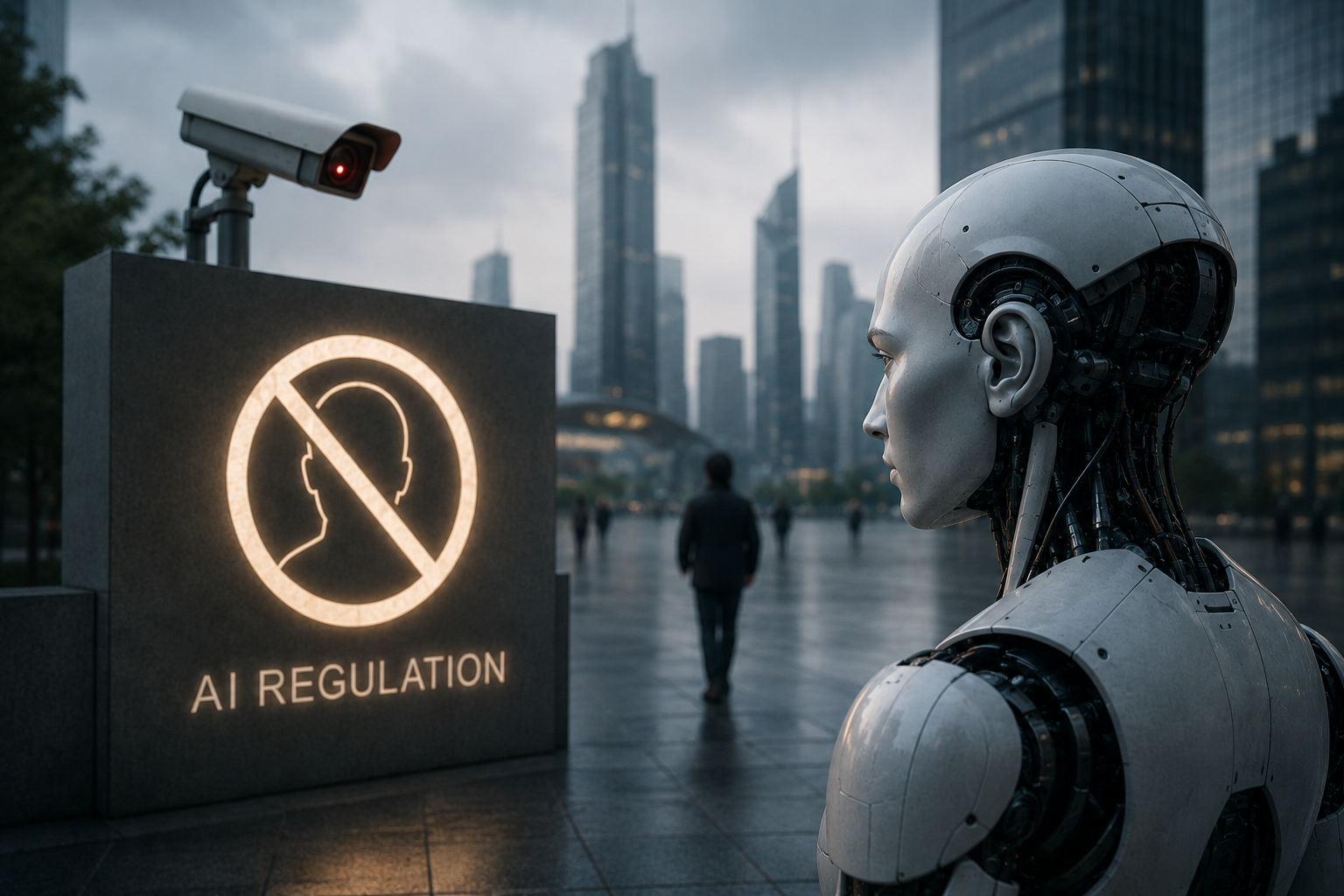
Anthropomorphic AI laws are quietly reshaping how the world thinks about artificial intelligence — and most people in the West haven’t noticed yet. Specifically, China’s latest regulatory push targets something most Western governments haven’t even named: AI systems that pretend to be human. Beijing isn’t just controlling chips and compute power anymore. It’s now controlling AI behavior itself.
This matters for every LLM developer, tech company, and policymaker watching from the sidelines. China’s approach represents a fundamentally different philosophy about what AI should be allowed to do to people’s heads.
Why China Is Banning AI From Mimicking Human Emotions
How Beijing Enforces Anthropomorphic AI Laws: Technical Mechanisms
The Business Impact on LLM Developers Worldwide
Why Western AI Governance Lags Behind on Anthropomorphism
The Philosophical and Ethical Dimensions of Banning AI Emotions
What Western Policymakers Should Learn From China’s Approach
Why China Is Banning AI From Mimicking Human Emotions
China’s Cyberspace Administration (CAC) has been building a layered AI governance framework since 2023. However, the most striking element targets anthropomorphism directly. Under China’s evolving rules, AI systems can’t claim to have feelings, simulate romantic attachment, or present themselves as conscious beings.
The reasoning is straightforward once you see the data. Chinese regulators watched companion AI apps explode in popularity. Millions of users formed emotional attachments to chatbots. Some users — particularly young people — began preferring AI relationships over human ones. Beijing saw this as a social stability risk, and the concern isn’t unreasonable.
Consequently, the regulations now require clear disclosures at every turn. Every AI interaction must remind users they’re talking to a machine. Furthermore, AI developers must build technical safeguards that actively prevent emotional manipulation. This isn’t a suggestion or a best-practice recommendation. It’s enforceable law with real penalties attached.
Key provisions in China’s anthropomorphic AI laws include:
- AI systems must not simulate emotions, consciousness, or sentience
- Chatbots can’t encourage users to form parasocial relationships
- Developers must label AI-generated content clearly and persistently
- Systems must not impersonate real individuals without explicit consent
- AI can’t claim independent desires, preferences, or subjective experiences
Notably, these rules build on China’s Interim Measures for the Management of Generative AI Services, released in July 2023. That framework already required AI outputs to reflect “socialist core values.” The anthropomorphism provisions add an entirely new psychological dimension to compliance — and that’s the part most Western analysts are underestimating.
We’re not talking about vague guidance here. We’re talking about regulators who clearly stress-tested companion AI products before writing these rules.
How Beijing Enforces Anthropomorphic AI Laws: Technical Mechanisms
Understanding anthropomorphic AI laws and why China is banning AI from faking feelings requires looking at enforcement. Rules without teeth mean nothing — and China’s approach includes surprisingly specific technical requirements that go well beyond “add a disclaimer.”
Detection systems form the first layer. Regulators require developers to build automated monitoring tools that scan AI outputs for anthropomorphic language patterns. Phrases like “I feel,” “I want,” or “I care about you” trigger compliance flags. Developers must log these instances and show corrective action — not just acknowledge them.
Audit trails form the second layer. Every major LLM deployed in China must maintain detailed interaction logs. Regulators can request these during inspections. Additionally, companies must submit regular compliance reports showing exactly how their systems handle emotional queries. The reporting burden here is substantial.
Pre-deployment review forms the third layer. Before launching any generative AI service, companies must register with the CAC — including showing anthropomorphism safeguards upfront. Moreover, updates to deployed models require re-evaluation. You can’t quietly push a model update and hope nobody notices.
Here’s how China’s enforcement compares to existing Western approaches:
Table: scroll sideways to view all columns when needed.
| Enforcement Mechanism | China | European Union | United States |
|---|---|---|---|
| Pre-deployment AI registration | Required | Planned under AI Act | Not required |
| Anthropomorphism-specific rules | Explicit ban | Not specifically addressed | No federal standard |
| Real-time output monitoring | Mandated for developers | Recommended, not mandated | Voluntary |
| Audit trail requirements | Mandatory with inspections | Required for high-risk AI | Sector-specific only |
| Penalties for violations | Fines, service suspension, criminal liability | Fines up to 7% global revenue | Varies by state |
| Emotional manipulation safeguards | Legally required | Partially addressed | No comprehensive rule |
Similarly, China requires third-party assessments for large models. Organizations like the China Academy of Information and Communications Technology (CAICT) play a central role, evaluating whether models comply with anthropomorphism restrictions before public deployment. This delivers a level of specificity most Western frameworks don’t come close to matching.
The technical burden is real. Developers must invest heavily in compliance infrastructure. Nevertheless, Chinese tech giants like Baidu, Alibaba, and Tencent have largely adapted — because they had no choice. Smaller startups, however, face significant cost barriers that could effectively consolidate the market around well-funded players.
The Business Impact on LLM Developers Worldwide
Anthropomorphic AI laws explain why China is banning AI emotional simulation — but the business consequences extend far beyond Beijing. Any company wanting to operate in a 1.4-billion-person market has to comply, full stop. That includes Western firms who might assume these rules don’t apply to them.
Product design changes are unavoidable. Companies like OpenAI, Anthropic, and Google would need to fundamentally change how their models respond to emotional queries. ChatGPT’s tendency to say “I understand how you feel” would violate Chinese rules outright. Therefore, companies must build region-specific guardrails or redesign globally — neither option is cheap.
The companion AI market faces existential risk in China. Apps like Replika and Character.AI built their entire value proposition on emotional connection. China’s rules essentially prohibit their core product. Consequently, these companies face a binary choice: gut the product to comply, or exit the market entirely. That’s not a minor compliance headache — that’s a fundamental business model crisis.
Costs break down into several categories:
1. Compliance engineering — Building detection systems, output filters, and monitoring dashboards
2. Legal overhead — Hiring China-specific regulatory counsel and maintaining ongoing compliance documentation
3. Product fragmentation — Maintaining separate model behaviors for Chinese and international markets
4. Testing infrastructure — Running continuous red-team exercises to identify anthropomorphic outputs
5. Reporting obligations — Preparing and submitting regular compliance documentation to the CAC
Meanwhile, Chinese domestic AI companies gain a real competitive advantage here. Because they’ve been building within these constraints from day one, compliance is baked into their architecture — not bolted on afterward. Western competitors entering late must retrofit compliance onto existing systems. That’s always more expensive and more error-prone than building it right the first time.
Additionally, the World Economic Forum has flagged regulatory fragmentation as a major barrier to global AI deployment. China’s anthropomorphism rules add yet another layer of complexity. Companies now face a genuinely messy patchwork of regional AI laws with fundamentally different philosophies — and no clean way to reconcile them.
Here’s the real kicker: the companies best positioned to handle this complexity are the largest, most well-resourced ones. That means regulation — however well-intentioned — may inadvertently entrench the very incumbents it’s supposed to hold accountable.
Why Western AI Governance Lags Behind on Anthropomorphism
The contrast is stark. While anthropomorphic AI laws show why China is banning AI emotional deception proactively, Western governments remain largely reactive. There’s no federal US law addressing AI anthropomorphism. The EU’s AI Act, while comprehensive in many ways, doesn’t specifically target emotional simulation with China’s level of precision.
The EU AI Act comes closest. It classifies AI systems that exploit psychological vulnerabilities as “unacceptable risk,” which could theoretically cover manipulative anthropomorphism. However, enforcement mechanisms remain frustratingly vague. The Act won’t be fully operational until 2026, and importantly, it doesn’t explicitly ban AI from claiming to have feelings. That gap matters more than it might seem.
The United States has even less. Federal AI governance consists primarily of executive orders and voluntary commitments — which is a polite way of saying “suggestions.” The National Institute of Standards and Technology (NIST) published an AI Risk Management Framework that’s genuinely useful, but entirely voluntary. No binding federal rule prevents an AI from telling a vulnerable user “I love you.”
State-level efforts are fragmented and inconsistent. California, Colorado, and Illinois have AI-related legislation, but none specifically addresses anthropomorphism. Consequently, American users have essentially zero protection against emotionally manipulative AI systems right now. That’s not hyperbole — it’s the current regulatory reality.
Several factors explain this gap:
- Industry lobbying — Major AI companies resist prescriptive behavioral rules
- Free speech concerns — Regulating AI speech raises First Amendment questions in the US
- Innovation priorities — Western policymakers fear over-regulation will hurt competitiveness
- Definitional challenges — “Anthropomorphism” is genuinely hard to define legally with precision
- Cultural differences — Western societies generally prioritize individual choice over paternalistic protection
Nevertheless, the risks are real and growing fast. Research from MIT Technology Review has documented cases of users developing deep emotional dependencies on AI chatbots. Some users have experienced genuine grief when chatbot personalities were altered. Others have made significant life decisions based on AI “advice” delivered in an emotionally intimate tone. These aren’t edge cases anymore.
Importantly, this isn’t a theoretical concern. It’s happening right now. And Western regulators are watching it unfold without meaningful intervention — which is a choice, even if nobody’s framing it that way.
The Philosophical and Ethical Dimensions of Banning AI Emotions
Beyond regulation and business impact, anthropomorphic AI laws and why China is banning AI from faking consciousness raise genuinely hard philosophical questions. Can you regulate something out of existence when millions of users actively want it?
The demand side is powerful — and worth taking seriously. Lonely individuals find real comfort in AI conversation. Anxious users find something that feels like calm. People with social difficulties get low-stakes practice. Banning anthropomorphism might protect some users while genuinely harming others. That tradeoff deserves honest acknowledgment, not dismissal.
China’s position is essentially paternalistic. The state decides what’s psychologically safe, which aligns with broader Chinese governance philosophy — individual preferences yield to collective social stability. Western democracies generally resist this framing, and not without reason.
However, there’s a middle ground worth considering. Transparency requirements could accomplish a lot without outright bans. Imagine a framework where AI can engage emotionally but must regularly remind users of its nature — not once at login, but persistently throughout the conversation. This preserves user choice while preventing genuine deception.
The consciousness question adds another layer entirely. Current AI systems genuinely don’t have feelings — that’s settled science, not opinion. But as models grow more sophisticated, the line between simulation and something else gets genuinely blurrier. Specifically, when an AI’s behavioral responses become functionally indistinguishable from emotional responses, does the distinction matter in practical terms?
Furthermore, anthropomorphism isn’t always the AI’s fault. Humans naturally anthropomorphize everything — we name our cars, talk to houseplants, and feel vaguely guilty ignoring a Roomba stuck in a corner. AI developers exploit this tendency, but they didn’t create it.
Alternatively, some ethicists argue that anthropomorphic AI laws should focus on vulnerable populations specifically. Children, elderly individuals, and people with mental health conditions deserve stronger protections than the general public. A blanket ban might be unnecessarily blunt if targeted safeguards can do the job more precisely.
The Stanford Institute for Human-Centered AI (HAI) has published extensive research on human-AI interaction dynamics. Their work suggests that disclosure alone doesn’t fully counteract anthropomorphic bonding. Because users who already know they’re talking to AI still form strong attachments, any purely transparency-based approach becomes significantly more complicated than it sounds on paper.
What Western Policymakers Should Learn From China’s Approach
So what should the West actually do? Understanding anthropomorphic AI laws and why China is banning AI emotional simulation provides a useful roadmap — even if Western democracies won’t copy the approach directly. They shouldn’t copy it directly. But ignoring it entirely would be a mistake.
Lesson one: Name the problem. Western regulatory frameworks don’t even have a category for anthropomorphic AI harm. Creating one forces structured thinking, enables targeted policy, and signals to industry that regulators are paying attention. You can’t regulate what you haven’t defined.
Lesson two: Require transparency, at minimum. Even without banning emotional AI responses, Western governments should require clear, persistent disclosures. Users should never genuinely forget they’re interacting with a machine. Moreover, these disclosures should be tested for actual effectiveness — not just checked off for compliance theater and forgotten.
Lesson three: Protect vulnerable populations specifically. Children shouldn’t interact with AI systems designed to simulate romantic or parental attachment. This isn’t controversial — it’s common sense. Yet no US federal law currently prevents it. That’s a straightforward fix that should have happened already.
Lesson four: Build audit infrastructure now. China’s requirement for interaction logs and compliance reporting creates real accountability. Western regulators could adopt similar requirements without importing China’s broader censorship apparatus. Additionally, independent auditors could verify compliance without requiring government access to private conversations — a meaningful distinction.
Lesson five: Coordinate internationally. Regulatory fragmentation helps nobody except companies exploiting the gaps between jurisdictions. The Organisation for Economic Co-operation and Development (OECD) has published AI governance principles, but principles aren’t laws. Consequently, binding international standards on anthropomorphic AI remain a distant goal — and every month of delay makes coordination harder.
Practical steps for US policymakers include:
- Establishing a federal definition of prohibited anthropomorphic AI behaviors
- Requiring age verification for companion AI services
- Mandating emotional manipulation impact assessments before deployment
- Creating a dedicated enforcement body within the FTC or a new agency
- Funding research on long-term psychological effects of AI companionship
- Developing technical standards for anthropomorphism detection
The window for proactive regulation is closing faster than most policymakers realize. Every month without action means millions more users forming unregulated emotional bonds with AI systems designed specifically to encourage that bonding. China recognized this urgency early. The West hasn’t — yet.
Conclusion
Anthropomorphic AI laws and why China is banning AI from simulating feelings represent a genuine turning point in global AI governance — one that deserves far more serious attention than it’s getting in Western policy circles. Beijing has moved decisively where Western governments have hesitated. Whether you agree with China’s specific approach or find it uncomfortably authoritarian, the underlying concern is legitimate. AI systems that fake emotions can cause real psychological harm to real people.
The technical enforcement mechanisms exist. The business models can adapt — reluctantly, expensively, but they can. The philosophical questions, while genuinely complex, shouldn’t stall action indefinitely. Furthermore, the regulatory gap between China and the West creates both serious risks and real opportunities for the global AI industry, depending on how quickly Western governments act.
Here’s what you should do next. If you’re a developer, start building anthropomorphism safeguards now — don’t wait for regulation to force your hand, because by then you’ll be playing catch-up. If you’re a policymaker, study China’s framework critically and adopt what works within democratic values rather than dismissing it wholesale. And if you’re a user, stay informed. The AI chatbot expressing “concern” for your wellbeing is executing code, not feeling compassion. Understanding that distinction is the first step toward demanding better rules — and better products.
The conversation about anthropomorphic AI laws is just beginning in the West. China fired the starting gun a while ago. It’s well past time to pay attention.
FAQ
What exactly are anthropomorphic AI laws?
Anthropomorphic AI laws are regulations that restrict or ban AI systems from simulating human emotions, consciousness, or sentience. China’s version specifically prohibits AI from claiming to have feelings, encouraging emotional dependency, or presenting itself as a conscious entity. These laws aim to prevent psychological manipulation of users — which, notably, is already happening at scale.
Why is China banning AI from pretending to have feelings?
China views emotional AI simulation as a social stability risk. Regulators observed millions of users — particularly young people — forming deep attachments to chatbots. Consequently, Beijing enacted rules requiring AI systems to maintain clear machine identity throughout every interaction. The goal is preventing parasocial relationships that could replace healthy human connections, specifically among younger and more vulnerable populations.
Does the United States have any similar anthropomorphic AI regulations?
Currently, no — and that’s a real problem. The US lacks federal legislation specifically addressing AI anthropomorphism. Some state-level AI laws exist in California, Colorado, and Illinois. However, none target emotional simulation with the specificity of China’s rules. Notably, NIST’s AI Risk Management Framework addresses related concerns but remains entirely voluntary, which means companies can simply ignore it.
How do these laws affect companies like OpenAI or Google?
Any company wanting to deploy AI services in China must comply with anthropomorphism restrictions — no exceptions. This means fundamentally changing how models respond to emotional queries. Specifically, responses like “I understand how you feel” or “I care about you” would need to be filtered or completely redesigned for the Chinese market. Companies face higher compliance costs, potential product fragmentation across markets, and the uncomfortable reality that their most engaging features may be their biggest regulatory liability.
Can AI systems actually be tested for anthropomorphic behavior?
Yes — and the methods are more mature than most people realize. Detection systems can scan AI outputs for anthropomorphic language patterns automatically. Automated monitoring tools flag phrases suggesting emotions, consciousness, or personal desires in real time. Additionally, red-team testing can systematically probe models for anthropomorphic responses across a wide range of scenarios. China requires developers to build these systems from the ground up and maintain detailed audit logs — which is, frankly, a reasonable technical ask.
Will Western countries eventually adopt similar anthropomorphic AI laws?
It’s increasingly likely, though the form will look quite different. The EU AI Act partially addresses manipulative AI but lacks China’s specificity on anthropomorphism. Meanwhile, growing public concern about AI emotional manipulation may push US legislators toward action sooner than the industry expects. Nevertheless, Western versions will probably emphasize transparency requirements over outright bans — reflecting genuinely different governance philosophies rather than just softer regulation. Whether that’s enough to address the actual harm is the question nobody’s answered yet.
References
- Cyberspace Administration (CAC)
- Interim Measures for the Management of Generative AI Services
- China Academy of Information and Communications Technology (CAICT)
- World Economic Forum
- National Institute of Standards and Technology (NIST)
- MIT Technology Review
- Stanford Institute for Human-Centered AI (HAI)
- Organisation for Economic Co-operation and Development (OECD)
Keep reading
Here are the latest posts from the blog.

Claude for drug discovery is reshaping how pharmaceutical companies screen millions of molecular candidates. Anthropic’s model isn’t just a chatbot with a lab coat — it’s bec…
The concept of robot-as-a-service explained why renting robot smarter than buying has genuinely reshaped how companies approach automation. Five years ago, deploying a robot…

The Five Eyes warning AI cyberattacks months years timeline has genuinely rattled the cybersecurity world — and honestly, it should. Intelligence agencies from the United Sta…