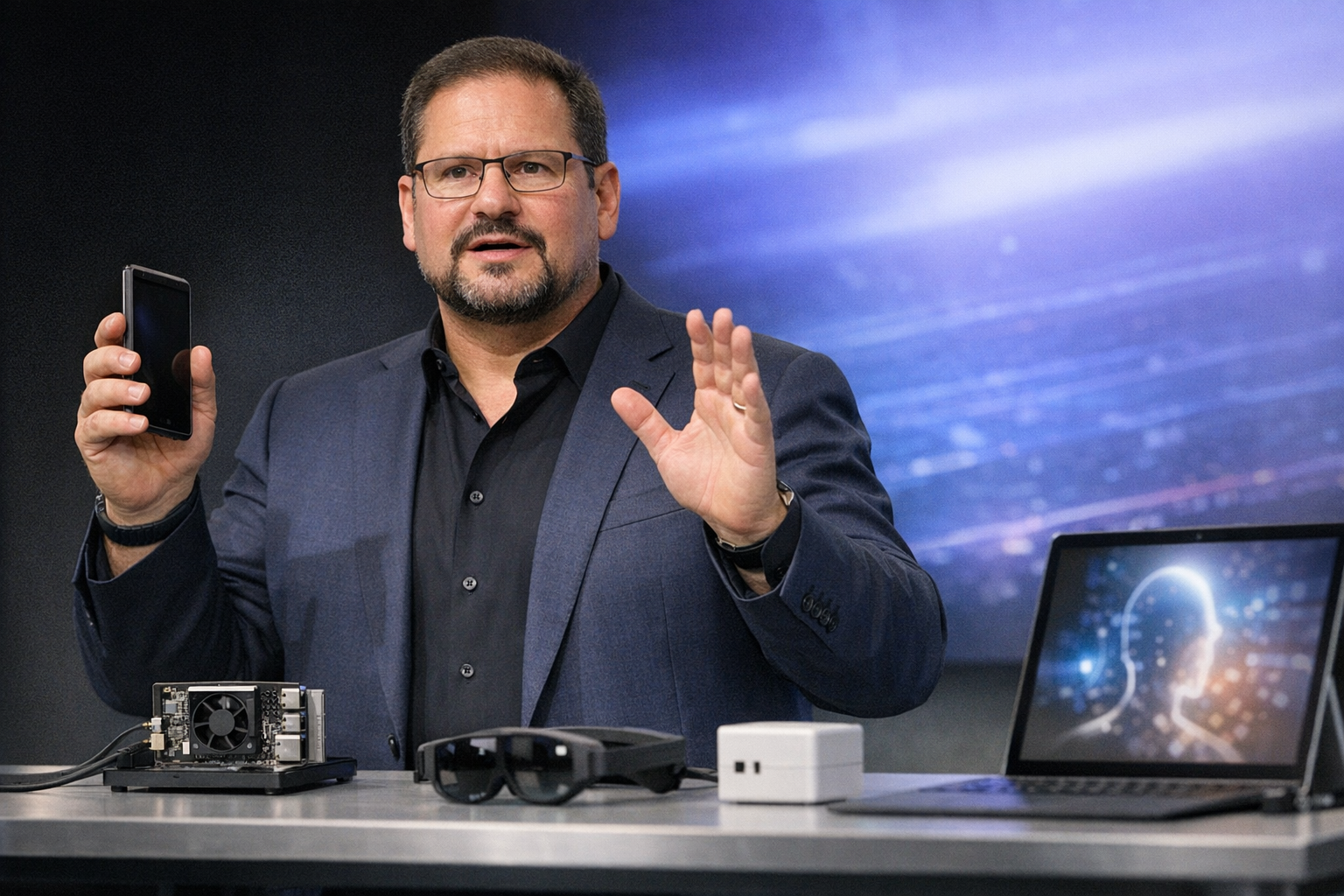
When Qualcomm CEO Cristiano Amon spoke at Computex, he set 2026 as the year that will make or break agentic AI. The IT world paused to listen. Not politely— actually listened. This was not another ambiguous roadmap keynote. He envisioned tangible AI agents running directly on your devices, with no cloud required.
While Jensen Huang of Nvidia was stealing headlines with GPU introductions, Amon was quietly making a larger claim. “The real AI shift is not going to happen in data centers,” he said. Instead it will happen on the edge – on laptops, phones and enterprise devices powered by Qualcomm technology.
I’ve been reporting on chip introductions for a decade and this one seemed different. But it is also a fundamental change in the way we think about the structure of computing architecture for the next decade. Not incremental, but basic.
Why Amon Called 2026 the Agentic Inflection Point
Amon’s talk was not about incremental gains. He’s expressly called out 2026 as the year agentic AI goes mainstream — but what does “agentic AI” truly entail in practice?
Agentic AI is AI that operates autonomously. They answer questions, but they also conduct multi-step tasks, make judgments and communicate with other systems without being prompted. Imagine an AI that doesn’t just write your email, but… It reads your calendar, sets up meetings, books travel and follows up with participants – and you don’t have to lift a finger.
Location was the main difference Amon made. Most of today’s AI bots are cloud-based. This makes them slow, expensive and a severe privacy problem. His argument is simple: Qualcomm’s processors will be running these agents locally, on-device, in your bag by 2026.
Having examined dozens of on-device AI systems in the last two years, the gap between “technically possible” and “actually useful” has been real. But the tempo is picking up fast. Several variables suggest a 2026 timetable for Amon:
- Progress in model compression is making big language models (LLMs) small enough to employ on-device without losing their usefulness
- The Snapdragon X Elite’s neural processing unit (NPU) already delivers 45 TOPS (trillions of operations per second) – and that’s not a marketing number, it’s a relevant threshold
- Private, low latency AI is particularly sought after in regulated areas and the demand for enterprise use is developing quickly
- Improvement in battery efficiency is what makes the first time that prolonged on-device inference becomes possible
Amon also cited ties with Microsoft, Meta and other software firms. Such collaborations mean that when the hardware is ready, so will be the software ecosystem. Importantly, Microsoft’s Copilot+ PC initiative already relies heavily on Qualcomm’s Snapdragon X series chips for on-device AI, so this is no hypothetical situation. It’s shipping already.
It’s calculated timing. Qualcomm CEO Cristiano Amon said this at Computex because the company’s next generation Snapdragon chips, slated in late 2025 and early 2026, will reportedly double present NPU performance. That’s the level Amon says will enable totally autonomous on-device bots. And to be honest? That statement is specific enough to hold him to it.
Snapdragon X Elite’s Role in On-Device Agent Deployment
The Snapdragon X Elite isn’t your average laptop chip. It’s Qualcomm’s proof of concept for edge-based agentic AI, and the specs back that up.
The capabilities already are remarkable. The device can execute models of up to 13 billion parameters locally – enough to do decent text generation, code completion, and some basic multi-step reasoning. Plus, its specialized NPU can handle AI tasks without reducing battery life like GPU-based inference. When I first looked into the design I was shocked by this because the power efficiency story is really strong.
And that’s why the Snapdragon X Elite is particularly good for agentic workloads:
- Dedicated NPU architecture – The Hexagon NPU runs AI workloads independently from the CPU and GPU. Your AI agent runs in the background when you do other things. There’s no performance loss.
- Memory bandwidth – The device uses LPDDR5x memory to provide data to AI models at a high enough rate for real-time agent replies.
- Power efficiency – Agentic AI must be always-on. The Snapdragon X Elite, which is ARM-based, is far more power-efficient than its x86 equivalents.
- Security enclave – On-device processing means important enterprise data never leaves the device, which is critical for healthcare, financial and legal applications.
But there are some limits. Cloud-based systems like GPT-4o and Claude 3.5 Sonnet provide a depth of reasoning that today’s on-device models can’t match, a weakness that Amon saw straight away which I liked. Fair warning: if you think local models can compete with frontier cloud AI today, you’ll be disappointed. But he argued that hybrid arrangements – where simple tasks are run locally and complex ones are sent to the cloud – are the practical short-term solution. That’s a fair and honest position.
The enterprise angle is very interesting. When Qualcomm CEO Cristiano Amon spoke at Computex and framed the Snapdragon X Elite as a corporate platform, he wasn’t only talking about consumers. He mentioned certain use scenarios that make the on-device argument hard to dismiss:
- Remote places with AI agents that work offline used by Field service personnel
- Diagnostic AI run by health professionals without sending patient data off to external servers
- Financial analysts running proprietary trading models on secure, air-gapped devices
- Zero-latency local AI coding assistance for software developers
Qualcomm has also been bulking up its AI Hub – a library of optimized models ready to deploy on Snapdragon chips. This platform strategy is reminiscent of what made Apple’s App Store successful: make it easy for developers and applications will come. The platforming is excellent, and it’s deeper than you may think.
Qualcomm vs. Nvidia: Two Competing Visions for AI Infrastructure
The difference between Amon’s speech and Jensen Huang’s couldn’t be more stark. Both leaders spoke at Computex 2025, and both spoke of agentic AI – but their perspectives diverged in a fundamental sense.
Nvidia’s strategy is more centralized. Huang demonstrated the NV72 rack-scale architecture and the next generation Blackwell Ultra GPUs. His vision retains AI workloads within big data centers. In particular, Nvidia wants to see more GPU clusters bought by corporations to power AI agents in the cloud.
Qualcomm’s is a distributed method. Amon envisions AI agents running on billions of edge devices, with the cloud as a backup, not the core computational layer.
Here’s how the two ways compare:
| Feature | Qualcomm (Edge/On-Device) | Nvidia (Cloud/Data Center) |
|---|---|---|
| Primary hardware | Snapdragon X Elite, future mobile SoCs | H100, B200, NV72 rack systems |
| AI model size | Up to 13B parameters locally | 1T+ parameters in data centers |
| Latency | Near-zero (on-device) | Variable (network-dependent) |
| Privacy | Data stays on device | Data sent to cloud |
| Power use | ~25W per device | ~700W per GPU |
| Cost model | One-time hardware purchase | Ongoing cloud compute fees |
| Scalability | Billions of devices globally | Limited by data center capacity |
| Best for | Personal agents, edge enterprise | Complex reasoning, training |
Both firms also realize hybrid models are most likely to triumph in practice. Nvidia has been working in edge computing through its Jetson and automotive platforms. Qualcomm, on the other hand, acknowledges the relevance of cloud AI for big workloads. So this isn’t an all or nothing fight – but the default computing location is critical for the business model.
The main battle is over where the default computing takes place. When Qualcomm CEO Cristiano Amon gave his Computex speech framing the debate this way, he was making a particular strategic gamble. If most agentic AI tasks can be run locally, Qualcomm wins. “If they need cloud scale compute, Nvidia is the winner. That’s all.
Most importantly, the economics favor Qualcomm’s approach in many enterprise cases. Cloud AI costs pile up quickly—a corporation operating AI agents for 10,000 employees could spend millions of dollars a year on cloud compute. Or it’s a one-time hardware cost in deploying Snapdragon-powered devices with local AI. CFOs are gonna see that math.”
But Nvidia has a huge advantage in developer mindshare – and that’s the rub. CUDA, its parallel computing framework, is still the standard for AI development. Qualcomm has to convince developers that it’s worth the effort to tune for their NPU. That’s a big challenge, and no one in Amon’s side would pretend differently.
Workforce Transformation and Enterprise Agentic Adoption
This is more than just a tech debate about chips. It’s about how organizations will truly deploy AI agents across their workforces — and that’s where Amon’s Computex message ties into something far greater.
Enterprise leaders are already gearing up for agentic AI. Recent industry studies suggest that most Fortune 500 CEOs consider deploying AI agents as a top-three strategic goal for 2025-2027. The question is not whether to deploy agents. It’s the how. It’s the what infrastructure.
Qualcomm CEO Cristiano Amon addressed the enterprise opportunity at Computex, outlining three phases of adoption:
- Phase one (2024-2025): Copilot era – AI helps humans in specialized jobs. Think auto-complete, summary, search. This is where most businesses are right now.
- Phase two (2025–2026): Semi-autonomous agents – AI executes routine workflows from end to finish, but requires human clearance for key decisions. The current hardware from Qualcomm supports this phase.
- Phase three (2026+): Fully autonomous agents – AI systems are independent, under known guardrails. This is the next generation of Snapdragon silicon.
The ramifications for the workforce are huge. And thus organizations must rethink job responsibilities, training programs and team structures – not someday, but today. Agentic AI is not simply about automating chores. It completely affects what human workers are focused on.
With the edge-first approach, Qualcomm has some advantages for enterprise rollouts:
- On-device: IT departments retain control AI doesn’t have the complexities of cloud infrastructure management
- Easier compliance: It’s easier to comply with data rules when data remains on the device
- Scaling is natural: every new gadget is another AI compute node
- Offline capability: Agents work in factories, hospitals and field sites without connectivity
In addition, CFOs are highly vulnerable to the total cost of ownership (TCO) argument. Cloud AI can go crazy without warning, whereas device-based AI has predictable, front-loaded costs. I’ve spoken to IT procurement leads at mid-size organizations currently crunching these numbers, and the edge case appears persuasive at scale.
According to the World Economic Forum, AI will transform hundreds of millions of occupations worldwide by 2030. Amon’s thesis is that on-device agentic AI makes this change more available to mid-market firms, not just tech giants with enormous cloud budgets. That’s a key element and missing from the Nvidia appeal in a big way.
What Amon’s Computex Framing Means for the AI Chip Market
Amon’s Computex keynote didn’t take place in a vacuum. His characterization of 2026 as the agentic turning moment has Qualcomm up against a number of rivals at the same time, in the hotly contested AI chip industry.
Apple Intelligence is developing its own on-device AI capabilities. Its M-series CPUs already do well with local AI models. But Apple is tightly controlled and consumer centered, while Qualcomm is targeting the open enterprise environment, which is a meaningfully different lane.
Intel has been floundering in the AI silicon space. Its Meteor Lake and Lunar Lake chips feature NPUs, but lag behind the Snapdragon X Elite in AI performance benchmarks. Intel’s production woes have also set back its future quite a bit. That’s a nice way of expressing they’re in a bit of a pickle at the moment.
The AMD Ryzen AI family delivers powerful GPU-based AI capabilities. But AMD’s forte is still in data center GPUs against Nvidia rather than edge-focused AI processors.
MediaTek is taking on Qualcomm in the mobile AI space, and its Dimensity 9400 chip offers competitive on-device AI capabilities. MediaTek lacks the corporate contacts and PC platform presence that Qualcomm has, and those relationships are more important than benchmarks when you’re selling to huge enterprises.
Qualcomm CEO Cristiano Amon laid out the competitive scenario at Computex, highlighting one advantage above all others: Qualcomm is present in every device category. The company makes processors for smartphones, PCs, vehicles, IoT devices and XR headsets – a reach no other AI chip company can match now.
This cross-device presence enables something quite unique: distributed agentic networks. Imagine your phone’s AI agent having a conversation with your laptop’s agent, your car’s agent and your smart home’s agent. All on Qualcomm chips. All sharing context securely. All operating together without the need for cloud intermediaries. That’s the picture Amon laid forth, and it’s fundamentally different than anything rivals have proposed.
The market opportunity is huge. IDC estimates AI PC shipments to expand significantly through 2028, with on-device AI becoming a mainstream feature. Qualcomm is aiming to grab a big chunk of this market, especially in the enterprise space where its Snapdragon X Elite is currently powering devices from Dell, HP, Lenovo and others.
So, in the big picture of the AI chip industry, Qualcomm’s edge-first strategy represents the most direct challenge to Nvidia’s dominance in the cloud. It’s not about supplanting data-center AI, it’s about ensuring that most common AI workloads never ever need the data center. And if that gamble pays out, huge repercussions for the entire business.
Conclusion
When Qualcomm CEO Cristiano Amon took the stage at Computex and called 2026 the “inflection point” for agentic AI, he wasn’t making a trivial forecast. He backed it with concrete hardware roadmaps, enterprise collaborations and a defined architectural vision. The message was clear: the future of AI is distributed, on-device, with Qualcomm chips.
Here are some further actions to consider based on Amon’s Computex framing:
- Enterprise IT leaders should look at Snapdragon X Elite smartphones for pilot AI agent deployments today – don’t wait till 2026
- Developers should look at Qualcomm’s AI Hub and start to fine-tune models for NPU inference, as first movers will have a big advantage Investors should pay close attention to
- Qualcomm’s enterprise design victories, as they’ll be a good indication of whether Amon’s vision is gaining real momentum
- Workforce planners should begin mapping the positions that will interface with on-device AI agents, since the transition time frame is shorter than most believe.
The edge vs cloud AI debate is not a binary one – both will be employed. But Amon’s keynote made a compelling case that the pendulum will swing toward edge computing before many realize it. Qualcomm CEO Cristiano Amon delivered a speech at Computex envisioning a future where your devices don’t only link to AI – they are AI. And 2026 is when that future begins to happen. Companies who prepare now won’t be trying to catch up when it arrives.
FAQ
What did Qualcomm CEO Cristiano Amon announce at Computex 2025?
Qualcomm CEO Cristiano Amon spoke at Computex, framing 2026 as the critical turning point for agentic AI. He outlined how Qualcomm’s Snapdragon processors will let AI agents run directly on devices. Specifically, he highlighted the Snapdragon X Elite’s NPU capabilities and previewed next-generation chips with doubled AI performance. He also covered enterprise partnerships and the shift from cloud-dependent AI to edge-based autonomous agents.
What is agentic AI, and why does Qualcomm consider 2026 the turning point?
Agentic AI refers to AI systems that complete multi-step tasks on their own without constant human input. Qualcomm considers 2026 the turning point because its next-generation chips will reportedly deliver enough on-device compute power to run sophisticated AI agents locally. Additionally, model compression techniques are advancing fast. By 2026, models capable of independent reasoning should fit within the power and memory limits of mobile processors.
How does Qualcomm’s approach to AI differ from Nvidia’s?
Qualcomm focuses on distributed, on-device AI processing at the edge, while Nvidia concentrates on centralized, cloud-based AI powered by massive GPU clusters. Qualcomm’s Snapdragon chips put power efficiency and privacy first, whereas Nvidia’s GPUs prioritize raw computational power. Consequently, Qualcomm targets everyday AI agent workloads on personal devices, while Nvidia targets complex AI training and heavy inference in data centers. Both approaches will likely coexist in hybrid setups.
Can the Snapdragon X Elite actually run AI agents locally?
Yes — the Snapdragon X Elite already runs AI models with up to 13 billion parameters on-device. Its Hexagon NPU delivers 45 TOPS of AI performance, which is enough for text generation, code completion, and basic multi-step reasoning. However, it can’t match the capabilities of cloud-based models like GPT-4o for complex reasoning. Hybrid approaches — where simple tasks run locally and complex ones go to the cloud — offer the best practical answer today.
What does Qualcomm CEO Cristiano Amon’s Computex framing mean for enterprise AI strategy?
When Qualcomm CEO Cristiano Amon spoke at Computex, framing the enterprise opportunity, he outlined a three-phase adoption model. Enterprises should expect to move from AI copilots (2024–2025) to semi-autonomous agents (2025–2026) to fully autonomous agents (2026+). For IT leaders, this means evaluating on-device AI hardware now, planning for data rules, and rethinking workforce roles that will interact with AI agents daily.
Which devices will support Qualcomm’s on-device agentic AI capabilities?
Qualcomm’s cross-device presence is a key advantage. Snapdragon chips power smartphones, Windows PCs, cars, IoT devices, and XR headsets — so agentic AI capabilities will eventually span all these categories. Currently, the Snapdragon X Elite in Copilot+ PCs from Dell, HP, Lenovo, and other OEMs offers the most advanced on-device AI experience. Moreover, future Snapdragon mobile chips will bring similar capabilities to smartphones and other portable devices.
References
Keep reading
Here are the latest posts from the blog.
Jensen Huang announced that NV72 Vera Rubin cabinets are now in full production — and that’s a larger deal than most headlines are making it out to be. The news came at Nvidi…

Anthropic submits secret S-1, eyes IPO in October at around $1T valuation — and honestly, the AI industry felt that. The safety-focused startup secretly submitted its S-1 reg…

A staggering 99% of CEOs expect workforce changes driven by artificial intelligence. That single stat from the CEO workforce transformation strategy AI adoption 2026 conversa…