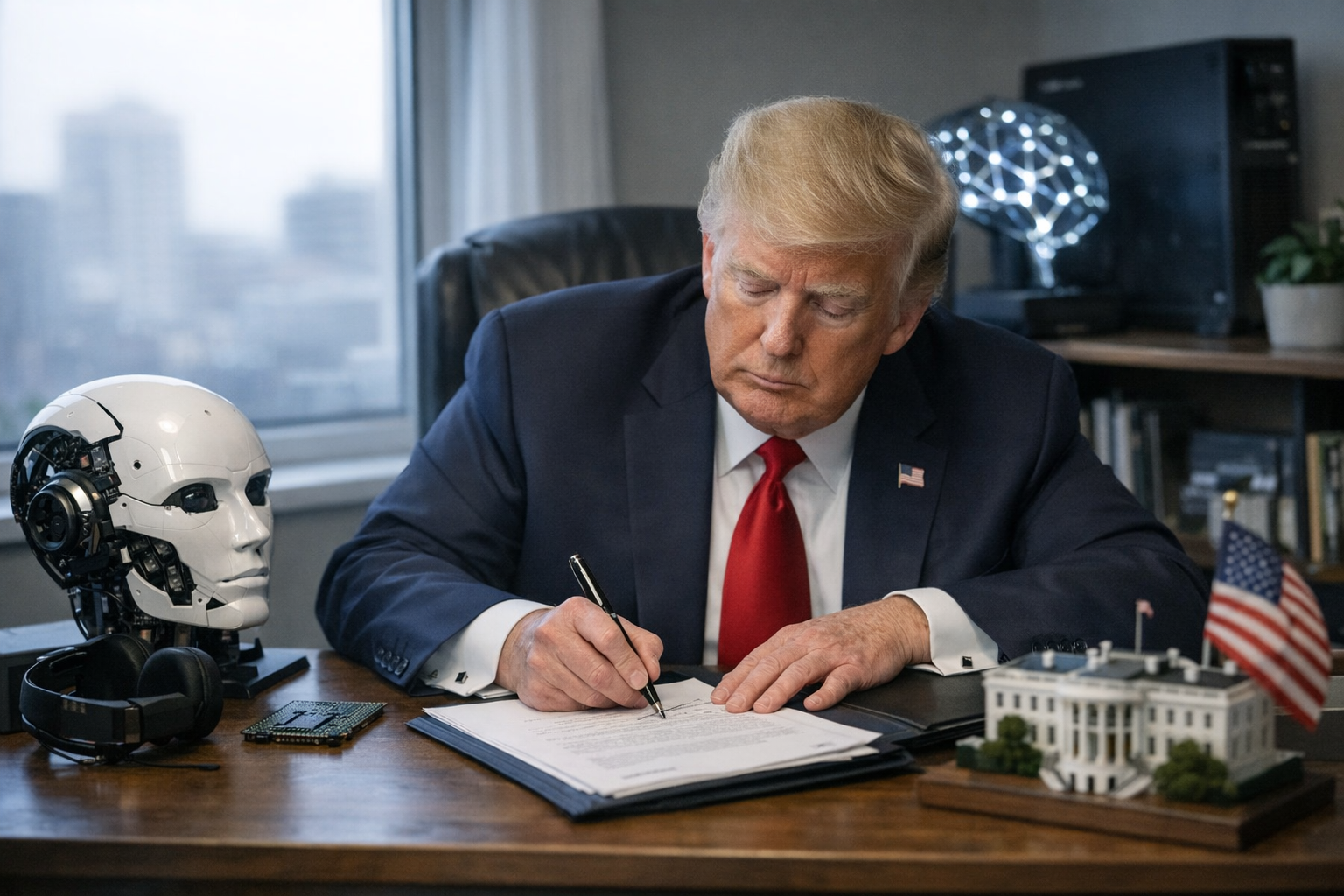
The White House just tossed the entire card off the table for AI development. As Trump signs the Landmark AI executive order that turns optional pre-release review into policy, every big tech corporation takes notice — quickly. This is not a proposal tucked in a footnote that lawyers quietly disregard. It’s a structured compliance framework with real timetables, real expectations and real repercussions for corporations who choose to play dumb.
More specifically, this executive order is targeting the most powerful AI systems before they even reach the public. It offers a voluntary review mechanism that chip makers, cloud providers and big language model developers are expected to follow. Participation is ostensibly voluntary, but political and business pressure makes opting out actually perilous — career-ending risky for the executives who make that judgment.
Everything you need to know.
What the Executive Order Actually Says
The presidential order establishes an optional pre-release review procedure for AI systems that meet specified competence requirements. As a result, companies creating frontier AI models must provide safety documentation before they are released to the public. The White House information sheet lists a handful of important elements – and it’s worth reading right now, rather than waiting for a summary.
The main provisions are:
- A organized evaluation procedure run by the Department of Commerce
- Reporting requirements for AI models trained over certain compute thresholds.
- Voluntary safety standards associated with the NIST AI Risk Management Framework standards.
- Transparency Recommendations for Dual-Use Foundation Models
- Procurement privileges and other incentives for participating firms
Importantly, this action reverses parts of the Biden-era AI executive order issued in October 2023. But it requires a new conceptual approach – less stick, more carrot. Trump’s momentous AI executive order voluntary approach relies on business participation, not mandated reporting. The administration says this will spur innovation, while maintaining safety guardrails. There have been enough policy cycles for us to know framing matters a lot for the way corporations really respond.
Timeline highlights:
- 30 days: Commerce Department releases comprehensive advice documents
- 90 days: Companies can start filing voluntary pre-release reviews
- 180 days: First compliance reports from participating entities due
- 1 year: Full framework review, possible policy revisions
The order also directs the Office of Science and Technology Policy (OSTP) to work with overseas partners. So multinational corporations should also anticipate pressure from European and Asian agencies to align. That international angle is the one that most of the domestic news misses. A corporation that focuses its compliance documents only on U.S. regulations, while ignoring the equivalent duties of the EU AI Act, for example, will be performing the job twice – an expensive and preventable mistake.
Compliance Framework and Checklists for AI Companies
It’s key to understand the compliance framework – don’t let the word “voluntary” fool you into thinking you have time to sort this out later. Landmark AI executive order voluntary review takes effect once Trump signs it. Companies want detailed plan of action. And the framework isn’t one-size-fits-all. It varies significantly by type of organization and level of AI capacity, which is a sharper design than we typically see in early-stage policy texts.
LLM developers compliance checklist (OpenAI, Anthropic, Meta, Google):
- Record model training data sources and compute utilization – be detailed, not vague
- Pre-deployment red-team testing
- Submit a safety evaluation report to the Department of Commerce
- Release a model card with transparent disclosures of capabilities and limitations
- Keep incident reporting processes after deployment
- share information with federal agencies on a voluntary basis
Compliance checklist for semiconductor makers: Nvidia, AMD, Intel
- Report advanced AI chip sales above performance benchmarks
- Establish know-your-customer (KYC) processes for big volume purchasers
- Cooperation with export control enforcement
- Provide Commerce Department with aggregate computing capability data
- Identify odd purchase trends originating from restricted entities
Cloud provider compliance checklist (AWS, Microsoft Azure, Google Cloud)
- Monitor big scale training runs on your infrastructure
- Report on computation utilization over given thresholds
- Identity authentication for AI training customers
- Keep logs of important AI workloads for possible review
- Provide safety tooling for frontier-capable consumers resources
The framework also establishes a tiered system. Small AI enterprises and models below the compute barrier have little duties. Frontier AI labs confront the most thorough review expectations. This tiered approach is the crux of how the voluntary AI executive order mixes innovation with oversight — and honestly, it’s the detail that makes the whole thing workable instead than theatrical.
For example, a 10-person business that is refining an open-source model for customer support apps is well under the compute threshold and needs simply self-certification. A lab training a 500 billion parameter model on a cluster of tens of thousands of GPUs is solidly at the frontier tier, and has the full review stack. The gap between those two circumstances is huge and the framework tackles them accordingly.
| Company Type | Review Depth | Reporting Frequency | Participation Incentive |
|---|---|---|---|
| Frontier LLM developers | Complete safety review | Quarterly | Federal procurement preference |
| Mid-tier AI companies | Standard documentation | Semi-annually | Expedited licensing |
| Chip manufacturers | Supply chain reporting | Quarterly | Export license simplification |
| Cloud infrastructure | Compute monitoring | Monthly | Liability safe harbor |
| AI startups (below threshold) | Self-certification only | Annually | Innovation grants eligibility |
One tradeoff worth flagging: the tiered structure is sensible in theory, but the compute thresholds that define each tier won’t be published until the Commerce Department’s 30-day guidance window closes. That creates a frustrating interim period where mid-tier companies genuinely don’t know which bucket they fall into. The practical advice here is to document as if you’re in the tier above where you think you land — overpreparation costs less than scrambling to catch up.
How Nvidia, Anthropic, and OpenAI Are Responding
The industry reacted quickly. The biggest companies are already setting themselves up as enthusiastic early adopters – part really, part because it’s fantastic PR, but the effect is the same either way.
Nvidia has officially applauded the order. Nvidia’s compliance infrastructure was partly in place before this order even landed, as the business already complies with export limits on advanced chips like the H100 and H200. CEO Jensen Huang has said voluntary involvement bolsters Nvidia’s position for government contracts – a savvy play. The company’s AI governance page already has revised compliance language. They went rapidly. Within days of the signing, Nvidia’s legal and policy teams were cross-referencing the chip-reporting requirements in the order with their current export control protocols, an indication the business had been closely watching the draft before it became official, sources said.
Arguably the best-equipped of the big labs is Anthropic. Many internal processes already exceed the order’s standards since the company has championed responsible scaling principles since its beginning. Anthropic’s Responsible Scaling Policy also mirrors voluntary review levels with its internal AI Safety Levels architecture. Their old ASL architecture is really well aligned to the new tiers. Anthropic sees this arrangement as evidence, and they are not wrong. Their ASL-3 level – triggering heightened safeguards for models that can provide considerable uplift to weapons development – closely resembles the terminology the presidential order uses to identify frontier-tier review duties.
OpenAI is in a more difficult condition. The corporation has lately shifted to a for-profit setup, which adds an element of scrutiny to every public pledge it makes. Still, OpenAI has committed to signing up to the voluntary framework, and CEO Sam Altman has frequently urged for “smart regulation.” OpenAI has close ties with Microsoft as well, which contributes another layer of compliance through cloud infrastructure (Azure), meaning they’re not starting from scratch. Fair caution though, their safety team is still growing and the paperwork burden here is considerable. Writing a believable safety evaluation report for a frontier model is not a weekend endeavor. It often requires weeks of systematic red-teaming, capability elicitation testing, and cross-functional review before a single page is delivered.
Other interesting answers:
- Google DeepMind integrates review mechanisms into its Gemini model pipeline
- Meta has said it will comply but expressed worries about exemptions for open-source models – a truly tricky subject that the injunction does not fully address
- Amazon (AWS) is creating automatic compliance tooling for cloud customers
- Apple has not commented but is known to be involved secretly
You see the pattern here. Big corporations don’t see voluntary involvement as a burden. They see it as a competitive advantage.” But organizations that don’t go this route do so at the risk of looking foolish. And in this industry, perception is reality.
Sector-by-Sector Impact Analysis
The ramifications of this executive order go far beyond Silicon Valley. The voluntary review structure of the Trump landmark AI executive order affects all sectors that create, implement or rely on sophisticated AI. Some of these second-order effects are larger than the tech press is giving them credit for.
- Semiconductor industry: Chipmakers face new reporting duties on advanced processor sales. These rules are voluntary, but the Commerce Department has existing export control jurisdiction, which gives it implied enforcement power that any compliance lawyer will recognize in a heartbeat. The Bureau of Industry and Security will probably also manage chip-related compliance, so the voluntary framework includes a regulatory backup that corporations can’t disregard. A chip distributor who bypasses KYC protocols and unwittingly sells a large H200 cluster to a restricted company won’t be able to point to “voluntary” terminology as a defense when the BIS comes knocking.
- Cloud computing: AWS, Azure and Google Cloud now need to consider monitoring requirements for large-scale AI training workloads. This is a big change in operation. Traditionally, cloud providers have kept their hands off what customers are running – that’s been a fundamental tenet of the business model. The voluntary framework requires them to highlight compute consumption above specific levels while without violating the privacy of their customers. “That’s a really delicate balance and no one has cracked that yet. One such technique is automated threshold alerting – a system that alerts when a customer’s aggregate GPU-hours reach a certain level without any human looking at the actual workload content. The 30-day guidance document should provide a clear answer as to whether that meets the intent of the framework.
- Healthcare AI: Companies that use AI in clinical contexts are subject to overlapping regulations. The optional examination under the executive order supplements existing FDA oversight. Healthcare AI developers should, therefore, prepare for two compliance pathways. In fact, this makes things easier for companies currently making their way through the FDA pre-market review process — one of the few sectors where the new approach is net reduction in complexity, not an increase. For a medical imaging company that has already done an FDA 510(k) application, much of the safety paperwork it supplied will easily map into the Commerce Department’s model card and evaluation report requirements.
- Financial services: Banks and fintech companies utilizing AI for credit decisions, fraud detection and trading are already facing significant regulatory scrutiny. The new structure layers on top. But financial regulators have said they will coordinate with Commerce Department guidelines, which avoids the piling up of contradictory requirements, and compliance nightmares.
- Defense and national security: This is where the biggest direct impact is. Period. The executive order specifically prioritizes AI safety for dual-use technologies. The procurement preferences turn non-participation into a genuine — not theoretical — competitive disadvantage. “Companies that sell AI tools to the Department of Defense will discover that voluntary participation is, in practice, effectively mandatory.
- Startups and small companies: The tiered approach is the proper move for protecting the little guy. Companies below the compute criteria are just need to self-certify. Innovation grants also offer favorable incentives for early engagement. That counters the typical complaint that AI regulation crushes businesses before they have a chance to scale — and moreover, it’s the information that should make founders really read this order rather than ignore it.
What “Voluntary” Really Means in Practice
Let’s be honest about that word. When Trump announces groundbreaking AI executive order In the policy language, “voluntary” is more meaningful than it would first seem. And anyone who’s been tracking tech policy for more than a few years understands exactly how this goes down.
Voluntary schemes tend to become required schemes. That cycle has been replicated more than once in related businesses. The voluntary reporting of fuel efficiency in the automotive industry became the binding CAFE requirements within 10 years in the 1970s. The Obama administration developed voluntary cybersecurity frameworks for critical infrastructure, which have been integrated by reference in federal contractor standards. AI is just on the same arc, just faster.
Why “voluntary” is not really voluntary:
- Government contracts: Companies who participate gain billions of dollars in procurement preferences – that’s not a rounding error
- Liability protection: Safe harbor arrangements for voluntary participants in future lawsuits
- Market signaling: Customers and investors increasingly want visible AI safety promises
- Regulatory trajectory: What is a voluntary framework now, is typically a requirement tomorrow (see: how GDPR transformed from “guidance” into obligatory law)
International alignment: Trading partners may require equivalence of conformity to gain access to their markets
The Organisation for Economic Co-operation and Development (OECD) AI Principles have followed a similar approach. Originally voluntary guidelines, they are now part of binding regulations in several nations. So savvy corporations are treating this voluntary AI executive order framework as if compliance were already mandated — because operationally, for those who want government business, it is.
Compliance teams implications:
- Start documentation today, even before official guidelines is released
- Appoint an AI governance leader for your organization
- Budget for third party safety audits and red-team exercises – heads up they aren’t cheap
- Build ties with Commerce Department contacts ahead of time
- Pay particular attention to the 90-day advisory window for specific threshold amounts
- Work with legal counsel on intellectual property protections during review
On point three especially, a credible third-party red-team engagement for a frontier model often takes six to twelve weeks and brings in external security experts to probe the model for damaging outputs, risky capability elicitation and jailbreak vulnerabilities. At the frontier tier, it’s not uncommon to budget $200,000 to $500,000 for that task. Lower costs are to be expected for mid-tier enterprises, proportionately. “Proportionally” nevertheless means real money that needs to show up in next year’s budget immediately.
There is also a political dimension worth naming explicitly. The directive shows the administration’s preference for industry self-regulation over prescriptive regulations. But congressional action might quickly alter this calculus. Several AI proposals with bipartisan support are advancing through committee today. That’s the real kicker here: Companies that voluntarily participate now set themselves up well against whatever regulatory direction ultimately comes to pass.
Analysis emerging from the Stanford HAI Policy Hub shows that voluntary frameworks, when supported by strong market incentives, deliver approximately 70-80% of the effects of forced compliance. This is the exact model on which this executive order is based. And really, 70-80% is a lot better than most people expect from a voluntary anything in IT.
Conclusion
Trump passes groundbreaking AI executive order voluntary pre-release review into policy and the AI industry begins a truly new era. This isn’t about heavy handed regulation. It’s about organized cooperation between government and the business sector, and the framework is far more intricate than early headlines indicated.
Your next steps to take action are:
- If you’re at a frontier AI business then: Start safety paperwork now and establish compliance ownership Don’t let this sit in a committee
- If you’re at a cloud provider: Build real client privacy-respecting compute monitoring capabilities
- If you’re in the semiconductor business: Beef up KYC standards & get ready for quarterly reporting workflows immediately
- If you’re at a startup: Self-certify early and check your models are below the compute threshold
- If you are an AI governance professional: Study the NIST AI Risk Management Framework and carefully map it to the new criteria.
Importantly, don’t wait until the 90-day guideline window is closing to make your move. Those companies who engage early will set the standards. Those that wait will be obliged to follow them — and that is a worse place to be in every relevant way. The Trump landmark AI executive order optional approach incentivizes proactive engagement. Handle it that way because the window of opportunity to be a standard-setter instead of a standard-follower is really limited.
FAQ
What exactly does the Trump AI executive order require?
The executive order creates a voluntary pre-release review framework for advanced AI systems. Companies developing frontier AI models are expected to submit safety documentation to the Commerce Department before public deployment. Although participation is voluntary, procurement preferences and liability protections make compliance the obvious business choice. The framework covers LLM developers, chip makers, and cloud providers differently based on their specific role in the AI supply chain — which is smarter design than a one-size-fits-all approach would’ve been.
Is the voluntary pre-release review truly optional?
Technically, yes. Practically, not really. When Trump signs landmark AI executive order voluntary compliance into policy, the accompanying incentives make non-participation genuinely costly. Government contract preferences, potential liability protections, and market perception all push companies toward participation. Furthermore, voluntary frameworks in tech historically evolve into mandatory requirements — sometimes faster than companies expect. Smart companies are treating this as essential from day one.
Which companies are affected by this executive order?
The order primarily affects three categories. First, frontier AI developers like OpenAI, Anthropic, Google DeepMind, and Meta. Second, chip manufacturers including Nvidia, AMD, and Intel. Third, major cloud providers such as AWS, Microsoft Azure, and Google Cloud. Additionally, any company training AI models above specified compute thresholds falls within scope. Startups below those thresholds face only lightweight self-certification — which is a meaningful distinction worth checking carefully.
How does this differ from Biden’s AI executive order?
The Biden-era executive order from October 2023 relied more heavily on mandatory reporting requirements. Conversely, the Trump landmark AI executive order voluntary approach puts industry cooperation and market-based incentives ahead of top-down mandates. The new order also simplifies some bureaucratic processes and introduces tiered compliance based on company size and AI capability. Notably, it keeps certain national security provisions from the previous order while relaxing others — so it’s not a clean wipe, more of a significant renovation.
What are the compliance deadlines?
The Commerce Department must publish detailed guidance within 30 days. Companies can begin submitting voluntary pre-release reviews after 90 days. First compliance reports from participating organizations are due at 180 days. A full framework evaluation occurs at the one-year mark. Therefore, companies should begin preparation immediately — waiting for the guidance to drop before starting internal work is a mistake you’ll regret around day 85.
Keep reading
Here are the latest posts from the blog.
When Qualcomm CEO Cristiano Amon spoke at Computex, he set 2026 as the year that will make or break agentic AI. The IT world paused to listen. Not politely— actually listened…

Jensen Huang announced that NV72 Vera Rubin cabinets are now in full production — and that’s a larger deal than most headlines are making it out to be. The news came at Nvidi…

Anthropic submits secret S-1, eyes IPO in October at around $1T valuation — and honestly, the AI industry felt that. The safety-focused startup secretly submitted its S-1 reg…