Facts checked against official documents and reporting on 1 November 2026.
On 29 September, the White House told federal agencies to stop writing “artificial intelligence” and start writing “super intelligence.” Within two weeks, Salesforce’s chief executive said the company’s AIforce platform was “officially SIForce,” and SpaceX’s AI unit changed its X handle to @SpaceXSI. None of the three announced a new capability. The order itself says that, for its purposes, “super intelligence” has the same legal meaning as artificial intelligence.
That’s the puzzle at the centre of AGI vs superintelligence in 2026. The words are moving faster than the machines. Separating what a system is called, what it can demonstrably do, and what the evidence says about its level of intelligence is now a basic reading skill.
Key Takeaways
- AI is an established field. AGI and superintelligence are proposed levels of capability without agreed thresholds.
- AGI vs superintelligence is a question of breadth and margin: matching broad human competence against greatly exceeding it almost everywhere.
- The 2026 rebrands added no announced capability. The executive order defines “super intelligence” as AI until a new definition is proposed, due 28 November.
- The Super Intelligence Force has a separate, reported 120-day mandate to report on risks and opportunities.
- The best index score is 59, not 59%. Gemini 4 Carbon (high) still trails on coding and scores 28% on one knowledge-work test.
- Superhuman results in one domain don’t establish superintelligence, and reliability on long tasks remains the harder test.
- Regulation keys on compute and deployment, so how the new term is defined will matter more than the word itself.
- Judge labels with evidence: capability, independent evaluation and real deployment.
Quick Navigation
- AGI vs superintelligence, and where AI fits
- The 2026 rebrand skipped the AGI vs superintelligence question
- Testing an AGI vs superintelligence claim
- Where frontier models stand on AGI vs superintelligence
- Superhuman tasks and the AGI vs superintelligence gap
- Why AGI vs superintelligence matters for governance
- Who benefits from AGI vs superintelligence language?
- Frequently asked questions
- AGI vs superintelligence: what is the difference?
- Has AGI been achieved in 2026?
- Is ChatGPT an example of AGI?
- What is artificial superintelligence?
- Can an AI model be superhuman without being AGI?
- How would anyone measure AGI vs superintelligence progress?
- Are current frontier models superintelligent?
- What would happen if artificial superintelligence were achieved?
- Does the AGI vs superintelligence label change how a model is regulated?
AGI vs superintelligence, and where AI fits
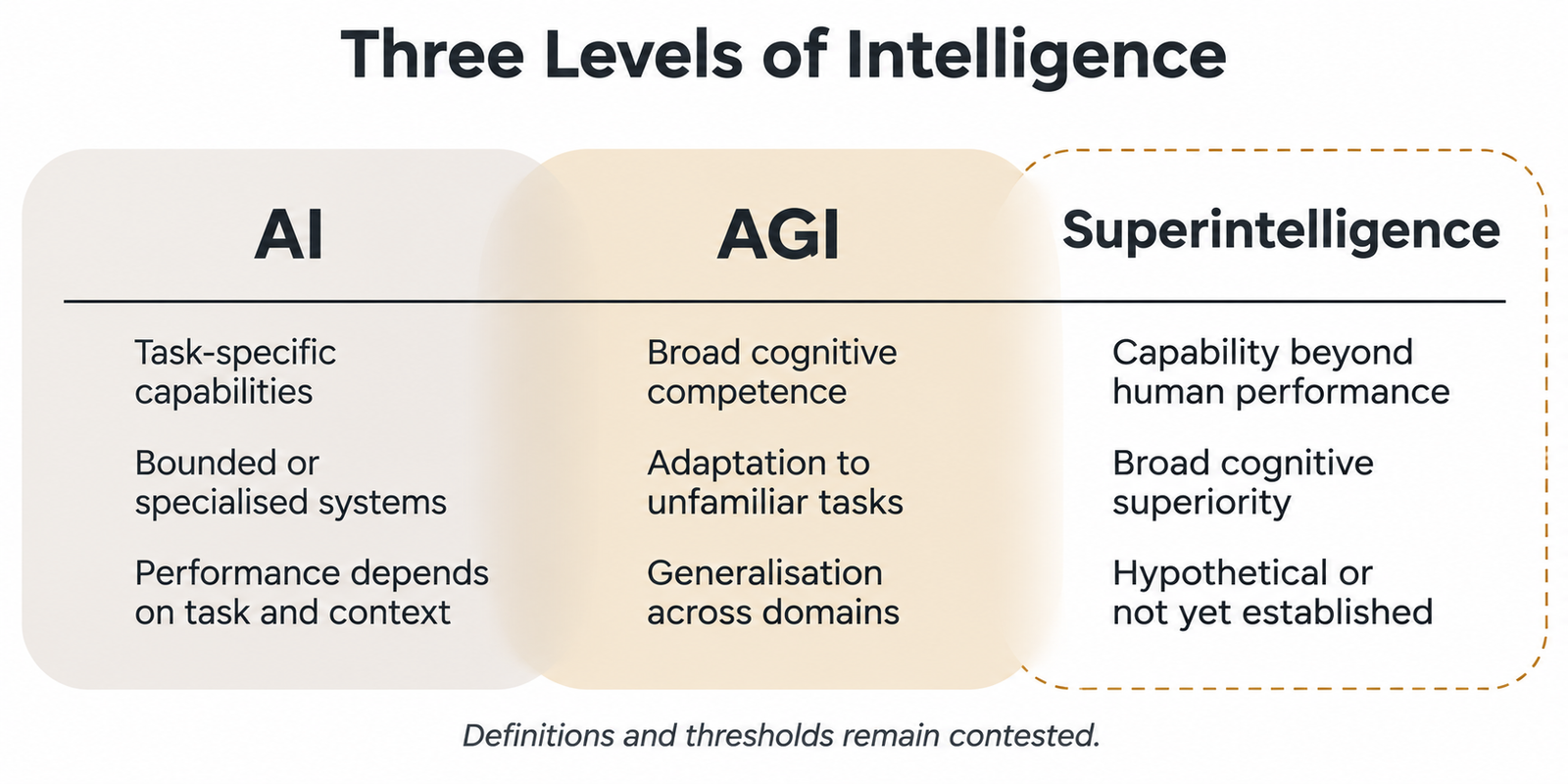
- Artificial intelligence (AI) is the established field of building systems that perform tasks associated with perception, prediction, language, reasoning, learning and decision-making. Much deployed AI is bounded by task, context, tools or data. A fraud model, a translation system and a frontier chatbot are all AI. Calling all of it “narrow” no longer fits models that write code, read images and plan multi-step work, but none of that breadth makes them general in the full sense.
- Artificial general intelligence (AGI) is a proposed level of broad competence: handling diverse cognitive tasks, including unfamiliar ones, and learning to adapt. There is no agreed test for it. OpenAI’s charter defines AGI as “highly autonomous systems that outperform humans at most economically valuable work.” A 2025 paper led by Dan Hendrycks, A Definition of AGI, proposes “matching the cognitive versatility and proficiency of a well-educated adult” across ten cognitive domains. Its authors scored GPT-5 at 57% by that measure. Google DeepMind’s Levels of AGI framework rates systems on two axes, depth of performance and breadth of generality. These definitions disagree on whether economic value, human-like cognition or autonomy is the yardstick.
- Artificial superintelligence (ASI) is a further, hypothetical level: capability substantially beyond the best humans across most important cognitive domains. Nick Bostrom’s widely cited formulation is “any intellect that greatly exceeds the cognitive performance of humans in virtually all domains of interest.” The key word is all. Superhuman chess doesn’t qualify, and neither does a model that beats experts at one scientific task.
Strong benchmark results don’t settle any of this. A benchmark samples a set of tasks someone chose, scored under one configuration. A model can be tuned towards the tasks that are measured, and a high score on expert questions says nothing about whether the model can work out an unfamiliar office process or notice it’s been given bad data. AGI claims need evidence of breadth and transfer, which is harder to collect than a leaderboard position.
So AGI vs superintelligence is a question of breadth and margin. AGI asks whether a system matches broad human competence. Superintelligence asks whether it greatly exceeds it nearly everywhere. Neither has an agreed threshold, and neither is an established label for any commercial model today.
The 2026 rebrand skipped the AGI vs superintelligence question
The striking thing about this autumn’s renaming is that it went straight from AI to superintelligence, with no stop at AGI.
The executive order, Inaugurating the Era of Super Intelligence, signed on 29 September, directs agencies to use “Super Intelligence” and “SI” in non-statutory documents, reports and websites, and to “no longer acknowledge” the old terms. It isn’t retroactive. As Freshfields’ analysis sets out, Section 3 gives the terms the same meaning as “artificial intelligence” under 15 U.S.C. § 9401(3). It also gives Michael Kratsios, the president’s science adviser, until 28 November, 60 days, to propose legislative language that could modify, expand or replace that definition.
A separate body followed. On 4 October, President Trump announced a Super Intelligence Force on Truth Social. TechCrunch reported that Jay Clayton would chair it. Citing the Wall Street Journal, it named FTC chairman Andrew Ferguson, Emil Michael and Scott Kupor as vice-chairs, and said the force has 120 days to report on the technology’s risks and opportunities. That’s a different deadline from the order’s 60 days. Its reported charter directs it to “develop plans for responding to SI-enabled threats” while avoiding overregulation. No official charter document had been published in the sources reviewed.
What the renaming does is change the vocabulary of federal communications and signal policy priority. What it doesn’t do is change any statute, any model or any evaluation. A system that was “AI” in a procurement file on 28 September is “SI” on 30 September, with identical capabilities.
Companies moved quickly. Marc Benioff wrote on X on 9 October that “AIForce is officially SIForce.” The platform had been called Headless 360 until September, when Salesforce’s help documentation, as quoted by the consultancy Vantage Point, described its rename to AIforce as coming “with the same functionality.” Musk replied “Yes, we will make that change” to a suggestion about SpaceXAI, Reuters reported on 4 October. By 10 October, the X account was @SpaceXSI.
| Organisation | Previous term | New term | Demonstrable technical change |
|---|---|---|---|
| US executive branch | Artificial intelligence (AI) | Super intelligence (SI) | None. The definition is unchanged pending a 28 November proposal |
| Salesforce | AIforce (Headless 360 until September) | SIforce | None announced |
| SpaceX’s AI unit | SpaceXAI (xAI until July) | SpaceXSI on X | None announced. Legal entity and Grok branding unchanged |
Testing an AGI vs superintelligence claim
When a label changes, three questions separate a name from a capability. Call it the Intelligence Label Test. It’s an editorial framework for reading claims, not an established scientific test.
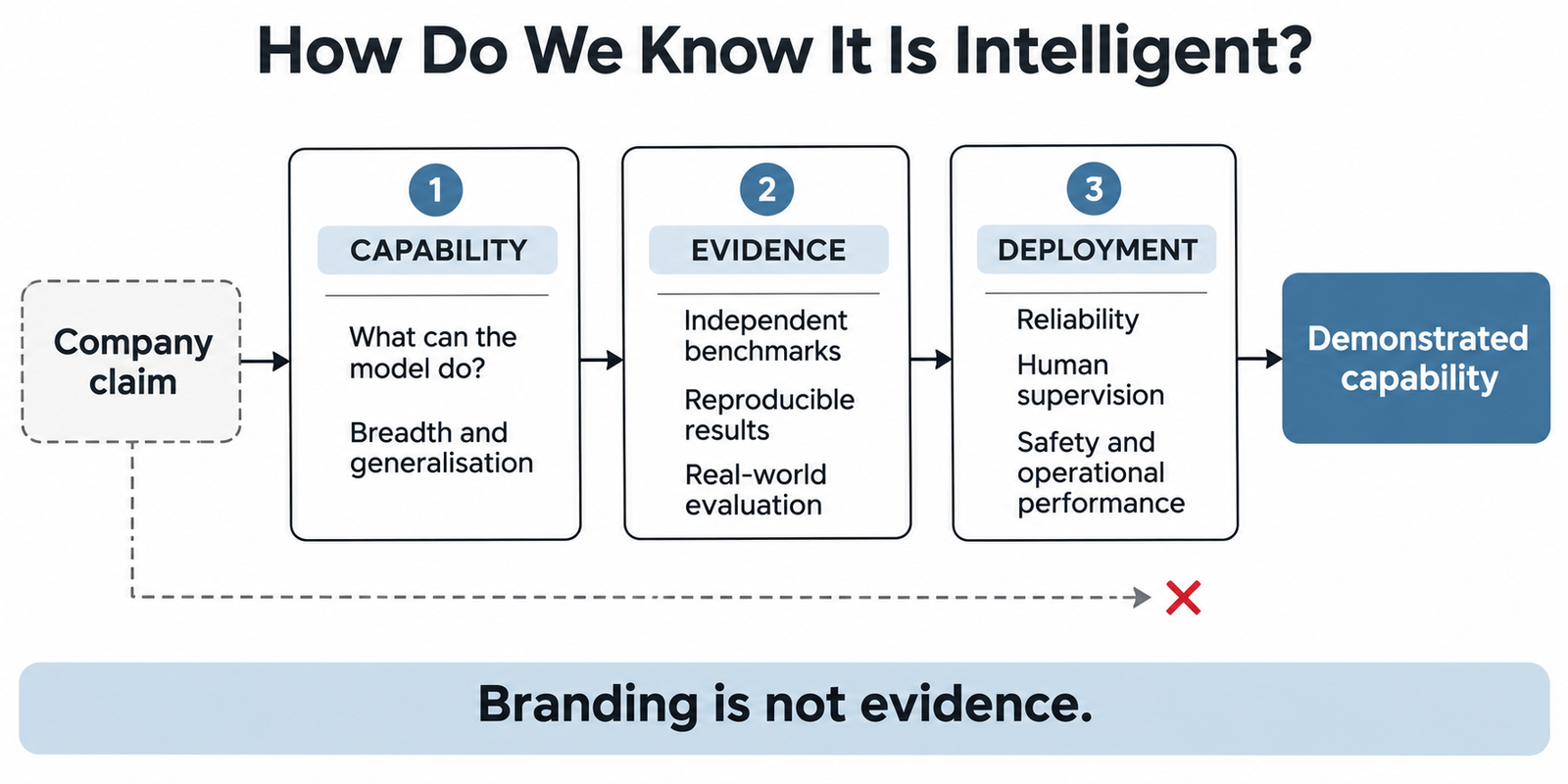
- The capability test: what can it do? Look at breadth across unrelated tasks, performance on problems it hasn’t seen, reliability over many attempts and how much autonomy it can sustain. A system that excels in one domain passes a narrow version of this test, not a general one.
- The evidence test: how do we know? Prefer independent, reproducible evaluations with clear configurations, human baselines and stated uncertainty over vendor demos. Private or held-out test sets matter because public benchmarks leak into training data.
- The deployment test: does it hold up outside a demo? Check error rates in real use, how much human supervision it needs, cost per task, behaviour on long-running work, and security. A capability that needs a person checking every step is a different thing from one that runs alone.
None of the three rebrands above asserted anything that the first two tests could examine. They’re naming decisions, and should be read as such.
Where frontier models stand on AGI vs superintelligence
Artificial Analysis, an independent benchmarking firm, relaunched its Intelligence Index as v5 on 27 October. The index combines nine evaluations across knowledge work, coding, science and general tasks, and 60% of it now uses private or held-out test sets. Its output is a composite score, not a percentage.
On the current leaderboard, Gemini 4 Carbon at high reasoning effort leads with 59, ahead of Claude Opus 5.5 (max) at 58 and GPT-6 Astra (max) at 57. The parts tell a more useful story than the total.
| Benchmark (v5) | What it tests | Gemini 4 Carbon (high) |
|---|---|---|
| HLE-Diamond | Expert-level reasoning and knowledge questions | 69% |
| CritPt v2, hard subset | Research-level physics problems | 63% |
| Terminal-Bench-Science 0.1 | Scientific research workflows in a terminal | 65% |
| FrontierCode 2.0 | Real repository changes a maintainer would merge | 41% (Opus 5.5 leads at 46%) |
| GDP.pdf | One of the index’s knowledge-work evaluations | 28% |
Artificial Analysis runs these evaluations itself, in Carbon’s case through Google’s API, so they’re independent of Google’s own launch claims. The benchmarks remain samples, and the scores reflect one configuration per entry.
So the index leader doesn’t lead every component. It trails Opus 5.5 on the coding benchmark, and it scores below a third on one of the knowledge-work tests. At v5’s launch, before Carbon was added, GPT-6 Astra led Terminal-Bench-Science at 63%. The best model with released open weights, DeepSeek V4.1 Flash 1017, scored 13% on it.
Configuration matters too. Artificial Analysis lists Opus 5.5 at 35 on low effort and 58 on max, so a headline number without its setting is half a fact. As our analysis of why benchmark scores don’t transfer to your workload argues, an index is a sample of tasks, not a measure of general intelligence.
The evidence supports a narrower conclusion. Today’s frontier models show striking competence in specific, measurable areas, with wide variation across domains. That’s consistent with neither AGI by most definitions nor anything resembling superintelligence.
Superhuman tasks and the AGI vs superintelligence gap
Machines have been superhuman at some tasks for decades. Deep Blue beat Garry Kasparov at chess in 1997. Calculators are superhuman at arithmetic. None of this is superintelligence, because each skill is confined to its task.
The useful question is what kind of task is involved. Each step up this list asks more of a system:
- Winning a game with fixed rules and instant feedback.
- Solving a hard but well-specified maths or physics problem.
- Writing software that passes tests.
- Carrying out multi-step research in a terminal.
- Operating unfamiliar software through its interface.
- Managing a project over days, with changing requirements.
- Learning an unfamiliar skill without being retrained.
Frontier models now do well on the early items and some of the middle ones. Evidence thins out towards the end.
The gap that matters today is between solving a well-specified problem and sustaining open-ended work. METR’s research on long software tasks measures the length of task, in human working time, that models complete with 50% reliability. It found that horizon doubling roughly every seven months since 2019. That’s rapid progress. It also shows that reliability falls as tasks lengthen, which is exactly where general competence is tested.
The harder abilities are the ones benchmarks capture least: following ambiguous instructions, noticing contradictory information, recovering from unexpected failures and learning a new skill without retraining. Current models vary widely on these, and few evaluations measure them directly. A model can score 63% on CritPt’s research-level physics problems and still need supervision to finish a two-day project.
Why AGI vs superintelligence matters for governance
A label doesn’t determine regulatory risk by itself. Laws attach obligations to measurable triggers, and the triggers used so far are compute and deployment, not intelligence labels.
The EU AI Act presumes systemic risk for general-purpose models trained with more than 10^25 floating-point operations (Article 51). California’s SB 53, in force since 1 January, applies to frontier models trained with more than 10^26 operations. It requires transparency reports, safety frameworks and incident reporting from large developers. Our guide to AI compliance deadlines tracks which of these obligations apply when.
That’s why the 28 November definition matters more than the renaming. A capability-based definition of “super intelligence” would require agreed evaluations. A compute-based one would capture models by training scale, whatever they can do. Keeping today’s meaning would leave the change cosmetic. Each choice would sweep in different systems and companies. The September industry accord, signed by Trump and six technology leaders, offers voluntary commitments (internal monitoring, external audits and board oversight) rather than a legal threshold.
Labels also blur accountability. If “super intelligence” ends up meaning any AI system, obligations written for the most capable models could reach ordinary software, or the term could stop signalling risk at all. The questions regulators actually need answered are concrete: what the model can do, how it’s deployed, who can access it and which legal framework applies.
Policy also shapes demand for the hardware behind frontier models, a link our piece on pacing the frontier explores.
Who benefits from AGI vs superintelligence language?
Superintelligence language was already commercial before Washington adopted it. In July 2025, Mark Zuckerberg wrote that “developing superintelligence is now in sight.” He framed Meta’s strategy around “personal superintelligence.”
What changed in 2026 is alignment with government. The White House framed its order as inaugurating “the era of super intelligence,” and Trump described the technology as “bigger than the Industrial Revolution, and the Internet,” according to Fox News. The Salesforce and SpaceX renames followed the executive order within days, and Reuters tied the SpaceX change to the administration’s push for the new term. Neither company said its systems had become more capable.
An analyst can reasonably infer some incentives without claiming to know private motives. Matching federal terminology may help with procurement and public positioning. Stronger words signal ambition to investors and recruits. Distinctive names help in a crowded market.
The pattern isn’t new. “AI” itself was stretched over a decade to cover everything from spreadsheet forecasts to chatbots, and the word lost precision as it gained reach. “Superintelligence” now risks the same fate, faster.
There’s a fair case for the companies too. A name can signal a genuine change in strategic priority even when today’s product hasn’t changed. The problem comes only when the name is read as evidence.
Frequently asked questions
AGI vs superintelligence: what is the difference?
AGI means broad, human-level competence across diverse cognitive tasks, including unfamiliar ones. Superintelligence means capability greatly exceeding the best humans across nearly all important domains. Neither has an agreed threshold.
Has AGI been achieved in 2026?
No, not by any widely accepted definition. Frontier models score strongly on many benchmarks but vary widely across domains and remain less reliable on long, open-ended work.
Is ChatGPT an example of AGI?
No. ChatGPT runs frontier models with broad abilities, but OpenAI’s own charter sets AGI as outperforming humans at most economically valuable work, which hasn’t been demonstrated.
What is artificial superintelligence?
It’s a hypothetical level of AI that would far exceed human cognitive performance in virtually every important domain. No current system meets that description.
Can an AI model be superhuman without being AGI?
Yes. Chess engines have been superhuman at chess for decades without being general. Today’s models can score well on research-level physics benchmarks while struggling elsewhere.
How would anyone measure AGI vs superintelligence progress?
Through independent, reproducible evaluations across many domains, tests on unfamiliar tasks, long-horizon reliability and real deployment data. Proposals such as the CHC-based definition and DeepMind’s Levels of AGI offer starting points, not consensus.
Are current frontier models superintelligent?
No. The top model on Artificial Analysis’s index scores 59 on a composite scale, and it scores 28% on one of the index’s knowledge-work tests.
What would happen if artificial superintelligence were achieved?
Nobody knows, and forecasts range from rapid scientific progress to serious loss-of-control risks. Because no such system exists, these are scenarios, not findings, which is why evaluation and governance work focuses on measurable capabilities today.
Does the AGI vs superintelligence label change how a model is regulated?
Not by itself. Existing laws use compute thresholds and deployment obligations. The federal definition due on 28 November could change that, depending on how it’s written.
Keep reading
Here are the latest posts from the blog.
Verify Model Weights: 7 Checks Before You Download

DeepSeek Super-Agent vs Claude Code: The Hidden AI Power Shift

AGI vs Superintelligence: A New Name Isn’t a New Intelligence