A humanoid robot on a factory floor has a problem that rarely appears in demo videos. It runs on a battery, and the battery runs out. A fixed robot arm draws mains power all shift. A walking robot has to stop, find a charger and wait, and every minute it waits leaves the line a pair of hands short.
UBTECH Walker S2 is UBTECH’s answer to that problem. It is a full-size industrial humanoid that, according to the company, can walk to a station, remove its own depleted battery and fit a charged one in about three minutes. UBTECH began mass production and delivery in November 2025 and says it built its 1,000th unit that December.
This investigation looks at what Walker S2 actually is, how its battery system works, what its software does and what the public evidence says about its work in factories. The battery swap solves one real engineering problem. Whether Walker S2 does useful, repeatable factory work at scale is a separate question, and the public evidence on that is still thin.
Key Takeaways
- Industrial, not consumer: UBTECH Walker S2 is the third-generation Walker S humanoid, built for factories, logistics and data-collection centres.
- Self-swapping battery: UBTECH says it swaps its own battery in about three minutes, staying powered on its second battery.
- Built for human workstations: 52 degrees of freedom, a 15 kg two-arm payload, a 0 to 1.8 m working range and ±162° waist rotation.
- Three software layers: stereo vision, Co-Agent on each robot and BrainNet 2.0 across the fleet, built on UBTECH’s Thinker models.
- Large output: the 1,000th unit was built in December 2025, and UBTECH sold 1,079 full-size humanoids in 2025.
- Thin deployment proof: the best-documented customer cases, Airbus and Ajin Industrial, are trials.
- Battery autonomy is not operational autonomy: reliability, speed, safety certification, cost and repeat orders remain publicly unproven.
Quick Navigation
- What UBTECH Walker S2 actually is
- Inside the engineering of UBTECH Walker S2
- Why UBTECH Walker S2 can replace its own battery
- How UBTECH Walker S2 sees and plans its work
- Where UBTECH Walker S2 is being deployed
- How Walker S2 compares with other industrial humanoids
- What UBTECH Walker S2 still has to prove
- Is UBTECH Walker S2 a real step towards factory automation?
- Frequently Asked Questions
- What is UBTECH Walker S2?
- How does Walker S2's autonomous battery swapping work?
- How long does Walker S2 take to replace its battery?
- What is the payload capacity of UBTECH Walker S2?
- What is BrainNet 2.0 in Walker S2?
- Where is UBTECH Walker S2 being deployed?
- How much does UBTECH Walker S2 cost?
- Can Walker S2 work continuously in factories?
- What makes Walker S2 different from other humanoid robots?
What UBTECH Walker S2 actually is
Walker S2 is the third generation of UBTECH’s Walker S series of industrial humanoids, after Walker S and Walker S1, according to UBTECH’s 2025 annual results. It launched in July 2025.
UBTECH’s product introduction lists it at 176 cm tall and 70 kg, with 52 degrees of freedom and a walking speed of up to 2 metres per second. UBTECH’s November 2025 announcement names four target uses: automotive manufacturing, smart factories, intelligent logistics and data-collection centres.
It is not a household or companion robot. UBTECH does make humanoids for other markets, including its U1 “ultra-bionic” line, which may be where confusion starts. On UBTECH’s website, Walker S2 sits in the industrial range beside Walker S1 and Walker S.
There is no public list price. The Walker S2 product page asks buyers to contact UBTECH, which sells the robot as a turnkey package with deployment and user training.
Inside the engineering of UBTECH Walker S2
The figures below are UBTECH’s own. They describe what the robot is designed to do, not how it performs on a production line.
| Specification | Manufacturer figure | Source |
|---|---|---|
| Height and weight | 176 cm, 70 kg | Product introduction |
| Degrees of freedom | 52: 6 per leg, 2 in the waist, 7 per arm, 2 in the head, 11 per hand | Product manual, product introduction |
| Walking speed | Up to 2 m/s | Product introduction |
| Payload | 15 kg with both arms; 7.5 kg per hand | Product page, product introduction |
| Working range | 0 to 1.8 m above the floor | Product page |
| Waist | ±162° rotation; pitch from +90° to −35° | Product page, product introduction |
| Hands | 11 degrees of freedom and 6 tactile sensor arrays each | Product introduction |
| Vision | RGB stereo cameras in the head | Product page |
| Power | Two batteries; self-swap in about 3 minutes | Product page |
Resellers also list a 48 V lithium iron phosphate battery and NVIDIA Jetson AGX Orin compute, which UBTECH’s product page does not confirm.
What the UBTECH Walker S2 numbers mean on a factory floor
The 15 kg payload covers totes, parts bins and many components, but not the heavy lifts that fixed robots handle today. The 0 to 1.8 m range spans floor level to just above head height, the reach of a workstation built for people. That is the core argument for a humanoid: it can work at existing stations without the line being rebuilt around it.
The waist lets the robot turn from a pick point to a place point without stepping, which shortens cycles and reduces balance risk under load. And 22 of the 52 degrees of freedom are in the hands, which shows where UBTECH sees the hard problem: reliable grasping of varied parts.
One caution for readers comparing sources: some early English-language coverage reported 20 degrees of freedom. UBTECH’s documents consistently list 52.
Why UBTECH Walker S2 can replace its own battery
UBTECH calls Walker S2 the world’s first humanoid robot that can swap its own battery. Its product page says a swap takes under three minutes, a figure shown in company videos but, as far as we could find, never independently timed.
How the UBTECH Walker S2 battery swap works
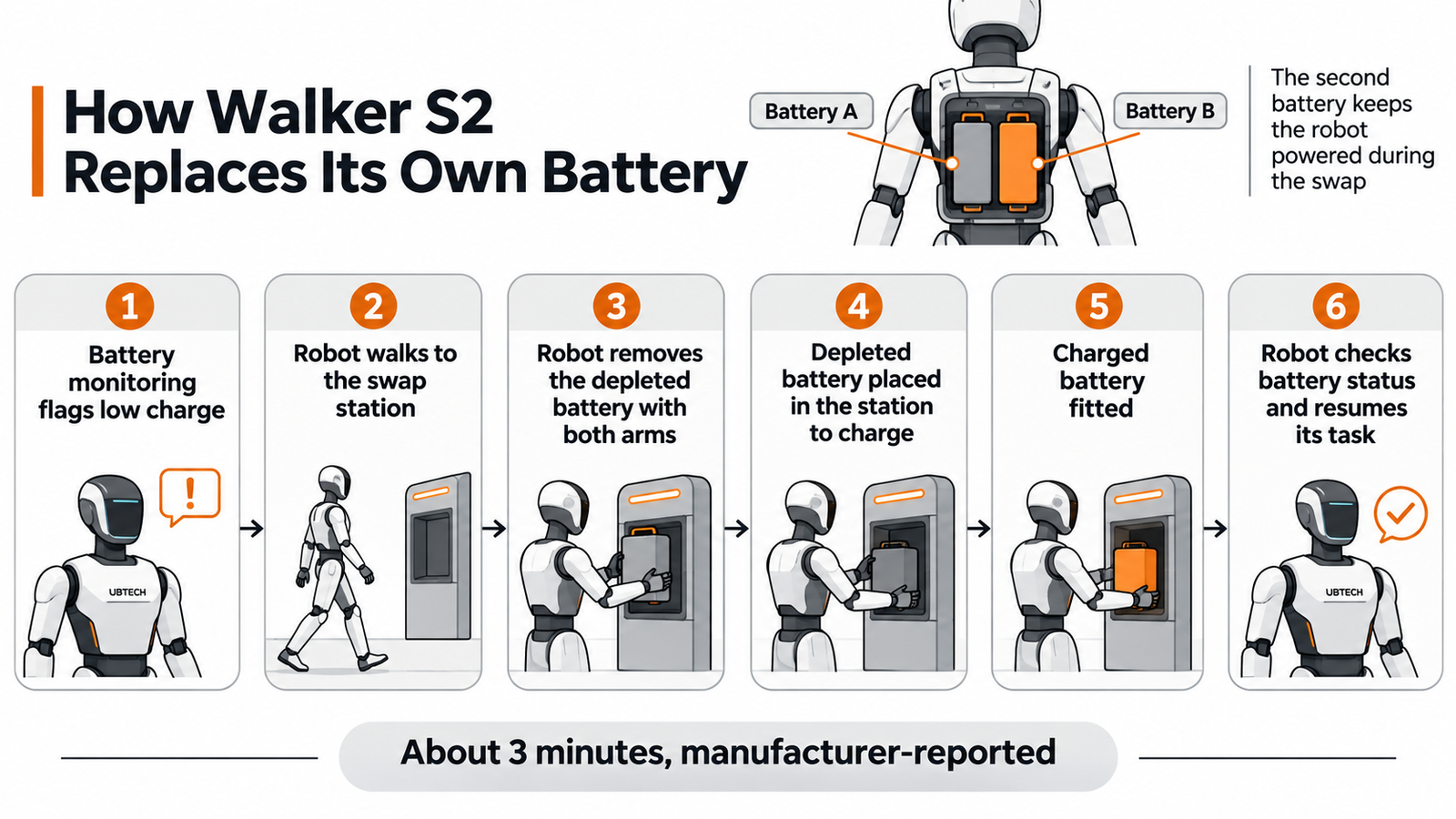
Walker S2 carries two batteries and can run on one while the other is out, so it stays powered throughout. When charge runs low, it walks to a swap station, removes the depleted pack with its own arms, leaves it to charge and fits a charged one. UBTECH says the robot can instead plug in and charge when its task is less urgent, choosing between the two by task priority.
Why swapping beats recharging
Recharging ties a robot to a dock for the whole charge. Swapping cuts the robot’s downtime to the swap itself and moves the slow part onto a battery sitting in the station. For a plant running two or three shifts, that can decide whether a robot spends hours a day standing at a charger. UBTECH pairs the system with the promise of 24/7 operation.
What the battery swap does not prove
Swapping needs infrastructure: stations within walking distance and enough charged spares that one is always ready. UBTECH has not published how many a fleet needs, how long one battery lasts, how many cycles a pack survives or how often a swap fails.
Power is also only one reason robots stop. Grasp failures, perception errors, falls, maintenance and software updates all cause downtime. Battery autonomy removes one cause; it does not make the robot operationally autonomous.
Swappable batteries are not unique to UBTECH either. Apptronik’s Apollo, for example, uses hot-swappable packs. What sets Walker S2 apart is that it performs the swap itself, without a person.
How UBTECH Walker S2 sees and plans its work
UBTECH describes three software layers: stereo-vision perception, a robot-level agent called Co-Agent and a fleet-level platform called BrainNet 2.0, all built on its Thinker AI models.
Vision from two cameras
Walker S2 sees through two RGB cameras in its head, spaced like eyes. A deep-learning model turns each pair of images into depth maps in real time, according to the product page. Cameras keep the hardware simple, but camera depth can struggle with poor light and shiny metal, and UBTECH has not published how Walker S2 copes with either.
Co-Agent and BrainNet 2.0
UBTECH calls Co-Agent the world’s first industrial agent for humanoid robots. Its November 2025 announcement says Co-Agent lets the robot understand an instruction’s intent, plan the task, use tools, and detect and handle problems itself. Put simply, it turns an instruction such as “move these parts to station 4” into walking, grasping and placing steps. It is a task planner, not a chat assistant.
UBTECH pairs Co-Agent with BrainNet 2.0 in what it calls a dual-loop AI system. Our reading of UBTECH’s description: Co-Agent runs the loop inside each robot, while BrainNet 2.0 coordinates tasks across the robots on a line.
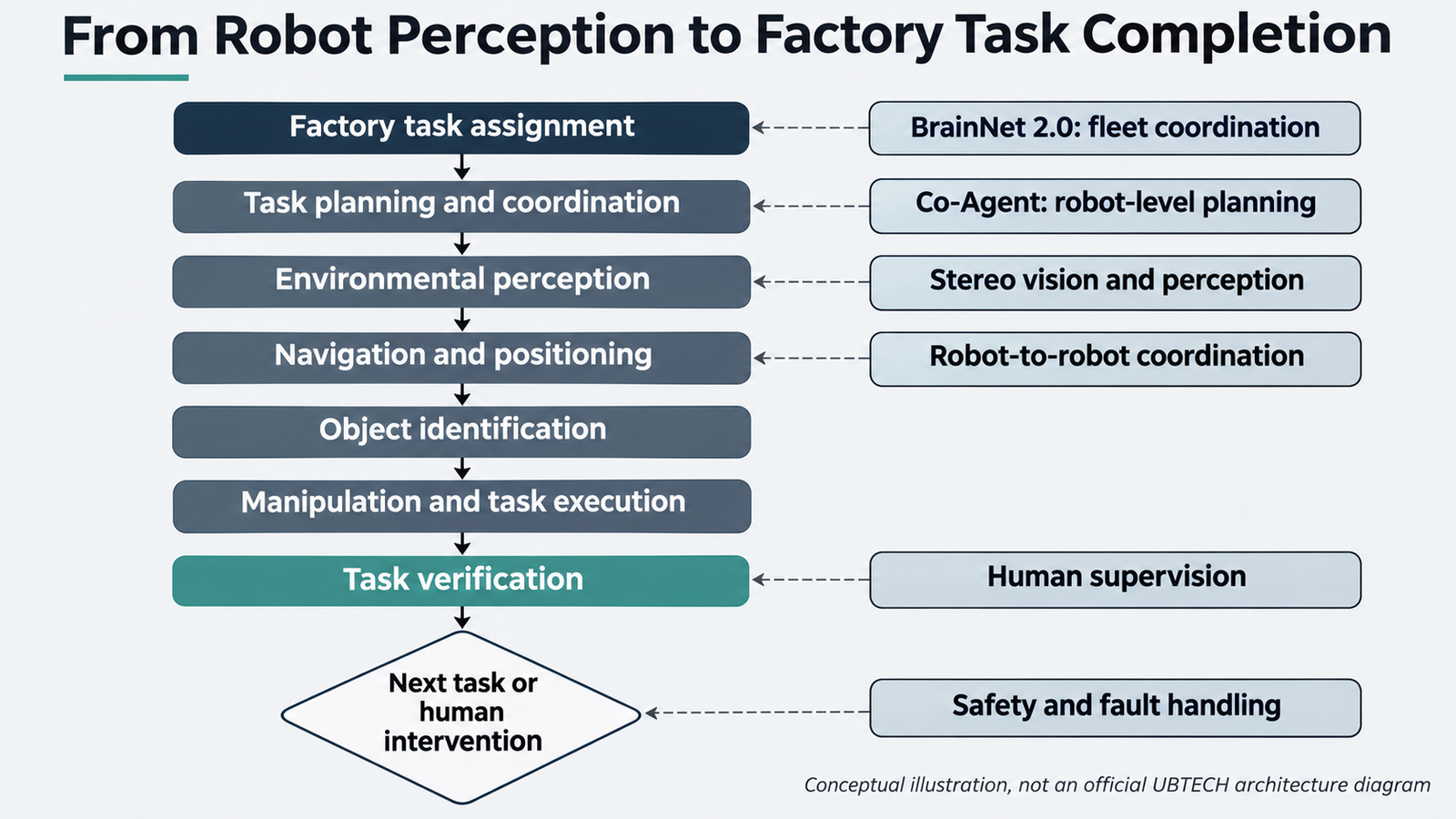
Underneath, UBTECH’s company profile lists the Thinker foundation model, the Thinker-WM world model and the Thinker-VLA action model, which links vision and language to movement.
What the public record lacks is how often a person has to step in, take over remotely or reset a task. That intervention rate is the best single measure of an industrial robot’s autonomy, and no buyer has published it. We have looked at where agent software meets physical robots in Isaac ROS 5.0 and the robotics agent boundary problem.
Where UBTECH Walker S2 is being deployed
UBTECH says it was the only company to deliver more than 1,000 full-size humanoids in 2025. Evidence that those robots do recurring productive work in customers’ factories is much thinner.
Orders, production and deliveries
On 17 November 2025, UBTECH announced mass production and delivery, with a first batch of several hundred units and a target of 500 deliveries that year. It said Walker series orders since early 2025 had passed 800 million yuan, about US$112 million.
The second-largest order, worth 159 million yuan, was for robots at a data-collection centre in Zigong. Such centres use robots to generate AI training data, not to make products. UBTECH has not named the buyer of its largest order, worth 250 million yuan and signed in September.
The 1,000th Walker S2 rolled off the line in Liuzhou on 26 December 2025, by which point UBTECH said more than 500 had been delivered. Its annual results then reported 1,079 full-size humanoids sold in 2025, a figure covering the whole Walker S series. Its first-half 2026 results added 921 more.
Who is using UBTECH Walker S2
UBTECH says it collaborates with BYD, Dongfeng Liuzhou Motor, Geely Auto, FAW-Volkswagen Qingdao, Audi FAW, BAIC New Energy, Foxconn and SF Express. None of these buyers has published how many Walker S2 robots it runs, on which tasks or for how long.
The best-documented customer cases are trials. Airbus bought a Walker S2 in 2026 and described the work as being at an early concept-testing stage, Reuters reported. Several Walker S2 robots are in a verification project at Ajin Industrial in South Korea, SouthwardTech reported, citing Autodaily.
| Claim | Who says so | Evidence level |
|---|---|---|
| Orders above 800 million yuan | UBTECH | Company-reported orders |
| 159 million yuan Zigong order | UBTECH | Data-collection centre, not factory production |
| 1,000th unit built; 500+ delivered (Dec 2025) | UBTECH | Company-reported production and deliveries |
| 1,079 full-size humanoids sold in 2025 | UBTECH annual results | Filed sales figure, not deployments |
| BYD, Geely, FAW-Volkswagen and others | UBTECH | Announced partnerships; no buyer-published detail |
| Airbus | Airbus, via Reuters | Buyer-confirmed trial |
| Ajin Industrial | Autodaily, via SouthwardTech | Independently reported trial |
The pattern holds across the industry. Of 41 named Chinese humanoid deployments SouthwardTech checked at source in November 2026, 20 were trials and nine were training or tests. We tested the same gap in Humanoid Robots in Production: 3 Proven and 6 Unverified.
How Walker S2 compares with other industrial humanoids
UBTECH leads on units built and sold. Agility Robotics and Figure AI lead on documented hours of work at named customers. None has published a full return-on-investment case.
| Robot | Strongest public evidence |
|---|---|
| UBTECH Walker S2 | More than 1,000 built by December 2025; buyer-confirmed work limited to trials |
| Agility Digit | More than 65,000 cumulative operating hours reported; 100,000+ totes moved at GXO; two more GXO sites from early 2027 |
| Figure 02 | An 11-month BMW pilot: about 1,250 hours, 90,000+ parts loaded, 30,000+ vehicles supported |
| Apptronik Apollo | Agreements with Mercedes-Benz, GXO and Jabil; no comparable public hours |
| Tesla Optimus | Elon Musk indicated public sales were likely by the end of 2027; little factory data |
UBTECH is going wide, placing many robots across many sites. Agility and Figure have gone deep, with fewer, longer and better-documented runs. Above any brand sits another choice: conveyors and fixed arms beat humanoids wherever a process can be redesigned around them. A humanoid such as UBTECH Walker S2 earns its place in brownfield plants built for people.
Investors are now pricing these strategies. Agility agreed in June 2026 to go public through a SPAC merger valuing it at $2.5 billion, a route we questioned in Agility Robotics’ $2.5B SPAC: A Warning, Not a Win.
What UBTECH Walker S2 still has to prove
The open questions are the ones a factory manager asks before placing a second order, and UBTECH has not published answers.
- Reliability: no public figures for time between failures, falls or grasp success on real tasks.
- Battery life: no published cycle life or capacity loss, though spares and stations are a recurring cost.
- Speed: no published cycle times, so nobody outside UBTECH and its customers can compare the robot with a person or a fixed robot.
- Safety: the product page does not name the safety standards Walker S2 meets for work near people.
- Cost: no list price. For context, a Hangzhou parts maker running 15 humanoids from rival Leju expects payback in three to four years, Yicai reported.
- Repeat orders: UBS analyst Phyllis Wang has named repeat purchases as the measure to watch. For Walker S2, buyer-named repeat orders are the missing evidence.
Is UBTECH Walker S2 a real step towards factory automation?
On manufacturing, yes. UBTECH went from its first Walker S2 off the Liuzhou line in June 2025 to the 1,000th in December. On engineering, the battery swap turns energy from a hard stop into a three-minute errand, a design aimed at shift work rather than stage demos.
On productive work, the case is still open. Most of the evidence comes from UBTECH, the largest buyers have published nothing, the best-documented cases are trials and part of the order book is for data collection.
Chinese ministries have asked for humanoid deployment progress reports by 30 November 2026, which may give the first official count of robots at work. Until buyers publish unit counts, tasks and hours, UBTECH Walker S2 is best understood as a well-engineered industrial humanoid in early deployment, not yet a proven part of the factory workforce.
Frequently Asked Questions
What is UBTECH Walker S2?
A full-size industrial humanoid robot from UBTECH Robotics in Shenzhen. It is 176 cm tall, has 52 degrees of freedom and is built for factories, logistics and data-collection centres.
How does Walker S2’s autonomous battery swapping work?
It walks to a swap station, removes its depleted battery with its own arms and fits a charged one, while its second battery keeps it powered.
How long does Walker S2 take to replace its battery?
About three minutes, according to UBTECH. We found no independent measurement.
What is the payload capacity of UBTECH Walker S2?
Up to 15 kg with both arms, according to UBTECH, and up to 7.5 kg in one hand.
What is BrainNet 2.0 in Walker S2?
UBTECH’s platform for coordinating several robots on a production line. It works with Co-Agent, the planner inside each robot.
Where is UBTECH Walker S2 being deployed?
UBTECH names collaborators including BYD, Geely, FAW-Volkswagen, Audi FAW and Foxconn, but they have not published details. Public customer cases include trials at Airbus and Ajin Industrial.
How much does UBTECH Walker S2 cost?
A verified public price is not available. UBTECH asks buyers to contact it and sells the robot as a turnkey package.
Can Walker S2 work continuously in factories?
UBTECH says the battery swap enables 24/7 operation, but no buyer has published round-the-clock data. Continuous work also depends on spare batteries, stations and reliability.
What makes Walker S2 different from other humanoid robots?
Its self-performed battery swap and UBTECH’s production scale. Rivals such as Agility’s Digit and Figure 02 have published more operating hours at named customers.
Keep reading
Here are the latest posts from the blog.

Browser Agents Compared: What Can They Actually Do in 2026?
UBTECH Walker S2: The Humanoid Robot Built for Factory Work

AGI vs Superintelligence: A New Name Isn’t a New Intelligence