What Breaks When Your Model Version Retires

Model Retirement

The email arrives on a Friday. One of your model snapshots has a shutdown date, and it is sixty days out.

Your first instinct says config change. Swap the string, redeploy, done.

Then you start looking. The prompt was tuned against that snapshot. The eval baseline was measured on it. The vector index was built with an embedding model from the same family. The fine-tune sits on a base that goes with it.

Model retirement is not a version bump. It is a migration with a hard deadline, and the deadline belongs to your vendor.

This piece walks those sixty days in order, from notice to cutover, and names what model retirement breaks at each stage.

Key Takeaways

  • The clock is short and it is not yours. Anthropic runs a fixed 60-day window from deprecation to retirement. Opus 4.1 was deprecated on 5 June 2026 and retired on 5 August.
  • Nothing fails loudly. The API returns 200, latency holds, throughput holds, and the behavioural regression ships anyway.
  • Embeddings are the worst case. A retired embedding model means re-embedding the whole corpus, and a dimension or distance-metric mismatch silently ruins ranking.
  • Fine-tunes retire with their base. OpenAI is shutting down fine-tuned GPT-3.5 and GPT-4 variants on 23 October 2026, and Cohere has already made older fine-tunes inaccessible.
  • Auto-upgrade can move you before any retirement date. Azure deployments set to update to the default version switch roughly two weeks after a new default publishes.
  • Sometimes there is no replacement. OpenAI’s deprecation table lists a dash against the Videos API, which means choosing a vendor, not swapping an identifier.

Quick Navigation


Why Model Retirement Is Not a Version Bump

A library upgrade breaks loudly. Types stop matching, tests go red, the build fails. You fix it before anything ships.

Model retirement breaks quietly. The new snapshot takes the same request, returns valid JSON, and answers in the same voice.

That is the trap. Your dashboards watch error rate, latency and throughput. A model retirement swap can leave all three flat while it rewires how the system behaves.

So the regression ships, then shows up later wearing a different face. Support tickets rise. A classifier drifts. An agent takes an extra tool call it never needed.

Model retirement also runs on someone else’s calendar. You are not choosing to upgrade. You are handed a date, and the date does not negotiate.
Model Retirement

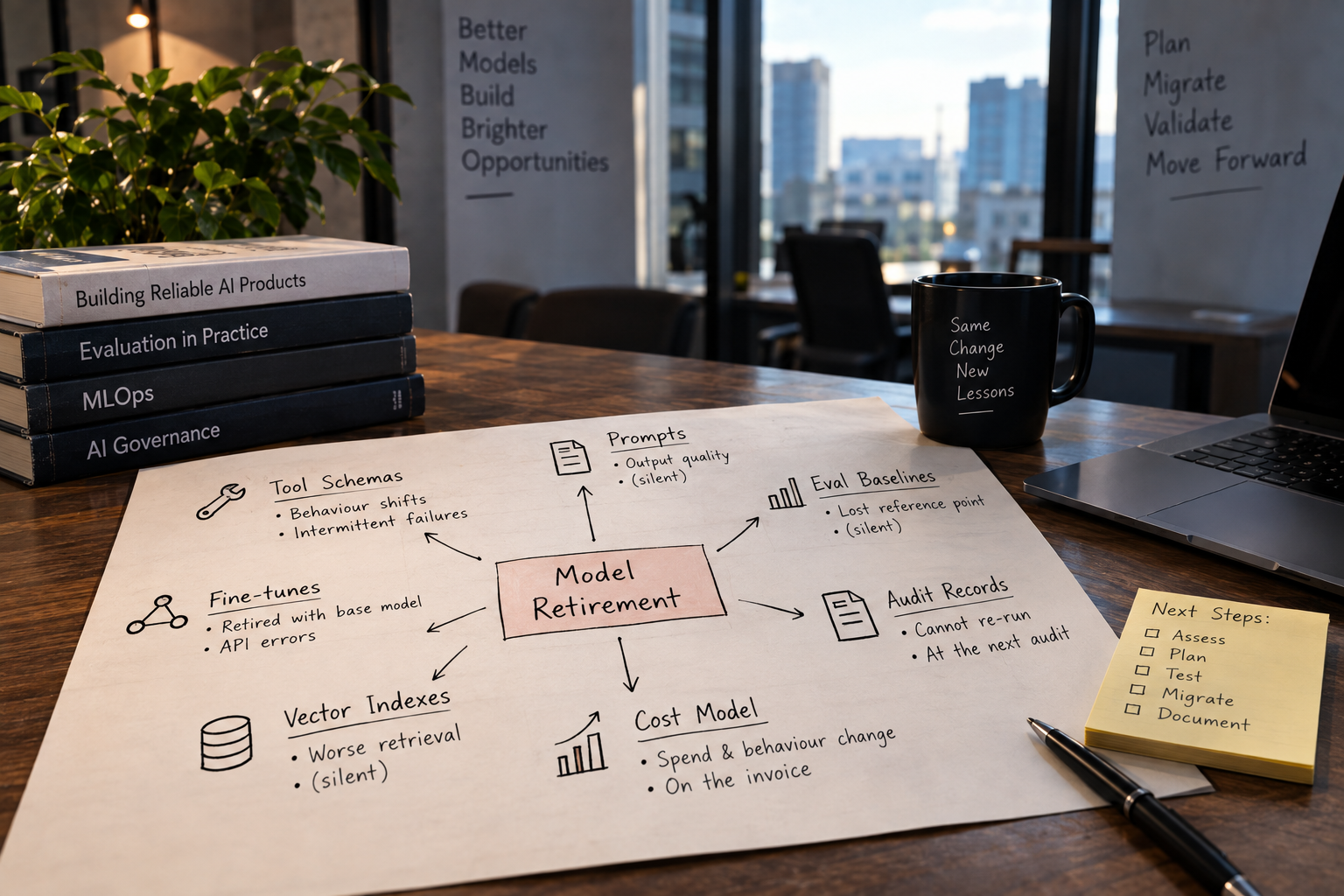
The Blast Radius: What Model Retirement Actually Touches

Before the runbook, the map. Most teams guess this table at about half its real size, which is why model retirement overruns.

ArtefactWhat model retirement does to itHow it fails
PromptsTuning was fitted to one snapshotQuietly, in output quality
Eval baselinesScores were measured on a model that no longer existsSilently, as a lost reference point
Vector indexesBuilt with an embedding model in the same lifecycleSilently, as worse retrieval
Fine-tunesRetired alongside their base modelLoudly, with an API error
Tool schemasCalling behaviour and format shift between versionsIntermittently, under load
Audit recordsReference a model nobody can re-runAt the next audit
Cost modelToken spend and reasoning behaviour changeOn the invoice

Note the third column. Four of the seven fail with no error at all. That silence is why model retirement eats more calendar time than anyone budgets.


Day 0: The Model Retirement Notice Nobody Reads

The first model retirement problem is delivery. Notices go to whoever is on the account, not to whoever owns the code.

Azure notifies the subscription roles: owner, contributor, reader and the monitoring roles. Whether that list includes the engineer who wrote the prompt is down to your tenant hygiene.

Model retirement windows vary more than people expect. Anthropic commits to at least 60 days for a public model, with a fixed gap from deprecation to shutdown.

Azure notifies at 60 days, at 30 days, and at retirement, with at least 60 days of notice for generally available models and only 14 days before a preview version upgrade.

OpenAI runs longer on its main line. Its June 2026 notice set a December 2026 shutdown for the GPT-5 and o3 snapshots, roughly six months out.

One detail hides inside the date itself. Azure runs retirements on a rolling basis, region by region, so two deployments of the same model can behave differently for part of the window.

What to do on day zero. Put the date in your release calendar, name an owner, and check the notice actually reached that person. Model retirement nobody owns gets found in week seven.


Week 1: The Inventory Model Retirement Forces on You

You cannot plan a model retirement until you know where the string lives. It is almost never in one place.

Grep the model ID across app code, prompt templates, eval configs, infra code, notebooks, cron jobs and vendor dashboards. Then grep the aliases too.

Aliases deserve their own line, because they fail the other way. An alias never errors on model retirement. It just starts pointing somewhere else, which is worse than a break you can see.

Azure makes this concrete. A deployment set to update when a new default arrives moves about two weeks after that default publishes, not on the retirement date.

So model retirement can move you early, on a schedule you were not watching. Pinning to a dated snapshot trades that surprise for a date you control.

Check the replacement column while you are there. Most model retirement notices name a successor, and the ones that do not are a different project entirely.

One inventory item teams forget. List every artefact the old model produced that you still lean on: embeddings, cached completions, synthetic training data, labelled eval sets.


Weeks 2 to 4: Where Model Retirement Actually Breaks Things

Prompts Tuned to a Snapshot

Every production prompt carries fitting. Someone added a line because the old model rambled, or cut one because it refused too much.

That fitting does not carry over. A newer model may need less scaffolding, or may react badly to lines written around a quirk it no longer has. Model retirement resets the tuning, not just the ID.

Reasoning models sharpen this. Vendor migration guides now read as “rewrite the prompt”, not “reuse the prompt”.

Evals That Lose Their Baseline

Here is the circular problem in every model retirement. You want to prove the new model is no worse, and the proof rests on scores measured against a model about to vanish.

Re-run your full eval suite on the outgoing snapshot before it shuts down. Store the outputs, not just the aggregate numbers.

Those stored outputs are the only comparison you will ever have. After the shutdown date you cannot rebuild the baseline, and model retirement has quietly taken your reference point.

The Embedding Trap in Model Retirement

This is the expensive one, and the one model retirement plans miss until late.

If your index was built with an embedding model that is retiring, you cannot mix old and new vectors. The whole corpus needs re-embedding. That is compute, calendar time and database write throughput.

Worse, matching dimensions do not mean the models match. Models differ in distance metric and scaling, so an index set for cosine similarity holding vectors meant for dot product ranks wrongly while looking healthy.

The safe model retirement pattern is a dual index. Build the second one beside the first, route each query to model and index together, compare on a labelled set, then cut over. Keep the old index as rollback for a week.

Fine-Tunes That Retire With Their Base

A fine-tune is not an asset you fully own. It is an adapter on a base model, and model retirement usually takes both.

OpenAI’s table lists shutdowns for fine-tuned GPT-3.5 and GPT-4 variants on 23 October 2026. It names replacement base models rather than migrating anything for you.

Cohere went further and stated plainly that previously fine-tuned models would no longer be accessible once fine-tuning for those bases was retired.

Plan a re-train, not a port. Keep training data, hyperparameters and eval scores versioned together, because model retirement will ask for all three.

This stretch decides whether you make the date. Five model retirement failure classes, roughly in the order they eat time.

Tool Calls and Structured Output

Agents have a model retirement failure mode the rest do not. Tool-calling behavior shifts between versions in ways that are hard to write a test for.

The new model may call a tool the old one never touched, call it in a new order, or pass a slightly different argument. Everything validates. The path changes.

Watch for API changes riding alongside model retirement. When OpenAI sunset the Assistants API, threads became conversations and runs became responses, so the request shape moved, not just the ID.


Weeks 5 to 7: Running Both Models Through Model Retirement

Offline evals catch the obvious regressions. Production catches the rest, so model retirement needs both.

Shadow traffic is the cheapest insurance available during model retirement. Send a slice of real requests to both models, log both outputs, and compare without serving the new one to anyone.

Compare the right things. Output quality on your labelled set, yes, but also token spend per request, p95 latency, refusal rate, and for agents, tool-call counts and path length.

Then ramp rather than flip. One percent, five, twenty five, with a rollback that stays valid until the old snapshot actually shuts down.

Keep one number in view throughout. A model that scores identically while spending forty percent more output tokens is not a neutral swap, and that arithmetic sits in our piece on what inference actually costs per token.

Also re-run your safety testing. A model version change is one of the standard triggers for a fresh adversarial pass, which we covered in the hidden flaws in a passing red-team test.


The Cutover: What Model Retirement Leaves Behind

The switch is the easy part of model retirement. The residue is not.

Start with repeatability. You can no longer regenerate any output the old snapshot made. That matters when a customer disputes a decision, or a regulator asks how it was produced.

That is a records problem more than a technical one. Model retirement means your logs must already hold the snapshot ID, the prompt version and the parameters, because the model will not be there to ask. We went deeper on that in our guide to AI compliance evidence.

Then come the dependencies you never called dependencies. Cached completions from the old model. Synthetic data used to train a smaller one. Labelled sets where the old model did the labeling.

None of those break on the shutdown date. Model retirement just turns them into relics of a system you can no longer rebuild.

One harder case deserves naming. Sometimes model retirement offers no replacement at all. OpenAI’s table carries a dash against the Videos API entry, which means finding another vendor rather than editing a string.


Building So the Next Model Retirement Costs Less

There will be a next model retirement, usually within a year. Five changes make it routine instead of disruptive.

  1. Pin snapshots in production. Aliases are for experiments. A dated identifier means model retirement arrives as a deadline you can see rather than a behavior change you cannot.
  2. Put the model behind one boundary. One config value, one client wrapper, one place to edit. If the ID sits in forty files, model retirement is forty times harder than it needs to be.
  3. Version the eval set like code. Same repository, same review process, and a rule that every migration re-runs the outgoing model before shutdown.
  4. Derive index names from the embedding config. Model, dimensions, distance metric and chunk version in one config that builds the index name, so a mismatch cannot happen quietly.
  5. Log the snapshot with every response. Not the family name, the dated identifier. This is the single cheapest habit on the list and the one that saves you in an audit.

Then diary a quarterly check of your vendors’ deprecation pages. The model retirement email is unreliable. The page is not.


The Verdict: Model Retirement Is a Standing Cost

  • Go back to that Friday email and the sixty-day clock. Nothing in your system was broken when it arrived.
  • What changed is that a part you do not control picked up an expiry date, and every artefact built on it inherited the same one.
  • Treat model retirement as a recurring line item rather than an incident. Somewhere between two and four times a year, an engineer spends a few weeks on migration, and the budget should say so.
  • The line item is smaller than it looks, too. An engineer for three weeks, twice a year, is cheaper than one rushed cutover that ships a quiet regression to customers.
  • Teams that find model retirement painless are not lucky. They pinned their snapshots, versioned their evals, and logged which model produced what.
  • The teams that find it brutal usually discover in week seven that the vector index was built with something that retires on the same day.

Frequently Asked Questions

What happens when a model version is retired?

Requests to the retired ID stop working. Azure states plainly that deployments of a retired model always return error responses. Anything built on that model — prompts, eval baselines, fine-tunes, embeddings — either breaks with it or loses its reference point.

How much notice do providers give before model retirement?

Model retirement notice varies widely. Anthropic commits to at least 60 days for public models, with a fixed gap from deprecation to shutdown. Azure gives at least 60 days for GA models and only 14 days before preview upgrades. OpenAI’s main-line notices run closer to six months.

Do fine-tuned models survive model retirement of the base?

Usually not. Model retirement of the base normally takes the fine-tune with it. OpenAI listed shutdown dates for fine-tuned GPT-3.5 and GPT-4 variants with replacement base models rather than automatic migration, and Cohere said previously fine-tuned models would become inaccessible. Budget a re-train and keep your training data versioned.

What happens to my vector database when an embedding model retires?

You re-embed the corpus. Old and new vectors cannot be mixed, and matching dimensions do not mean the models match, since they differ in distance metric and scaling. Use a dual-index migration, compare retrieval quality on a labelled set, then cut over with the old index kept as rollback.

Can a model change before its retirement date?

Yes, if you use an alias or an auto-update policy. An Azure deployment set to update once a new default arrives moves about two weeks after that default publishes, whatever the retirement date says. Pinned snapshots avoid this.


Keep reading

Kimi K3.1 Pro hardware requirements

Kimi K3.1 Pro Hardware Requirements: GPUs, Memory, Cost

Before anyone argues about which GPU to rent, a smaller question settles most of the argument: how many bytes have to sit in accelerator memory …
Kimi K3.1 Pro

Kimi K3.1 Pro vs Sonnet 5.5: Same Price, Different Bill

On paper, Moonshot AI priced Kimi K3.1 Pro to the cent against Claude Sonnet 5.5: $2 per million input tokens and $10 per million output …
RAG vs fine-tuning

RAG vs Fine-Tuning: Which One You Actually Need
Take a support team that ships two prototypes on the same base model. The first searches the product documentation on every question and pastes the …
AI capex

AI Infrastructure Spending: What $145 Billion and a Sold-Out AWS Actually Buy

Published 25 October 2026 · Last verified 25 October 2026 · By the UniverseBlend editorial desk On 21 October, Meta set the latest marker for …

Model Vendor Risk: 7 Dangerous Gaps in Your AI Contract

Model Vendor Risk

Most AI buying calls follow the same script. Someone asks about SOC 2, someone asks whether the data trains the model, someone asks about pricing tiers, and everyone signs.

Those questions are fine. They are also the ones every model vendor has answered four hundred times and has a slide for. The questions that decide what happens to you in eighteen months are the ones nobody asks, and this piece is nine of them.

Each one comes with the same three notes: why it matters, what a good model vendor answer sounds like, and what a bad one sounds like. Take them into the call word for word.

Key Takeaways

  • A retention promise is not a retention guarantee. A US court order in May 2025 forced OpenAI to preserve output logs it would normally have deleted, including standard API traffic. Zero-retention and certain enterprise agreements were carved out.
  • Notice periods vary by an order of magnitude. Anthropic commits to at least 60 days before retiring a public model. OpenAI’s published floors run to six months for generally available models and about two weeks for previews.
  • Aliases float. A model name without a dated snapshot suffix points at whatever the vendor ships next, which means a silent behavior change you never approved.
  • Indemnities cover copyright, not correctness. Every major shield has conditions, and disabling or circumventing safety features voids most of them.
  • Your model vendor’s subprocessor list is the real contract. No-training clauses matter only if they flow down to the foundation lab underneath.
  • EU buyers can demand documentation by law. Article 53(1)(b) of the AI Act entitles downstream providers to an Annex XII package, and most integrators never ask for it.

Quick Navigation


Why the Standard Questionnaire Misses Your Model Vendor

Standard software buying asks about uptime, security and price. Those questions assume the thing you bought stays the thing you bought, which is exactly what a model vendor cannot promise.

A model does not stay put. It gets retired, re-pointed, re-tuned and re-priced, and the behavior you tested in March may not survive to September.

Model Vendor Risk

So the useful model vendor questions target change rather than state. Not “is it secure today” but “what happens when it changes, and who tells me”.

The nine below sit in five rounds. Ask them in order, because each round narrows what your model vendor can plausibly claim in the next one.


Round One: What Your Model Vendor Does With Your Data

Question 1: What happens to our retention promise under a litigation hold?

Why it matters. A retention policy is a promise between you and your model vendor. A court is not part of that deal.

In May 2025, a federal judge told OpenAI to keep and set aside output log data it would normally delete, as part of the New York Times copyright case. The order was two pages long and it reached standard API traffic that had a 30-day deletion policy.

The order was lifted on 26 September 2025 and normal deletion resumed. Data from the April to September window stayed in secure storage, and in November 2025 the court ordered production of 20 million de-identified logs to the plaintiffs.

Crucially, OpenAI stated that zero-data-retention endpoints and certain enterprise agreements sat outside the hold. That is the real lesson for model vendor selection: architecture protected customers where policy did not.

A good answer sounds like. “We are subject to litigation X. ZDR endpoints are excluded. Here is who at the model vendor calls you if a hold ever touches your tenant.”

A bad answer sounds like. “Our policy is 30 days.” That is the policy. You asked about the exception.

Question 2: Is the foundation lab a subprocessor of your model vendor?

Why it matters. Most AI products are a wrapper. Your no-training clause is worthless if it stops at your model vendor and the lab underneath has different terms.

Ask your model vendor for the subprocessor list. Then ask whether the training ban, the retention window and the regional processing promise each flow down to every name on it.

A good answer sounds like. A named list, a link to a change-notice page, and proof the flow-down is in the contract rather than just words.

A bad answer sounds like. “We use a leading foundation model provider.” A vague model vendor answer here is almost always a gap, not a security habit.


Round Two: How Long Your Model Vendor Keeps the Model Alive

Question 3: How much notice does the model vendor give before retirement?

Why it matters. This is the most underasked model vendor question in AI buying, and the spread between providers is huge.

Anthropic publishes a lifecycle table with four states: active, legacy, deprecated and retired. It promises at least 60 days of notice before it retires a public model. A third-party tracker computing the real gap across 19 Anthropic models with both dates found a median of 63 days, ranging from 60 to 189.

The same tracker puts OpenAI’s published floors at roughly six months for general models, three months for special versions and about two weeks for previews. Mistral’s median lands near 91 days.

Sixty days is a real constraint. It barely covers re-running an eval suite, re-tuning prompts and shipping a tested migration, and it fails outright if your model vendor’s notice lands during a code freeze.

One more detail catches teams out. Retirement dates on Anthropic-operated platforms do not govern Amazon Bedrock or Google Cloud, which set their own schedules, so your model vendor answer depends on which door you came through.

A good answer sounds like. A minimum notice period in the contract, a public lifecycle page, and a named migration contact at the model vendor.

A bad answer sounds like. “We’ll let you know.” Get a number into the agreement, and ask for twelve months if the workload is regulated.

Question 4: Does our model identifier pin to a snapshot, or float?

Why it matters. Model vendors publish both dated snapshots and friendly aliases, and the alias points at whatever ships next.

That is convenient for demos and dangerous for production. If your integration calls the alias, your model vendor can change the behavior under you without breaching a single term.

Ask your model vendor three things: whether you are pinned, how long a pinned snapshot stays servable, and whether change notes ship with each new snapshot.

The ground has shifted here. In November 2025 Anthropic published Commitments on Model Deprecation and Preservation, pledging to keep the weights of every public model for at least the life of the company, and to run a set interview with each model before it retires.

Preserved weights are not the same as continued access. Even so, it is the first public commitment of its kind, and a fair bar to hold any model vendor against.

A good answer sounds like. “You are pinned to a dated snapshot. Snapshots stay live for N months. Change notes ship with every release.”

A bad answer sounds like. “We always use the latest and greatest.” That is a silent update policy dressed as a feature.


Round Three: What Your Model Vendor Owes You in Writing

Question 5: Will you deliver Annex XII documentation on every major update?

Why it matters. If you sell into the EU, this is a legal right against your model vendor that your team has probably never used.

Article 53(1)(b) of the EU AI Act tells providers of general-purpose AI models to give downstream providers the information listed in Annex XII: intended tasks, acceptable use, what the model can and cannot do, how it is built and how to plug it in. Those duties took effect on 2 August 2025, and the Digital Omnibus did not move them.

Signatories to the GPAI Code of Practice also promise to answer fair follow-up requests from downstream providers within 14 calendar days.

Here is the practical trap. Teams building on top cannot finish their own technical file without that package. Most never ask for it, and almost none write delivery-on-update into the model vendor contract.

We mapped the wider GPAI picture in our piece on the four gaps between GPAI obligations and the US patchwork, and the evidence classes regulators actually ask for sit alongside it.

A good answer sounds like. “Here is our current model documentation form, and yes, we will agree in writing to reissue it on every major version.”

A bad answer sounds like. “That is covered in our model card.” A model card is marketing-adjacent. Annex XII is a defined field list, and your model vendor knows the difference.


Round Four: Where the Model Vendor Indemnity Actually Stops

Why it matters. Almost every major model vendor offers some form of copyright shield, and almost every one is conditional in ways buyers skim past.

Microsoft’s Customer Copyright Commitment, for example, stacks conditions onto the base agreement. The customer must not tamper with safety systems, must hold rights to the input, must not use output it knew or should have known was infringing, and on Azure OpenAI must turn on the mitigations the docs require. Trademark claims are cut out entirely.

OpenAI’s Copyright Shield covers Enterprise and API customers, not free or Plus tiers, and it drops away where safety or citation features were switched off or ignored. Anthropic sets IP indemnity terms in its enterprise agreement rather than through a standard public scheme.

Notice the shared shape. Turn off a content filter for a sound engineering reason, and you may have quietly voided your model vendor coverage.

A good answer sounds like. A written list of the exact settings that must stay on, plus proof the shield survives your fine-tuning plans.

A bad answer sounds like. “We fully indemnify our customers.” Ask which conditions apply, then watch the pause.

Question 7: Who pays when the model is simply wrong?

Why it matters. A copyright shield is not an accuracy shield, and this is where the model vendor liability chain usually breaks.

Provider terms usually deny any promise about the accuracy of outputs, and cap total liability at the fees you paid in the past twelve months. A wrong dose, a wrong figure in a filing, a wrong sign-off: none of that sits inside an IP carve-out.

So the answer is almost always “you do”. Ask anyway, so it is explicit before your own customer contract promises something your model vendor never did.

A good answer sounds like. A plain statement of the cap, plus a talk about insurance and where a human must review.

A bad answer sounds like. Anything that implies the model vendor absorbs downstream harm.


Round Five: What Happens When You Leave the Model Vendor

Question 8: What do we get back, and in what format?

Why it matters. Model vendor exit terms tend to cover data export and stop there. The valuable assets sit elsewhere.

Ask for your fine-tuned weights or adapters, your eval sets and scores, your prompt and tool settings, and your full request logs with timestamps. Ask what format each one arrives in, and how long you have to collect it after you leave.

Ask one more thing: what deletion evidence your model vendor provides, and whether it covers backups and subprocessors.

A good answer sounds like. Named files, named formats, a stated window and a deletion certificate.

A bad answer sounds like. “You can export your data through the dashboard.”

Question 9: What capacity and rate limits are actually committed?

Why it matters. Most model vendor SLAs cover whether the endpoint is up, not how much you can push through it. Those are different promises, and only one protects a launch.

Ask whether your rate limits sit in the contract or in their discretion, what your model vendor does with them in a crunch, and whether pricing is locked for the term.

Then ask for twelve months of status page history, including slowdowns rather than only full outages.

If the answers here are soft, the honest comparison is against running the model yourself — a calculation we walked through in the hidden fees in a self-hosted LLM bill.

A good answer sounds like. Committed throughput, a written escalation path and notice before any price change.

A bad answer sounds like. “Limits are generous.” Generous is not a number.


Scoring the Answers: A Model Vendor Walk-Away Test

You will rarely get nine clean answers from any model vendor, and you should not expect to. What matters is which ones come back vague.

Use a simple rule. Any model vendor answer that offers a marketing phrase instead of a number, a name or a clause reference counts as a fail.

FailsWhat it means
0–1Normal. Close the gap in the contract and proceed.
2–3Negotiate. Push the weak answers into written terms before signing.
4+Walk, or pilot only. The model vendor has not thought about your risk.

One caveat, stated plainly. A startup that says “we do not have that yet, here is our plan” is a better partner than a big vendor that answers smoothly and promises nothing.


The Verdict: A Model Vendor Is a Dependency, Not a Purchase

Software buying asks what you get. Model vendor buying should ask what you depend on, because the thing you tested will change while you are still using it.

Every question above targets that difference: retention under legal pressure, notice before retirement, pinning versus floating, documentation on update, the conditions that void a shield, and what you carry out the door.

None of them are exotic. They are simply the questions a model vendor does not volunteer, because the honest answers are complicated and the deal closes faster without them.

Ask them anyway. The cost of asking is one uncomfortable call, and the cost of not asking arrives with a 60-day migration notice during your busiest quarter.


Frequently Asked Questions

What questions should we ask an AI model vendor before signing?

Beyond security and pricing, ask your model vendor about retention under litigation holds, subprocessor flow-down, minimum retirement notice, snapshot pinning, Annex XII documentation on update, indemnity voiding conditions, liability caps for wrong outputs, exit artefacts, and committed rate limits. Those nine surface the risks a standard questionnaire misses.

Can a court override our model vendor’s data retention policy?

Yes. A May 2025 order in the New York Times case required OpenAI to keep output logs it would normally have deleted, including standard API traffic on a 30-day policy. Zero-data-retention endpoints and some enterprise agreements were excluded, which is why architecture matters more than policy wording here.

How much notice do AI providers give before retiring a model?

It varies widely by model vendor. Anthropic commits to at least 60 days for publicly released models, with an observed median around 63 days. OpenAI’s published floors are roughly six months for generally available models, three months for specialized variants and about two weeks for previews. Partner platforms such as Bedrock and Vertex set separate schedules.

What is snapshot pinning and why does it matter?

A dated snapshot ID locks you to one model version, while an alias points to whatever the vendor ships next. Call an alias in production and your model vendor can change how it behaves without breaking any term, so pin in production and test new snapshots on purpose.

Does an AI copyright indemnity cover hallucinations?

No. Copyright shields cover third-party intellectual property claims arising from outputs, subject to conditions. They do not cover factual errors, and model vendor terms usually disclaim output accuracy while capping liability at the fees paid in the previous twelve months.


Keep reading

Kimi K3.1 Pro hardware requirements

Kimi K3.1 Pro Hardware Requirements: GPUs, Memory, Cost

Before anyone argues about which GPU to rent, a smaller question settles most of the argument: how many bytes have to sit in accelerator memory …
Kimi K3.1 Pro

Kimi K3.1 Pro vs Sonnet 5.5: Same Price, Different Bill

On paper, Moonshot AI priced Kimi K3.1 Pro to the cent against Claude Sonnet 5.5: $2 per million input tokens and $10 per million output …
RAG vs fine-tuning

RAG vs Fine-Tuning: Which One You Actually Need

Take a support team that ships two prototypes on the same base model. The first searches the product documentation on every question and pastes the …
AI capex

AI Infrastructure Spending: What $145 Billion and a Sold-Out AWS Actually Buy

Published 25 October 2026 · Last verified 25 October 2026 · By the UniverseBlend editorial desk On 21 October, Meta set the latest marker for …