Benchmarks read from Artificial Analysis on 27 October 2026. UniverseBlend did not run its own timing tests for this article.
Ask a hard question of Claude Opus 5.5 at its maximum effort setting through Anthropic’s API, and the first word of the answer can take more than eleven minutes to arrive. Artificial Analysis recorded a median of 688 seconds on its standard 10,000-token workload. Once the answer starts, it streams at about 96 tokens per second, faster than most of the field. The model is quick to write and very slow to begin.
That gap is the whole story of Claude vs ChatGPT speed. In independent API tests, Claude’s models usually generate text faster than OpenAI’s at comparable settings. At matched effort, Claude Sonnet 5.5 also starts answering sooner than OpenAI’s GPT-6.1 Sol, by 1.2 seconds against 2.9 at the lowest setting. But change the effort level, or compare the budget models, and the faster starter switches sides.
So is Claude faster than ChatGPT? At matched mid-tier settings, yes, by a clear margin. In general, the honest answer is that the reasoning setting you pick moves response time far more than the brand does.
Key Takeaways
- Time to first token, not tokens per second, dominates total response time for any reasoning-heavy request: at high effort and above, over 70% of a 500-token response is spent waiting.
- At matched effort, Claude Sonnet 5.5 beat GPT-6.1 Sol on both start time and generation speed at all five levels Artificial Analysis tests.
- The budget tiers flip it: GPT-6 Luna (Low) starts in 2.1 s against Claude Haiku 5.5 (Low) at 6.7 s, and finishes first on any answer under about 1,360 tokens.
- The same model can start in about 1 second or about 11 minutes depending on effort, so check the setting before blaming the model.
- Benchmark medians shift by 10–15% between page loads on the same day. Measure your own prompts before choosing.
Quick Navigation
- Claude vs ChatGPT speed: what are we actually measuring?
- Claude vs ChatGPT speed: what the latest benchmarks show
- Claude vs ChatGPT speed: why reasoning settings change the result
- A fair Claude vs ChatGPT speed test
- Why the fastest model may not feel the fastest
- How to measure AI response speed yourself
- Conclusion
- Frequently asked questions
- Is Claude faster than ChatGPT in 2026?
- Why does Claude sometimes take longer to start answering?
- What is time to first token?
- Is a higher tokens-per-second score always better?
- Does extended thinking make Claude or ChatGPT slower?
- Which is faster for coding: Claude or ChatGPT?
- How can I measure Claude and ChatGPT response times myself?
- Does API latency differ from the speed of the ChatGPT or Claude apps?
Claude vs ChatGPT speed: what are we actually measuring?
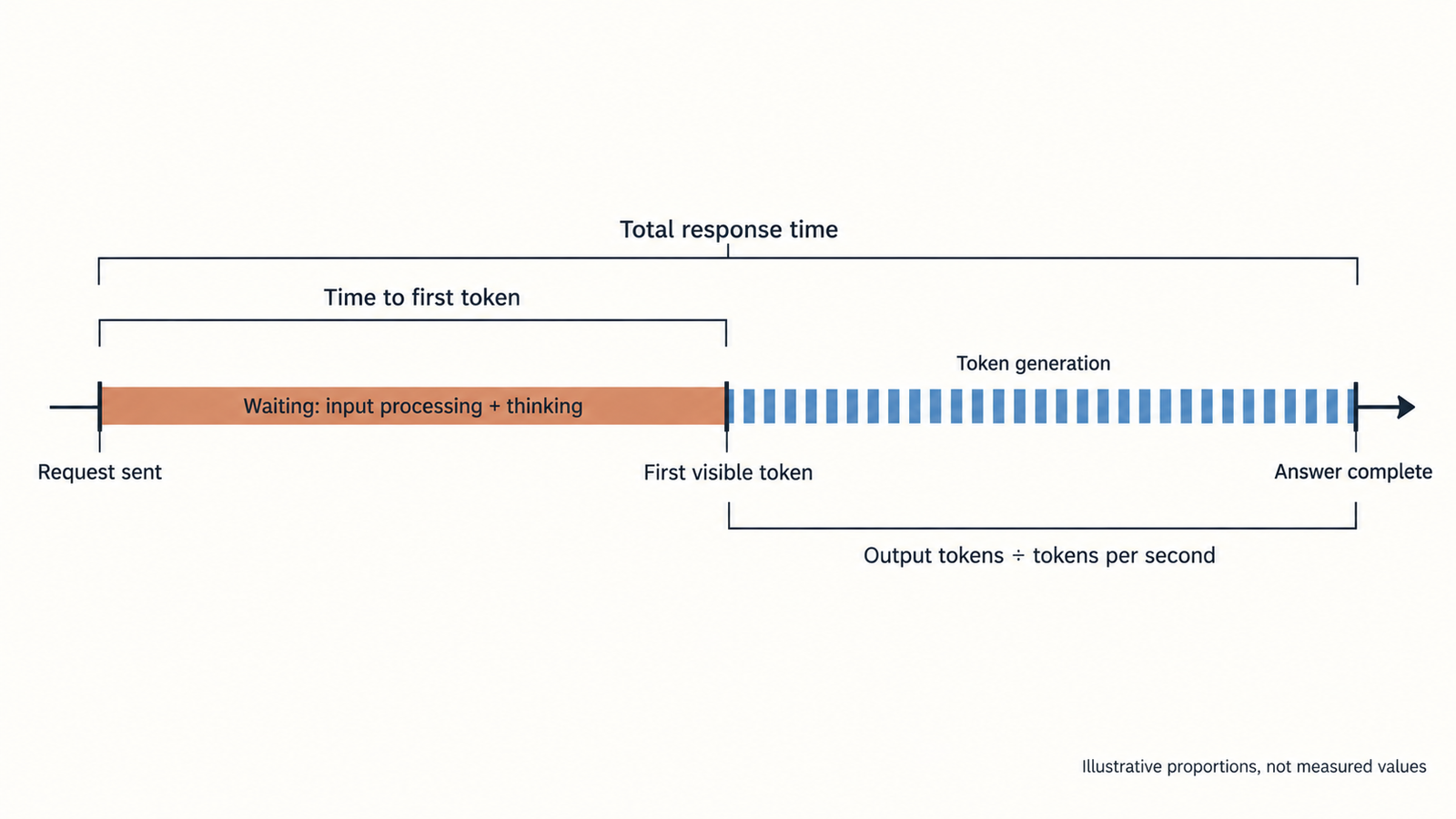
“Speed” bundles at least six different measurements. Comparisons that quote one and imply another are where most of the confusion comes from.
| Metric | What it measures | How Artificial Analysis defines it |
|---|---|---|
| Time to first token (TTFT) | Wait from sending a request to receiving the first token | Includes network latency; for reasoning models, the first reasoning token if one is streamed |
| Time to first answer token | Wait until the first token of the actual answer | Measured after any thinking time |
| Output speed | Tokens per second once generation has started | Average after the first token arrives |
| End-to-end response time | Request to complete answer | Input processing + thinking + time to produce 500 answer tokens |
| Reasoning latency | Time spent thinking before or between visible output | Not reported separately; folded into the two figures above |
| Perceived responsiveness | When the interface first shows something useful | Not measured; depends on the app |
Definitions from the Artificial Analysis performance methodology. It reports the median of the past 72 hours, measured about every three hours from a server in Google Cloud’s us-central1 region, with a 10,000-token prompt as the default workload.
There’s a detail that changes how to read every figure in this article. For Claude Opus 5.5, Sonnet 5.5, GPT-6.1 Sol and GPT-6 Luna, Artificial Analysis lists identical values for time to first token and time to first answer token. Neither provider streams raw reasoning to the client by default. Anthropic’s docs say Claude 5.5 models default to display: "omitted", which skips streaming thinking tokens entirely. OpenAI’s say reasoning tokens are “not visible via the API”. So for these models, “time to first token” really means “time spent thinking, plus a little”.
A simple latency formula
For a streamed response, total time is approximately:
Here T_first is the wait for the first visible token, N_remaining the number of answer tokens still to come, and R the output speed in tokens per second. This is exactly how Artificial Analysis derives its end-to-end figure: Sonnet 5.5 (Low) at 1.17 s plus 500 tokens at 108.9 tokens per second gives the 5.76 s it reports.
The formula ignores tool calls, retries, queueing spikes and the uneven, chunky streaming Anthropic warns about when thinking is on. It still explains most of what users notice, because one of its two terms usually dwarfs the other.
Claude vs ChatGPT speed: what the latest benchmarks show
The fairest comparison available pairs Claude Sonnet 5.5 with GPT-6.1 Sol. They launched within a week of each other in September 2026, cost the same per token ($2 input, $10 output), and Artificial Analysis tests both at the same five effort levels on each provider’s own API.
| Effort | Sonnet 5.5 TTFT | GPT-6.1 Sol TTFT | Sonnet 5.5 output speed | GPT-6.1 Sol output speed | Sonnet 5.5 end-to-end | GPT-6.1 Sol end-to-end |
|---|---|---|---|---|---|---|
| Low | 1.17 s | 2.86 s | 109 tok/s | 43 tok/s | 5.8 s | 14.5 s |
| Medium | 1.80 s | 4.90 s | 108 tok/s | 45 tok/s | 6.4 s | 16.0 s |
| High | 12.15 s | 69.02 s | 109 tok/s | 58 tok/s | 16.8 s | 77.6 s |
| Xhigh | 31.59 s | 163.06 s | 112 tok/s | 53 tok/s | 36.1 s | 172.6 s |
Source: Artificial Analysis comparison pages for Low, Medium, High and Xhigh, read 27 October 2026. Medians of the past 72 hours; 10,000-token input; first-party APIs. Sonnet variants run with Anthropic’s default fallback enabled.
On this pairing, Claude wins every row: it starts 2.4 to 5.7 times sooner and generates 1.9 to 2.5 times faster. That’s a clean result, but not a complete one. Sonnet 5.5 also writes more. On the same benchmark tasks it produced 14,000 output tokens per task at Low against GPT-6.1 Sol’s 4,000. Faster tokens partly pay for more of them. Artificial Analysis’s estimate of generation time per task (output tokens, thinking included, divided by output speed) puts the two close together: 82 s for Sonnet 5.5 against 93 s for GPT-6.1 Sol at Low.
Other pairings tell different stories:
| Pairing (same page) | Claude TTFT | OpenAI TTFT | Claude speed | OpenAI speed |
|---|---|---|---|---|
| Opus 5.5 (Max) vs GPT-6.1 Sol (Max) | 688.0 s | 242.2 s | 96 tok/s | 62 tok/s |
| Opus 5.5 (Low) vs GPT-6.1 Sol (Low) | 8.97 s | 2.67 s | 81 tok/s | 51 tok/s |
| Haiku 5.5 (Low) vs GPT-6 Luna (Low) | 6.68 s | 2.14 s | 176 tok/s | 111 tok/s |
| Sonnet 5.5 (Max) vs GPT-6 Luna (Max) | 461.9 s | 93.8 s | 141 tok/s | 127 tok/s |
Sources: Artificial Analysis comparisons for Opus vs Sol Max, Opus vs Sol Low, Haiku vs Luna Low and Sonnet vs Luna Max, read 27 October 2026.
Across every pairing in these tables, Claude generates faster. Which model starts sooner depends on the pairing. Notice too that GPT-6.1 Sol (Low) read 2.67 s and 51 tokens per second on one page and 2.86 s and 43 tokens per second on another the same day. These are rolling medians, and a 10% gap between two models in a single snapshot is not a result. Public leaderboards have other blind spots too, which we covered in why benchmark scores fail to predict production.
Claude vs ChatGPT speed: why reasoning settings change the result
Every current flagship from both companies reasons before it answers, and both let you set how hard. Anthropic’s Claude API offers five effort levels, Low through Max. Opus 5.5 and Haiku 5.5 default to Medium, Sonnet 5.5 to High. OpenAI’s reasoning effort runs from none to max; GPT-6.1 Sol doesn’t support none or minimal and defaults to Medium.
The effect on waiting time is enormous, and it dwarfs the gap between brands:
| Claude Opus 5.5 | Low | Medium | High | Max |
|---|---|---|---|---|
| Time to first token | 8.97 s | 10.44 s | 21.55 s | 688.0 s |
| Output speed | 81 tok/s | 84 tok/s | 81 tok/s | 96 tok/s |
Read from Artificial Analysis on 27 October 2026 (Opus Medium vs High, GPT-6 Sol Low vs Max).
Opus 5.5 waits 77 times longer at Max than at Low, while its output speed barely moves. OpenAI’s GPT-6 Sol, the model behind ChatGPT’s Instant mode, shows the same shape: 1.59 s to first token at Low, 132.5 s at Max. That’s the central argument in one row: effort changes how long a model thinks, not how fast it types.
Two cautions keep this honest. First, Anthropic’s thinking is adaptive: at Medium and below, Claude may skip thinking on a simple question, so a quick factual query can start much faster than a 10,000-token benchmark prompt suggests. OpenAI likewise says lower effort favours speed. Second, the two companies’ effort scales are separate designs. “High” on one isn’t calibrated to “High” on the other, so matched-effort tables compare labels, not identical amounts of thought. Capability differs by level too: GPT-6.1 Sol scores higher on Artificial Analysis’s Intelligence Index than Sonnet 5.5 at Low and Medium (42 against 36, 48 against 41), while Sonnet 5.5 leads at Xhigh (52 against 51).
Both providers also sell a paid speed boost. Anthropic’s fast mode promises up to 2.5 times higher output speed on Opus 5.5 at double the price, and says explicitly that it doesn’t shorten time to first token. OpenAI’s fast mode, formerly priority processing, claims up to 2.5 times faster speeds on supported models. Neither fixes the thinking wait.
A fair Claude vs ChatGPT speed test
UniverseBlend didn’t run its own timing tests for this article, so there’s no results table here. What follows is the protocol we’d use, and that you can run.
- Pick matched pairs by job, not by brand. Sonnet 5.5 against GPT-6.1 Sol is the closest current pairing on price and release date. Name the effort level for both, and don’t rely on defaults, which differ.
- Fix the prompts. Use 20 to 50 real prompts from your workload, identical across models, with the same requested output length.
- Stream everything. Record send time, first answer token and last token on the client, using a monotonic clock.
- Record the provider’s token counts, not a local tokenizer’s. Claude and OpenAI tokenize differently, so tokens per second aren’t directly comparable across providers. Characters or words per second are a useful cross-check.
- Repeat and spread across the day. At least five runs per prompt per model, at different hours. Report the median and the 90th percentile.
- Same machine, same region, warm connections. Run both from one client in one cloud region and reuse HTTP connections.
- Log failures. Rate limits, 529 overload errors, retries and timeouts are part of speed. Don’t silently drop them.
- Keep prompts unique per run, or account for caching. Repeated prefixes can be cached, which cuts processing time and cost.
The main limitation of the public data is the workload: Artificial Analysis uses generated prompts of about 10,000 tokens, which provoke more thinking than a short chat message does. Its numbers are a fair way to compare models on that workload. They won’t tell you your own app’s latency.
Why the fastest model may not feel the fastest
The formula has a consequence that surprises people: a model that starts sooner can lose to a faster generator once the answer gets long enough, and the reverse.
Take the budget tiers. GPT-6 Luna (Low) starts in 2.14 s and generates 111 tokens per second. Claude Haiku 5.5 (Low) starts in 6.68 s but generates 176. Solve for where their total times meet and you get about 1,360 tokens. Below that length, Luna finishes first; above it, Haiku does. A one-paragraph answer favours Luna by several seconds. A long report favours Haiku.
A closer case: Sonnet 5.5 (Low) at 1.17 s and 109 tokens per second against GPT-6 Sol (Low) at 1.59 s and 119 tokens per second. Sonnet shows its first word 0.4 s sooner, and GPT-6 Sol overtakes it after about 540 tokens. Neither difference is one a person would notice. That’s the point: on short interactive turns at low effort, both companies’ fast models start within two seconds, and the choice should be made on quality.
How it feels depends on the job:
- Everyday questions. Answers are short, so time to first token is nearly the whole experience. Two seconds feels instant; twenty does not.
- Summarisation. A long document means heavy input processing before anything appears. Generation speed matters less than how quickly the model gets through the input.
- Coding. People read code as it streams, so a fast start with steady output feels quick even if the full file takes a minute. A model that thinks for two minutes and then dumps the file feels slow even if total time is similar.
- Research. Users expect to wait. Perceived speed comes from progress signals, not tokens per second.
The apps add their own layer. OpenAI’s ChatGPT help centre says that with its “Intelligent UI” a response may begin while ChatGPT is still thinking. Anthropic’s Claude help centre says thinking can’t be turned off on its 5.5 models, and that higher effort means longer response times. Neither company publishes app latency figures, so app speed can’t be compared from public data.
Claude vs ChatGPT speed: which is better for your workload?
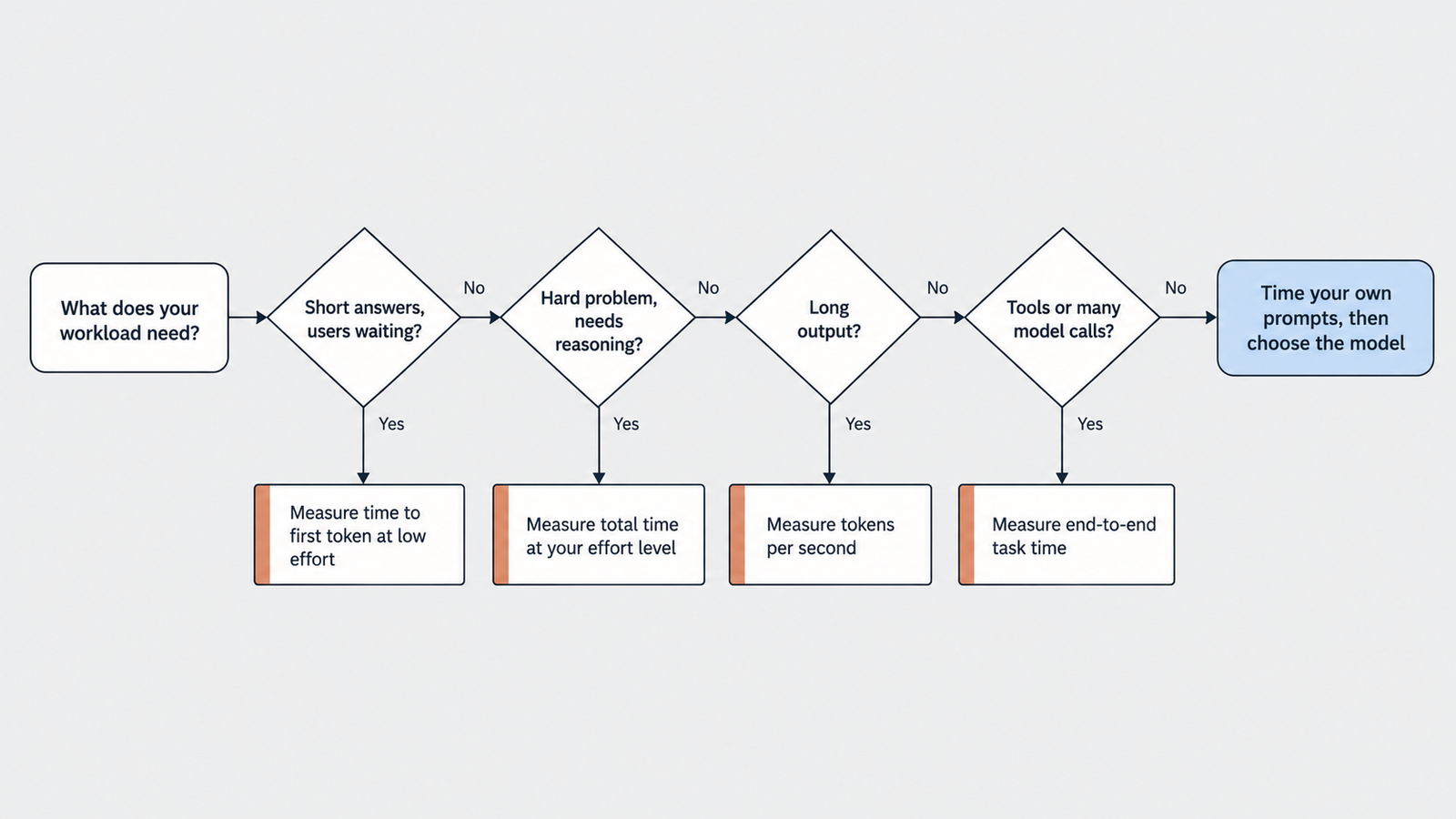
No workload has a universal winner. The table shows which metric to watch and what the current public data does and doesn’t support.
| Workload | Metric that matters most | What public data shows (27 Oct 2026) |
|---|---|---|
| Short questions | Time to first token at low or medium effort | Sonnet 5.5 starts 2.4 to 2.7x sooner than GPT-6.1 Sol at Low and Medium; GPT-6 Sol (Low) starts in 1.6 s, close to Sonnet |
| Long-form writing | Output speed | Claude was faster in every matched pairing read; GPT-6 Sol (Low) slightly outpaced Sonnet 5.5 (Low) |
| Coding and debugging | Total time per task, plus correctness | No coding-specific latency data; on Artificial Analysis’s mixed task set at High, estimated generation time per task is 215 s for Sonnet 5.5 against 229 s for GPT-6.1 Sol, close because Sonnet writes more |
| Deep research | End-to-end time including tool calls | No comparable public data; tool latency dominates |
| Long-context analysis | Time to first token at 100k+ input | Not covered by the figures read here; measure it |
| Agentic workflows | Per-call TTFT multiplied by number of calls | No public end-to-end agent latency comparison |
| Low-latency API apps | 90th-percentile TTFT at low effort | Budget tier: GPT-6 Luna (Low) 2.1 s against Haiku 5.5 (Low) 6.7 s |
| High-throughput apps | Output speed under concurrency | Haiku 5.5 (Low) 176 tok/s single-stream; concurrent results not read |
Agent workloads deserve a note. An agent that makes ten sequential model calls pays the time-to-first-token cost ten times, so a model that thinks for 12 seconds per call adds two minutes before any tool even runs. Our explainer on how AI agents work and what they cost shows how quickly call counts multiply. For agents, effort per call is usually a bigger lever than model choice.
How to measure AI response speed yourself
The public numbers describe one workload from one data centre. Yours will differ, and measuring it takes an afternoon. These two functions time a streamed response on each provider’s official Python SDK and return time to first answer token, total time, and visible output tokens.
import time
import anthropic
from openai import OpenAI

claude = anthropic.Anthropic()
oai = OpenAI()

def time_claude(prompt, model="claude-sonnet-5-5", effort="medium"):
    t0 = time.perf_counter()
    first = None
    with claude.messages.stream(
        model=model,
        max_tokens=8000,
        output_config={"effort": effort},
        messages=[{"role": "user", "content": prompt}],
    ) as stream:
        for event in stream:
            if (first is None and event.type == "content_block_delta"
                    and event.delta.type == "text_delta"):
                first = time.perf_counter()
        msg = stream.get_final_message()
    end = time.perf_counter()
    u = msg.usage
    thinking = getattr(getattr(u, "output_tokens_details", None), "thinking_tokens", 0) or 0
    return first - t0, end - t0, u.output_tokens - thinking

def time_openai(prompt, model="gpt-6.1-sol", effort="medium"):
    t0 = time.perf_counter()
    first, usage = None, None
    stream = oai.responses.create(
        model=model,
        input=prompt,
        reasoning={"effort": effort},
        stream=True,
    )
    for event in stream:
        if first is None and event.type == "response.output_text.delta":
            first = time.perf_counter()
        elif event.type == "response.completed":
            usage = event.response.usage
    end = time.perf_counter()
    reasoning = usage.output_tokens_details.reasoning_tokens
    return first - t0, end - t0, usage.output_tokens - reasoning
Generation speed is then visible tokens ÷ (total time − time to first token). A few caveats before trusting the numbers:
- Billing counts include thinking. Both providers count reasoning tokens in
output_tokens, so subtract them, as above, or you’ll inflate tokens per second. - Tokens differ across providers. Each uses its own tokenizer, so also compare characters per second.
- Defaults differ. Set effort explicitly. Sonnet 5.5 defaults to High on the API and GPT-6.1 Sol to Medium.
- First text isn’t always first output. A tool call or empty response leaves
firstunset; handle that case. - Variance is the point. Run each prompt at least five times across the day and report the median and 90th percentile. Queueing near capacity hits tail latency first, as our piece on accelerator utilisation explains.
Conclusion
Is Claude faster than ChatGPT? On the closest like-for-like API pairing, Claude Sonnet 5.5 against GPT-6.1 Sol at the same effort, yes: it started answering 2.4 to 5.7 times sooner and streamed roughly twice as fast in Artificial Analysis’s tests. Across every pairing read here, Claude’s models also generated tokens faster.
That isn’t the same as “Claude responds faster”. At maximum effort, Opus 5.5 kept users waiting 688 s against GPT-6.1 Sol’s 242 s. In the budget tier, GPT-6 Luna started three times sooner than Haiku 5.5. And the consumer apps add routing, interface and default settings that no public benchmark measures.
What the evidence supports, firmly, is the order of importance: effort setting first, model tier second, brand a distant third. Before you choose, time your own prompts at the effort level you’d actually ship, and watch time to first token before tokens per second.
Frequently asked questions
Is Claude faster than ChatGPT in 2026?
On matched API settings, usually yes. Claude Sonnet 5.5 started answering sooner and generated faster than GPT-6.1 Sol at every effort level in Artificial Analysis’s October 2026 data. At maximum effort, and between the budget models, OpenAI’s models started sooner. App speed isn’t publicly benchmarked.
Why does Claude sometimes take longer to start answering?
Because it’s thinking first. Claude’s 5.5 models reason adaptively, and their API hides that thinking by default, so nothing appears until the answer begins. Higher effort means more thinking: Opus 5.5 took about 9 seconds to start at Low and 688 seconds at Max on the benchmark workload.
What is time to first token?
It’s the time between sending a request and receiving the first token of the response, including network delay. When a model hides its reasoning, as both Claude and OpenAI’s models do by default, it effectively measures thinking time plus a small overhead.
Is a higher tokens-per-second score always better?
No. Tokens per second only describes speed after output starts. For short answers, the wait before the first token matters more. Haiku 5.5 (Low) generates far faster than GPT-6 Luna (Low), yet Luna finishes first on any answer under about 1,360 tokens.
Does extended thinking make Claude or ChatGPT slower?
Yes, for both. Thinking time is added before the answer appears. GPT-6 Sol’s time to first token rose from 1.6 seconds at Low effort to 133 seconds at Max. Both companies say lower effort favours speed and suits chat and latency-sensitive work.
Which is faster for coding: Claude or ChatGPT?
There’s no public coding-specific latency comparison. On Artificial Analysis’s mixed task set at High effort, which includes coding, estimated generation time per task is close: 215 seconds for Sonnet 5.5 against 229 for GPT-6.1 Sol, because Sonnet generates faster but writes more. Measure your own repository’s tasks, and judge correctness alongside time.
How can I measure Claude and ChatGPT response times myself?
Stream responses through each official SDK and record when you send the request, when the first answer text arrives and when the stream ends. Use identical prompts, set effort explicitly, repeat each test at least five times, and subtract reasoning tokens before calculating tokens per second.
Does API latency differ from the speed of the ChatGPT or Claude apps?
Yes. Apps choose models and default settings for you, may route between modes, and add interface features such as showing a response while the model is still thinking. Neither company publishes app latency figures, so API benchmarks are a guide to the models, not the apps.
Keep reading
Here are the latest posts from the blog.

Is Claude Faster Than ChatGPT? What the 2026 Benchmarks Show

Kimi K3.1 Pro Hardware Requirements: GPUs, Memory, Cost
Kimi K3.1 Pro vs Sonnet 5.5: Same Price, Different Bill