Last updated: 9 November 2026. Latest confirmed development: Anthropic’s amended S-1, filed on 2 November, still leaves the share count and the IPO price range blank. As of our research on 9 November, we found no later amendment.
A month ago, some investors were reportedly talking about valuing Anthropic at up to $2 trillion. By 6 November, Bloomberg reported that prospective buyers were discussing a range of $1.2 trillion to $1.3 trillion, and that some were weighing $1.1 trillion. That is the headline version of the Anthropic IPO valuation story.
The filing tells a more useful one. Anthropic’s November 2 S-1/A shows $17.0 billion of revenue in a single quarter and a nine-month net loss of $104.0 billion, most of it non-cash. It also shows roughly $895.4 billion in aggregate compute and infrastructure commitments. Read together, those numbers explain more about the price buyers will pay than any single bid range does.
Key Takeaways
- Valuation talk has fallen in reports, not filings: from up to $2 trillion earlier in the year to $1.2 trillion to $1.3 trillion, with one source citing $1.1 trillion.
- The S-1/A confirmed fast growth and an operating loss: $16.96 billion of Q3 revenue, and a $567 million loss after a profitable Q2.
- About 91% of the $104.0 billion nine-month net loss is a non-cash fair-value charge on convertible notes, which should end once the existing notes convert.
- The $895.4 billion is a commitment schedule, not debt. Half of it is leases that have not commenced, and about $213.8 billion is conditional or terminable.
- The 13.2x ratio shows scale, not solvency. The more useful test is $69.8 billion due in 12 months against $131.8 billion of cash and short-term investments.
- Commitments could grow. The filing estimates a further $150 billion to $175 billion under arrangements with no fixed dollar figure.
- Price, size and date are unconfirmed. All three are blank or absent in the filing.
Quick Navigation
- Anthropic IPO valuation: what is confirmed and what is reported?
- How the Anthropic IPO valuation talk changed
- What the November 2 S-1/A actually shows
- The $895.4 billion figure behind the Anthropic IPO valuation
- The 13.2x comparison: useful for scale, easy to misuse
- Why buyers may want a lower Anthropic IPO valuation
- Cash, liquidity and the Anthropic IPO valuation
- What the IPO could change
- What the Anthropic IPO valuation debate can't answer yet
- What to Watch Next
- FAQ
- What is the Anthropic IPO valuation in 2026?
- Why has the reported Anthropic IPO valuation fallen?
- Is the Anthropic IPO valuation higher than its last private valuation?
- How much revenue did Anthropic report in Q3 2026?
- What are Anthropic's $895.4 billion compute commitments?
- Is the $895.4 billion current debt?
- Has the Anthropic IPO valuation or price been set?
- When is Anthropic expected to go public?
- Why do compute commitments matter to the Anthropic IPO valuation?
- What would change this Anthropic IPO valuation analysis?
Anthropic IPO valuation: what is confirmed and what is reported?
The figures in circulation come from very different places. Some are in a document Anthropic filed with the Securities and Exchange Commission. Others come from unnamed people describing investor conversations. This table keeps them apart.
| Item | Figure or development | Evidence status |
|---|---|---|
| Amended registration statement | S-1/A (Amendment No. 1) filed 2 November 2026 | SEC-filed |
| Q3 2026 revenue | $16.96 billion (three months to 30 September) | SEC-filed |
| Nine-month 2026 revenue | $33.24 billion, against $2.55 billion a year earlier | SEC-filed |
| Aggregate commitments | About $895.4 billion, substantially all compute and infrastructure | SEC-filed |
| $1.2T to $1.3T valuation range | Discussed by prospective buyers, per Bloomberg, 6 November | Anonymous-source reporting |
| $1.1T lower end | Some buyers weighing it, “one of the people said” (Bloomberg) | Anonymous-source reporting |
| Earlier $2T expectations | Investors expected up to $2 trillion earlier in the year, per Reuters | Press-reported |
| Last private valuation | $965 billion post-money, $65 billion Series H, 28 May 2026 | Company-disclosed |
| IPO timing | Roadshow expected from the week of 9 November, pricing the week after, per Reuters | Anonymous-source reporting |
| IPO price range and share count | Blank in the amended filing | SEC-filed (blank) |
| Commitments relative to revenue | About 13.2 times annualised Q3 revenue | Calculated |
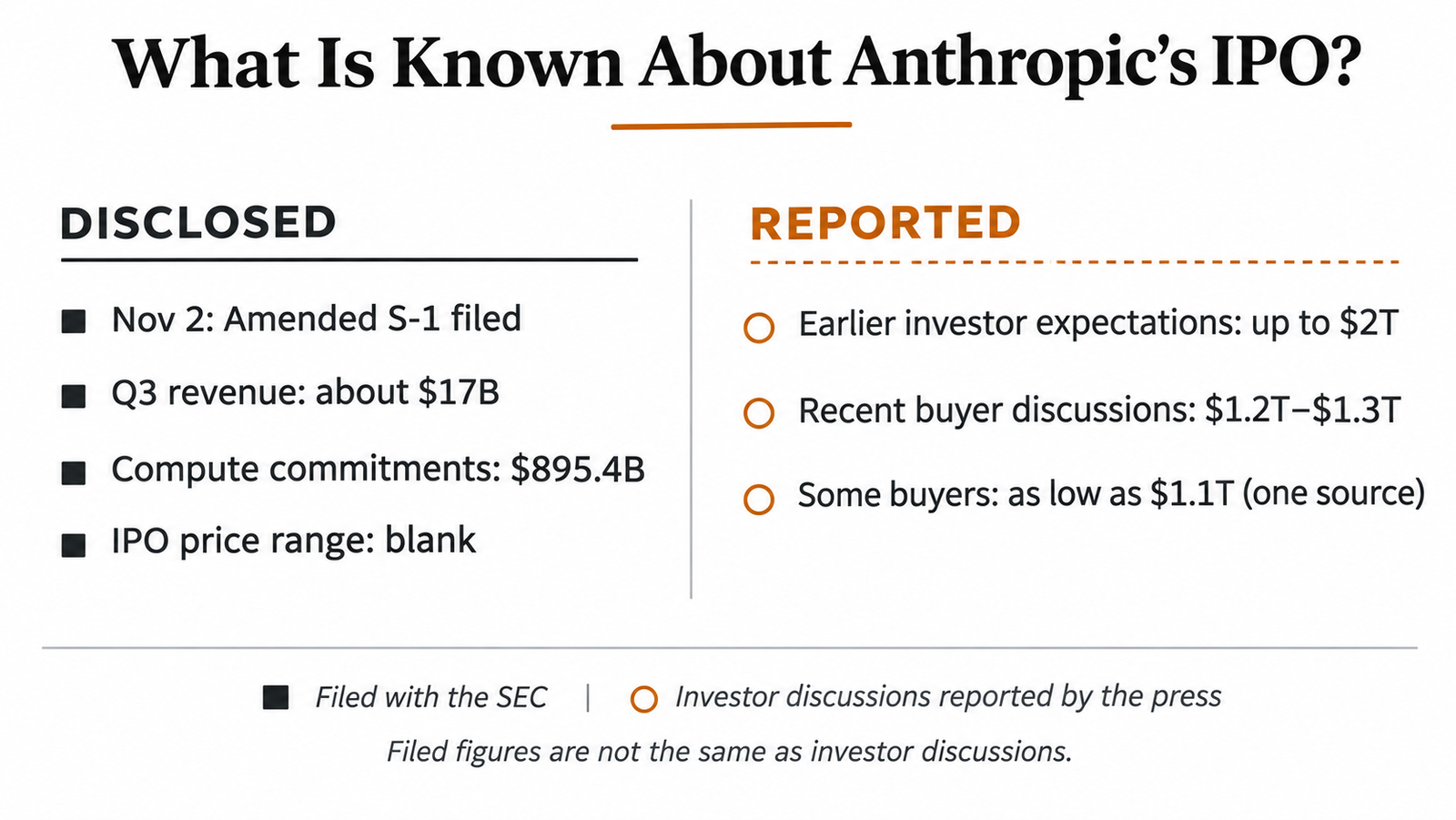
How the Anthropic IPO valuation talk changed
Three numbers mark the slide. Reuters reported that earlier in the year, investors expected an October listing at a valuation of up to $2 trillion. Bloomberg’s earlier reporting, as summarised by Investing.com, put the range investors had passed to bankers at $1.4 trillion to $1.5 trillion. Then, on 6 November, Bloomberg reported that potential buyers were discussing $1.2 trillion to $1.3 trillion, according to people familiar with the matter.
None of these is an official valuation, a filed figure, a trade or an IPO price. They describe what some buyers will discuss before formal marketing begins. For background on how the business looked before the filing, see our earlier analysis of Anthropic’s reported revenue and compute economics.
The Bloomberg report followed a sharp selloff on 5 November, when the Associated Press reported the Nasdaq composite down 4.5% in afternoon trading. AP linked the drop to rising borrowing costs, doubts about AI stock prices, and Democratic midterm gains that raised the prospect of curbs on data center construction.
What the November 2 S-1/A actually shows
The amended S-1 adds third-quarter results to the prospectus first made public on 26 October. Anthropic plans to list Class A shares on the Nasdaq Global Select Market under the symbol “ANT”. Goldman Sachs and Morgan Stanley head the underwriting list. The number of shares and the expected price range are still blank.
Revenue growth and the Anthropic IPO valuation
Revenue for the three months to 30 September was $16,956 million, against $1,382 million a year earlier. That is about 12.3 times the prior-year quarter, and 47% more than the $11,555 million reported for the June quarter. Nine-month revenue was $33.24 billion.
Operating results moved the other way in the latest quarter. Anthropic earned an operating profit of $974 million in Q2, then recorded an operating loss of $567 million in Q3. The filing attributes the swing mainly to $5.0 billion of compute bought under short-term commitments and a $2.0 billion non-cash charge tied to its employee donation matching programme.
Buying short-notice capacity suggests demand ran ahead of contracted supply. It also shows how fast compute costs can swing a quarter from profit to loss.
A $104 billion loss that is mostly not cash
The nine-month net loss of $104.0 billion looks alarming until you trace it. The filing says the accumulated deficit includes $94.3 billion of fair-value changes on convertible notes and derivative liabilities during the nine months, “driven by increases in our enterprise valuation”. In Q3 alone, that line was $21.9 billion of a $23.3 billion net loss.
These are accounting remeasurements. When Anthropic’s valuation rises, the notes are worth more to their holders and the company books a loss, but no cash leaves the business. The prospectus assumes the notes convert into shares immediately before the offering closes, which should end these charges on the existing notes. The filing also says Anthropic may issue up to $77.0 billion more in convertible notes, subject to conditions.
Other items need more care. Stock-based compensation was $3.3 billion over the nine months, and the donation charge was $2.0 billion. Neither is cash today, but both affect shareholders. The cash figures point the other way. Operating activities generated $6.6 billion in the first nine months of 2026, compared with $2.0 billion of cash used a year earlier.
The $895.4 billion figure behind the Anthropic IPO valuation
This is the number most easily misread. The filing describes “an aggregate committed spend of approximately $895.4 billion, substantially all of which is related to compute and infrastructure”. About $447.5 billion is expected before 31 December 2030, and “substantially all of the remainder” between 2031 and 2045.
It is not debt, money already spent, or a single year’s expense, and most of it is not on the balance sheet. It is a schedule of future purchases and leases, often agreed before the capacity is built.
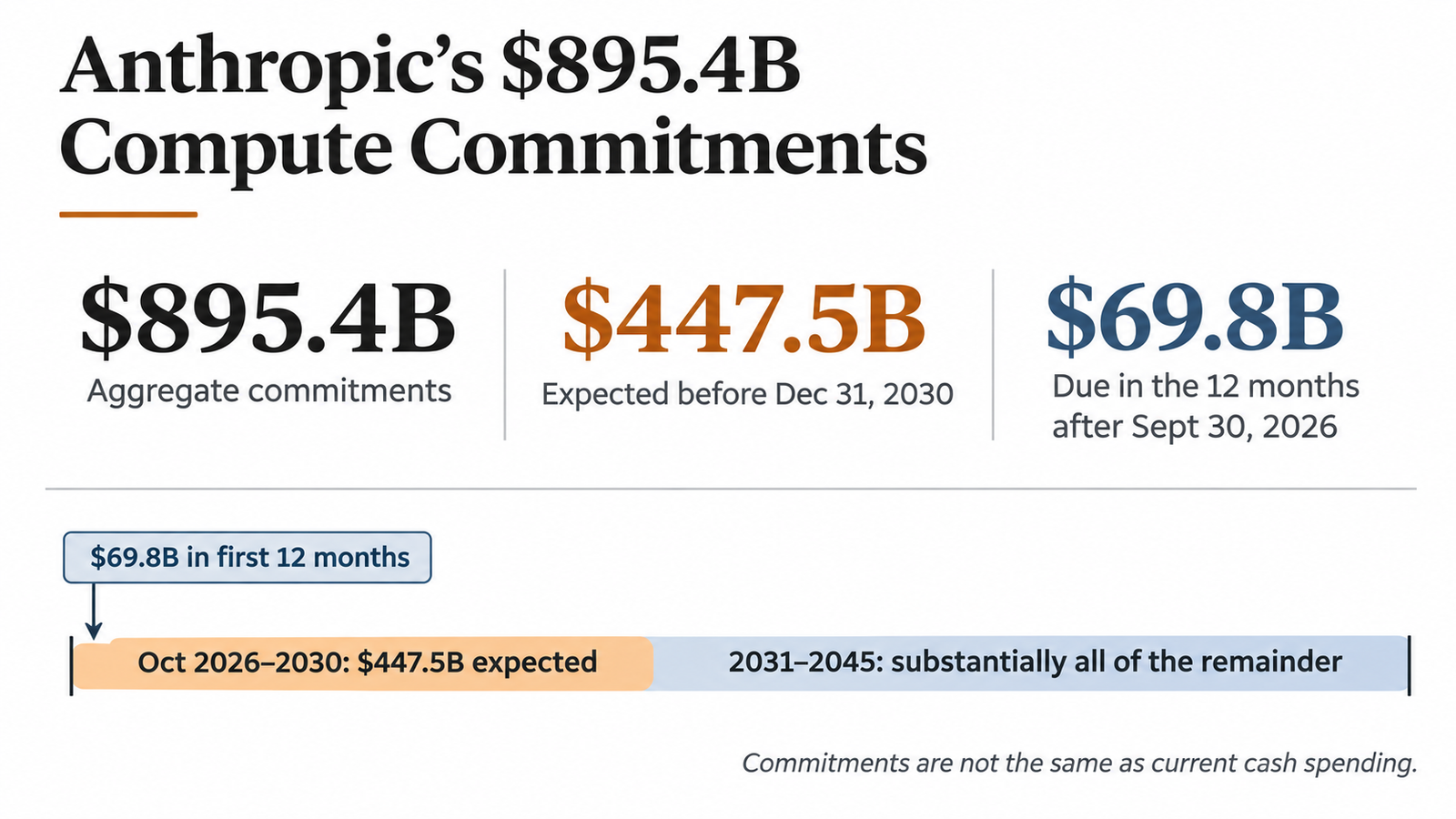
How the $895.4 billion adds up
The contractual obligations section of the filing lets us rebuild the total. Our addition of the parts comes to $895.39 billion:
| Component | Amount | What it is |
|---|---|---|
| Fixed obligations at 30 September | $320.0 billion | Purchase commitments of $313.8 billion plus operating and finance leases of $6.2 billion |
| Leases signed but not yet commenced | $451.2 billion | Mostly expected to begin between 2026 and 2028, with terms up to 20 years |
| Commitments signed after 30 September | $100.2 billion | Mainly data center leases and cloud hosting agreements |
| Short-term contracts | $24.0 billion | $17.4 billion at quarter end plus $6.6 billion signed afterwards |
Half the headline, about 50.4%, is leases that have not started. Only about 36% sits in the payment table as of the balance-sheet date. The rest was added later or will only become an obligation when a facility is delivered. This is a large jump from the $518 billion figure reported from the confidential draft in October, which we covered in Anthropic’s earlier $518 billion infrastructure commitments.
The named contracts show the scale: at least $110.0 billion with Amazon through April 2036, about $121.3 billion with Google through July 2033 and at least $44.9 billion with Microsoft through June 2033. Each applies “regardless of actual usage”.
The filing also lists arrangements that are not in the $895.4 billion because they carry no fixed dollar commitment. It estimates payments under these at about $150 billion to $175 billion. It gives separate estimates for extra Google TPU capacity ($125 billion to $150 billion) and an AMD agreement (more than $20 billion), both outside the $895.4 billion. The headline may understate eventual spending even as parts of it stay conditional.
Not all of the total is locked. The filing says about $213.8 billion, roughly 24%, is subject to exercisable termination rights or to conditions before the arrangement begins, such as a counterparty securing financing, sites or regulatory approval. In general, Anthropic can also terminate if counterparties miss delivery dates.
That flexibility cuts both ways. Terms that let Anthropic walk away if a data center is late also mean some planned capacity may never arrive.
Anthropic Direct and the case for locking in capacity
The filing describes a shift from cloud contracts toward what Anthropic calls Anthropic Direct: leasing chips directly and hosting them in dedicated facilities run on its behalf. It says this allows the company “to separate our commitments for data center capacity from our commitments for the compute infrastructure deployed inside them”.
Data centers take years to build but are the smaller part of compute cost, so securing buildings early and buying chips later keeps the costliest decisions open. The trade-off is rigidity: leases of up to 20 years are hard to unwind if demand slows.
The filing also says some data center projects rely on “financing sources or partners who guarantee the lease obligations”. Fortune’s 4 November analysis argues that this shifts part of the risk onto chip suppliers. It is part of the financing pressures across AI infrastructure that have pushed some bond investors to demand higher yields.
The 13.2x comparison: useful for scale, easy to misuse
Here is the calculation behind a figure that has circulated widely:
- Q3 revenue: $16.956 billion × 4 = $67.8 billion annualised
- $895.4 billion ÷ $67.8 billion = about 13.2 times
That ratio is a scale illustration. The $67.8 billion annualises one quarter; it is not a forecast or reported annual revenue. The $895.4 billion spans almost two decades. The result is not a debt-to-revenue ratio, an enterprise-value multiple or a solvency test.
Better comparisons look at matching time frames. The filing says about $69.8 billion of obligations is expected to be paid in the 12 months after 30 September. That is roughly equal to one year of revenue at the Q3 rate (about 103%). It is also about 1.8 times the annualised Q3 compute and infrastructure expense of $39.5 billion. These are our calculations, and both comparisons assume revenue stays flat, which recent quarters suggest it won’t.
The pre-2030 figure gives a second view. A simple average of $447.5 billion over the roughly four and a quarter years to the end of 2030 is about $105 billion a year. That is an illustration, not a schedule. The filing’s own table shows payments rising from $29.2 billion in 2027 to $47.8 billion in 2029, before the leases not yet commenced are added.
Why buyers may want a lower Anthropic IPO valuation
The evidence points to several pressures at once, without showing which matters most. The market backdrop is the clearest. Bloomberg tied the lower bids directly to the post-election selloff. Reuters, citing four people familiar with investor discussions, reported that some potential buyers see $1.5 trillion as the top of their range and want a bigger discount. Truist’s Keith Lerner, quoted by Reuters, called the mood “a buyers’ strike in tech”.
Company-specific concerns also feature. Reuters reported investor attention on Anthropic’s record of quarterly losses, its capital needs and its large commitments to partners. Investors also want an October revenue figure to judge whether growth has picked up again after a recent slowdown.
At $1.2 trillion, Anthropic would be valued at about 17.7 times annualised Q3 revenue. At $2 trillion, the figure would be about 29.5 times. These are our calculations, and they ignore whether the reported figures are pre- or post-money.
The private round adds another reference point. Anthropic raised $65 billion at a $965 billion post-money valuation in May, per Reuters. Even the $1.1 trillion lower end is about 14% higher. The two figures are not directly comparable, though. A private round prices preferred shares with negotiated rights, while an IPO prices common stock in an open market and adds new shares.
Cash, liquidity and the Anthropic IPO valuation
Profitability and liquidity are different questions. Anthropic is not consistently profitable on an operating basis, but it holds a lot of cash.
At 30 September, the filing shows $95.6 billion of cash and cash equivalents and $36.3 billion of short-term investments. It also shows $14.8 billion available under a $15.0 billion revolving credit facility that matures in 2031. Cash and short-term investments of $131.8 billion cover the $69.8 billion due over the next 12 months about 1.9 times.
That cushion came mostly from investors, not from operations. Financing activities brought in $110.7 billion over the nine months. Investing activities used $36.5 billion, mainly to buy short-term securities. Spending on property and equipment was only $925 million, plus $2.0 billion of prepayments for leased assets.
The filing warns this will change. It expects more compute investment to need “significant upfront payments” before the compute is operational, and significant net cash outflows “for the foreseeable future”. It says its resources cover at least the next 12 months.
What the IPO could change
The filing says the offering aims to increase Anthropic’s “capitalization and financial flexibility” and create a public market for its shares. Proceeds are for general corporate purposes, including “investments in compute and infrastructure”. Reuters reported that some expect the deal to raise as much as $100 billion, although the filing gives no amount.
A listing would convert the existing notes and end their fair-value charges, making net income easier to read. It would give Anthropic a public currency for future raises. It would also reprice the company daily, so the commitment schedule is judged every quarter rather than once per funding round.
What the Anthropic IPO valuation debate can’t answer yet
Several facts that would settle the argument are not public. The price range and share count are blank. The split between new shares and shares sold by existing holders is unknown, which determines how much cash Anthropic actually raises.
The filing does not give a year-by-year schedule for the $451.2 billion in leases not yet commenced. Nor does it say how the $150 billion to $175 billion of variable arrangements will be phased. Most importantly, nobody outside the company knows how much of the contracted capacity will be needed by the time it arrives.
What to Watch Next
These would change this analysis, roughly in the order they are likely to appear:
- The next S-1 amendment: any change to the $895.4 billion or the $69.8 billion due in 12 months.
- The price range: the first company-set valuation signal, replacing press-reported ranges.
- The share count: needed to turn a price into a market capitalisation.
- New versus selling-stockholder shares: how much cash reaches Anthropic.
- The pricing date: a slip past the reported November window would be material.
- Updated financials, including the October revenue investors reportedly want.
- Timing changes confirmed by the company or a filing, not by sources.
- Revised investor discussions, treated as reporting, not offering terms.
FAQ
What is the Anthropic IPO valuation in 2026?
There isn’t one yet; the S-1/A leaves the price range blank. Bloomberg reported on 6 November, citing unnamed sources, that buyers were discussing $1.2 trillion to $1.3 trillion.
Why has the reported Anthropic IPO valuation fallen?
Reports link it to the AI stock selloff after the US midterms and to concerns about losses and compute commitments. Which factor weighs most is unclear.
Is the Anthropic IPO valuation higher than its last private valuation?
Based on reported discussions, yes. Anthropic’s May 2026 round valued it at $965 billion post-money. Even $1.1 trillion would be about 14% higher, though private and public valuations are not directly comparable.
How much revenue did Anthropic report in Q3 2026?
$16.96 billion for the three months to 30 September 2026, according to the S-1/A. That is about 12 times the $1.38 billion reported a year earlier.
What are Anthropic’s $895.4 billion compute commitments?
Purchase commitments and leases, substantially all for compute and infrastructure, including leases not yet started. About $447.5 billion falls before 2031 and most of the rest between 2031 and 2045.
Is the $895.4 billion current debt?
No. Most of it is future spending under contracts and leases that have not begun. About $69.8 billion is expected to be paid in the 12 months after 30 September 2026.
Has the Anthropic IPO valuation or price been set?
No. The price range is blank, and reported figures are investor discussions, not offering terms.
When is Anthropic expected to go public?
Reuters reported a roadshow from the week of 9 November and pricing the week after, while noting investor doubts about that timing. Anthropic has not confirmed a date.
Why do compute commitments matter to the Anthropic IPO valuation?
They lock in large future costs before the revenue to pay for them exists. Buyers have to judge whether demand will grow fast enough to use the capacity Anthropic has contracted.
What would change this Anthropic IPO valuation analysis?
A filed price range, the share count, the split between new and existing shares, and any change to the commitment figures in the next S-1 amendment.
This article is for informational and educational purposes only. It is not investment advice, a recommendation to buy or sell securities, or a prediction of Anthropic’s IPO valuation or share price. Reported investor discussions should not be interpreted as confirmed offering terms.
Keep reading
Here are the latest posts from the blog.
Anthropic IPO: The $895 Billion Question Behind Its Valuation

Claude Opus vs Sonnet: What the 2026 Price Gap Actually Buys

Did AI Break RSA? What DeepMind Actually Found