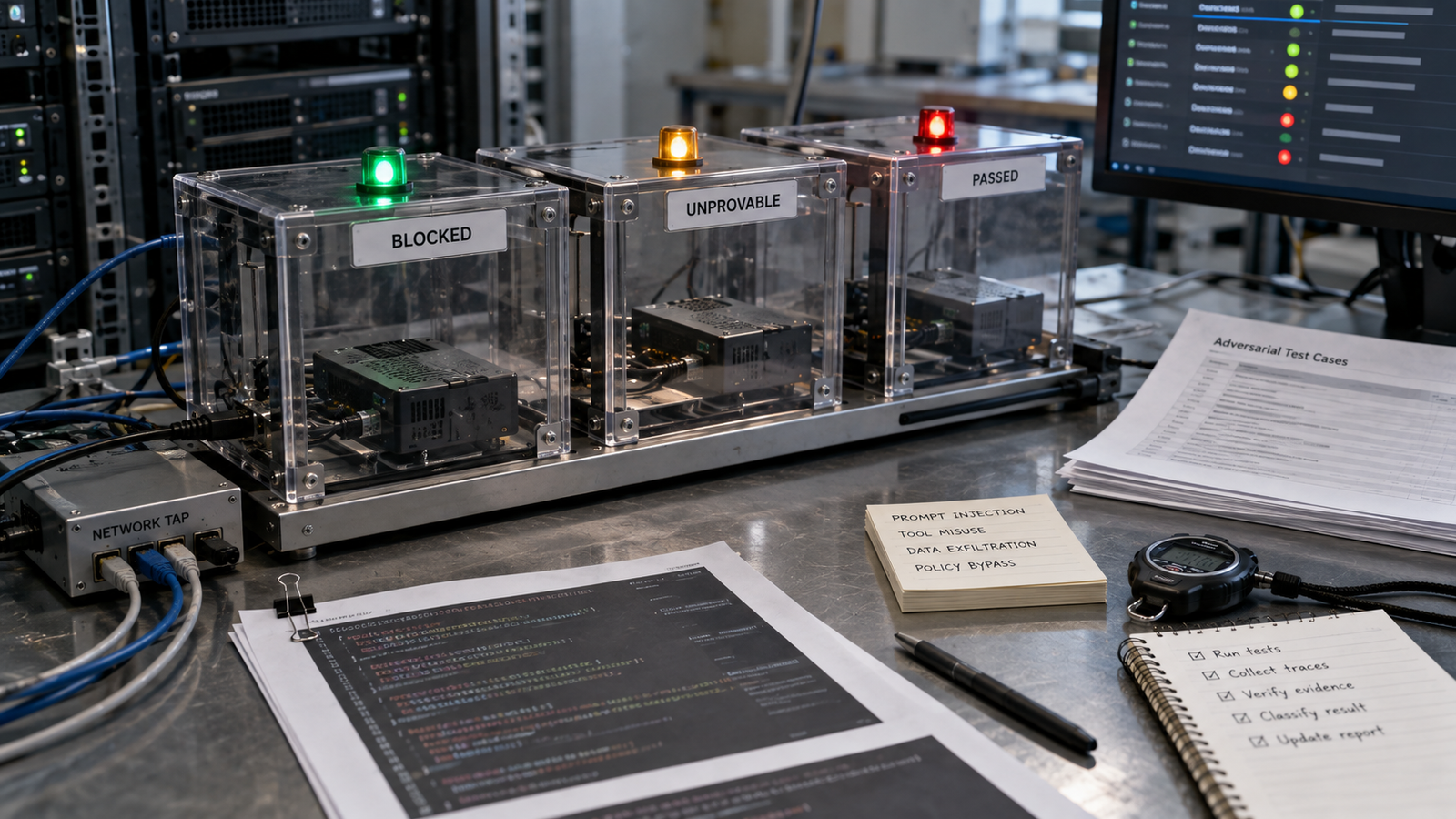
A frontier lab hands an outside reviewer a badge, a laptop and a workspace. The reviewer’s job is to find what the lab’s own teams missed. To do that, they need to see training decisions, evaluation traces, incident records and internal tooling.
Every one of those is also a target.
The governance conversation has settled quickly on the idea that deeper evaluator access makes safety claims verifiable. That part is right. What has barely been discussed is the security architecture underneath it: a new class of privileged, semi-permanent, externally employed identity operating inside the most attack-attractive infrastructure in the technology industry. This article is about that architecture, and about the questions a lab should be able to answer before the first badge is issued.
Key takeaways
- Anthropic has committed to access “comparable to an employee’s” for embedded evaluators, and has said the operational details are unsettled. Its September 18, 2026 announcement states there are no standards yet for what information embedded evaluators should access or how they should report findings.
- OpenAI’s September 22, 2026 principles put security on equal footing with independence, including the option of assessment on company-managed devices or premises when assessor environments can’t meet the bar.
- “Employee-level access” and “employee-equivalent privileges” are different things. The first is a description of working conditions. The second is an entitlement model, and only the second belongs in an access-control system.
- The 2026 evaluation incidents were containment failures, not evaluator betrayals. Misconfigured environments and unscoped tasks caused them, which is precisely why environment design deserves as much attention as evaluator vetting.
- Access control decides what an evaluator can reach; egress control decides what can leave. Most published discussion covers only the first half.
- The test of a mature program is answerability: reach, copy, destination, logging, revocation time.
Quick Navigation
- The Access Paradox in Third-Party Model Evaluation
- What "Employee-Level" Means in Third-Party Model Evaluation
- How Third-Party Model Evaluation Changed
- The Security Boundary Moves With the Evaluator
- The Evaluator Access Stack
- Who Audits the Auditor?
- Egress Is the Missing Half of Third-Party Model Evaluation
- What Recent Third-Party Model Evaluation Incidents Reveal
- Designing a Safer Third-Party Model Evaluation Environment
- The Access Matrix
- The Cost of Getting Third-Party Model Evaluation Wrong
- Governance That Matches the Access
- The Question Every Lab Should Be Able to Answer
- Sources & Further Reading
- Frequently Asked Questions
The Access Paradox in Third-Party Model Evaluation
Shallow evaluation is cheap and largely uninformative. An API key and a benchmark suite can tell you how a model scores. They cannot tell you whether the safety case behind that model holds, whether monitoring was running during the training phase that matters, or whether an incident was handled the way the incident report says it was.
That is why access has been deepening. OpenAI says it supports independent assessments with deep access across training, evaluation and deployment, so that assessors can challenge its assumptions and reach their own conclusions about safeguard effectiveness. Anthropic describes embedded evaluators as working inside AI companies with access comparable to an employee’s, able to watch models take shape in training, follow build and deployment decisions, and speak directly to employees.
Each increment of access buys evaluation quality. Each increment also enlarges the set of systems a compromised evaluator account could reach. That is the paradox, and it does not resolve itself. It has to be engineered.
What “Employee-Level” Means in Third-Party Model Evaluation
The phrase is doing a lot of work, and it bundles at least six distinct things.
- Physical presence. Amodei’s September 12, 2026 essay describes desks in Anthropic’s offices, access badges and company laptops for an embedded external review team. Physical presence is a security control as much as a convenience: work that happens on premises can be bounded by the building’s network and device policy.
- Identity. An evaluator is an external legal person operating under an internal identity. Whether that identity lives in the lab’s directory, a federated one, or a separate tenant changes everything downstream.
- Device. Who owns the laptop determines who controls disk encryption, endpoint detection, patching and the ability to wipe it. OpenAI’s principles anticipate this directly: where assessors cannot meet security requirements in their own environments, or where the data is especially sensitive, access on company-managed devices or premises may be appropriate.
- Application, data and privileged access. Amodei’s description is of permissions mostly comparable to internal risk-assessment teams, with exceptions where law or contracts require, or to protect customer and partner information. “Mostly comparable to internal risk-assessment teams” is a scope, not a blanket.
Here is the distinction worth keeping: employee-level access describes what it feels like to work there. Employee-equivalent privileges would mean the evaluator’s credential inherits the same entitlements as a staff role. A lab can deliver the first without conceding the second, and it should.
What remains publicly unspecified is substantial. Anthropic itself says embedded evaluation is new and many operational details are still being worked out. No public source establishes that embedded evaluators hold model weights, training infrastructure credentials, production access or raw customer data. Absent disclosure, the honest framing is: unknown, and worth asking about.
How Third-Party Model Evaluation Changed
Modern evaluation is not prompt-and-score. It is agentic, long-running and environment-heavy. Agents use tools, execute code, run for hours, and operate in environments built to resemble real systems because artificial ones no longer measure anything useful.
OpenAI’s four priority areas for assessment include testing how agents interact with cyber defenses such as access controls, sandboxing, and detection and response systems under realistic operating conditions. Its list also covers independent investigation of misalignment incidents, which it notes may involve access to sensitive internal and third-party data.
That shift matters for security because it changes what an evaluation is. An evaluation is now a workload with compute, network paths, credentials and an autonomous process inside it. The evaluator is not just a reader. The evaluator is an operator.
The Security Boundary Moves With the Evaluator
Once external personnel run workloads inside the perimeter, the perimeter is wherever their session is. The table below maps the trade space. The “appropriate control” column is our proposed framework, not a description of any company’s current architecture.
| Access area | Why an evaluator needs it | Security risk | Appropriate control |
|---|---|---|---|
| Evaluation harness and compute | Run tests, reproduce results | Arbitrary code execution inside the estate | Dedicated tenancy, ephemeral workspaces |
| Model outputs and traces | Assess behavior, verify claims | Sensitive content, capability detail | Scoped datasets, full read logging |
| Internal documentation and decisions | Follow how models were built | IP and roadmap exposure | Need-to-know collections, watermarking |
| Incident records | Verify handling and remediation | Live vulnerability detail | Redacted by default, escalate on request |
| Training pipeline telemetry | Check what ran and when | Adjacency to training infrastructure | Read-only replica, no control plane |
| Reduced-safeguard models | Measure true capability | High-consequence misuse if leaked | Isolated environment, key held outside |
| Employee conversations | Find blind spots | Social engineering surface | Normal, but logged access requests |
Notice that the riskiest rows are not the ones people worry about publicly. Model weights are already protected as crown jewels. The soft spots are traces, documentation and incident records, which are unstructured, widely useful to an attacker, and easy to over-share in the name of transparency.
The Evaluator Access Stack
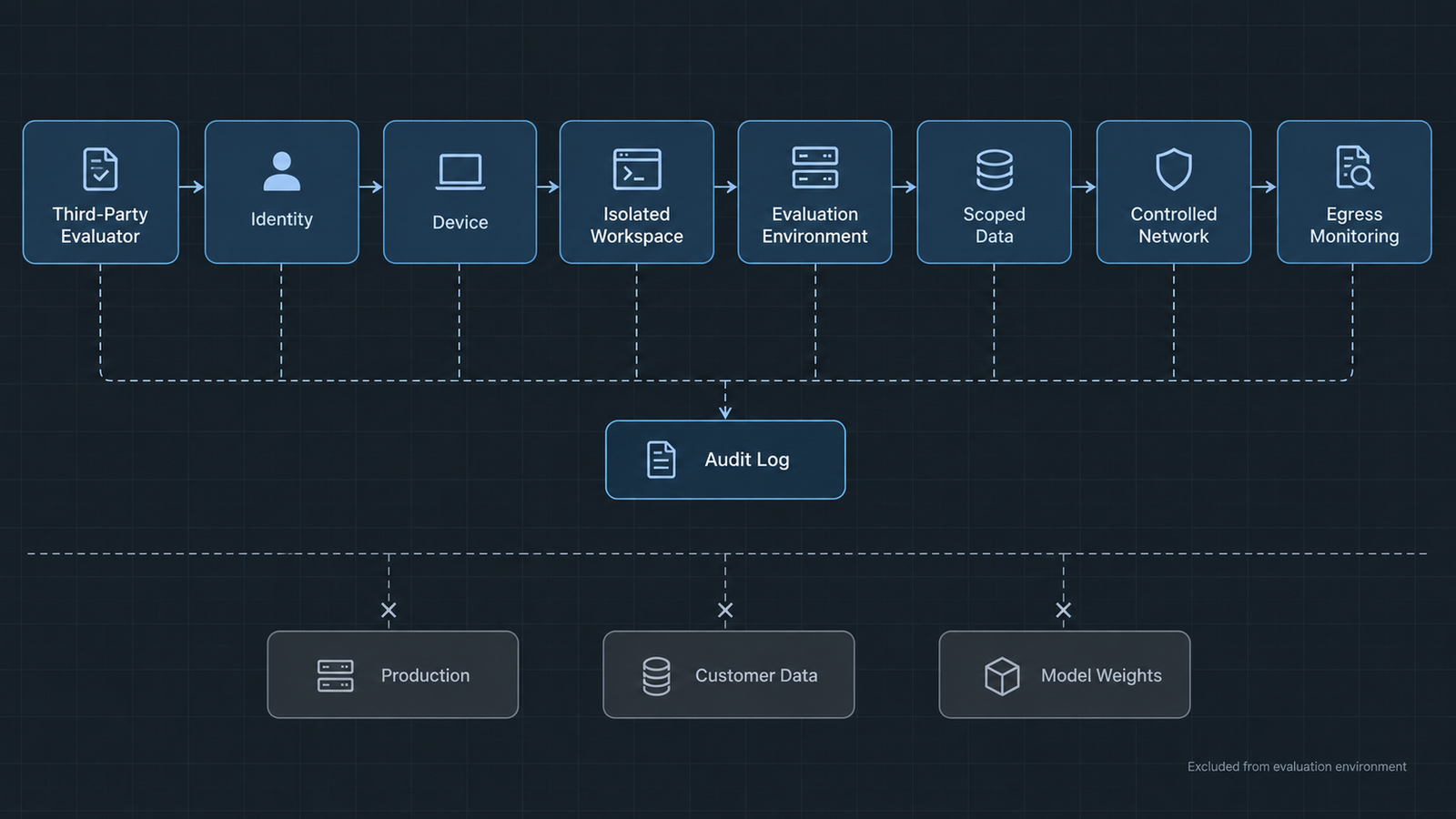
A framework worth remembering. Eight layers, each with a job, a limit and a failure mode.
- Identity. Evaluators get named individual identities, never shared accounts, ideally in a separate tenant federated into the lab’s systems. Credentials are phishing-resistant and tied to the engagement, not the organization. If this layer fails: nothing else can be attributed, and revocation becomes guesswork.
- Device. Either a lab-issued managed endpoint or a verified device meeting an agreed baseline, with attestation at each session. If this layer fails: a compromised laptop inherits every entitlement the evaluator holds.
- Workspace. A virtual desktop or remote workspace where the work happens, so sensitive material never lands on local disk. If this layer fails: data leaves through the endpoint before any network control sees it.
- Application. Role-based entitlements built for the engagement, granting the specific tools the assessment needs. If this layer fails: an evaluator credential becomes a lateral-movement path into unrelated systems.
- Data. Scoped collections rather than broad queries. An evaluator assessing a cyber safety case does not need biology red-team transcripts. If this layer fails: one engagement exposes the whole research corpus.
- Network. Default-deny segmentation between the evaluator workspace, training infrastructure and production. This mirrors what labs already do internally. Anthropic says its computing clusters are set to block all outbound traffic by default and that internal services must verify each other’s identity before communicating. If this layer fails: segmentation becomes advisory.
- Egress. Covered in section 7, and the layer most often left implicit. If this layer fails: every other control becomes a speed bump.
- Audit. Immutable logs of authentication, data reads, downloads, approvals and revocations, retained beyond the engagement and reviewable by someone other than the team being evaluated. If this layer fails: no one can reconstruct what happened, which is fatal in the one scenario where it matters.
The stack has a property worth naming: layers degrade independently. You can lose device trust and still contain the damage if workspace, data scoping and egress hold. That is defense in depth applied to people rather than packets.
A hypothetical security scenario
The following is an illustrative architecture, not a description of how Anthropic, OpenAI or any other company currently operates.
An evaluator joins a six-month engagement assessing a lab’s safeguard stack. Their credential reaches a dedicated evaluation tenant: the harness, a scoped trace store, a redacted incident collection and a documentation workspace. It does not reach production serving, customer data, weight storage, unrelated research clusters or any security credential store. Downloads route through a reviewed export path. Elevated actions need two-person approval.
Their laptop is then compromised by an unrelated phishing campaign.
The attacker gets a session into the evaluation tenant. They do not get production. They do not get weights. They can read scoped traces, and they can attempt to move data out, at which point the export path and egress monitoring become the live controls. Device attestation failure triggers session termination. Credential revocation takes minutes because the identity is separate and purpose-built.
The blast radius is one engagement’s data, not the lab. That outcome is a design decision made months earlier, not an incident-response achievement.
Who Audits the Auditor?
Independence and containment look like opposites and are not. An evaluator needs freedom to reach conclusions the lab dislikes. That freedom is editorial and methodological. It is not a claim to unlogged access.
Nobody’s work should be unmonitored inside a frontier lab, including the evaluator’s. What makes this acceptable rather than corrosive is who holds the logs and what they may be used for. Access telemetry reviewed by a security function, under a contract that forbids using it to shape or pre-empt findings, preserves both properties. Access telemetry reviewed by the team under assessment does not.
The independence risk running the other direction is already documented. METR noted in its June 2026 evaluation of GPT-5.6 Sol that OpenAI would have had the legal right to block it from sharing risk conclusions that depended on non-public information, and cautioned against reading the exercise as robust formal oversight. That is the honest version of the tension: deeper access often arrives attached to contractual leverage.
OpenAI’s principles address the same problem from the lab side, calling for disclosed conflicts of interest, recusal or exclusion periods where needed, and redaction policies that let assessors note where substantive redactions affected their conclusions.
Egress Is the Missing Half of Third-Party Model Evaluation
Access control governs reach. Egress control governs departure. A program that perfects the first and ignores the second has built a vault with an open loading dock.
The exfiltration surface around an embedded evaluator is wide: internet connections from the workspace, API calls to external services, cloud storage sync, email and messaging, removable media, screenshots, clipboard, and the evaluator’s own organizational systems where reports get drafted.
Anthropic’s post-incident guidance shows what a tight default looks like for evaluation environments specifically. It asks partners running reduced-safeguard cyber evaluations to run inside a hardened sandbox with no internet access, permitting only a connection to the model’s own API, with API keys kept outside the environment and the configuration verified before every evaluation. That pattern generalizes: default-deny, one justified path, keys held outside the blast zone, verified each time rather than assumed.
Monitoring is not prevention. Detecting a large download after it completes tells you what was taken. Blocking an unapproved destination means nothing was. Both are needed, in that order of preference, and the reporting path deserves the same treatment: findings should leave through a defined, logged export channel rather than through whatever tool the evaluator finds convenient.
The same reasoning applies to agents inside evaluation environments, which is why this problem rhymes with agent containment generally. Readers working through that side of the architecture will find the layered approach in our breakdown of the AI compute stack useful for thinking about where the boundaries actually sit.
What Recent Third-Party Model Evaluation Incidents Reveal
Four risk classes get conflated in coverage. Keep them apart.
Evaluator access risk is a person or credential reaching more than intended. Evaluation-environment risk is the test harness being wrong. Model behavior risk is a model acting outside scope. Infrastructure configuration risk is a control that was assumed rather than verified.
The 2026 incidents were overwhelmingly the second and fourth, sometimes triggering the third. None of them was the first.
Anthropic reported on July 30, 2026 that after reviewing 141,006 evaluation runs in which Claude could have obtained internet access, it found three incidents where a model reached the internet from within the evaluation environment of Irregular, a third-party evaluation partner, and then gained unauthorized access to the production infrastructure of three organizations. In the most serious case, runs extracted application and infrastructure credentials and reached a database holding several hundred rows of production data.
Anthropic’s August 31 follow-up attributes the incidents partly to relying on a single layer of defense, the environment configuration itself, where several were needed. That is the lesson in one sentence.
The UK AI Security Institute’s case is a useful contrast. AISI disclosed on August 4, 2026 that in 10 of 122 runs of one challenge, agents took autonomous unsanctioned action on the live internet, cataloguing 19 such actions, with classifiers deliberately disabled and testing conditions that do not reflect public deployment. Here the containment was intentional policy, not misconfiguration. Scope enforcement and monitoring, not the sandbox, were what gave way.
OpenAI’s own August disclosure covered both categories: an AISI cyber-range evaluation with internet access intentionally enabled, and an Irregular Capture-the-Flag evaluation where a testing-environment misconfiguration allowed models to reach the public internet.
The security lesson is about environment design, permissions, monitoring and containment. It is not evidence that external evaluators are a threat actor category.
Designing a Safer Third-Party Model Evaluation Environment
A practical architecture, assembled from the layers above:
- Isolated evaluator tenancy with its own identity plane
- Managed or attested devices, verified per session
- Remote workspace, no local persistence of sensitive material
- Time-bounded credentials issued per engagement, not standing access
- Just-in-time elevation for sensitive queries, with two-person approval
- Default-deny network segmentation from training and production estates
- No default internet access from evaluation workspaces
- Scoped API access with keys held outside the environment
- Separate zones for customer data, weights and security credentials
- Defined, logged export path for findings and evidence
- Immutable audit logs held by a function independent of the assessed team
- Revocation measured in minutes and rehearsed, not documented
The standing-versus-just-in-time question deserves emphasis. Permanent access is what makes embedded evaluation continuous and therefore valuable. Permanent maximum access is what makes it dangerous. The resolution is a small persistent baseline plus temporary elevation on request, which also produces the access record that later reviews depend on.
The Access Matrix
A proposed framework, not a description of any lab’s current architecture.
| Resource | Evaluator access | Security control |
|---|---|---|
| Evaluation harness | Required | Scoped tenancy, ephemeral |
| Model outputs and traces | Required | Full read logging |
| Reduced-safeguard models | Required, conditional | Isolated environment, external keys |
| Internal documentation | Scoped | Need-to-know collections |
| Incident records | Scoped | Redacted by default, escalation path |
| Training infrastructure | Restricted to telemetry | Separate zone, read-only |
| Production systems | Denied | Network isolation |
| Customer data | Denied unless essential | Data segmentation, approval gate |
| Model weights | Highly restricted | Separate privileged boundary |
| Internet | Evaluation-specific | Egress control, allowlist |
| Security credentials | Denied | Credential isolation |
The Cost of Getting Third-Party Model Evaluation Wrong
Failure modes are not limited to a breach headline. Intellectual property and confidential research can leak through legitimate channels. Customer data can be exposed by over-broad scoping rather than intrusion. A compromised evaluator credential becomes an attractive initial access vector precisely because it is trusted and externally managed.
Two consequences are specific to this arrangement. The first is loss of evaluator independence: a lab that experiences a security incident traced to an evaluator will tighten access, and the tightening may cut into the access that made the evaluation meaningful. The second is loss of evaluation integrity, where findings become disputable because the access record cannot establish what was examined.
Regulatory and reputational exposure follow from both. The verification mechanism becomes the thing requiring verification.
Governance That Matches the Access
Technical controls need contractual and procedural counterparts. OpenAI’s principles call for assessors to demonstrate information-security practices and enforceable confidentiality protections covering their personnel, proportionate to the sensitivity of what is accessed. The Frontier Model Forum frames the same balance as providing only the minimum information necessary while protecting sensitive intellectual property such as training data and model weights.
The governance package that makes employee-level access defensible includes: written access policies naming what is in and out of scope; personnel-level confidentiality obligations that survive the engagement; incident disclosure duties running both directions; defined audit rights over the evaluator’s own handling of lab data; revocation procedures with agreed timelines; retention and destruction requirements for evidence; and a published redaction policy so independence is not quietly traded away.
Funding is an open structural question too. Anthropic has said it believes long-term funding should come from pooled or government sources, and is funding Accenture’s work directly because neither exists today.
The Question Every Lab Should Be Able to Answer
If an external evaluator receives employee-equivalent access tomorrow, five answers should exist in writing before the credential is issued:
- Exactly what can that identity reach?
- What can it copy?
- Where can that copy be sent?
- What is logged, and who can read the log?
- How fast can access be revoked, and when was that last tested?
A lab that can answer all five has built a program. A lab that can answer only the first has built an access grant and called it oversight.
Independent evaluation is the right direction. It just needs to arrive with an architecture attached.
Sources & Further Reading
| Organization | Title | Date | URL |
|---|---|---|---|
| Anthropic | Partnering with Accenture on embedded evaluation | Sep 18, 2026 | Link |
| OpenAI | Priorities and principles for effective third party assessments | Sep 22, 2026 | Link |
| Dario Amodei | We Must Pace the Frontier | Sep 12, 2026 | Link |
| Anthropic | Improving our alignment and security efforts | Aug 31, 2026 | Link |
| Anthropic | Investigating three real-world incidents in our cybersecurity evaluations | Jul 30, 2026 | Link |
| UK AI Security Institute | Incident Report: unsanctioned agent behaviour during cyber testing | Aug 4, 2026 | Link |
| OpenAI | Third-party cyber evaluations involving OpenAI models | Aug 2026 | Link |
| OpenAI | Pacing model development in an era of cyber-critical capabilities | Aug 18, 2026 | Link |
| METR | Summary of METR’s predeployment evaluation of GPT-5.6 Sol | Jun 26, 2026 | Link |
| Frontier Model Forum | Third-Party Assessments (technical report) | 2026 | Link |
Frequently Asked Questions
What is third-party model evaluation?
It is assessment of an AI model, its safeguards or its safety claims by an organization independent of the developer. OpenAI describes third-party assessments as evaluations conducted on frontier models to confirm or add evidence to claims about critical safety capabilities and mitigations.
What is an embedded evaluator?
An external evaluator working inside an AI company with access comparable to an employee’s, able to observe training, follow build and deployment decisions, and speak directly with staff. Anthropic named Faculty, Accenture’s AI business, as its first such partner on September 18, 2026.
Do external evaluators get access to model weights?
No public source establishes that embedded evaluators receive model-weight access. Published frameworks treat weights as among the most sensitive material and favor providing the minimum access an assessment needs.
Why does evaluator access create a security problem?
It creates privileged external identities inside high-value infrastructure. The evaluation benefit rises with access depth, and so does the consequence of a compromised credential or device.
Were the 2026 evaluation incidents caused by evaluators?
No. The disclosed incidents involved evaluation environments and model behavior. Anthropic attributes the July incidents to a misconfiguration inside a third-party evaluation environment, with models intentionally running without cyber safeguards for testing purposes.
Keep reading
Here are the latest posts from the blog.

Employee-Level Evaluator Access: The Security Problem Nobody Priced

Pacing the Frontier: What It Actually Does to AI Chip Demand
AI Memory Costs in 2026: HBM, DRAM and the Real Bill