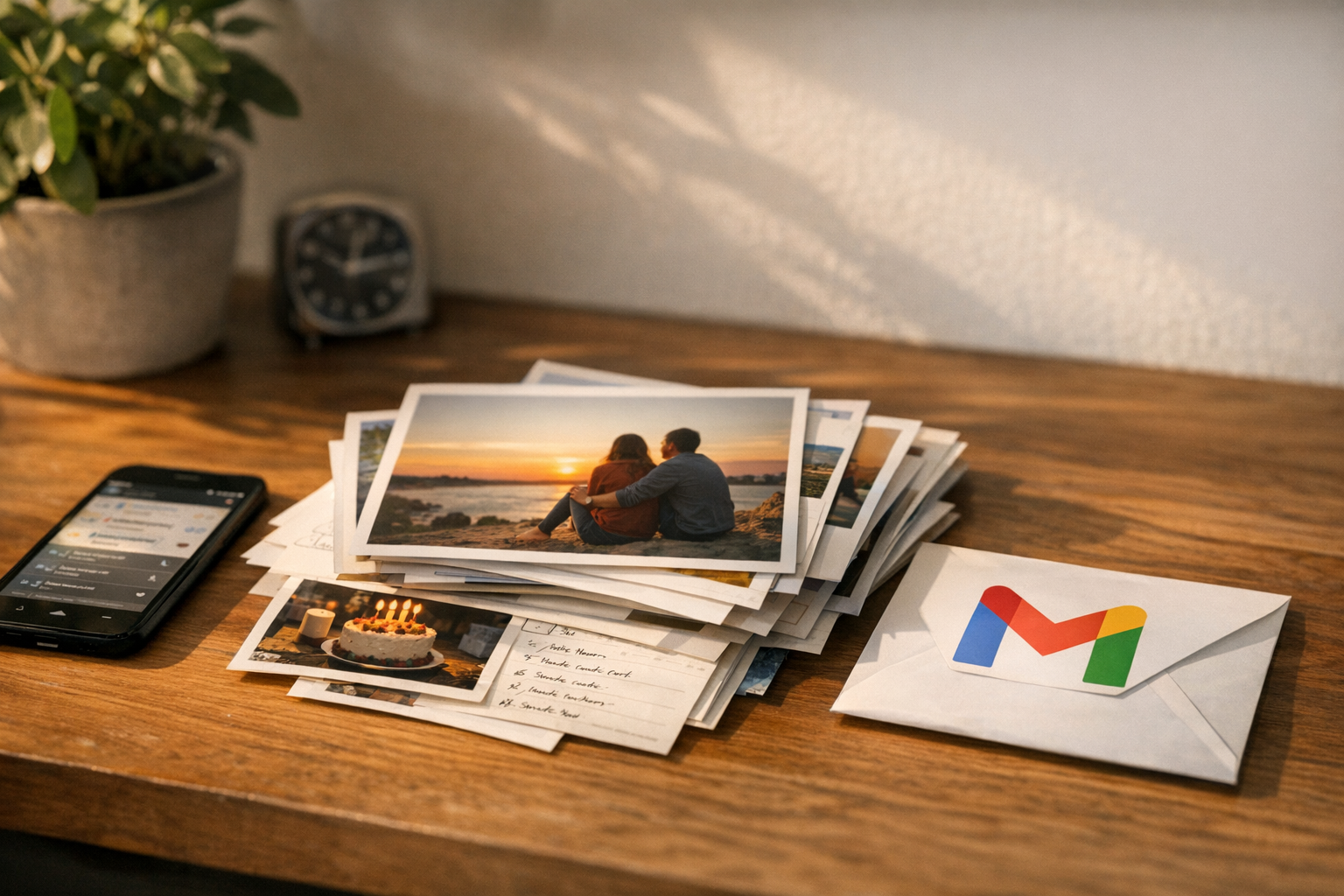
Imagine an AI that reads your emails, scans your calendar, and weaves everything into a coherent life story. That’s exactly what Google Dreambeans AI curates life story Gmail data to accomplish. Google’s experimental project represents a bold new category of personal AI — one that doesn’t just organize your information but turns it into a narrative.
And this goes way further than simple search or summarization. Dreambeans wants to understand the arc of your life by connecting scattered digital breadcrumbs. Furthermore, it raises some genuinely uncomfortable questions about privacy, data ownership, and what happens when AI knows your story better than you do.
How Google Dreambeans Turns Gmail Data Into Personal Narratives
The core idea behind Google Dreambeans is surprisingly intuitive. Your Gmail inbox and Google Calendar already contain a remarkably complete record of your life — job offers, doctor appointments, travel confirmations, family conversations. Dreambeans synthesizes these fragments into something meaningful.
I’ve been following AI personal-data tools for years, and this one actually made me stop and think differently about my inbox.
Specifically, the system works through several interconnected processes:
- Temporal mapping — emails and calendar events get plotted on a personal timeline, giving your data an actual chronological spine
- Entity recognition — people, places, and organizations are identified and linked across messages automatically
- Theme extraction — recurring topics like career changes, health journeys, or relationships surface on their own (which is either exciting or unsettling, depending on your mood)
- Narrative generation — large language models stitch these elements into readable life chapters
Google’s approach builds on its existing Gemini AI architecture, which already powers summarization features across Gmail and Docs. However, Dreambeans goes further by maintaining persistent memory across data sources — and that’s the part that makes this genuinely different.
The result? A living document that updates as new emails arrive and new events get scheduled. Notably, this isn’t a static snapshot. It’s a continuously evolving story that reflects your actual life as Google Dreambeans AI curates life story Gmail interactions in real time.
Why narratives matter more than summaries. Traditional email search gives you individual messages. AI summaries give you bullet points. Narratives, however, give you context and meaning. When you search “that job I almost took in 2022,” Dreambeans understands the full arc — the recruiter emails, the interview calendar blocks, the offer letter, the eventual decline. That’s a meaningfully different kind of recall.
The Technical Architecture Behind AI Life Curation
Building a system where Google Dreambeans AI curates life story Gmail content requires solving several genuinely hard technical problems. The architecture involves multiple AI layers working together — and honestly, the engineering here is impressive even if the privacy implications are complicated.
Data ingestion and normalization. Gmail messages arrive in wildly different formats — marketing emails look nothing like personal conversations. Calendar events range from “Dentist” to detailed meeting agendas with attachments. The first layer normalizes everything into structured data objects with timestamps, participants, topics, and sentiment scores.
Fair warning: this normalization step is where a lot of the nuance in your communications can get flattened. A sarcastic email reads differently to an AI than it does to a human.
Knowledge graph construction. Dreambeans likely builds a personal knowledge graph for each user. This graph connects entities — people, companies, locations — through relationships discovered in email and calendar data. Consequently, the system understands that “Mom,” “Margaret,” and “margaret.smith@gmail.com” are the same person. This surprised me when I first thought through it — the entity-linking alone is a substantial machine learning problem.
Retrieval-augmented generation (RAG). Rather than feeding your entire inbox into an LLM all at once, Dreambeans almost certainly uses RAG. This technique retrieves only relevant data chunks before generating narrative text. Therefore, the AI produces accurate, grounded stories instead of hallucinated ones. It’s a smart architectural choice, and it’s increasingly the industry standard for exactly this reason.
Key architectural components include:
- Embedding models that convert emails and events into vector representations
- Vector databases that enable fast similarity search across years of data
- Temporal reasoning modules that understand sequence, causation, and duration
- Privacy filters that screen sensitive content before narrative generation
- Personalization layers that learn each user’s preferred storytelling style
Additionally, Google’s infrastructure advantage here is enormous. Gmail processes over 1.8 billion accounts, giving Dreambeans access to unmatched training signal for understanding email patterns. Meanwhile, Google Calendar integration provides the structural backbone of daily life that email alone can’t capture.
The real challenge isn’t understanding individual messages — it’s maintaining coherence across thousands of data points spanning years. That’s precisely where Google Dreambeans AI curates life story Gmail data differently from simpler summarization tools.
Competing Solutions: Rewind, Mem, Notion AI, and Others
Google isn’t alone in this space. Several companies are building tools that pull personal data into meaningful narratives or searchable memory. Nevertheless, each takes a distinctly different approach — and I’ve tested enough of these to tell you the differences actually matter.
Rewind AI (now Limitless) captures everything you see, hear, and say on your computer. It records screen activity, meetings, and browsing history. Similarly to Dreambeans, it aims to create a searchable personal memory. However, Rewind operates at the device level rather than the cloud level — which is a significant privacy distinction. You can learn more at Rewind’s official site.
Mem focuses specifically on notes and knowledge management with AI-powered organization. It automatically links related ideas and surfaces relevant context. Although Mem doesn’t directly ingest Gmail, it represents the same core approach — letting AI find patterns humans miss.
Notion AI integrates with Notion’s workspace to summarize, connect, and generate content from your existing documents. It’s powerful for professional knowledge management. Conversely, it lacks the deeply personal life-curation angle that defines Dreambeans. It’s a great tool, just a different one.
Microsoft Copilot deserves mention too. With access to Outlook, Teams, and OneDrive, Microsoft 365 Copilot could theoretically build similar life narratives. So far, Microsoft has focused on productivity rather than personal storytelling — but don’t count them out.
| Feature | Google Dreambeans | Rewind (Limitless) | Mem | Notion AI | Microsoft Copilot |
|---|---|---|---|---|---|
| Email integration | Gmail (native) | Limited | No | No | Outlook (native) |
| Calendar synthesis | Google Calendar | Meeting capture | No | No | Outlook Calendar |
| Narrative generation | Yes | Search-focused | Partial | Partial | Summary-focused |
| Data storage | Cloud | Local device | Cloud | Cloud | Cloud |
| Privacy model | Google servers | On-device | Cloud encrypted | Cloud encrypted | Microsoft servers |
| Life story focus | Primary goal | Secondary | No | No | No |
| Price model | TBD | Free/Premium | Free/Premium | $10/month | $30/month |
Importantly, the key differentiator for Google Dreambeans AI curates life story Gmail approach is native access. Competitors must build integrations — Google already owns the data pipeline. That architectural advantage is genuinely difficult to replicate.
Where competitors excel. Rewind’s on-device approach offers stronger privacy guarantees — and for a lot of people, that’s the whole ballgame. Mem’s note-taking focus gives users more control over what gets remembered. Notion AI excels at team-based knowledge synthesis. Moreover, many users will likely end up combining multiple tools rather than committing to any single platform. That’s what I’d probably do, honestly.
Privacy Trade-Offs When AI Reads Your Entire Life
Here’s the thing: this is where it gets genuinely complicated. When Google Dreambeans AI curates life story Gmail messages into narratives, it necessarily processes deeply personal information. Medical results, financial discussions, relationship conflicts, legal matters — everything becomes raw material for your AI-curated life story.
The consent problem. You might consent to AI reading your emails. But what about the people who sent those emails? They didn’t sign up for narrative analysis. This creates a complex web of implied consent that current privacy frameworks don’t adequately address — and it’s a problem nobody has cleanly solved yet.
Regulatory considerations. The General Data Protection Regulation (GDPR) in Europe gives individuals the right to an explanation when AI makes decisions about them. If Dreambeans characterizes a relationship or life event incorrectly, users need recourse. Similarly, California’s CCPA provides data deletion rights that could conflict with persistent narrative memory. These aren’t theoretical concerns — they’re live regulatory tensions.
Key privacy concerns include:
- Data minimization — does Google need to store full narratives, or just generate them on demand?
- Right to be forgotten — can you delete a chapter of your life story without breaking the whole narrative?
- Third-party exposure — how are other people’s data protected within your personal narrative?
- Security risks — a breach of narrative data would be far more damaging than a breach of raw emails (this one keeps me up at night, genuinely)
- Manipulation potential — could a curated life story subtly shift your self-perception or decision-making?
- Government access — law enforcement requests for narrative data raise serious Fourth Amendment questions
Google has published AI principles that stress safety, fairness, and accountability. Nevertheless, principles and implementation don’t always align. The gap between stated values and actual data practices remains a persistent concern — and I say that as someone who’s watched this industry for a decade.
Practical safeguards users should demand. Before trusting any system where Google Dreambeans AI curates life story Gmail content, look for these specifically:
- Granular opt-out controls for specific email threads or time periods
- On-device processing options that keep narratives off Google’s servers
- Transparent audit logs showing exactly what data the AI accessed
- Easy export and deletion tools
- Clear policies on how narrative data differs from raw email data in legal proceedings
Bottom line: the technology is impressive. The privacy infrastructure needs to catch up.
Actionable Tips for Preparing Your Digital Life for AI Curation
Whether Dreambeans launches widely or a competitor beats it to market, AI life curation is coming. Here’s how to get ahead of it.
Audit your Gmail now. Search for sensitive emails you wouldn’t want included in any AI narrative. Archive or delete messages containing financial details, medical information, or private conversations you’d prefer to keep out of automated analysis. Specifically, check your Sent folder — it reveals more about you than your inbox does, and most people forget it entirely.
Organize your Google Calendar intentionally. AI narrative tools rely heavily on calendar data for temporal structure. Vague event titles like “Thing” or “Busy” will produce poor narratives. Consequently, adding descriptive titles and locations to events improves any future AI curation — and honestly, it makes your calendar more useful right now too.
Set up email labels strategically. Gmail labels could eventually serve as narrative boundaries. A “Private — No AI” label might tell Dreambeans to skip certain conversations. Although this feature doesn’t exist yet, establishing organizational habits now pays real dividends later. I’ve started doing this myself, just as a hedge.
Consider your email writing style. Because Google Dreambeans AI curates life story Gmail messages directly, the quality of your writing affects the quality of your narrative. Clear, contextual emails produce better AI-generated stories than cryptic one-liners. Quick note: this is also just good communication practice regardless of AI.
Additional preparation steps:
- Review and update your Google Privacy settings regularly — notably, most people haven’t touched these in years
- Turn on two-factor authentication on all accounts that might feed into AI curation
- Download your Google data export periodically as a backup
- Research competing tools to understand your options before committing to one platform
- Talk with family members whose emails appear in your inbox about AI curation preferences (this conversation is worth having sooner rather than later)
Think about what story you want told. This sounds philosophical, but it’s genuinely practical. AI curation tools stress the patterns they detect — so if your email history is dominated by work stress, that’s the story you’ll get. Deliberately using email and calendar for positive life documentation — trip planning, family coordination, creative projects — shapes the narrative AI will eventually tell. You have more authorship here than you might think.
Conclusion
The concept behind Google Dreambeans AI curates life story Gmail data represents a fundamental shift in how we interact with personal information. We’re moving from search-and-retrieve to understand-and-narrate. And that’s a genuinely profound change — not hype, just an accurate description of what’s happening.
Importantly, this isn’t just about Google. The entire category — from Rewind to Mem to Notion AI — signals that AI life curation will become mainstream. Your emails and calendar events will increasingly serve as raw material for AI-generated personal narratives. The question is whether you’re shaping that process or just letting it happen to you.
Here are your actionable next steps:
- Audit your Gmail and Calendar for sensitive data you’d want excluded from AI analysis
- Review Google’s privacy controls and tighten permissions on third-party app access
- Test competing tools like Rewind or Mem to understand what AI curation actually feels like in practice
- Establish organizational habits — labels, descriptive event titles, intentional archiving — that make future AI curation more accurate
- Stay informed about Dreambeans’ development and broader AI privacy legislation
The question isn’t whether Google Dreambeans AI curates life story Gmail interactions effectively. It’s whether we’re ready for AI that knows our story this well. Start preparing now, and you’ll be in control of the narrative — literally.
FAQ
What exactly is Google Dreambeans?
Google Dreambeans is an experimental AI project that pulls data from Gmail and Google Calendar into coherent personal narratives. Rather than simply searching or summarizing individual messages, it connects events, relationships, and themes across your entire digital history. The goal is creating a living, AI-curated life story that updates automatically as new data arrives. Notably, it represents a new category of AI tools focused on personal narrative rather than productivity.
How does Google Dreambeans AI curate a life story from Gmail?
The system uses several AI techniques working together. First, it ingests and normalizes email and calendar data. Then it builds a personal knowledge graph connecting people, places, and events. Furthermore, it uses large language models with retrieval-augmented generation to produce accurate narrative text. The result is a chronological, thematic life story drawn entirely from your existing Google data. Temporal reasoning helps the AI understand cause-and-effect relationships between events.
Is Google Dreambeans safe to use with personal email data?
Safety depends on your risk tolerance and Google’s implementation. Google already processes billions of emails for spam filtering and Smart Reply features. However, narrative generation requires deeper analysis than these existing features. Key concerns include third-party privacy (other people in your emails didn’t consent), data breach risks, and potential government access to narrative data. Always review your Google account security settings before turning on any new AI features.
How does Dreambeans compare to Rewind AI?
The biggest difference is architecture. Dreambeans operates in Google’s cloud with native Gmail and Calendar access. Rewind (now Limitless) captures data locally on your device, offering stronger privacy guarantees. Additionally, Rewind captures screen activity and meetings beyond just email. Conversely, Dreambeans benefits from Google’s massive AI infrastructure and tight integration with services you already use. Your choice depends on whether you prioritize privacy (Rewind) or integration depth (Dreambeans).
Can I control what Google Dreambeans includes in my life story?
Specific controls haven’t been publicly detailed yet. However, based on Google’s existing privacy tools, users will likely get options to exclude specific time periods, email labels, or conversation threads. Moreover, Google’s AI principles stress user control and transparency. You should expect granular opt-out settings, data export capabilities, and deletion tools. Meanwhile, establishing Gmail labels and organizational habits now gives you a head start on managing what any future AI curation tool can access.
When will Google Dreambeans be available to the public?
Google hasn’t announced a specific public launch date for Dreambeans. The project remains in experimental stages, and Google frequently tests AI features through limited previews before wider release. Nevertheless, the underlying technology — Gemini’s summarization capabilities, Gmail integration, and knowledge graph construction — already exists in various Google products. Therefore, a phased rollout through Google Labs or Workspace seems likely. Keep watching Google’s AI blog for official announcements and early access opportunities.
References
Keep reading
Here are the latest posts from the blog.
The future of health monitoring isn’t sitting in a hospital. It’s on your skin. AI biosensing UC San Diego’s breakthrough wearable technology is fundamentally changing how we…
Here’s the thing: the data isn’t subtle. Narrow-use robots outselling humanoids 20 founders should be studying isn’t some fringe contrarian take — it’s the dominant commercia…
Meta Muse Spark AI features capabilities release date — these three things are dominating every tech conversation I’m having right now. And honestly? The timing couldn’t be m…