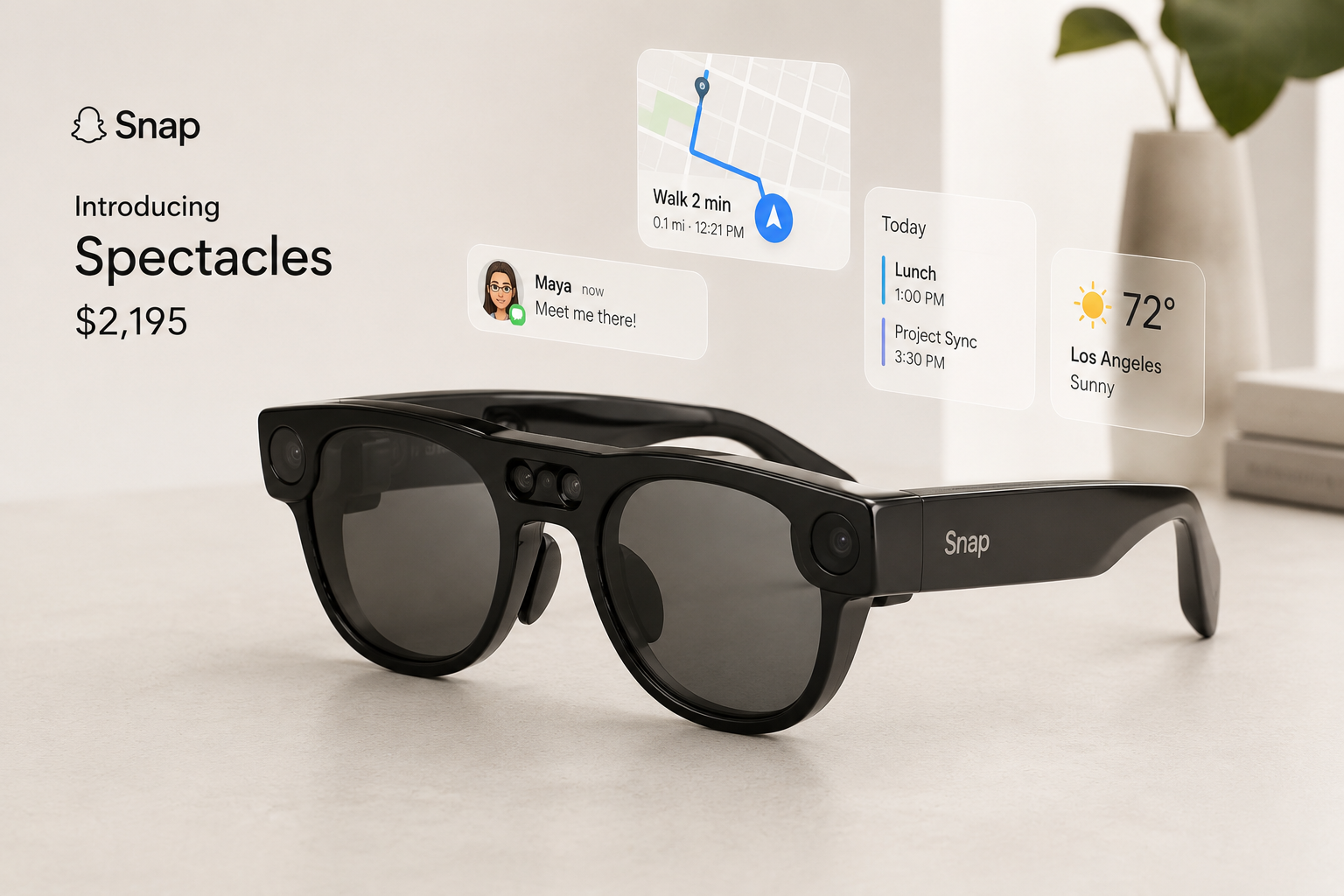
When Snap unveiled $2,195 AR glasses, CEO Evan Spiegel didn’t just announce a product — he declared war on the smartphone. His bet is that augmented reality hardware, the kind that layers digital content directly onto the real world, will eventually push phones into the background. Specifically, he thinks we’re heading toward a future where the glass rectangle in your pocket becomes the secondary device.
That’s a massive gamble. Smartphones still dominate everything we do digitally, yet Spiegel isn’t alone in making it. Apple, Meta, and Google are all racing toward face-worn computing. However, Snap’s fifth-generation Spectacles are arguably the most aggressive consumer-facing move yet from a company most people still associate with disappearing messages.
So what exactly are these glasses? How do they stack up against Meta Quest 3 and Apple Vision Pro? And can Snap actually pull off a hardware pivot?
Why Snap Unveiled $2,195 AR Glasses and What CEO Evan Spiegel Sees Ahead
Hardware Specs: How Snap’s AR Glasses Compare to Meta Quest 3 and Apple Vision Pro
The Software Strategy: How Snap Locks In Developers and Creators
Price, Positioning, and the Developer-First Approach
The Post-Smartphone Future: Realistic Timeline or Silicon Valley Fantasy?
Why Snap Unveiled $2,195 AR Glasses and What CEO Evan Spiegel Sees Ahead
Spiegel has been talking about AR glasses for years, but this launch feels genuinely different. The fifth-generation Snap Spectacles aren’t a toy or a camera accessory. They’re a standalone AR computing platform — and that’s not marketing fluff, that’s a meaningful architectural shift.
The core thesis is simple. Spiegel believes AR glasses will replace smartphones within a decade. He’s compared the transition to the shift from desktop computers to mobile phones. Consequently, Snap is positioning itself as the platform company for that next wave — not just an app on someone else’s hardware.
Here’s what makes this bet notable:
- Snap is a software company trying to become a hardware company. That’s historically difficult. (Ask Google how Glass went.)
- The $2,195 price tag targets developers first. Consumer adoption comes later — deliberately.
- Snap’s Lens Studio ecosystem already has 300,000+ creators. That’s a real software moat competitors don’t have.
- The glasses run a custom Snap OS. This isn’t Android with a Snap skin slapped on top.
Moreover, Spiegel has been refreshingly clear about his timeline. He doesn’t expect mass adoption tomorrow. Instead, he’s building the developer ecosystem now so compelling apps already exist when prices eventually drop. Smart sequencing, honestly.
This strategy mirrors what Apple did with the original iPhone SDK. Furthermore, it echoes Meta’s approach with Quest developer programs. The difference? Snap is smaller, leaner, and — let’s be real — arguably more desperate to find its next growth engine beyond advertising.
The advertising angle matters too. Snap’s core revenue lives and dies on attention, and AR glasses could capture that attention in entirely new ways. Imagine walking past a restaurant and seeing a Snap-powered AR menu floating in your field of view. That’s the future Spiegel is selling to investors — and when you picture it that concretely, it doesn’t sound crazy.
Hardware Specs: How Snap’s AR Glasses Compare to Meta Quest 3 and Apple Vision Pro
When Snap unveiled $2,195 AR glasses, the tech press immediately started comparing them to existing headsets. Although those comparisons aren’t perfectly apples-to-apples, they reveal some important strategic differences worth understanding.
Here’s a detailed breakdown:
| Feature | Snap Spectacles (Gen 5) | Meta Quest 3 | Apple Vision Pro |
|---|---|---|---|
| Price | $2,195 (subscription model) | $499 | $3,499 |
| Form factor | Lightweight glasses | VR/MR headset | VR/MR headset |
| Weight | ~226 grams | ~515 grams | ~600-650 grams |
| Field of view | ~46 degrees diagonal | ~110 degrees | ~100 degrees |
| Display type | Waveguide AR lenses | Pancake LCD | Micro-OLED |
| Processor | Qualcomm Snapdragon AR2 Gen 1 | Snapdragon XR2 Gen 2 | Apple M2 + R1 |
| Battery life | ~45 minutes | ~2-3 hours | ~2 hours (external battery) |
| Pass-through | True AR (see-through lenses) | Video pass-through | Video pass-through |
| OS | Snap OS | Meta Horizon OS | visionOS |
| Primary use case | AR overlays in real world | Gaming + mixed reality | Productivity + media |
Several things jump out from this comparison.
First, Snap’s glasses are genuinely lightweight. At 226 grams, they’re less than half the weight of Meta Quest 3. That matters enormously for daily wear — nobody wants to strap a half-kilogram headset on their face for hours. I’ve tested bulkier AR rigs, and the neck fatigue alone kills the experience.
However, the trade-offs are significant. Battery life of roughly 45 minutes is limiting, and additionally, the 46-degree field of view is narrow compared to competitors. You’ll see AR content in a relatively small window, not spread across your entire vision. That constraint shapes every experience you build or use on this platform.
Processing power tells another story. The Snapdragon AR2 Gen 1 chip is purpose-built for lightweight AR glasses, not raw horsepower. It’s not remotely as powerful as the M2 chip inside Apple Vision Pro. Consequently, Snap’s glasses can’t run the kind of complex spatial computing apps that Apple’s headset handles comfortably.
But here’s the thing: that’s somewhat intentional. Snap isn’t trying to replace your laptop. The processing constraints actually push developers toward simple, useful, snackable experiences rather than resource-heavy applications — and that might be exactly right for the use case.
The true AR advantage deserves real emphasis. Both Meta Quest 3 and Apple Vision Pro use video pass-through — cameras capture the outside world and display it on internal screens. Snap’s waveguide lenses let you see the real world directly, with digital content appearing on top. This surprised me when I first tried a comparable waveguide setup. It feels fundamentally less isolating — more like wearing glasses than piloting a submarine.
The Software Strategy: How Snap Locks In Developers and Creators
Hardware alone doesn’t win platform wars. Software does. And this is where the story of how Snap unveiled $2,195 AR glasses with CEO Evan Spiegel’s vision gets particularly interesting — because the software angle is genuinely underappreciated.
Snap’s software ecosystem has three key layers:
- Snap OS — A custom operating system built specifically for spatial computing. It handles hand tracking, voice commands, and spatial mapping.
- Lens Studio — Snap’s AR development platform, already used by hundreds of thousands of creators. Developers build “Lenses” that work across both Snapchat mobile and Spectacles at the same time.
- SnapML — Machine learning tools that let developers plug AI models directly into AR experiences.
This three-layer approach creates a powerful lock-in effect. Notably, developers who build for Lens Studio can reach both the massive Snapchat mobile audience and the growing Spectacles user base. That dual-platform reach is a genuinely strong incentive — you’re not building for a tiny hardware install base in isolation.
The open-versus-closed ecosystem debate applies here too. Apple’s visionOS is famously closed. Meta’s Horizon OS recently opened up to third-party hardware makers. Meanwhile, Snap sits somewhere in between — Lens Studio is freely available, but Snap OS only runs on Snap hardware. Similarly to how OpenAI and open-source AI models compete on different philosophies, AR platforms are splitting along openness lines right now.
Developer incentives matter enormously. Snap offers:
- Free access to Lens Studio tools
- Revenue sharing on sponsored AR experiences
- Featured placement in the Snapchat Lens Carousel
- Early access to Spectacles hardware for approved developers
- Technical support and documentation
Furthermore, Snap has partnered with Unity to ensure existing game engines support Spectacles development. That’s smart — it lowers the barrier for 3D developers who’d otherwise need to learn an entirely new toolchain.
The creator economy angle is underrated, and it’s arguably Snap’s biggest actual advantage. AR filters and lenses are already core to Snapchat’s identity. Consequently, Snap doesn’t need to build a creator community from scratch — it needs to move an existing one to new hardware. That’s a very different, much easier problem. Apple Vision Pro launched with relatively few spatial apps. Snap’s existing Lens catalog gives Spectacles an immediate content advantage in the AR-overlay category specifically.
Price, Positioning, and the Developer-First Approach
That $2,195 price tag isn’t cheap, but it’s not meant to be. When Snap unveiled $2,195 AR glasses, CEO Evan Spiegel explicitly positioned them as developer hardware — and the pricing structure reinforces that at every level.
The pricing strategy breaks down like this:
- $2,195 covers a one-year subscription. You don’t own the glasses outright. After a year, you return them or renew.
- The subscription model funds rapid hardware iteration. Snap can ship improved versions faster without worrying about stranding early buyers on obsolete hardware.
- Developer pricing signals seriousness. Free or cheap hardware attracts hobbyists. Premium pricing attracts committed builders with actual budgets.
This approach has precedent. Additionally, it echoes how Google distributed early Glass Explorer editions at $1,500 to developers and influencers. The goal wasn’t mass sales — it was ecosystem seeding. Whether that worked out for Glass is a different conversation, but the logic holds.
Compared to competitors, the pricing tells a strategic story:
- At $2,195, Snap Spectacles cost more than Meta Quest 3 ($499) but less than Apple Vision Pro ($3,499).
- However, Snap’s glasses are the only true AR glasses in the group. The others are headsets.
- The subscription model means total cost of ownership could actually exceed Apple Vision Pro over three years. Worth doing that math before committing.
Who should actually buy these right now? Bottom line — most consumers should wait. These are genuinely for:
- AR developers building the next generation of spatial apps
- Enterprise teams exploring AR for training, maintenance, or design workflows
- Content creators who want to get ahead of new AR formats before the space gets crowded
- Tech enthusiasts with disposable income and high risk tolerance (you know who you are)
Nevertheless, the developer-first approach is smart sequencing. Platforms succeed when they have apps, apps require developers, and developers need hardware to build against. Snap is correctly ordering those dependencies.
Enterprise potential shouldn’t be overlooked either. Lightweight AR glasses have obvious uses in manufacturing, healthcare, and field service. Workers could see repair instructions overlaid on live equipment. Surgeons could view patient data without breaking eye contact with the operating table. Consequently, Snap could find meaningful B2B revenue well before consumer adoption takes off — and that runway matters for a company of Snap’s size.
The Post-Smartphone Future: Realistic Timeline or Silicon Valley Fantasy?
Spiegel’s “post-smartphone future” claim deserves real scrutiny. Importantly, we need to separate the long-term directional vision from near-term reality — because conflating them is how people end up disappointed or dismissive.
Arguments supporting the post-smartphone thesis:
- Smartphones haven’t fundamentally changed in design since 2007. The form factor is genuinely mature.
- AR glasses offer hands-free, context-aware computing — that’s more convenient for a surprising number of daily tasks.
- Display technology is improving rapidly. Waveguide lenses are getting thinner, lighter, and wider with each generation.
- AI assistants work dramatically better with always-on, always-visible interfaces.
- Younger generations are already comfortable with AR through Snapchat and Instagram filters. The behavior is primed.
Arguments against near-term disruption:
- Battery technology limits all-day wear. Forty-five minutes isn’t enough — not even close.
- Social acceptance remains a real barrier. People still feel uncomfortable around camera-equipped glasses in public.
- The smartphone ecosystem is deeply entrenched. Billions of apps built for a form factor don’t migrate overnight.
- Cellular connectivity in glasses requires miniaturized antennas and modems that don’t fully exist yet.
- Cost must drop dramatically — we’re talking 80-90% — for mass adoption to happen.
The realistic timeline probably looks something like this:
- 2024-2026: Developer adoption and enterprise pilots. Hardware improves meaningfully each generation.
- 2027-2029: Consumer-priced AR glasses under $500 start emerging. Battery life exceeds four hours.
- 2030-2035: AR glasses become a mainstream companion device alongside smartphones.
- 2035+: Glasses potentially begin replacing smartphones for many daily tasks — emphasis on “potentially.”
Alternatively, the transition might never fully complete. Smartphones could simply absorb AR capabilities through better cameras and spatial displays. The International Telecommunication Union continues developing connectivity standards that could make phones even more capable, moreover narrowing the gap AR hardware needs to cross.
What’s clear is that Snap is making a calculated bet. When Snap unveiled $2,195 AR glasses, CEO Evan Spiegel wasn’t predicting overnight disruption — he’s smart enough to know better. He’s planting seeds for a decade-long transition. Whether those seeds grow depends on execution, battery breakthroughs, and developer adoption. I’ve watched enough hardware bets play out over the last ten years to know that all three variables need to move together.
Furthermore, Snap’s bet intersects with the broader AI wave in ways that could speed everything up. AR glasses become dramatically more useful when paired with powerful on-device AI. Imagine glasses that recognize objects in real time, translate languages as you look at them, and surface relevant information before you even ask. The convergence of AR hardware and AI software is the real kicker here — and it’s moving faster than most people expect.
The competitive field will shape outcomes too. If Apple releases lightweight AR glasses — which Bloomberg’s Mark Gurman has reported is in development — the entire market shifts overnight. Apple’s ecosystem power could speed up consumer adoption in ways Snap alone simply can’t match. Conversely, Apple’s entry could also push smaller players to the margins. That’s the existential risk Spiegel is racing against.
Conclusion
The moment Snap unveiled $2,195 AR glasses, CEO Evan Spiegel staked his company’s future on a vision that’s simultaneously compelling and genuinely uncertain. These aren’t perfect devices — not even close. Battery life is short, the field of view is narrow, and the price excludes essentially every mainstream consumer. Nevertheless, they represent the most wearable, most natural-feeling AR computing platform available today. That counts for something.
Here’s what matters for different audiences:
- Developers should seriously consider building for Spectacles now. Early platform movers historically capture outsized value — and the Lens Studio ecosystem gives you mobile distribution alongside hardware reach.
- Investors should watch developer adoption metrics closely. App ecosystem growth will determine whether Snap’s hardware bet pays off or becomes a cautionary tale.
- Consumers should wait for Gen 6 or Gen 7. The technology needs at least two more hardware cycles before it’s ready for daily use.
- Enterprise buyers should pilot Spectacles for specific use cases like field service and training — the ROI case there is already interesting.
The broader takeaway? Hardware and software strategies are inseparable. Snap’s AR glasses only matter if developers build compelling experiences, and those experiences only matter if the hardware is comfortable enough for sustained use. It’s a classic chicken-and-egg problem, and every platform company eventually has to stare it down.
Snap unveiled $2,195 AR glasses with CEO Evan Spiegel leading the charge toward a post-smartphone world. Whether that world arrives in five years or fifteen — or in a form nobody’s quite predicted yet — the race to build it is officially underway. Watch developer adoption numbers, battery technology improvements, and competitive responses from Apple and Meta. Those three factors, more than anything Spiegel says on stage, will determine whether this bet actually pays off.
FAQ
Are Snap’s new AR glasses available to buy right now?
Yes, but with conditions. The fifth-generation Spectacles are available through a $2,195 annual subscription aimed at developers. You don’t purchase them outright — you essentially lease the hardware for one year, then return or renew. Snap specifically targets AR developers and creators rather than general consumers. Notably, availability may also vary by region, so check directly with Snap before planning around them.
How do Snap Spectacles compare to Apple Vision Pro?
They serve fundamentally different purposes, so direct comparison only goes so far. Apple Vision Pro is a high-powered mixed reality headset weighing over 600 grams, whereas Snap Spectacles are lightweight AR glasses at roughly 226 grams. Importantly, Spectacles use true see-through waveguide lenses, while Apple uses video pass-through — a meaningfully different experience in practice. Apple offers superior processing power and a much wider field of view. However, Snap offers a far more wearable form factor for extended daily use. The price difference is also notable: $2,195 versus $3,499.
What can you actually do with Snap Spectacles?
Current capabilities include viewing AR Lenses overlaid on the real world, hand tracking interactions, voice commands, and spatial mapping. Developers can build custom experiences using Lens Studio, and the catalog is already growing. Use cases range from interactive games and art installations to navigation overlays and educational content. Additionally, enterprise applications like remote assistance and training simulations are being actively explored. The real experience catalog will grow as more developers build specifically for the platform — so the honest answer is that the best use cases probably haven’t been invented yet.
Why did Snap choose a subscription model instead of selling the glasses outright?
The subscription model serves several strategic purposes, and once you understand them, it actually makes sense. It lets Snap update hardware quickly without stranding early buyers on outdated devices. Furthermore, it keeps the upfront cost lower than a full purchase price would need to be, and it ensures Snap maintains a direct relationship with every active user. Consequently, the company can push software updates, gather real usage feedback, and plan future hardware generations far more effectively than a traditional one-time sale would allow.
Is Evan Spiegel right about the “post-smartphone future”?
The long-term directional arrow is probably correct. However, the timeline is genuinely debatable, and anyone who gives you a confident specific year is guessing. Most industry analysts expect AR glasses to complement smartphones before replacing them — think of it as a companion device phase first. Battery technology, display miniaturization, and social acceptance all need significant improvement before mainstream adoption is realistic. Notably, when Snap unveiled $2,195 AR glasses, CEO Evan Spiegel acknowledged this would be a gradual transition — he’s not claiming it happens next year. A realistic mass-adoption timeline is probably 2030 or later, and even that assumes a few key technology breakthroughs land on schedule.
Keep reading
Here are the latest posts from the blog.

The phrase export controls intelligence why governments treating AI like military hardware would’ve sounded absurd five years ago. Not anymore. Today, advanced AI models sit…

The question of voting rights vs capital in DeepSeek’s unusual funding structure isn’t just a corporate finance curiosity. It’s a window into how the world’s most powerful AI…

Sim real transfer how robots learn walk is one of the most important breakthroughs in modern robotics — and honestly, it’s one of those ideas that sounds obvious in hindsight…