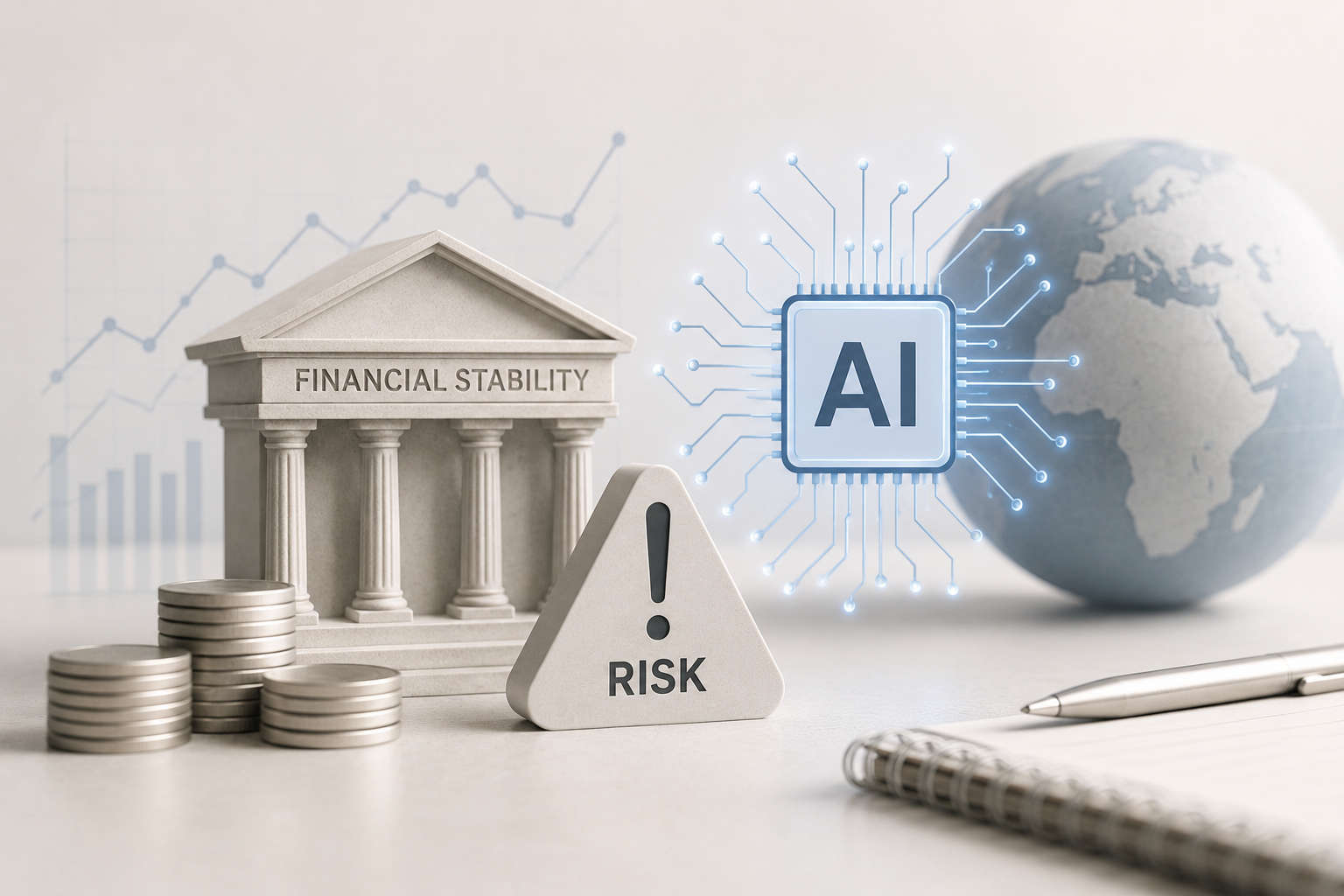
ECB President Christine Lagarde warned AI huge risks are bearing down on the global financial system — and she wasn’t mincing words. Artificial intelligence could trigger market crashes, bury systemic dangers where nobody can find them, and outpace every regulator on the planet before they’ve finished their morning coffee.
This isn’t another hand-wavy warning about robots stealing jobs. Lagarde specifically called out algorithmic trading cascades, opaque risk models, and contagion effects that could ripple across borders in literal seconds. For a US tech audience used to hearing AI safety framed around model alignment or prompt injection, this is a fundamentally different conversation. It’s about money — trillions of dollars of it.
Moreover, these warnings arrive at a moment when regulators are arguably moving faster than Silicon Valley on AI guardrails. That gap between tech optimism and financial caution deserves serious attention.
Why Lagarde Warned AI Could Destabilize Markets
Christine Lagarde, president of the European Central Bank, has been steadily escalating her warnings about AI in financial markets throughout 2024 and into 2025. Her concerns aren’t theoretical — they’re grounded in how AI is already being deployed across trading floors, risk departments, and lending operations worldwide.
Algorithmic trading cascades sit at the top of her worry list. AI-powered trading systems now execute millions of transactions per second. When multiple systems react to the same market signal simultaneously, they amplify volatility instead of dampening it. Specifically, Lagarde has flagged scenarios where AI models trained on similar datasets could all sell at once. The result? A flash crash on steroids. (I’ve covered market microstructure for years, and this particular scenario keeps serious people up at night.)
This isn’t unprecedented. The 2010 Flash Crash wiped nearly $1 trillion from US markets in minutes — and that happened with relatively simple algorithms. Today’s AI trading systems are exponentially more complex. Consequently, the potential damage is exponentially larger.
Model opacity is the second major concern. Banks and financial institutions increasingly rely on AI for credit scoring, fraud detection, and risk assessment. However, many of these models are black boxes — nobody, sometimes not even the developers, fully understands how they reach their conclusions. When a black-box model is wrong, it can be catastrophically wrong. And you won’t see it coming. Consider a practical example: a major bank deploys an AI credit-scoring model that quietly learns to penalize borrowers in specific zip codes — not because of explicit instructions, but because of patterns buried in decades of historical lending data. The model performs well on standard benchmarks, passes internal review, and gets deployed at scale. The flaw only surfaces when a regulator runs an independent audit two years later. By then, thousands of loan decisions have already been made on flawed grounds.
Systemic contagion rounds out the trifecta. Financial institutions worldwide are buying AI tools from the same handful of vendors. If a widely used model contains a flaw or develops a blind spot, that vulnerability spreads across the entire system at once. Lagarde has compared this to the pre-2008 era, when everyone was holding the same toxic mortgage products without realizing the shared risk. That comparison should make anyone in fintech uncomfortable. The parallel is uncomfortably precise: just as banks in 2006 assumed their mortgage-backed securities were independently safe, banks today often assume their AI vendors’ models are independently validated. In both cases, the shared exposure only becomes obvious after something breaks.
How These Warnings Differ From Tech Industry Safety Debates
Most AI safety conversations in the US tech world focus on model internals — mechanistic interpretability, alignment research, prompt injection attacks. Anthropic and OpenAI publish papers about preventing AI from going rogue at the model level. Important work, genuinely. But it’s a different universe from what Lagarde’s describing.
Her warnings operate on a completely different plane. Here’s a comparison:
| Tech Industry AI Safety Focus | Lagarde’s Financial Stability Focus |
|---|---|
| Mechanistic interpretability of individual models | Systemic risk from interconnected AI systems |
| Preventing harmful outputs (bias, toxicity) | Preventing market-wide cascading failures |
| Agentjacking and prompt injection | Correlated AI behavior across institutions |
| Model alignment with human values | Regulatory alignment with market realities |
| Individual model transparency | Sector-wide opacity in risk assessment |
| Long-term existential risk scenarios | Near-term financial crisis scenarios |
The distinction matters enormously. Tech safety researchers worry about what happens inside a single AI system. ECB President Christine Lagarde warned AI huge dangers emerge from the interaction between thousands of AI systems operating simultaneously across global markets. That’s not a subtle difference — it’s a completely different category of problem.
Furthermore, Lagarde’s framing shifts the accountability question in a way that’s genuinely fascinating. In tech, developers bear responsibility for their models. In finance, the question becomes: who’s responsible when fifty different AI systems, built by fifty different companies, collectively trigger a market meltdown? Nobody designed that outcome. Nevertheless, it happened. Current legal frameworks have no clean answer to that question, which is itself part of the problem — ambiguous liability reduces the incentive for any single institution to invest in safeguards.
Additionally, the timelines differ dramatically. Tech researchers often discuss AI risks in terms of years or decades. Lagarde is talking about risks that could show up tomorrow. An AI-driven flash crash doesn’t require artificial general intelligence — it just requires correlated stupidity at machine speed.
New Regulatory Frameworks Are Now Unavoidable
Lagarde hasn’t just sounded alarms. She’s pushed for concrete policy responses — and notably, she’s not alone. The regulatory world is moving with surprising speed here. This surprised me when I first started tracking it closely.
The G7 connection is significant. Recent G7 meetings have included AI leaders like Sam Altman of OpenAI and Dario Amodei of Anthropic. These summits have produced frameworks blending tech industry input with financial regulatory priorities. However, the resulting policies lean heavily toward the regulatory side — and that’s entirely intentional.
Here’s what regulators are specifically pursuing:
- Mandatory AI model documentation — Financial institutions would need to explain how their AI systems make decisions, particularly for trading and lending
- Stress testing for AI systems — Similar to bank stress tests, but specifically designed to evaluate how AI models behave under extreme market conditions
- Concentration risk monitoring — Tracking which AI vendors serve which institutions to identify dangerous dependencies
- Circuit breakers for AI trading — Automated halts when AI-driven trading volumes exceed certain thresholds
- Cross-border coordination — Because AI doesn’t respect national boundaries, neither can regulation
A practical illustration of why circuit breakers matter: imagine a mid-sized sovereign debt market — say, a smaller eurozone member — where three of the five largest institutional traders all run AI systems sourced from the same vendor. A sudden shift in inflation data triggers all three systems to reduce exposure simultaneously. Within forty seconds, bid-ask spreads widen dramatically, liquidity evaporates, and the yield on that country’s ten-year bond jumps sixty basis points. No individual actor did anything wrong. The circuit breaker exists precisely to pause the cascade before it becomes a self-fulfilling crisis.
The Financial Stability Board has been coordinating much of this work internationally. Their reports echo Lagarde’s concerns almost verbatim. Similarly, the Bank for International Settlements has published research showing how AI concentration among a few providers creates systemic vulnerability. Both institutions are worth bookmarking if you’re tracking this space.
Meanwhile, the European Union’s AI Act already classifies certain financial AI applications as “high risk,” meaning stricter requirements for transparency, human oversight, and documentation. The US has been slower to legislate, although the SEC and CFTC are increasing scrutiny of AI-driven trading. Importantly, Lagarde has argued that voluntary industry commitments aren’t enough — she’s pushing for binding rules. Her reasoning is straightforward: in a competitive market, no bank will voluntarily handicap its AI systems unless every competitor must do the same.
The Specific Mechanics Behind AI-Driven Financial Instability
Understanding why ECB President Christine Lagarde warned AI huge threats exist means looking at the actual mechanics. These aren’t hypothetical — they’re already visible in smaller-scale incidents. Fair warning: some of these are more technical, but they’re worth understanding.
Herding behavior at machine speed. When multiple AI trading systems train on similar historical data, they develop similar strategies, spot similar patterns, and react to similar triggers. In calm markets, this creates efficiency. In volatile markets, it creates stampedes — everybody runs for the exit at once. Unlike human traders, AI systems don’t pause to think. They just execute, instantly. A useful analogy: imagine every driver on a ten-lane highway using the same navigation app, and that app simultaneously reroutes all of them onto the same side street. The app is working perfectly. The resulting gridlock is still a disaster.
Feedback loops and self-reinforcing cycles. AI system A sells a large position and the price drops. AI system B detects the drop and sells its position, pushing prices lower still. AI system C responds in kind. This cascade can happen in milliseconds — faster than any human can step in. Consequently, small market movements can become large ones before anyone realizes what’s happening. The real kicker is that no individual system is malfunctioning. They’re all doing exactly what they were designed to do.
Data poisoning and adversarial attacks. Financial AI systems consume enormous amounts of market data. If that data is manipulated — even subtly — the models’ outputs change accordingly. A sophisticated attacker could theoretically influence multiple AI systems at once by poisoning shared data sources. Although this sounds like science fiction, NIST has documented these vulnerabilities extensively. A concrete version of this risk: a bad actor introduces a small but consistent distortion into a widely used alternative data feed — say, satellite imagery used to estimate retail foot traffic. Every model consuming that feed gradually miscalibrates its retail sector forecasts. The distortion is too small to trigger data-quality alerts but large enough to skew trading positions across dozens of funds simultaneously.
Procyclicality amplification. This is a technical term for a simple problem: AI systems tend to amplify existing market trends rather than push back against them. When markets rise, AI models treat rising prices as the norm and encourage more buying. When markets fall, they encourage more selling. Traditional risk management tries to be countercyclical. AI, left unchecked, does the opposite.
Concentration in AI infrastructure. A handful of cloud providers host most financial AI workloads, and a handful of model providers supply the underlying technology. If any of these single points of failure run into trouble, the effects spread across the entire financial system. Lagarde has specifically highlighted this as an underappreciated risk — and honestly, she’s right to flag it. The tradeoff here is real: centralized AI infrastructure offers cost efficiency and rapid capability improvements, but it trades those benefits for fragility. Distributed, heterogeneous AI infrastructure is more expensive and harder to manage, but it’s also far more resilient. Regulators are increasingly signaling that financial institutions need to take that tradeoff seriously rather than defaulting to whatever is cheapest.
These mechanisms don’t operate in isolation. They interact, they compound, and they can do so faster than any human can respond. That’s precisely why ECB President Christine Lagarde warned AI huge systemic risks require proactive regulation, not reactive cleanup.
What US Tech Companies and Investors Should Watch For
Lagarde’s warnings carry real practical implications for anyone building, deploying, or investing in AI technology. Bottom line: this stuff is going to affect your roadmap and your returns. Here’s what matters most.
Regulatory compliance costs are coming. If you’re building AI tools for financial services, expect significantly higher compliance requirements. Documentation, explainability, and audit trails will become mandatory in more jurisdictions. The EU is leading, but the US will follow — budget accordingly. I’ve talked to enough compliance teams to know that retrofitting explainability is far more expensive than building it in from day one. A rough rule of thumb from those conversations: teams that bolt on explainability post-deployment typically spend three to five times more than teams that architect for it upfront, and they still end up with a less defensible product.
Diversification pressure on AI vendors. Regulators don’t want every bank using the same AI provider. This creates both risk and opportunity. Specifically, it means:
- Large AI vendors may face market-share caps in financial services
- Smaller, specialized AI companies may gain real advantages here
- Open-source AI solutions could become more attractive to institutions seeking vendor diversity
- Multi-model strategies will become standard practice
Explainability is no longer optional. Black-box models are increasingly unacceptable for financial applications. If your AI can’t explain its decisions in terms a regulator can understand, it won’t get deployed — full stop. This has major implications for model architecture choices. Simpler, more interpretable models may win over more powerful but opaque alternatives. That’s a tradeoff the industry hasn’t fully grappled with yet. Gradient-boosted decision trees, for instance, are far easier to audit than large neural networks and may become the default choice for credit and risk applications even if they sacrifice a few percentage points of raw predictive accuracy. Regulatory acceptability, not benchmark performance, will increasingly drive architecture decisions.
Insurance and liability frameworks are evolving. When AI causes financial losses, who pays? Nobody has a clear answer yet. Nevertheless, Lagarde and other regulators are pushing hard for clarity. Tech companies building financial AI tools should expect to carry more liability for their products’ decisions. Heads up: your legal team needs to be in these conversations now.
Cross-border regulatory arbitrage is closing. Some companies have historically moved operations to lighter-touch jurisdictions. For AI in finance, that strategy is becoming less viable. The G7’s Hiroshima AI Process and similar multilateral efforts are aligning rules across major economies. Conversely, companies that embrace strong compliance early may gain meaningful competitive advantages — and that’s not spin, it’s how these regulatory cycles tend to play out.
Additionally, investors should pay close attention to which AI companies are building with regulatory compliance baked in versus bolted on. The former will scale more easily as rules tighten. The latter will face expensive, painful retrofits.
Conclusion
ECB President Christine Lagarde warned AI huge risks to financial stability can’t be dismissed as European overcaution. Her concerns about algorithmic trading cascades, model opacity, and systemic contagion are grounded in real market dynamics that are already visible today. I’ve been covering tech long enough to recognize when a warning is worth taking seriously — and this one is.
Therefore, here are actionable next steps depending on your role:
- If you’re a developer building financial AI, prioritize explainability and audit trails now, before regulations force expensive rebuilds
- If you’re an investor, evaluate AI companies based on their regulatory readiness, not just their model performance
- If you’re a tech leader, engage with regulatory processes rather than resisting them — companies that help shape rules gain advantages over those that don’t
- If you’re a trader or portfolio manager, understand what AI systems your firm uses, who else uses them, and what happens when they all react identically
The tech industry has spent years debating AI safety in terms of alignment and interpretability. Lagarde’s warnings add an urgent, practical dimension that’s harder to philosophize away. Financial instability doesn’t wait for perfect solutions — it exploits gaps in understanding, and right now those gaps are enormous. The question isn’t whether AI in finance will face heavier regulation. It’s whether the tech industry will help design smart rules or have blunt ones imposed on it. Lagarde has made the stakes unmistakably clear.
FAQ
What exactly did Lagarde warn about AI in financial markets?
Lagarde warned that AI poses significant risks to financial stability through three primary mechanisms. First, algorithmic trading systems could trigger cascading market crashes. Second, opaque AI models used for risk assessment could hide systemic vulnerabilities. Third, widespread adoption of similar AI tools across institutions creates dangerous concentration risk. Her warnings focus on macro-level financial stability rather than individual model safety.
How could AI actually cause a financial crisis?
AI could cause a financial crisis through correlated behavior. When many financial institutions use AI systems trained on similar data, those systems tend to make similar decisions at the same time. In a market downturn, this means mass selling at machine speed — far faster than human intervention can stop it. Feedback loops make the problem worse. Each round of AI-driven selling triggers more AI-driven selling. The 2010 Flash Crash showed a primitive version of this dynamic. Modern AI systems could produce a far larger event.
Are US regulators taking similar positions to Lagarde on AI risk?
US regulators are moving in the same direction, although more slowly. The SEC has increased scrutiny of AI-driven trading strategies, and the CFTC has explored rules for algorithmic trading. However, the US lacks a complete AI regulatory framework comparable to the EU’s AI Act. Notably, bipartisan interest in AI regulation is growing in Congress. The White House Executive Order on AI from October 2023 touched on financial stability but didn’t impose binding rules on financial AI specifically.
How do Lagarde’s warnings differ from typical AI safety concerns in tech?
Tech industry AI safety focuses primarily on individual model behavior — preventing harmful outputs, ensuring alignment with human values, and improving interpretability. Lagarde’s warnings focus on emergent system-level risks. She isn’t worried about a single AI going rogue. She’s worried about thousands of well-functioning AI systems collectively producing catastrophic outcomes. This is a fundamentally different risk category that requires different solutions — namely, market-wide regulation rather than model-level fixes.
What should AI startups in fintech do in response to these warnings?
Fintech AI startups should take several concrete steps. Build explainability into your models from day one and document decision-making processes thoroughly. Prepare for mandatory stress testing of AI systems, and diversify your technology stack to avoid single-vendor dependencies. Importantly, engage with regulators proactively. Companies that show responsible AI practices early will find it easier to scale as compliance requirements tighten. Those that treat regulation as an afterthought will face costly retrofits.
Could AI regulation hurt innovation in financial technology?
This is a legitimate concern, and opinions vary. Nevertheless, Lagarde has argued that unregulated AI innovation in finance is more dangerous than slightly slower innovation. Historical precedent supports this view — the 2008 financial crisis resulted partly from financial innovation that outpaced regulation. Smart regulation can actually support innovation by creating clear rules that companies can build around. The key is designing rules that target genuine risks without adding unnecessary burdens, and that balance is precisely what current regulatory discussions are trying to achieve.
Keep reading
Here are the latest posts from the blog.
The phrase export controls intelligence why governments treating AI like military hardware would’ve sounded absurd five years ago. Not anymore. Today, advanced AI models sit…
The question of voting rights vs capital in DeepSeek’s unusual funding structure isn’t just a corporate finance curiosity. It’s a window into how the world’s most powerful AI…
Sim real transfer how robots learn walk is one of the most important breakthroughs in modern robotics — and honestly, it’s one of those ideas that sounds obvious in hindsight…