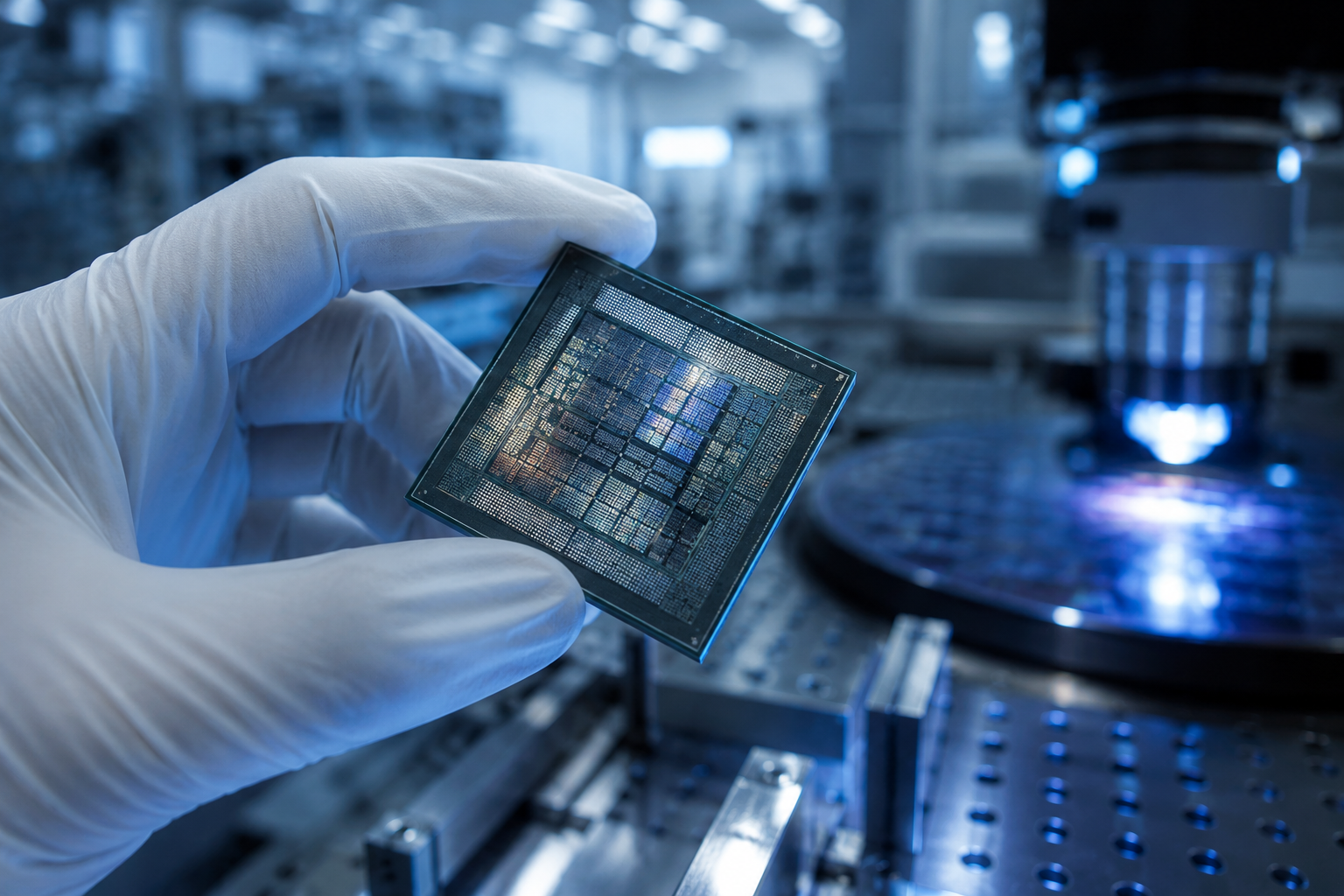
Custom Silicon Explained: Why Every Major AI Company Is Pouring Billions Into Chip Design
Nvidia already makes extraordinary GPUs. So why are Google, Meta, Amazon, Microsoft, and OpenAI all pouring billions into designing their own chips?
The short answer: generic hardware is wasteful. It burns power, costs more than it should, and runs on someone else’s schedule. Custom silicon lets companies build exactly what they need — optimized down to the transistor level for their specific workloads. The result is faster inference, lower costs, and freedom from a single supplier’s roadmap.
This isn’t theoretical anymore. The shift is underway, the money is committed, and the pace of change is unlike anything I’ve seen in years of watching this space. Here’s what’s actually happening, what each company is building, and why it matters far beyond the chip industry.
The Nvidia Monopoly Problem
Nvidia owns AI training hardware. Their H100 and B200 GPUs power the majority of large language model training runs worldwide — and that dominance creates serious problems for every company that depends on them.
The supply crisis of 2023 and 2024 made that painfully clear. Companies couldn’t get enough GPUs at any price. Nvidia’s data center revenue jumped from $15 billion to over $47 billion in a single fiscal year. Customers realized their entire AI roadmaps were hostage to one company’s production schedule. That’s a deeply uncomfortable place to be.
Pricing is the other issue. When you’re the only game in town, you set the terms. Nvidia’s gross margins exceed 70% — extraordinary for a hardware company — which means every dollar spent on their silicon includes a premium that custom chips could eventually eliminate.
And then there’s CUDA. Nvidia’s software ecosystem is genuinely excellent, but it’s also a trap. Code written for CUDA doesn’t port easily to other platforms, and that’s by design. It locks you into Nvidia’s hardware for years. Engineers at hyperscalers will tell you the frustration wasn’t just financial — it was the feeling of having no control over their own future.
That sentiment is what’s driving the custom silicon wave more than anything else.
Why the Economics Actually Work
The math on custom silicon only makes sense at scale, but at hyperscaler scale, it’s almost uncomfortably obvious.
A single H100 GPU costs $25,000–$40,000. Training a GPT-4-class model requires tens of thousands of them. Total compute costs can clear $100 million per training run. A 20% efficiency improvement saves tens of millions — per model. And inference costs over a model’s lifetime dwarf what training costs to begin with.
So spending $2–5 billion on chip development pays for itself within a few years if you’re deploying at the volumes these companies operate at. It’s not cheap, but at this scale, it’s not optional either.
Here’s what each major player is building:
Google TPUs are the most mature program in the industry. Google has been iterating on Tensor Processing Units since 2016 — nearly a decade. The latest generation, TPU v5p, is competitive with Nvidia’s best hardware for training. Google uses them internally and makes them available through Google Cloud, spreading development costs across two revenue streams.
Amazon Trainium and Inferentia serve a similar purpose for AWS. Amazon claims Trainium2 delivers 30–40% better price-performance than comparable GPU instances. Controlling the full stack from chip to cloud service is a real strategic advantage.
Meta’s MTIA (Meta Training and Inference Accelerator) targets recommendation and ranking workloads — the systems driving what billions of people see on Facebook and Instagram every day. Even a 10% efficiency gain at that scale is worth hundreds of millions annually.
Microsoft’s Maia accelerator is designed specifically for large language model workloads running in Azure. Microsoft is also partnered deeply with OpenAI, which creates an interesting dual-track strategy.
OpenAI is reportedly developing its own chip program. Details are sparse, but the logic is clear — relying entirely on Nvidia is a bottleneck for scaling future models. It surprised me a bit when it first surfaced given the capital requirements, but strategically it makes complete sense.
What Custom Silicon Actually Buys You
The performance gains show up in a few specific areas.
Latency matters enormously for inference. When someone asks ChatGPT a question, milliseconds count. Custom chips can dedicate hardware blocks to the exact operations transformers use most — matrix multiplications, attention mechanisms — rather than sharing resources with unrelated compute tasks.
Power efficiency is becoming the primary design constraint, not raw performance. Data centers are already struggling with electricity supply. Cooling costs scale directly with power draw. A chip that delivers the same output at half the wattage effectively doubles your data center capacity without breaking ground on a new building.
Here’s a rough comparison across the major platforms:
| Metric | Nvidia H100 (GPU) | Google TPU v5p | Amazon Trainium2 | Meta MTIA v2 |
|---|---|---|---|---|
| Primary use | Training + inference | Training + inference | Training + inference | Inference + ranking |
| Design philosophy | General purpose | Transformer-optimized | Cloud workload-optimized | Recommendation-optimized |
| Chip cost | $25,000–$40,000 | Internal only | Cloud pricing) | Internal only |
| Power efficiency | Baseline | ~1.5–2x better per watt | ~1.3–1.5x better per watt | ~2–3x better for target tasks |
| Software ecosystem | CUDA (massive) | JAX/XLA | Neuron SDK | PyTorch-based |
| Availability | Supply-constrained | Google Cloud only | AWS only | Meta internal only |
Total cost of ownership calculations have to account for more than chip price — you’re also paying for servers, networking, electricity over 3–5 years, cooling, software development, and staff. For hyperscalers running millions of chips, custom silicon can cut TCO by 30–50% on targeted workloads. Those savings compound as chip designs improve. Your first-generation chip funds your second.
The International Energy Agency projects that data center electricity consumption could double by 2026. Power efficiency isn’t just a cost story — it’s a question of whether you can physically run your AI systems at all. That problem is already here.
The Risks Nobody Talks About Enough
Most coverage of custom silicon focuses on the upside. The downsides deserve more airtime.
Design costs are brutal. Building a competitive AI chip from scratch costs $2–5 billion. That means hiring hundreds of chip architects, licensing IP blocks, and paying for advanced fabrication at TSMC or Samsung. One design error can set a program back 12–18 months. In AI terms, 18 months might as well be a decade.
Talent is genuinely scarce. The world has a finite supply of experienced chip designers, and Google, Apple, Nvidia, and a wave of well-funded startups are all fishing the same pond. Total compensation for senior chip architects regularly exceeds $1 million. I’ve watched promising hardware programs stall out because the engineering team simply couldn’t be assembled fast enough.
Software ecosystems are hard. CUDA has been refined for 15+ years. It has millions of developers, thousands of libraries, and deep integration with every major AI framework. Building a comparable software stack takes enormous sustained effort. Companies that target narrower use cases can sidestep some of this, but that limits what the chip can do. I’ve seen genuinely impressive hardware go nowhere because the software story wasn’t there.
Fabrication risk is real but underappreciated. Nearly all advanced AI chips — custom or commercial — are manufactured by TSMC in Taiwan. That geographic concentration introduces geopolitical risk that doesn’t go away just because you’re building your own chip.
And the AI landscape might shift under you. Custom chips take 3–5 years from concept to production. If transformer architectures give way to something fundamentally different during that window, today’s optimizations could be partially obsolete before the chip ships.
What This Means for the Broader Industry
The custom silicon trend reshapes far more than the companies building chips.
Startups face a widening moat. Google trains models on TPUs optimized for their architecture. Meta runs inference on chips designed specifically for their recommendation models. Competitors using generic hardware pay more per prediction and get slower results. These structural cost advantages compound over time. It’s one of the more underappreciated dynamics in AI right now.
Cloud pricing is already shifting. AWS Inferentia instances are already priced below comparable GPU options for specific workloads. As custom silicon matures, that gap will widen. If you’re running inference workloads in the cloud and haven’t benchmarked against custom chip instances recently, it’s worth doing.
Nvidia isn’t going anywhere. Despite the trend, most companies still rely on Nvidia GPUs for training, and Nvidia’s Blackwell architecture shows they’re not standing still. Their software ecosystem and innovation pace keep them competitive. Custom silicon will erode specific segments of their market, not displace them entirely.
Specialization will deepen. The industry is moving toward distinct chips for distinct tasks:
- Training chips built for massive parallel computation
- Inference chips designed for low latency and high throughput
- Edge chips for on-device processing
- Reasoning chips tailored for chain-of-thought workloads
This mirrors what happened in networking decades ago, when custom ASICs replaced general-purpose processors. The same economic logic applies: when you know exactly what computation you need, purpose-built hardware almost always wins.
Geopolitics are part of this story. U.S. export restrictions on advanced chips, the CHIPS and Science Act subsidies for domestic fabrication, Taiwan’s central role in manufacturing — these aren’t background details. They’re actively shaping where AI development goes and which companies can participate.
Conclusion
Custom silicon comes down to three things: cost, control, and competitive advantage.
Google proved the model works with TPUs. Amazon, Meta, and Microsoft followed. OpenAI appears to be heading the same direction. The upfront investment is massive, but at hyperscaler volumes, the long-term savings and strategic freedom justify it.
A few things worth keeping in mind:
- Custom silicon supplements and competes with Nvidia — it doesn’t replace it
- The economics only work at massive scale; most companies should still use commercial hardware
- Software ecosystems matter as much as hardware — a great chip with bad tooling is useless
- Power efficiency has surpassed raw performance as the primary design constraint
- The gap between large and small AI companies is widening, and chips are part of why
If you’re thinking about AI infrastructure, the chip market is splitting fast. The most useful thing you can do right now is benchmark your inference workloads against cloud-based custom chip instances. The price difference may already justify a switch — and it’ll only grow from here.
FAQ
Why are AI companies building custom chips instead of buying Nvidia GPUs?
Nvidia GPUs are excellent general-purpose accelerators, but “general-purpose” means they include capabilities that specific AI workloads don’t need. Custom silicon cuts that overhead. Companies also reduce dependence on Nvidia’s pricing and supply decisions — a concern that became very concrete during the 2023 supply crunch. At hyperscaler volumes, even modest efficiency gains add up to hundreds of millions in savings annually.
How much does it cost to design a custom AI chip?
A competitive custom AI chip typically costs $2–5 billion from concept to production. That covers chip architecture, verification, tape-out fees, and software development. Advanced fabrication at TSMC’s leading-edge nodes adds significant per-unit cost on top. The investment only makes sense if you’re deploying hundreds of thousands of chips or more. Everyone else is better served by commercial hardware or cloud-based custom chip instances.
Will Nvidia lose its dominance because of custom silicon?
Not anytime soon. Nvidia’s CUDA ecosystem, rapid innovation cycle, and broad applicability give it enormous staying power. Custom silicon will gradually take share in specific segments — inference in particular is shifting faster than training. But Nvidia recognizes the threat and is responding hard. They’re not a company that loses quietly.
What’s the difference between a GPU and a custom AI accelerator?
A GPU is a general-purpose parallel processor. It handles graphics, scientific computing, and AI equally well. A custom AI accelerator is designed exclusively for AI computations — dedicated hardware for matrix operations, specialized memory architectures, optimized data paths for neural network inference or training. The tradeoff is clear: better performance per watt for target workloads, less versatility for everything else.
Which company has the most advanced custom AI chip program?
Google’s TPU program is the most mature. Six generations since 2016, used extensively internally and on Google Cloud, with Google training its Gemini models on TPU pods containing thousands of chips. Amazon’s Trainium program is advancing quickly. And Apple’s Neural Engine — focused on consumer devices rather than data centers — is one of the most successful custom silicon efforts for on-device AI. Don’t underestimate Apple here.
Should smaller companies consider building custom silicon?
For almost all of them, no. Custom chip design requires billions in investment, years of development, and enormous deployment volumes to justify the cost. Smaller companies should focus on selecting the right commercial hardware and optimizing their software stack. Cloud services offering custom chip instances — Google TPU access, AWS Inferentia — are the right middle ground. You get the efficiency benefits without bearing the design cost.
References
Keep reading
Here are the latest posts from the blog.
Autonomous penetration testing — when AI stops being told what to hack and starts choosing its own targets — isn’t a future scenario anymore. We’re no longer talking about AI…
Large language models forget everything between conversations. That’s the dirty secret of modern AI — and it’s been quietly wrecking the economics of building useful AI produ…
The OpenAI Jalapeño chip custom semiconductor AI inference project signals a massive shift. OpenAI isn’t just building AI models anymore — it’s building the hardware to run t…