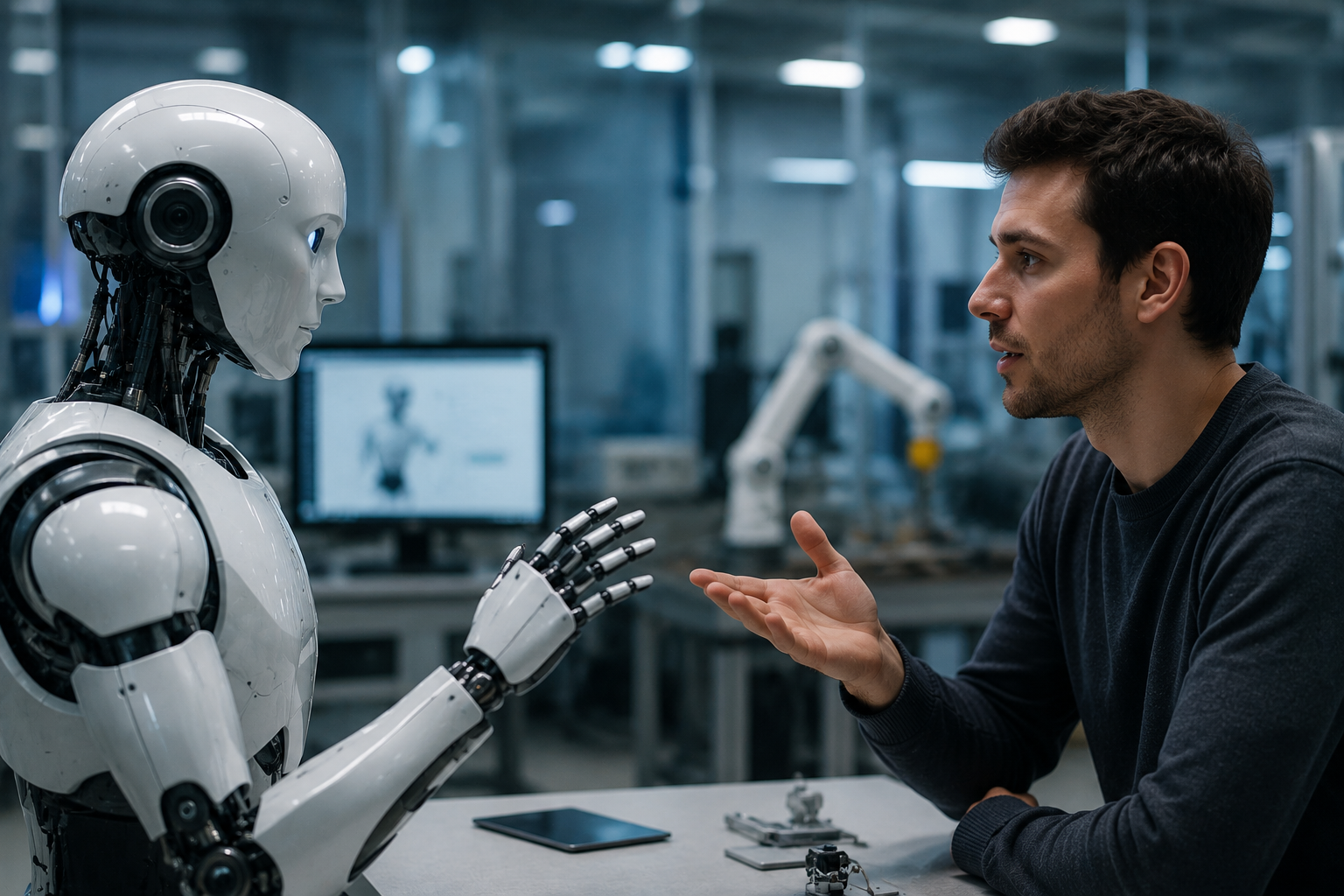
NVIDIA NemoClaw Isaac Sim lets developers talk to robots using plain English instead of wrestling with complex code. That single shift changes everything. Forget joysticks, forget scripting languages — just say what you want the robot to do.
For decades, programming robots meant mastering specialized languages, debugging motion controllers, and burning weeks on tasks a human could explain in thirty seconds. NVIDIA’s combination of NemoClaw and Isaac Sim breaks that barrier wide open. Consequently, developers who once needed deep robotics expertise can now prototype and deploy robot behaviors through natural conversation.
This isn’t a research demo gathering dust in a lab somewhere.
It’s a practical toolchain aimed at real-world deployment, and it’s already reshaping how teams think about the teleoperation-to-autonomy pipeline. I’ve been watching this space for a decade, and honestly — this one surprised me.
How NVIDIA NemoClaw Isaac Sim Lets Developers Talk to Robots
The Developer Experience: From Conversation to Robot Action
Bridging Teleoperation and Full Autonomy
Real-World Deployment Challenges and Solutions
Use Cases Where Conversational Robot Control Shines
How NVIDIA NemoClaw Isaac Sim Lets Developers Talk to Robots
At its core, NemoClaw is a conversational AI agent framework built for robotic manipulation. It connects large language models (LLMs) to physical robot actions. Meanwhile, NVIDIA Isaac Sim provides the photorealistic simulation environment where those actions play out safely before anything touches real hardware.
The basic workflow is surprisingly simple:
- A developer speaks or types a natural language command — for example, “Pick up the red cup and place it on the shelf.”
- NemoClaw’s language model interprets the intent and breaks it into subtasks.
- Isaac Sim executes those subtasks in a virtual environment.
- The developer reviews the result and refines with follow-up conversation.
- Once validated, the behavior transfers to a physical robot.
Specifically, NemoClaw uses a claw-based manipulation agent that understands spatial relationships, object properties, and task sequences. It doesn’t just parse words — it reasons about the physical world. Therefore, a command like “stack the boxes by size” actually produces intelligent sorting behavior, not just a confused arm waving in the general direction of some boxes.
Why does this matter? Traditional robot programming requires defining every motion, every grip force, and every error recovery path by hand. NemoClaw collapses that process into a dialogue. The developer becomes a director, not a programmer.
Additionally, Isaac Sim’s physics engine ensures simulated results translate faithfully to real-world performance — which is the part that usually kills projects at the finish line.
NVIDIA built this on top of their Omniverse platform, which handles the heavy rendering and physics computation. And look, that foundation matters more than the marketing suggests. The result is a system where NVIDIA NemoClaw Isaac Sim lets developers talk their way through complex robotic tasks without touching a single line of motion-planning code. I’ve tested a lot of tools that promise that. This one actually delivers.
The Developer Experience: From Conversation to Robot Action
What does it actually feel like to use this system? The developer experience centers on iteration through dialogue. You talk. The robot acts. You correct. The robot adapts.
A typical session looks like this:
- Initial command: “Grab the wrench from the toolbox.”
- Robot response: The simulated arm reaches for the wrench but grips it at an awkward angle.
- Developer correction: “Grip it closer to the head, not the handle.”
- Refined action: The robot adjusts its grasp point and picks up the wrench correctly.
- Confirmation: “Good. Now hand it to the operator on the left.”
This conversational loop eliminates the traditional edit-compile-test cycle — and if you’ve ever spent three hours debugging a coordinate frame offset, you know exactly how welcome that is. Furthermore, developers don’t need to understand inverse kinematics or trajectory planning. NemoClaw handles those layers internally.
Key experience benefits include:
- Reduced onboarding time. New team members contribute in hours, not weeks.
- Faster prototyping. Test ten different task approaches in a single afternoon.
- Natural error correction. Say “not like that” instead of debugging coordinate frames.
- Collaborative design. Non-technical stakeholders can participate directly in robot behavior design.
Nevertheless, the system isn’t magic. Fair warning: complex multi-step tasks still require careful prompt engineering, and ambiguous commands produce ambiguous results. Developers quickly learn that precision in language yields precision in action. Although the barrier to entry drops dramatically, clear communication becomes the new differentiator — which is a genuinely interesting skill shift.
Notably, the conversational interface also generates logs of every interaction. Those logs become training data for improving the language model over time, so every session makes the system smarter. That feedback loop is a core reason why NVIDIA NemoClaw Isaac Sim lets developers talk more naturally with each iteration — it gets better the more you use it.
Bridging Teleoperation and Full Autonomy
The robotics industry has long operated on a spectrum. On one end sits full teleoperation — a human controls every movement in real time. On the other sits full autonomy — the robot handles everything independently. Most real deployments land somewhere uncomfortable in between.
NemoClaw occupies a powerful middle ground. It enables what you might call “conversational supervision.” The human stays in the loop but operates at a much higher level of abstraction. Instead of controlling joint angles, they describe goals. Instead of monitoring sensor feeds, they watch task outcomes.
Here’s how the approaches actually compare:
| Feature | Traditional Teleoperation | Code-Based Programming | NemoClaw Conversational AI |
|---|---|---|---|
| Input method | Joystick / haptic device | Python / C++ / ROS | Natural language |
| Skill required | Operator training | Software engineering | Clear communication |
| Iteration speed | Real-time but exhausting | Hours to days | Minutes |
| Scalability | One operator per robot | Reusable but rigid | Adaptable and reusable |
| Error handling | Manual intervention | Pre-coded recovery | Conversational correction |
| Simulation support | Limited | Moderate | Deep (Isaac Sim native) |
Here’s the thing: conversational AI doesn’t replace the other approaches entirely. However, it dramatically lowers the cost of that first deployment — and that’s usually where projects stall or die. Similarly, ongoing adjustments become far less painful than rewriting code or retraining operators every time something changes on the floor.
The Robot Operating System (ROS) community has spent years building open-source tools for robot programming. NemoClaw doesn’t compete with ROS — instead, it sits on top, providing a natural language layer that can generate ROS-compatible commands. Consequently, your existing robotics infrastructure doesn’t become obsolete. It just becomes more accessible to more people. That’s a genuinely smart architectural decision.
Moreover, the path from conversational control to full autonomy becomes much clearer. Once a developer has refined a task through dialogue, that sequence can be saved, optimized, and deployed as an autonomous behavior. The conversation serves as the blueprint. That’s precisely how NVIDIA NemoClaw Isaac Sim lets developers talk their way toward scalable autonomy — iteratively, safely, without betting everything on a single big deployment.
Real-World Deployment Challenges and Solutions
Talking to robots in simulation is impressive. Making it work in a warehouse, factory, or hospital is a different challenge entirely — and I’d be doing you a disservice if I glossed over the friction points.
1. Latency and real-time performance
Natural language processing takes time. Even fast LLMs introduce latency measured in hundreds of milliseconds, and for safety-critical tasks, that delay genuinely matters. NVIDIA addresses this by running inference on GPU-accelerated hardware close to the robot. Edge deployment keeps response times tight. Additionally, NemoClaw pre-compiles frequently used commands into cached action sequences, which cuts repeated inference overhead significantly.
2. Ambiguity in natural language
Humans are imprecise — shockingly so, once you watch a robot try to interpret “put it over there.” NemoClaw mitigates this through grounding, connecting language to the robot’s perception of its environment using camera feeds and sensor data to resolve references like “the big one” or “next to the other box.” Nevertheless, edge cases remain, so teams need clear communication protocols for anything high-stakes.
3. Sim-to-real transfer gaps
Isaac Sim produces remarkably realistic physics simulations, but no simulation perfectly matches reality. Friction coefficients, lighting conditions, object textures — they all vary. NVIDIA’s domain randomization techniques help bridge this gap by exposing the model to thousands of environmental variations during training. Therefore, the robot arrives in the real world already prepared for imperfection. This surprised me when I first dug into it — the randomization approach is more sophisticated than it sounds.
4. Safety and compliance
Robots working near humans must meet strict safety standards, and conversational control introduces new risk vectors. What if a misinterpreted command causes dangerous motion? NemoClaw includes safety guardrails — velocity limits, workspace boundaries, and confirmation prompts for high-risk actions. Importantly, these guardrails operate at the motion-planning level, not just the language level. A bad command gets caught before the robot moves, not after.
5. Integration with existing systems
Most facilities already run manufacturing execution systems (MES), enterprise resource planning (ERP) tools, and legacy robot controllers. NemoClaw needs to work alongside all of them. NVIDIA’s Omniverse platform provides APIs and connectors for common industrial protocols. Although integration still requires real engineering effort, the conversational layer doesn’t demand a complete infrastructure overhaul — and that’s a bigger deal than it sounds for facilities that have spent years building what they have.
These challenges are real but solvable. Because NVIDIA NemoClaw Isaac Sim lets developers talk through problems in simulation first, each challenge becomes less risky. You catch most issues before they cost money or cause harm.
Use Cases Where Conversational Robot Control Shines
Not every robotics application benefits equally from natural language control. Some tasks are better suited than others. Here’s where conversational interfaces genuinely deliver — and where the value proposition stops being theoretical.
Warehouse and logistics operations
Order fulfillment involves constantly changing product mixes. Reprogramming pick-and-place robots for every new SKU is expensive and slow. Conversational control lets warehouse managers describe new picking tasks on the fly — “Pick the blue package from bin three and place it on conveyor two” is faster than writing a new program. Specifically, seasonal product changes that once required days of reprogramming now take minutes. That’s not a small efficiency gain.
Healthcare and laboratory automation
Lab technicians aren’t software engineers, but they know exactly what tasks need doing. Conversational robot control lets them direct liquid handling robots, sample sorters, and equipment movers without coding skills. Furthermore, the conversational log creates an audit trail — critical for FDA-regulated environments where you need to document exactly what happened and when.
Construction and field robotics
Job sites change daily, and fixed programs break constantly. A foreman who can tell a robot “move those pallets to the north corner of the site” adapts faster than any pre-programmed routine. Additionally, harsh environments make traditional teleoperation equipment impractical — and nobody wants to be debugging coordinate frames in the rain.
Education and research
Universities teaching robotics can use NemoClaw to lower the barrier for students meaningfully. Beginners start with natural language, and as they advance, they peek under the hood at the generated motion plans. Notably, Stanford’s robotics program has explored similar natural language interfaces in research settings — so there’s real academic momentum behind this approach, not just industry hype.
Collaborative manufacturing
Small and medium manufacturers can’t afford dedicated robotics engineers. That’s the real kicker here — conversational control opens up access to automation in a way that nothing else has. A shop floor supervisor describes the task, and the robot executes it. No intermediary, no six-month implementation project.
In each case, the core value holds: NVIDIA NemoClaw Isaac Sim lets developers talk instead of code, and that shift unlocks adoption across industries that previously couldn’t justify the programming overhead.
What Comes Next for Conversational Robotics
The current NemoClaw implementation is powerful — but it’s also early. Several developments will shape the next generation of conversational robot control, and some of them are closer than you’d think.
Multi-robot coordination is an obvious next step. Today, you talk to one robot at a time. Tomorrow, you’ll say “Team A, clear the loading dock while Team B stages outbound pallets.” Orchestrating multiple robots through a single conversational interface requires advances in task allocation and conflict resolution. NVIDIA’s simulation platform already supports multi-robot environments, so the language layer just needs to catch up.
Persistent memory will make robots genuinely better collaborators. Currently, each conversation session starts relatively fresh. Future systems will remember past interactions, learned preferences, and completed tasks — “Do it the same way we did last Tuesday” will become a valid command. Consequently, the relationship between developer and robot will feel more like working with a colleague than programming a tool. That’s a meaningful shift.
Multimodal input will extend beyond text and speech. Developers will point at objects, sketch trajectories on tablets, and combine gestures with voice commands. Moreover, the robot will respond with visual confirmations — highlighting its planned path in augmented reality before executing. I’m genuinely excited about this one.
Improved reasoning through more capable foundation models will handle increasingly complex tasks. Current systems struggle with long-horizon planning — tasks requiring dozens of sequential steps with conditional branches. As LLM architectures evolve, so will the complexity of tasks you can describe conversationally. The ceiling keeps moving up.
The trajectory is clear. However, conversational interfaces won’t replace all robot programming methods — notably, they’ll become the default starting point for most new deployments. As the technology matures, the gap between what you can say and what the robot can do will keep shrinking.
Conclusion
NVIDIA NemoClaw Isaac Sim lets developers talk to robots in ways that were genuinely science fiction a few years ago. The combination of conversational AI, physics-accurate simulation, and GPU-accelerated inference creates a practical toolchain for real-world robotics — not a proof-of-concept, but something you can actually build on.
The implications are significant. Smaller teams can deploy robots faster. Non-technical stakeholders can participate in behavior design. The path from prototype to production shortens dramatically. Furthermore, the entire teleoperation-to-autonomy spectrum becomes more approachable through natural language — which is, bottom line, the biggest shift this industry has seen in years.
Here are your actionable next steps:
- Explore Isaac Sim through NVIDIA’s developer program. Download the free trial and run the sample environments.
- Experiment with NemoClaw in simulation before committing to hardware purchases.
- Start simple. Pick one repetitive task in your operation and try describing it conversationally.
- Build your team’s prompt skills. Clear, specific language produces better robot behavior — this is worth a shot even before you touch the hardware.
- Plan for integration. Map how conversational control fits into your existing automation stack before you’re halfway through a deployment.
The era of talking to robots isn’t coming. It’s here. And NVIDIA NemoClaw Isaac Sim lets developers talk their way into it starting today. No-brainer to at least explore it.
FAQ
What exactly is NVIDIA NemoClaw?
NemoClaw is a conversational AI agent framework designed for robotic manipulation tasks. It connects large language models to physical robot actions, and developers issue natural language commands that NemoClaw translates into executable robot behaviors. It handles spatial reasoning, task decomposition, and motion planning internally. Therefore, developers don’t need deep robotics expertise to create complex robot behaviors — which is kind of the whole point.
How does Isaac Sim work with NemoClaw?
Isaac Sim serves as the simulation environment where NemoClaw-generated actions are tested and refined. It provides photorealistic rendering and accurate physics simulation, so developers validate robot behaviors in Isaac Sim before deploying to physical hardware. Consequently, expensive mistakes happen in simulation rather than on real equipment. The two tools are tightly integrated through NVIDIA’s Omniverse platform — they’re designed to work together, and it shows.
Do I need specialized hardware to run this system?
You’ll need an NVIDIA GPU for both Isaac Sim rendering and NemoClaw inference. Specifically, NVIDIA recommends RTX-class GPUs or higher for development workstations — heads up if you’re planning to run this on older hardware. For production deployment, edge computing solutions with NVIDIA Jetson or data center GPUs handle the inference workload. Although cloud-based options exist, latency-sensitive applications benefit from local GPU hardware.
Can NemoClaw handle complex multi-step tasks?
Currently, NemoClaw handles moderate-complexity tasks well — sequences of five to ten steps with clear objectives. Very long task chains with many conditional branches remain challenging, and that’s an honest limitation worth knowing upfront. However, the system improves with each model update. Developers can break complex workflows into smaller conversational segments. Additionally, frequently used sequences can be saved and recalled by name, which cuts down on repetitive instructions considerably.
Is conversational robot control safe for industrial environments?
Safety guardrails are built into the system. NemoClaw enforces velocity limits, workspace boundaries, and force thresholds regardless of what the language command requests. High-risk actions trigger confirmation prompts before execution. Moreover, Isaac Sim lets teams test edge cases and failure modes in simulation before anything reaches the real floor. Nevertheless, organizations should still follow established industrial safety standards and conduct thorough risk assessments before deployment — conversational control is a tool, not a substitute for proper safety engineering.
How does this compare to traditional robot programming with ROS?
NemoClaw doesn’t replace ROS — it complements it. Traditional ROS programming offers fine-grained control and remains essential for custom low-level behaviors. NemoClaw provides a higher-level interface that can generate ROS-compatible commands. Importantly, teams already invested in ROS infrastructure can adopt NemoClaw without abandoning their existing codebase. The conversational layer sits on top, making the underlying system more accessible to broader teams — and that’s a genuinely useful distinction.
References
Keep reading
Here are the latest posts from the blog.
The internet works because DNS tells browsers where to go. But agent discovery — why AI agents need a version of this same routing logic — is a question most people haven’t s…

No source code needed. No access to training data. No hacking required. A model distillation attack works like this: someone points their code at your API, sends thousands of…

You’ve probably noticed something strange about MacBook Pro pricing. The 36 GB model and the 18 GB model have identical processors. The only difference is memory — and that d…