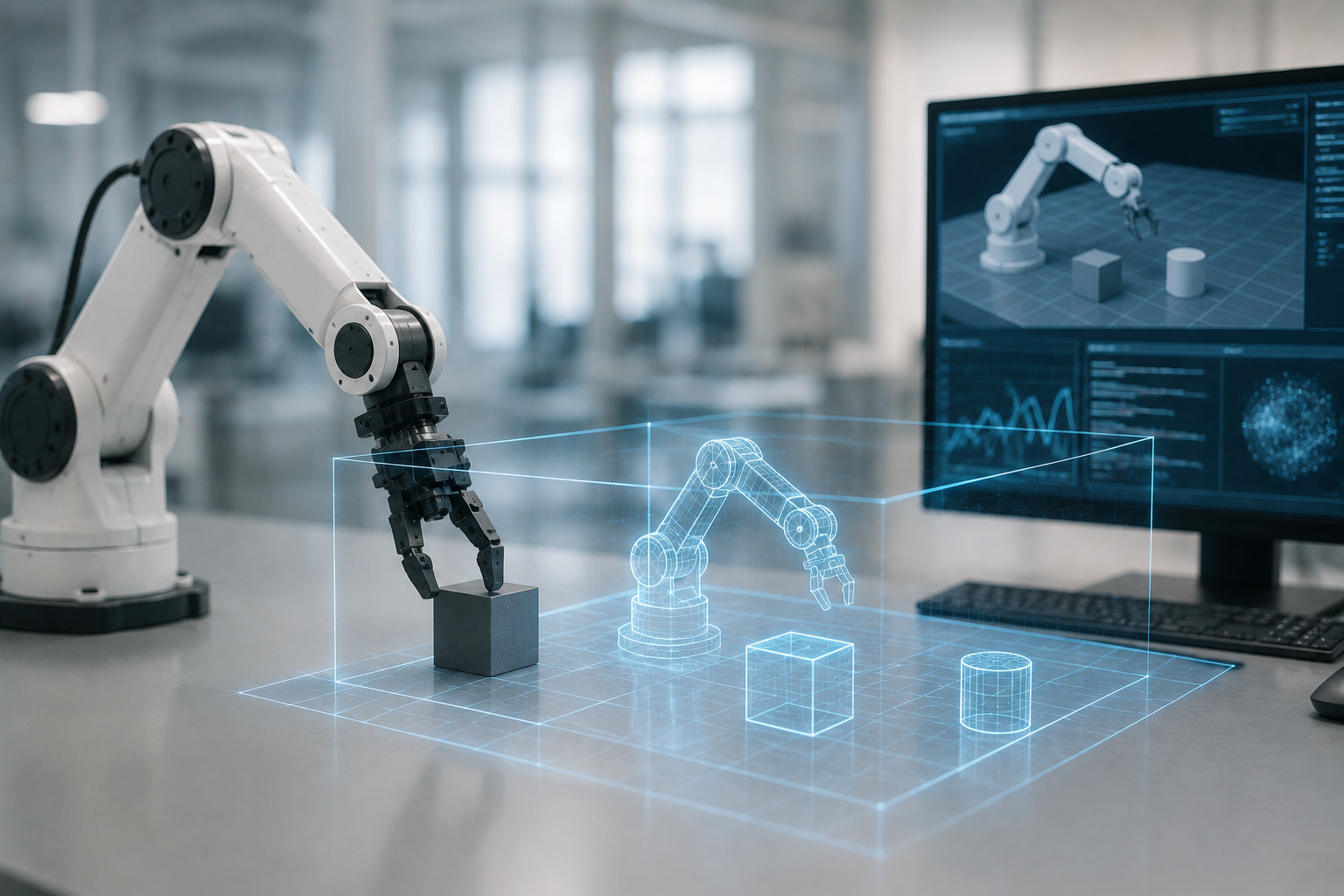
The world model AI concept behind serious robotics labs isn’t new. However, it’s finally ready for prime time. Every major robotics team — from stealth startups to NVIDIA’s simulation division — now treats world models as essential infrastructure.
So what changed? Compute got cheaper. Architectures got smarter. And pure imitation learning hit a wall. Consequently, 2026 marks the year production robotics labs shifted from “teach by showing” to “learn by imagining.” That shift matters for anyone building, investing in, or writing about intelligent machines.
Why World Models Matter More Than Ever for Robotics
How World Models Actually Work: Architectures That Drive Production Labs
World Models vs. Pure Imitation Learning: Why Labs Are Switching
Why 2026 Is the Inflection Point for Production Adoption
Why World Models Matter More Than Ever for Robotics
A world model is a learned internal representation of how an environment works. Specifically, it lets an AI agent predict what happens next — before it acts. Think of it as a robot’s imagination.
Traditional robotics relied on hand-coded physics engines or reactive policies. The robot saw something, then responded. No prediction, no planning — just stimulus and response.
World models flip that script. The robot builds a mental simulation and asks, “If I push this cup left, will it fall off the table?” It tests that scenario internally. Only after evaluating the outcomes does it commit to an action. I’ve watched this play out in demos and, honestly, it still surprises me how much more deliberate the motion looks compared to reactive systems.
This is the world model AI concept behind serious robotics breakthroughs we’re seeing right now. Notably, it connects directly to how platforms like NVIDIA Isaac Sim generate synthetic training environments. Isaac Sim provides the physics sandbox. World models let robots carry that sandbox in their heads.
Furthermore, this approach solves a brutal bottleneck. Real-world robot training is slow, expensive, and dangerous. A robot arm learning by trial and error might destroy thousands of dollars in hardware before it figures out a single task. Meanwhile, a robot with a good world model can rehearse millions of scenarios in seconds, all in latent space. That’s not marketing language — that’s a genuine order-of-magnitude difference in iteration speed.
Here’s the thing: I’ve covered a lot of “paradigm shifts” in robotics over the past decade. Most of them weren’t. This one actually is.
Key benefits of world models for robotics:
- Fewer real-world training hours needed
- Safer exploration of dangerous or high-stakes tasks
- Better generalization to situations the robot’s never seen before
- Faster adaptation when environments change unexpectedly
- More sample-efficient learning overall
How World Models Actually Work: Architectures That Drive Production Labs
Understanding the world model AI concept behind serious robotics means knowing the main architectural approaches. Not all world models are built the same — and the differences matter more than most people realize.
Latent space prediction models compress high-dimensional sensor data — images, point clouds, force readings — into a compact latent vector. A dynamics model then predicts the next latent state given an action. The robot never reconstructs full images internally; it reasons entirely in compressed space. This is fast and memory-efficient. Yann LeCun’s Joint Embedding Predictive Architecture (JEPA) is a prominent example of this approach. It’s worth reading if you want to understand where the field’s theoretical foundation is heading.
Video prediction models take a different path. They literally generate future video frames, so the robot “watches” what it thinks will happen. Google DeepMind’s work on video generation models showed this approach at scale. Although video prediction is more computationally expensive — we’re talking 5–10x the compute of latent approaches — it produces outputs humans can actually inspect and debug. That interpretability tradeoff is real and worth thinking about carefully.
Hybrid approaches combine both. They use latent representations for fast planning but can decode back to pixel space for verification. Importantly, these hybrids are becoming the default in production labs. Fair warning: the added flexibility comes with added complexity in training pipelines.
| Architecture | Speed | Interpretability | Compute Cost | Best For |
|---|---|---|---|---|
| Latent space prediction | Very fast | Low (compressed) | Low | Real-time control |
| Video prediction | Slow | High (visual) | High | Complex manipulation |
| Hybrid (latent + decode) | Moderate | Moderate | Moderate | Production robotics |
| Autoregressive token models | Moderate | Moderate | High | Multi-modal reasoning |
The planning loop works like this:
- The robot observes its current state through sensors
- The world model encodes this observation into latent space
- The model predicts outcomes for multiple candidate actions
- A planner selects the action with the best predicted outcome
- The robot executes that action and updates its model
This loop runs continuously. Consequently, the robot improves its world model with every interaction. Similarly, it gets better at planning as its predictions become more accurate. That means the system is genuinely self-improving in deployment, not just during training.
The connection to agent-based systems is direct. When AI agents like those in NVIDIA’s NeMo framework interact with environments, they use learned world models to understand dynamics. The agent doesn’t just react — it anticipates. And that distinction is everything.
World Models vs. Pure Imitation Learning: Why Labs Are Switching
For years, imitation learning dominated robotics AI. The idea was simple: show the robot what to do and it copies you. Collect thousands of human demonstrations, train a policy network, deploy. Nevertheless, this approach has serious limitations that the world model AI concept behind serious robotics directly addresses.
I’ve tested systems built on pure imitation learning, and they’re genuinely impressive — right up until they aren’t. The moment you hand them something slightly outside their training distribution, things fall apart fast.
Imitation learning’s core problems:
- It only works in situations similar to training demos
- Edge cases cause catastrophic, sudden failures
- Scaling requires exponentially more demonstrations — not linearly more
- The robot doesn’t understand why actions work, just that they do
- Transfer to new tasks means starting the whole process over
World models solve these problems differently. A robot with a good world model understands causality. It knows heavy objects fall faster and wet surfaces are slippery. It doesn’t need to see every possible scenario — it can reason about novel ones using what it already knows about physics. That’s a fundamentally different kind of generalization.
Additionally, world models allow something imitation learning simply can’t do: counterfactual reasoning. The robot can ask, “What would have happened if I’d gripped harder?” This is crucial for continuous improvement. It’s also the kind of self-reflection that makes these systems genuinely smarter over time.
Here’s a practical comparison:
| Capability | Imitation Learning | World Model Approach |
|---|---|---|
| Data efficiency | Low (needs thousands of demos) | High (learns underlying physics) |
| Novel situation handling | Poor | Strong |
| Explainability | Minimal | Moderate to high |
| Training cost | High (human demos required) | Moderate (simulation-driven) |
| Real-time adaptation | Limited | Excellent |
| Task transfer | Difficult | Natural |
That said, the best labs aren’t choosing one over the other. Specifically, they’re combining both — and this is the detail most coverage misses. Imitation learning provides an initial behavioral prior. The world model then refines and extends that behavior through imagination-based planning. This combination is the world model AI concept behind serious robotics teams at companies like Boston Dynamics and Toyota Research Institute.
Moreover, the economics have shifted. Training a world model in simulation is now cheaper than collecting 10,000 human demonstrations. That cost crossover happened around late 2025. Consequently, even smaller labs can afford the world model approach. This isn’t just a big-lab story anymore.
Why 2026 Is the Inflection Point for Production Adoption
Several converging trends make 2026 the breakout year for world model AI concept behind serious robotics deployment. This isn’t hype — the technical and economic conditions finally align. I say that as someone who’s watched plenty of “this is the year” predictions fizzle out.
Compute availability. GPU clusters capable of training large world models dropped roughly 40% in cost between 2024 and 2026. Cloud providers now offer robotics-specific instances with physics simulation accelerators built in. That’s a structural change, not a temporary discount.
Foundation model transfer. Large language models and vision transformers taught the field how to build foundation models. Those same techniques — transformer architectures, self-supervised pretraining, scaling laws — now apply directly to world models. Hugging Face’s model hub already hosts several open-source world model checkpoints for robotics researchers. You don’t have to start from scratch.
Simulation maturity. Platforms like Isaac Sim, MuJoCo, and Genesis now generate training data realistic enough that sim-to-real transfer actually works. Five years ago, robots trained purely in simulation failed badly in the real world. That gap has narrowed dramatically — and narrowing it further is still one of the most active research areas in the field.
Standardization efforts. The Open Robotics community and similar groups are building shared benchmarks. Standardized evaluation means labs can compare world model performance objectively. That accelerates adoption in a way that informal comparisons never could.
Industry signals that confirm the inflection:
- NVIDIA dedicated an entire GTC track to world models for robotics
- Google DeepMind published multiple papers on scalable world models in a single year
- Several YC-backed startups raised Series A rounds specifically for world model infrastructure
- Toyota Research Institute publicly shifted their manipulation pipeline to world model planning
- Academic benchmarks for world model evaluation gained mainstream adoption across top venues
Furthermore, the talent pool expanded significantly. Researchers who previously worked on video generation models at AI labs are now joining robotics companies. They bring architectural expertise that directly speeds up world model development. That cross-pollination is happening fast.
Importantly, the world model AI concept behind serious robotics labs isn’t limited to manipulation anymore. Navigation, inspection, surgery, agriculture — every robotics vertical is exploring world models. The concept is becoming horizontal infrastructure, and that’s a meaningful signal about where the field is heading.
Practical Applications and Real-World Deployment Patterns
Theory is great. But how does the world model AI concept behind serious robotics actually show up in deployed systems? Here are concrete patterns emerging across the industry — including a few that surprised me when I dug into them.
Warehouse pick-and-place. Robots in fulfillment centers handle thousands of different objects daily. A world model predicts how each object will behave when grasped — will it deform, slip, or break? The robot simulates multiple grasp strategies internally before choosing one. This reduces failure rates significantly compared to pure reactive policies. One major operator I spoke with described it as the difference between a robot that “tries things” and one that “thinks first.”
Surgical robotics. Surgical robots must predict tissue behavior under different forces. A world model trained on surgical simulation data can anticipate how tissue will deform during a procedure. Although human surgeons remain in the loop — and will for the foreseeable future — the world model provides real-time guidance that meaningfully reduces instrument contact errors.
Autonomous vehicle planning. Self-driving systems use world models to predict other drivers’ behavior. “If I merge now, will that truck brake?” The car simulates hundreds of scenarios per second. Waymo’s research has published extensively on prediction models that work as implicit world models — and their safety record is increasingly hard to argue with.
Agricultural robotics. Harvesting robots need to predict fruit ripeness, branch flexibility, and wind effects. A world model helps them plan picking motions that avoid damaging crops. This application doesn’t get enough attention, but the economic upside in agriculture is enormous.
Deployment patterns that work:
- Train in simulation first. Build the world model using synthetic data from physics simulators — this is your cheapest iteration loop
- Fine-tune with real data. Collect a small amount of real-world interaction data to close the sim-to-real gap
- Deploy with safety constraints. Use the world model for planning but add hard safety limits that can’t be overridden
- Continuously update. Feed real-world experience back into the model for ongoing improvement — the system should be getting smarter in production
- Monitor prediction accuracy. Track how well the model’s predictions match reality over time; drift here is an early warning sign
Similarly, the integration with agent frameworks matters more than most deployment writeups acknowledge. When an AI agent manages multiple robot subsystems — vision, manipulation, navigation — the world model serves as the shared understanding layer. Each subsystem queries the same model. This is precisely how agent architectures like those in NVIDIA’s NeMo ecosystem work, and it’s what makes the whole system coherent rather than a collection of disconnected modules.
Additionally, edge deployment is becoming viable. Compressed world models can run on robot-mounted GPUs, so the robot doesn’t need a cloud connection to imagine outcomes. This is critical for latency-sensitive tasks and environments without reliable connectivity — which, in the real world, is most of them.
The world model AI concept behind serious robotics is therefore not just a research curiosity. It’s production infrastructure. Labs that ignore it risk falling behind competitors who train faster, adapt quicker, and handle more diverse tasks. Bottom line: this is no longer optional.
Conclusion
The world model AI concept behind serious robotics has moved from academic papers to production pipelines. In 2026, it’s the dividing line between robotics labs that ship and those that stall.
So here’s what I’d actually do. If you’re building robots, start integrating world model architectures into your planning stack. Specifically, begin with latent space prediction — it’s the fastest to deploy and has the lowest compute overhead. Use simulation platforms like Isaac Sim to generate training data, then fine-tune with real-world interactions. Moreover, don’t wait until your imitation learning pipeline hits a ceiling to start this work. That ceiling comes up faster than you expect.
If you’re evaluating robotics companies, ask about their world model strategy. Teams still relying solely on imitation learning will struggle to scale. Furthermore, look for hybrid approaches that combine learned world models with safety-constrained planners — that combination is the current best practice, not a compromise.
If you’re a researcher, the opportunities here are genuinely enormous. World model architectures still need better long-horizon prediction, multi-modal integration, and efficient fine-tuning methods. Consequently, this field will absorb significant talent and funding through 2027 and beyond. It’s a good place to be.
The world model AI concept behind serious robotics isn’t optional anymore. It’s foundational. The robots that imagine before they act will outperform those that don’t — every single time.
FAQ
What exactly is a world model in AI and robotics?
A world model is a learned internal representation that predicts how an environment will change in response to actions. Specifically, it lets a robot simulate outcomes before committing to physical movement — think of it as a mental rehearsal system the robot carries everywhere. The robot encodes its current observations, imagines what different actions would produce, and picks the best option. This is fundamentally different from reactive systems that simply respond to sensor inputs without any prediction step.
How does the world model AI concept behind serious robotics differ from traditional simulation?
Traditional simulation uses hand-coded physics engines with explicit rules someone had to write. World models, conversely, learn environment dynamics directly from data — and that distinction matters enormously in practice. They can capture subtle effects that are hard to program manually, like how a specific fabric drapes or how a particular joint wears over time. Additionally, world models are portable: a robot carries its learned model everywhere and doesn’t need access to an external simulator during deployment.
Why are robotics labs moving away from pure imitation learning?
Imitation learning requires massive amounts of human demonstration data and fails in novel situations not covered by training examples. Nevertheless, the bigger issue is scalability — collecting demonstrations for every possible scenario is impractical. Data requirements grow exponentially as task complexity increases. World models solve this by letting robots reason about new situations they’ve never encountered. The robot understands underlying physics rather than memorizing specific behaviors. That’s a fundamentally more powerful kind of generalization.
What hardware do you need to run world models on robots?
Modern world models — particularly latent space variants — can run on edge GPUs like NVIDIA’s Jetson series. You don’t need a data center strapped to your robot. However, training the world model still requires significant compute, and that’s where most labs use cloud GPU clusters. The deployed model is then compressed and optimized for robot hardware. Notably, model distillation techniques are making edge deployment increasingly practical even for larger architectures — this is one of the faster-moving areas in the field right now.
Can world models work for robots in completely new environments?
Yes, although with caveats worth being honest about. A well-trained world model generalizes to new environments that share underlying physics with its training data. So a robot trained on tabletop manipulation can often handle new tables with different objects without retraining. However, truly alien environments — like underwater or zero-gravity — require additional training data specific to those dynamics. Furthermore, research from MIT CSAIL shows that foundation world models pretrained on diverse data transfer surprisingly well to novel settings. That’s an encouraging sign for generalization at scale.
How do world models connect to AI agent frameworks like NeMo?
AI agent frameworks manage multiple AI capabilities — perception, reasoning, planning, and action. The world model serves as the agent’s environment understanding layer, and it’s what gives the whole system its predictive power. Specifically, when an agent needs to decide what action to take, it queries the world model for predictions about what each option would produce. The agent architecture handles goal selection and task breakdown. The world model handles “what happens if I do X?” Importantly, this separation lets teams improve each component independently while keeping a coherent, functional system — which is exactly the kind of modularity that makes production deployment manageable.
References
Keep reading
Here are the latest posts from the blog.
Onsemi acquires Synaptics in a $7B bet on physical AI edge computing, and honestly, the implications are bigger than most people realize. This isn’t just another semiconducto…

The world of edge AI vision sensors hardware acceleration inference is evolving fast. Cameras aren’t just capturing images anymore. They’re thinking, deciding, and acting — a…
NVIDIA NemoClaw Isaac Sim lets developers talk to robots using plain English instead of wrestling with complex code. That single shift changes everything. Forget joysticks, f…