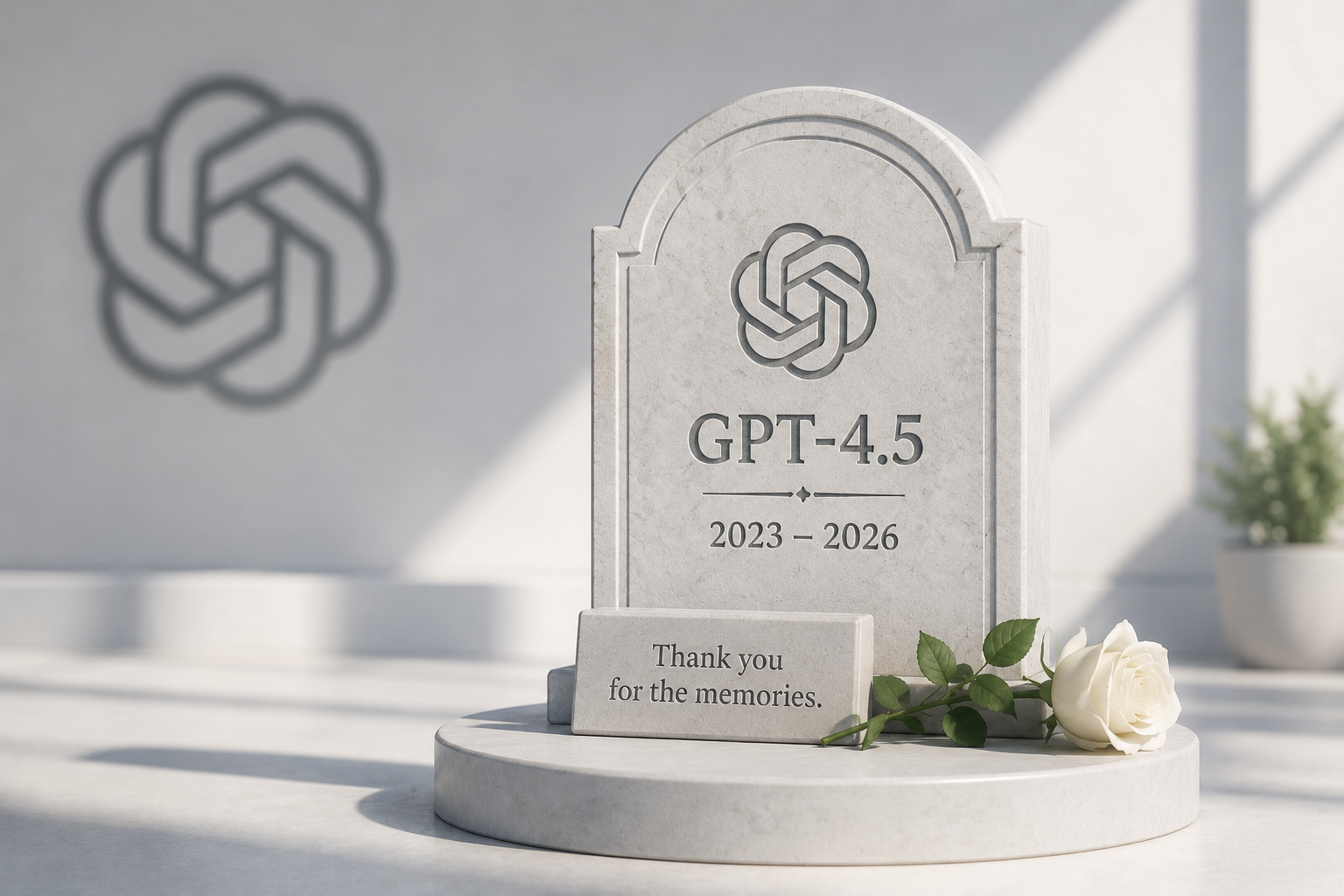
OpenAI officially pulled the plug. GPT-4.5 retired from ChatGPT on June 27, 2026, ending a model run that lasted barely 15 months. A lot of users didn’t see it coming — however, if you’d been watching the developer forums and API deprecation notices, the signs had been there for weeks.
I’ve tracked enough of these model transitions to know they’re rarely as sudden as they feel. This one was no different. Nevertheless, the timing raises real questions about cost, performance, and where frontier AI companies are actually heading.
So what happened? More importantly, what does it mean for developers, businesses, and everyday ChatGPT users who’d built habits — or entire products — around GPT-4.5?
Why GPT-4.5 Retired From ChatGPT on June 27, 2026
The Business Logic Behind Model Deprecation Cycles
Cost-Per-Inference Economics That Sealed GPT-4.5’s Fate
The Shift Toward Specialized Agents and Reasoning Models
What This Means for Developers and Enterprise Users
Why GPT-4.5 Retired From ChatGPT on June 27, 2026
The short answer is economics. The longer answer involves a perfect storm of technical limits, competitive pressure, and strategic shifts that had been building for months.
Performance plateaus hit hard. GPT-4.5 launched in early 2025 as an “emotionally intelligent” model — and honestly, that framing was accurate. It excelled at creative writing, nuanced conversation, and cutting hallucinations. However, benchmark gains over GPT-4o were modest at best. Specifically, improvements on reasoning tasks like MMLU and HumanEval were incremental rather than dramatic. Incremental doesn’t justify the price tag. To put a concrete number on it: GPT-4.5 scored only two to three percentage points higher than GPT-4o on several standard reasoning benchmarks — meaningful in a research context, but not the kind of leap that justifies a significant cost premium in a commercial product.
Cost-per-inference was unsustainable. This surprised me when I first dug into the numbers. GPT-4.5 was one of the most expensive models OpenAI ever deployed — developers reported API costs running significantly higher than GPT-4o for comparable tasks. A small startup running a customer-support chatbot on GPT-4.5, for example, might have been paying three to four times what a comparable GPT-4o deployment would cost for nearly identical output quality. Consequently, keeping it running alongside newer, more efficient models didn’t make financial sense for anyone involved.
Several factors converged to make retirement inevitable:
- Diminishing user adoption — most ChatGPT Plus subscribers had already moved to GPT-4o or the newer reasoning models without much prompting
- Infrastructure strain — running multiple frontier models at once taxes even OpenAI’s massive compute fleet
- Strategic redirection — resources needed to shift toward specialized agents and the o-series reasoning models
- Competitive pressure — Anthropic’s Claude and Google’s Gemini were closing capability gaps fast
Moreover, OpenAI had already begun the transition months earlier. By late May 2026, the OpenAI developer forum was packed with migration guides and anxious threads from developers scrambling to adapt. The writing was on the wall — in bold, underlined, and highlighted.
The Business Logic Behind Model Deprecation Cycles
When GPT-4.5 retired from ChatGPT on June 27, 2026, it followed a pattern OpenAI has repeated before. I’ve seen this play out a few times now, and understanding the pattern helps you predict what’s coming next.
Model deprecation isn’t new. OpenAI retired GPT-3.5 Turbo variants, sunset specific GPT-4 snapshots, and phased out earlier completion endpoints. Each time, the company gave a deprecation window. Each time, some developers scrambled anyway. Fair warning: if you’re not subscribed to their deprecation notices, you’ll always be caught off guard.
The business logic comes down to three pillars:
- Compute allocation — every retired model frees GPU hours for newer, higher-priority systems
- Maintenance burden — older models need ongoing safety patches, monitoring, and alignment updates that add up fast
- Brand clarity — too many model options confuse users and dilute the product experience
Additionally, there’s a less obvious factor at play. Model consolidation simplifies OpenAI’s safety work. Fewer active models mean fewer attack surfaces — and that matters enormously as NIST’s AI Risk Management Framework pushes companies toward stricter governance. It’s not glamorous, but it’s real. Every additional model in production requires its own red-teaming cycles, adversarial testing, and ongoing monitoring for new jailbreak patterns. Retiring GPT-4.5 eliminated an entire maintenance track that was consuming engineering hours without delivering proportional value.
Here’s how recent OpenAI model retirements compare:
| Model | Launch | Retirement | Active Lifespan | Primary Reason |
|---|---|---|---|---|
| GPT-3.5 Turbo (0301) | March 2023 | June 2024 | ~15 months | Superseded by newer snapshots |
| GPT-4 (0314) | March 2023 | June 2024 | ~15 months | Consolidated into GPT-4 Turbo |
| GPT-4 Turbo (preview) | November 2023 | Mid-2024 | ~8 months | Replaced by stable release |
| GPT-4.5 | Early 2025 | June 27, 2026 | ~15 months | Cost, performance plateau, strategic shift |
Notably, that ~15-month lifespan keeps showing up. It’s not a coincidence — it looks more like a deliberate planning horizon. Developers should absolutely build with that window in mind for any new model they adopt today. Think of it as a forcing function: if your architecture can’t swap out a model within a sprint or two, you’ve already accumulated technical debt that will hurt you at the next deprecation.
Cost-Per-Inference Economics That Sealed GPT-4.5’s Fate
The economics of running GPT-4.5 were brutal. Full stop.
GPT-4.5 used a dense transformer structure — and unlike mixture-of-experts (MoE) models, where only a fraction of parameters activate per query, GPT-4.5 fired on all cylinders for every single inference. Every query. Every time. That’s extremely expensive at any scale, let alone ChatGPT’s scale.
What does “cost-per-inference” actually mean? It’s the total expense to process one user query — GPU compute time, memory bandwidth, electricity, cooling, the works. For dense models with massive parameter counts, these costs stack up fast. Furthermore, the math gets genuinely painful at scale. ChatGPT serves hundreds of millions of users. Even a small per-query cost difference multiplies into millions of dollars monthly. Therefore, when newer models hit similar or better results at lower cost, the older model stops being a product and starts being a liability.
Here’s a practical illustration: imagine a legal tech company running contract-review summaries through GPT-4.5 at roughly 2,000 tokens per query, processing 50,000 documents a month. At GPT-4.5’s reported pricing, that workload could cost two to three times more than the equivalent GPT-4o run — with output quality that their own evaluation suite rated as statistically indistinguishable. That’s the kind of real-world arithmetic that makes model retirement decisions easy.
The shift toward MoE structures changed everything:
- GPT-4o used a more efficient design, delivering comparable quality at meaningfully lower cost
- The o-series reasoning models (o1, o3, o4-mini) offered better performance on the specific tasks where GPT-4.5 was supposedly strongest
- Distilled models captured much of GPT-4.5’s capability in smaller, cheaper packages that actually made sense to deploy
Importantly, this connects directly to OpenAI’s custom silicon strategy — something I don’t think gets enough coverage. The company has been investing in purpose-built inference chips built for newer designs, not legacy dense models. Consequently, GPT-4.5’s retirement from ChatGPT on June 27, 2026 also reflected a hardware shift happening beneath the surface. When your infrastructure roadmap is optimized for MoE-friendly architectures, keeping a dense model alive means running it on hardware that isn’t designed for it — which compounds the cost problem further.
As The Information has reported, OpenAI’s infrastructure costs remain one of its biggest ongoing challenges. Retiring costly models isn’t optional — it’s survival arithmetic.
The Shift Toward Specialized Agents and Reasoning Models
Here’s the thing: perhaps the most significant reason GPT-4.5 retired from ChatGPT on June 27, 2026 isn’t about cost at all. It’s strategic. OpenAI is moving away from large general-purpose models toward specialized agents — and GPT-4.5 simply didn’t fit the new direction.
What are specialized agents? They’re AI systems built for specific task types. Rather than one model doing everything adequately, multiple focused models handle different jobs well. Think of it as the difference between a Swiss Army knife and a professional toolkit. I’ve tested dozens of AI systems built around both approaches, and the specialized one wins on quality almost every time.
A concrete example makes this tangible. Ask GPT-4.5 to debug a recursive algorithm, draft a marketing email, and summarize a legal brief — it handles all three reasonably well. Ask o4-mini to debug that same algorithm, and it doesn’t just find the bug; it explains the logic error, suggests a more efficient approach, and flags edge cases you hadn’t considered. Specialization produces that kind of depth, and depth is what enterprise customers are actually paying for.
This shift shows up clearly across the product lineup:
- o4-mini handles coding and math reasoning with strong efficiency
- Operator and deep research agents tackle complex, multi-step workflows on their own
- GPT-4o stays the general-purpose workhorse for everyday conversation
- Custom GPTs let users build task-specific tools without touching the underlying model at all
Similarly, competitors have fully embraced this approach. Anthropic built Claude with strong tool-use capabilities. Google DeepMind wove Gemini into agentic workflows across Workspace. The industry view is clear: the future isn’t bigger models — it’s smarter use of specialized ones.
GPT-4.5 didn’t fit this new direction. It was built as a generalist. Its emotional intelligence and lower hallucination rates — however genuinely impressive at launch — have since been distilled into newer, more efficient systems that don’t carry the same overhead.
Meanwhile, OpenAI’s API documentation now actively steers developers toward task-appropriate model choices. The OpenAI platform docs include detailed guidance on picking between models based on latency, cost, and capability needs. GPT-4.5 simply wasn’t the right pick for any category anymore. And when a model can’t win a single category? That’s retirement territory.
What This Means for Developers and Enterprise Users
The real kicker here is practical. The fact that GPT-4.5 retired from ChatGPT on June 27, 2026 has genuine consequences — and if you built products on this model, you need a migration plan yesterday.
For API developers, the impact is immediate. Any app hardcoded to the GPT-4.5 model endpoint will break. OpenAI typically routes deprecated model calls to a successor, but behavior differences can introduce subtle bugs that are annoying to track down. A prompt that reliably produced structured JSON output from GPT-4.5, for instance, might return slightly different formatting from GPT-4o — not wrong, but different enough to break a downstream parser. Additionally, pricing structures shift with each model generation, so your cost projections may need a rethink.
Here’s a practical migration checklist:
- Audit your codebase — search for any hardcoded model references to GPT-4.5
- Test with GPT-4o or o4-mini — run your full evaluation suite against replacement models before committing
- Compare output quality — pay special attention to creative writing and nuanced instructions, where differences are most noticeable
- Update system prompts — newer models may read instructions differently than you’d expect
- Monitor costs — replacement models are generally cheaper, but verify against your actual usage patterns
- Review rate limits — different models carry different throughput allowances that could affect your setup
For enterprise customers, this retirement reinforces an important lesson I’ve been repeating for years. Don’t build critical infrastructure around a single model version. Abstract your AI layer — use model-agnostic middleware that lets you swap backends without rewriting application logic from scratch. It’s extra work upfront, but it’s a no-brainer when you’re staring down a deprecation deadline. A practical approach is to wrap all model calls in a single internal service with a standardized interface, so swapping GPT-4.5 for GPT-4o is a one-line configuration change rather than a two-week refactor.
Conversely, some enterprises may actually benefit from this change. If you were paying premium prices for GPT-4.5 API access, switching to GPT-4o could cut costs meaningfully while maintaining quality. Furthermore, enterprise agreements with OpenAI typically include deprecation timelines worth reviewing carefully — some agreements guarantee extended access windows beyond the public retirement date. The OpenAI enterprise page has details on support tiers worth bookmarking.
For casual ChatGPT users? Honestly, the impact is minimal. Most users won’t even notice. ChatGPT’s interface automatically routes conversations to the best available model — you’ll still get great responses, just from a different engine under the hood.
Predicting the Next Wave of Model Retirements
Now that GPT-4.5 has retired from ChatGPT as of June 27, 2026, the obvious question is: what’s next on the chopping block?
Based on the patterns I’ve watched play out over the last several years, a few predictions seem reasonable — though notably, this industry has a way of surprising everyone.
GPT-4o will eventually face the same fate. Although it’s currently OpenAI’s most popular model, its design will age. When GPT-5 or its successors fully mature, GPT-4o’s days will be numbered. The ~15-month retirement window points to a potential sunset in late 2026 or early 2027. Mark your calendar.
The o-series will consolidate. OpenAI currently offers o1, o3, o3-pro, and o4-mini — that’s a lot of reasoning model variants to keep running at once. Expect older versions to be retired as newer ones absorb their strengths. The most likely candidates for early retirement are the middle-tier variants: o1 and o3 will probably be squeezed out as o4-mini covers the cost-sensitive end and a future o5 or equivalent covers the high-capability end. Moreover, specialized agents will multiply before they consolidate — right now OpenAI is expanding its agent lineup fast, but eventually the same economic pressures that retired GPT-4.5 will force agent consolidation too. It always works this way.
Notably, this lifecycle pattern isn’t unique to OpenAI. Google has retired multiple Bard and Gemini model versions. Anthropic has sunset older Claude variants. The entire industry runs on a “launch, iterate, retire” cycle — and it’s speeding up, not slowing down.
How should you prepare? Three strategies that actually work:
- Build abstraction layers — never tie your application directly to a specific model version, full stop
- Maintain evaluation benchmarks — so you can quickly assess replacement models against your specific use cases when the time comes
- Subscribe to deprecation notices — OpenAI, Anthropic, and Google all offer developer newsletters with advance warning, and there’s no excuse for being caught flat-footed
The retirement of GPT-4.5 isn’t an anomaly. It’s the new normal. Models are becoming more like software releases — versioned, time-limited, and replaceable. Treating them as permanent fixtures is a recipe for disruption, and I’ve seen too many engineering teams learn that lesson the hard way. The teams that handle these transitions smoothly aren’t the ones with the best engineers — they’re the ones who planned for impermanence from the start.
Conclusion
The story of GPT-4.5 retired from ChatGPT on June 27, 2026 is ultimately about evolution — sometimes uncomfortable, always inevitable. Performance plateaus, unsustainable inference costs, and the rise of specialized agents made this retirement a matter of when, not if. OpenAI chose efficiency and strategic focus over legacy support, and honestly, it’s hard to argue with the logic.
For developers, the actionable takeaway is clear: abstract your AI dependencies, test against multiple models regularly, and subscribe to OpenAI’s deprecation calendar before deadlines become your problem.
For businesses, this event reinforces a principle worth writing somewhere visible. AI model selection is an ongoing process, not a one-time decision. The model you choose today will be retired tomorrow — build your systems accordingly, or keep paying the scramble tax.
For the broader AI community, the moment that GPT-4.5 retired from ChatGPT on June 27, 2026 marks something genuinely significant. We’re past the era of treating each new model as a permanent fixture. We’re firmly in the era of managed model lifecycles, strategic deprecation, and continuous migration. The sooner you accept that reality, the less painful the next retirement will be.
FAQ
Why did OpenAI retire GPT-4.5 from ChatGPT on June 27, 2026?
OpenAI retired GPT-4.5 due to a mix of high inference costs, modest performance gains over alternatives, and a strategic shift toward specialized reasoning models and agents. Keeping a costly dense model running alongside more efficient options simply wasn’t sustainable. Additionally, the company needed to redirect compute resources toward newer priorities — specifically the o-series and agentic tools that better fit where the product is heading.
Will my ChatGPT conversations be affected now that GPT-4.5 is retired?
Most users won’t notice any difference. ChatGPT automatically routes your queries to the best available model, so you’ll still get high-quality responses — simply from GPT-4o, o4-mini, or another active model. However, if you specifically relied on GPT-4.5’s creative writing style, you may notice subtle differences in tone. It’s worth a few test prompts to see how the transition feels for your particular use case.
What model should developers migrate to after GPT-4.5’s retirement?
It depends on your use case — and that’s not a cop-out, it’s genuinely the right answer. GPT-4o is the best general-purpose replacement for most applications. For coding and math-heavy tasks, o4-mini offers stronger reasoning at lower cost. For complex multi-step workflows, consider OpenAI’s agentic tools. Importantly, test your specific prompts against multiple models before committing to one — don’t assume the migration will be clean. If your application handles mixed workloads, it may be worth routing different request types to different models rather than picking a single replacement.
How much notice did OpenAI give before GPT-4.5 retired from ChatGPT on June 27, 2026?
OpenAI gave several weeks of advance notice through developer emails, API dashboard announcements, and community forum posts — which follows their standard deprecation pattern. Nevertheless, some developers felt the timeline was too tight for complex migrations, and that’s a fair criticism. Enterprise customers with premium support agreements may have received earlier notification, so it’s worth checking your contract terms.
Is the ~15-month model lifespan a pattern at OpenAI?
Yes, and it’s notable enough that you should be planning around it. Multiple OpenAI models have followed roughly a 15-month lifecycle from launch to retirement. GPT-3.5 Turbo (0301), GPT-4 (0314), and now GPT-4.5 all fit this window. Therefore, developers should treat 12–18 months as a reasonable planning horizon for any new model they adopt — and build their systems with that assumption in from day one.
Could GPT-4.5 come back in a different form?
Not directly — but its best qualities almost certainly live on. Key strengths from GPT-4.5, particularly its lower hallucination rates and emotional intelligence, have likely been distilled into newer models already. Model distillation lets OpenAI transfer knowledge from larger models into smaller, more efficient ones without dragging along the cost overhead. So while GPT-4.5 itself won’t return, you’re probably already benefiting from what it taught its successors.
Keep reading
Here are the latest posts from the blog.
Onsemi acquires Synaptics in a $7B bet on physical AI edge computing, and honestly, the implications are bigger than most people realize. This isn’t just another semiconducto…

The world of edge AI vision sensors hardware acceleration inference is evolving fast. Cameras aren’t just capturing images anymore. They’re thinking, deciding, and acting — a…

NVIDIA NemoClaw Isaac Sim lets developers talk to robots using plain English instead of wrestling with complex code. That single shift changes everything. Forget joysticks, f…