When automakers talk about “self-driving” and “autonomous” vehicles, they’re often describing wildly different things. Tesla calls its software Full Self-Driving. Waymo operates robotaxis with no safety driver. Most cars on the road still demand your complete attention. These products share a category name and almost nothing else.
The gap between a car that assists you and one that genuinely doesn’t need you isn’t just significant — it’s enormous. And understanding where that gap falls matters more than ever as autonomy claims multiply faster than the technology behind them.
The answer lives inside a technical standard most people have never read: SAE J3016, which defines six distinct levels of driving automation. Within that framework, Level 4 autonomy represents the specific threshold where a car truly stops needing you. I’ve spent years tracking how these definitions play out against real-world deployments, and the gap between marketing language and technical reality is consistently wider than most people expect.
The Six Levels That Define Autonomy
The Society of Automotive Engineers created J3016 to give the industry shared vocabulary. Every automaker, regulator, and technology company references this framework — it’s the closest thing to a universal rulebook for autonomy claims.
The standard defines Levels 0 through 5, and the defining question at each level is who handles the driving task and who monitors the environment. That distinction is everything.
Level 0 — No Automation: The human does everything. Warning systems like lane departure alerts may exist but don’t control the vehicle.
- Level 1 — Driver Assistance: The car handles either steering or acceleration and braking, but not both simultaneously. Adaptive cruise control is the classic example.
- Level 2 — Partial Automation: The car manages steering and speed together. The human must monitor everything and stay ready to intervene instantly.
- Level 3 — Conditional Automation: The car drives and monitors the environment. It will ask the human to take over when conditions exceed its capabilities.
- Level 4 — High Automation: The car drives itself completely within defined conditions. No human intervention is needed. If it can’t handle a situation, it pulls over safely on its own.
- Level 5 — Full Automation: The car drives everywhere, in all conditions. No steering wheel required. This level doesn’t exist yet in any commercial vehicle.
| Feature | Level 2 | Level 3 | Level 4 | Level 5 |
|---|---|---|---|---|
| Who drives? | Car assists | Car drives | Car drives | Car drives |
| Who monitors? | Human | Car | Car | Car |
| Human fallback needed? | Always | Sometimes | Never (in ODD) | Never |
| Steering wheel required? | Yes | Yes | Not necessarily | No |
| Available today? | Yes | Limited | Limited | No |
| Example | Tesla Autopilot | Mercedes Drive Pilot | Waymo One | None yet |
The standard draws a clear line between Levels 2 and 3: below that line, the human is always the fallback. Above it, the car takes responsibility. The truly transformative leap, though, happens at Level 4 autonomy — and most people don’t appreciate how different that actually feels until they’ve sat in a robotaxi with no safety driver present.
Where Today’s Vehicles Actually Fall
Marketing claims and technical reality rarely align. Understanding where current vehicles sit requires looking past the brochures — and sometimes past the headlines.
Tesla Full Self-Driving is perhaps the most misunderstood product on the market. Despite the name, FSD operates at Level 2. The driver must keep hands on the wheel and eyes on the road at all times — Tesla’s own documentation confirms this. The system handles city streets, makes turns, and stops at traffic lights, but if something goes wrong, the human bears full responsibility. That single characteristic places it squarely at Level 2, regardless of what the marketing calls it.
Mercedes-Benz Drive Pilot made history by becoming the first Level 3 certified system available to consumers. It works on specific highways at speeds below 40 mph in certain weather conditions. The driver can legally look away from the road, which the first time you experience it feels genuinely surreal. Mercedes also accepts liability when Drive Pilot is engaged — a distinction most coverage buries, but which represents a massive legal and technical commitment.
Waymo One operates what many consider the closest thing to true Level 4 autonomy available today. Its robotaxis carry passengers in Phoenix, San Francisco, Los Angeles, and Austin without a human safety driver. The vehicles operate within carefully mapped geographic areas called Operational Design Domains — and if they encounter something outside their capabilities, they stop safely on their own. No human takeover is expected or possible. Waymo’s safety record within defined zones has been genuinely impressive.
Cruise, General Motors’ autonomous vehicle subsidiary, also pursued Level 4 operations before a serious pedestrian incident in late 2023 forced the company to pause its robotaxi service and face significant regulatory scrutiny. That situation reveals something important: reaching Level 4 autonomy technically doesn’t guarantee safe deployment at scale. The gap between “it works in testing” and “it works reliably across millions of rides” is where things get genuinely hard — and where the most consequential engineering decisions live.
Most consumer vehicles sit at Level 2. A handful reach Level 3 in narrow conditions. Only a few robotaxi services approach Level 4 within strict geographic boundaries. The distance between those categories is far larger than a numbered list suggests.
Level 4 Autonomy: What Actually Changes
Level 4 is where the fundamental relationship between human and machine inverts. It deserves more examination than it usually gets.
At Levels 0 through 2, you’re always the driver — the car helps, but you’re in charge. At Level 3, you can briefly step away mentally, but you must be ready to resume control on short notice. Level 4 autonomy eliminates that requirement entirely, within defined operating conditions.
That phrase “within defined operating conditions” is doing significant work, and understanding it is key to understanding what Level 4 actually means in practice.
The Operational Design Domain (ODD) defines exactly where and when the autonomous system works. It might
- specify geographic areas such as mapped city zones,
- speed limits like under 65 mph,
- weather conditions excluding heavy snow or dense fog,
- road types covering only highways or only urban streets,
- and time-of-day restrictions like daytime operations only.
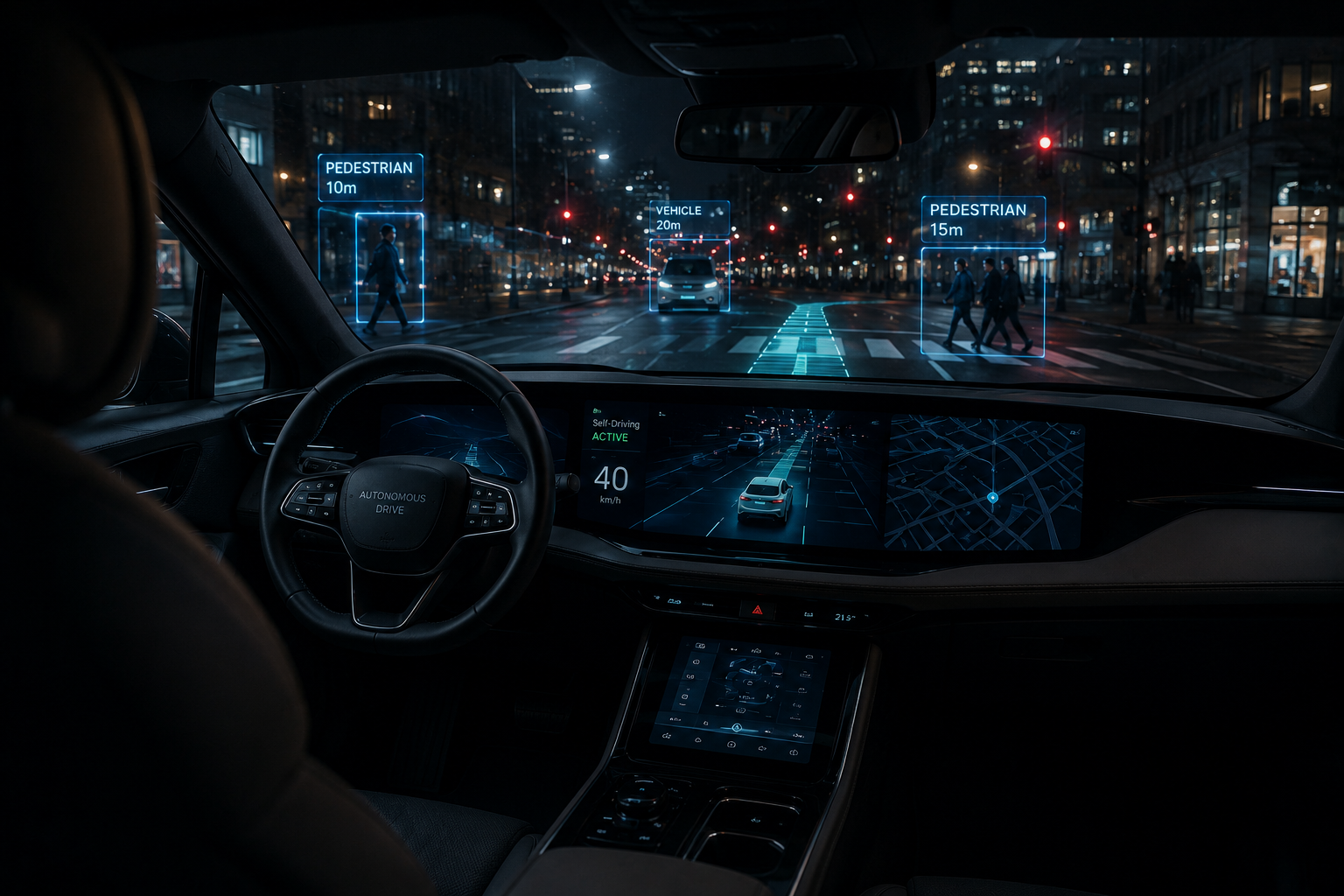
Within its ODD, a Level 4 vehicle handles everything. It perceives, decides, and acts. If a child runs into the street, the car brakes. If construction blocks the road, the car reroutes. If a sensor fails, the car pulls over safely. No human input is needed at any point — and that’s the threshold that defines Level 4 autonomy.
The exact line isn’t just about technology sophistication. It’s about responsibility. At Level 4, the manufacturer or operator — not you — bears responsibility for the driving task. That’s a seismic legal and ethical shift, not just a technical one.
Outside the ODD, a Level 4 vehicle simply won’t operate autonomously. A Waymo robotaxi won’t drive itself down an unmapped rural road. It knows its limits. That self-awareness is actually what makes Level 4 safer than systems that chronically overestimate their own capabilities — a problem that Level 2 systems with aspirational branding demonstrate regularly.
Why Level 4 matters more than Level 5 right now:
- Level 5 requires autonomy everywhere, in all conditions — which is likely decades away, if it’s achievable at all.
- Level 4 autonomy solves real problems today: urban mobility, last-mile delivery, and accessible transportation for people who can’t drive.
- Regulators can approve Level 4 systems for specific areas without having to solve every conceivable edge case first.
- Commercial viability exists within defined zones.
McKinsey estimates autonomous driving could generate hundreds of billions in revenue by 2035, and most of that value will come from Level 4 deployments, not Level 5 ambitions.
The Engineering Gap Between Level 3 and Level 4
The jump from Level 3 to Level 4 autonomy is arguably the hardest engineering challenge in automotive history. Both levels let the car drive itself, but the requirements differ dramatically — and the cost difference alone would surprise most people.
Redundancy is non-negotiable at Level 4. Every critical system needs a backup. Steering, braking, computing, power supply, sensors — all must have fail-safe alternatives. If the primary lidar fails, a secondary system takes over immediately. If the main computer crashes, a backup assumes control in milliseconds. This redundancy adds enormous cost and complexity. It’s also why Level 4 vehicles currently look like rolling sensor arrays rather than normal cars.
Sensor fusion becomes exponentially harder as autonomy requirements climb. Level 4 vehicles typically combine
- multiple lidar units for laser-based 3D mapping,
- radar sensors for detecting speed and distance,
- high-resolution cameras for visual recognition,
- ultrasonic sensors for close-range detection,
- high-definition pre-mapped route data, and GPS with inertial measurement units for precise positioning.
All of these inputs must agree in real time. When they conflict — and they frequently do — the system must decide which data to trust. This sensor fusion challenge is why companies like Waymo have spent billions on development over more than a decade. It’s not the individual sensors that are hard. It’s making them agree reliably under pressure, at speed, in conditions the system has never encountered before.
Edge cases are the real enemy. An edge case is an unusual scenario the system hasn’t encountered before. A mattress on the highway. A traffic officer waving cars through a red light. A construction worker holding a stop sign while walking backward. Humans handle these situations by instinct, drawing on years of lived experience. Teaching machines to handle them reliably is extraordinarily difficult — and each edge case you solve tends to reveal three more you hadn’t considered.
Software validation requirements are immense. The RAND Corporation published research suggesting autonomous vehicles would need to drive hundreds of billions of miles to statistically demonstrate they’re safer than human drivers. That’s why simulation testing has become essential — companies run millions of simulated miles daily to supplement real-world data, but simulation has its own limits when reality keeps producing scenarios the simulator didn’t model.
The liability question shapes everything. At Level 3, the human remains a fallback, so liability can shift between driver and manufacturer depending on whether the system requested a handoff. At Level 4 autonomy, the manufacturer or operator accepts full liability during autonomous operation. That’s a massive legal and financial commitment, which explains why even automakers with technical capability proceed with real caution. The engineering readiness and the willingness to accept legal exposure are two separate thresholds, and both have to clear before deployment.
The Regulatory Picture
Technology alone doesn’t determine when Level 4 vehicles reach your city. Regulations play an equally important role, and the regulatory landscape deserves more attention than it typically gets in technology coverage.
In the United States, regulation happens at federal and state levels simultaneously. The National Highway Traffic Safety Administration sets federal motor vehicle safety standards, but states control licensing, registration, and operational permits for autonomous vehicles. This creates a patchwork of rules that varies enormously by location.
- California has the most developed regulatory framework. The DMV issues permits for autonomous vehicle testing and deployment, and Waymo operates under these permits today.
- Arizona has historically been welcoming to autonomous vehicle testing, with fewer restrictions attracting major programs.
- Texas has relatively permissive laws, allowing autonomous vehicle operation without specific permits in many cases.
- Several states still lack clear autonomous vehicle legislation, creating genuine uncertainty for manufacturers planning expansion.
Europe takes a different approach. The United Nations Economic Commission for Europe has established international regulations that many countries adopt. Mercedes’ Level 3 system was first approved under these frameworks. Level 4 regulations across Europe remain limited and fragmented, though this is evolving.
China is moving aggressively. Baidu’s Apollo Go robotaxi service operates in multiple Chinese cities, and the Chinese government has created dedicated autonomous driving zones with streamlined approval processes. China’s approach to data collection and mapping also gives domestic companies structural advantages that Western competitors don’t have access to.
The core regulatory challenge for Level 4 autonomy comes down to one genuinely hard question: how do you certify that a car truly doesn’t need a human? There’s no universally accepted testing standard yet. Each jurisdiction develops its own rules independently, which slows deployment considerably. The regulatory lag consistently surprises people who assume the technology is the bottleneck — often, the technology is ahead of the rules governing it.
Insurance frameworks also need to evolve. Traditional auto insurance assumes a human driver. Level 4 vehicles need product liability coverage instead, and insurers are still building the models to price that risk accurately.
Most analysts now expect
- robotaxi services to expand to 20 or more US cities by 2027,
- consumer Level 4 vehicles on highways by 2028 to 2030,
- and broader Level 4 availability in urban areas by 2032 to 2035.
These timelines could shift based on technology breakthroughs, regulatory changes, or high-profile incidents that affect public trust — and public trust is a variable that engineering progress alone can’t control.
Conclusion
Understanding the SAE framework gives you the vocabulary to evaluate autonomy claims accurately, which in the current market is a genuinely useful skill.
A few concrete recommendations:
- Know what your car actually does. Read the owner’s manual carefully. Most people assume their car’s capabilities are either higher or lower than they actually are. Knowing the SAE level — which takes about 30 seconds to look up — tells you exactly what the system can and cannot do, and more importantly, who’s responsible when something goes wrong.
- Don’t trust marketing names. “Full Self-Driving” doesn’t mean fully self-driving. “Autopilot” doesn’t mean the car is flying itself. These names describe Level 2 systems that require constant human supervision. The branding exists in a different universe from the technical standard.
- Track Waymo’s expansion. It’s the clearest real-world indicator of Level 4 autonomy progress in the US. When Waymo enters a new city, it signals that regulators, operators, and the technology have aligned sufficiently for commercial deployment. That’s a meaningful data point.
- Follow NHTSA announcements for updates on federal autonomous vehicle policy. Federal standards will eventually establish a floor for what Level 4 deployment requires nationwide, and the shape of those standards will affect deployment timelines significantly.
- Watch state legislation in your area. Local laws will determine when autonomous vehicles arrive in your community more than any technology announcement will. A breakthrough in sensor fusion doesn’t help if your state hasn’t issued deployment permits.
The conversation around autonomous vehicles will only intensify as technology advances and more deployments accumulate safety records. The SAE framework — and specifically the distinction that Level 4 autonomy represents — is the tool that lets you cut through the hype and evaluate real progress. The future of driving is autonomous, but knowing exactly where the meaningful threshold falls keeps you informed today and safe in the meantime.
FAQ
What is the difference between Level 3 and Level 4 autonomy?
At Level 3, the car drives itself but expects you to take over when it asks. You must stay alert and ready to intervene. At Level 4 autonomy, the car handles everything within its defined operating conditions and resolves any problems on its own — typically by pulling over safely. The critical difference is that Level 4 never needs human intervention during autonomous operation, and liability shifts entirely from driver to manufacturer or operator as a result.
Is Tesla Full Self-Driving actually Level 4?
No. Despite the name, Tesla FSD operates at SAE Level 2. The driver must keep hands on the wheel and stay attentive at all times. Tesla’s system provides advanced driver assistance, not autonomous driving. Although Tesla has stated ambitions to reach higher autonomy levels, its current software requires constant human supervision. The “Full Self-Driving” branding has been widely criticized as misleading by safety advocates and regulators alike.
Where can I ride in a Level 4 autonomous vehicle today?
Waymo One offers Level 4 autonomy robotaxi rides in Phoenix, San Francisco, Los Angeles, and Austin. These vehicles operate without a human safety driver in designated service areas. Several Chinese cities also offer autonomous robotaxi services through companies like Baidu Apollo Go. Availability is limited to specific geographic zones — you can’t currently buy a Level 4 vehicle for personal use.
How does a Level 4 car handle emergencies without a driver?
Level 4 vehicles are built with extensive redundancy. If a critical system fails, backup systems take over immediately. If the car encounters a scenario it can’t handle — severe weather, an unmapped road — it executes what’s called a minimal risk condition, typically pulling safely to the side of the road and stopping. It may also contact a remote operations center for guidance. The key point is that it never relies on a human occupant to resolve the situation.
When will Level 4 cars be available for consumers to buy?
Most analysts expect consumer-grade Level 4 vehicles to become available between 2028 and 2030, starting with highway driving. Broader urban Level 4 capability will likely follow in the early 2030s. These vehicles will initially cost significantly more than traditional cars due to the extensive sensor arrays and computing hardware required — Level 4 autonomy will appear as a premium feature on luxury vehicles before reaching mainstream models.
Why is Level 5 autonomy so much harder than Level 4?
Level 5 requires the car to drive anywhere a human could, in any condition — unmapped dirt roads, heavy blizzards, flooded streets, chaotic construction zones. It must handle every possible edge case without geographic or environmental limits. Level 4 autonomy avoids this impossibly broad requirement by defining specific operating conditions where the system works reliably. Many researchers question whether true Level 5 is achievable with current sensor and computing approaches. The gap between “works reliably in a defined zone” and “works reliably everywhere” is far larger than most people realize.
Keep reading
Here are the latest posts from the blog.

There’s a supply chain story unfolding in the semiconductor industry that most people outside it haven’t fully absorbed — and it’s determining who wins the AI hardware race m…

Light moves faster than electrons. It generates less heat. It consumes dramatically less power. Those three facts have been true for decades, but only recently has the engine…

Every robotics team hits the same wall eventually. They need massive amounts of training data, and collecting it the traditional way is brutally expensive — in time, money, a…