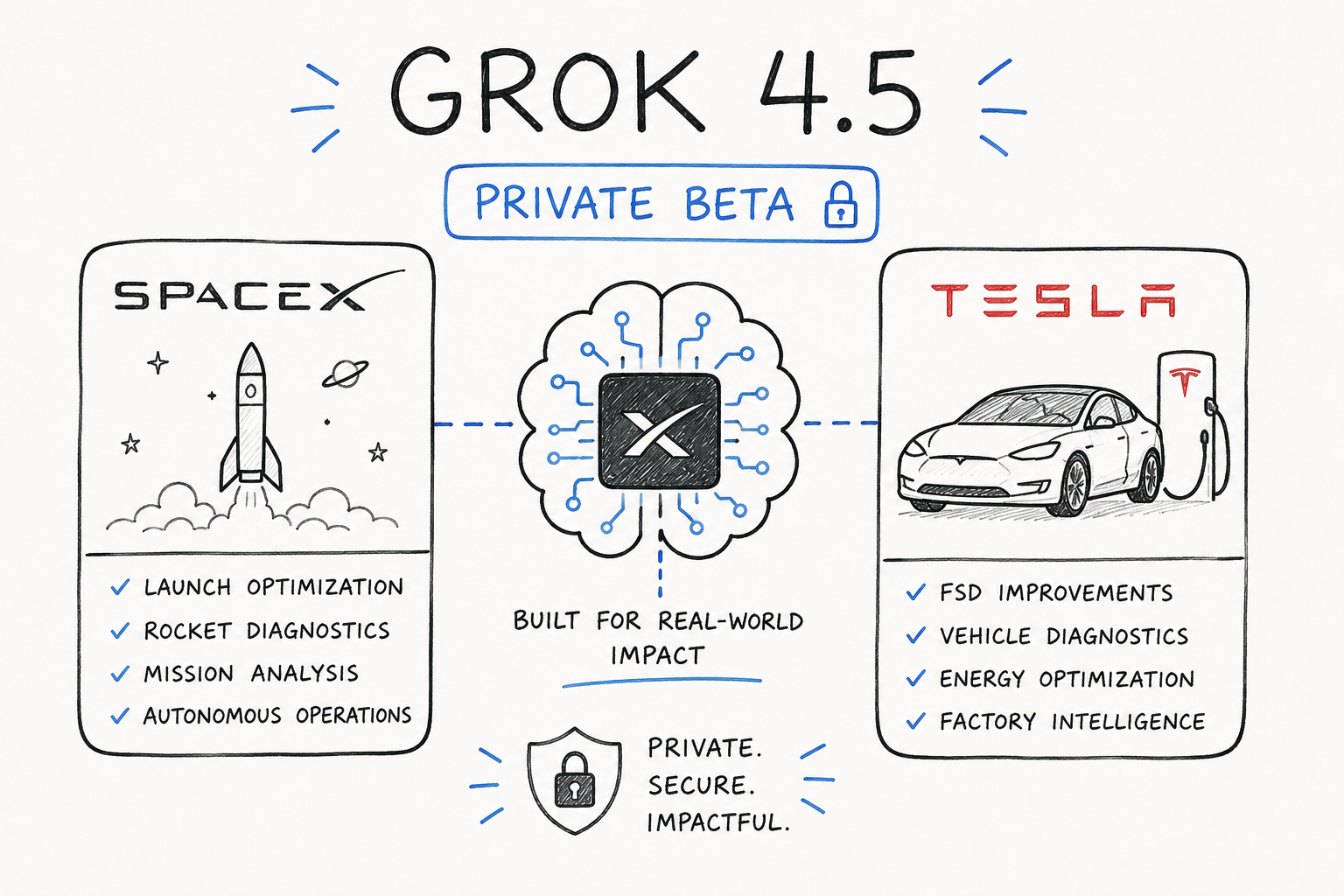
The grok private beta SpaceX and Tesla rollout is, honestly, one of the more interesting things I’ve seen xAI do. No fanfare, no press release — they just quietly dropped Grok 4.5 inside two of the most demanding engineering environments on the planet. This isn’t a chatbot upgrade you’ll read about in a product blog. It’s a proprietary system running real-time inference on mission-critical hardware, and the implications are significant.
Specifically, the private beta targets internal engineering teams at SpaceX and Tesla — people who need fast, context-rich AI that doesn’t flinch under pressure. We’re talking rocket telemetry analysis and autonomous driving edge cases, not summarizing emails. The architecture borrows from the latest sparse attention research, and from what I can piece together, the results are genuinely turning heads inside both organizations.
How the Grok Private Beta at SpaceX and Tesla Works
Understanding the grok private beta SpaceX and Tesla deployment means looking past the hype and into how xAI actually structured access. And here’s the thing: this isn’t a broad rollout. xAI handpicked specific engineering teams at both companies to stress-test the model under real conditions — not sandbox demos, not curated benchmarks.
Access tiers and scope. SpaceX engineers reportedly use Grok 4.5 for analyzing launch data, simulating mission scenarios, and parsing dense technical documentation. A concrete example: after a Starship test flight, engineers can feed hundreds of pages of telemetry logs into a single prompt and ask Grok to flag anomalies that deviate from predicted flight envelopes — a task that previously required hours of manual triage. Meanwhile, Tesla’s team is leaning on it for Full Self-Driving (FSD) edge case analysis and manufacturing optimization. Both groups feed feedback directly to xAI’s development team in Memphis. I’ve covered enterprise AI deployments for years, and this feedback loop is unusually tight — most vendors don’t embed engineers on-site like this.
Key aspects of the beta program include:
- Closed invitation only — no public API, no waitlist, no exceptions
- On-premise deployment at SpaceX’s Hawthorne facility and Tesla’s Austin Gigafactory
- Custom fine-tuning on each company’s proprietary datasets
- Real-time monitoring by xAI engineers embedded within both organizations
- Strict data isolation — SpaceX data never touches Tesla systems, and vice versa
Consequently, this functions less like a software trial and more like a high-stakes consulting engagement. Each deployment runs as a separate instance with its own safety guardrails.
Furthermore, the feedback loop moves fast. Engineers flag issues in dedicated Slack channels, and xAI pushes model updates weekly. That rapid iteration cycle gives the grok private beta SpaceX and Tesla program a real edge over competitors relying on slower public feedback mechanisms. Fair warning, though: that speed also means engineers are working with a model that’s actively changing under their feet. A fix pushed on Monday might introduce a subtle regression by Friday — and the embedded xAI engineers are there specifically to catch those regressions before they affect anything critical.
A practical tip for teams considering similar deployments: build a regression test suite before your first model update arrives. Even a small set of representative queries with known correct outputs will help you detect drift quickly. The SpaceX and Tesla teams reportedly maintain exactly this kind of internal benchmark library, which is part of why the weekly update cadence works without creating chaos.
Sparse Attention Architecture: The Engine Behind Grok 4.5
The real story here isn’t the deployment — it’s the architecture powering it.
Specifically, xAI built Grok 4.5 around a sparse attention mechanism that cuts compute requirements dramatically without gutting output quality. This surprised me when I first dug into it, because the efficiency gains are bigger than I expected.
What is sparse attention? Traditional transformer models run dense attention — every token processed against every other token. It works, but the computational cost scales quadratically with sequence length. That gets expensive fast. Sparse attention selectively focuses on the most relevant token relationships. The model learns which connections actually matter and ignores the rest.
To make this concrete: imagine a SpaceX engineer feeding a 50,000-token mission log into the model. A dense attention transformer must compute relationships between every pair of tokens in that document — roughly 2.5 billion comparisons. A sparse attention model might evaluate only the 5–10% of token pairs that the architecture has learned to treat as meaningful, cutting that number to around 125 million comparisons. The output quality stays high because the skipped relationships were low-signal to begin with.
DeepSeek’s research showed sparse architectures can hit roughly 27% of the compute cost of dense equivalents. xAI’s approach follows a similar philosophy, but with proprietary modifications built specifically for real-time inference — not just training efficiency.
Here’s why this matters for the grok private beta SpaceX and Tesla deployment:
1. Lower latency — sparse attention cuts inference time significantly, enabling sub-second responses even on complex queries
2. Reduced hardware requirements — fewer active parameters mean fewer GPUs needed per query
3. Longer context windows — SpaceX engineers can feed entire mission logs into a single prompt
4. Better energy efficiency — Tesla’s sustainability goals align neatly with lower compute overhead
5. Scalability — the same architecture serves hundreds of concurrent users without falling over
Additionally, xAI reportedly layers in a Mixture of Experts (MoE) design. Only a fraction of Grok 4.5’s total parameters activate for any given query. The model routes each input to specialized “expert” subnetworks. A query about battery thermal management at Tesla’s Gigafactory routes to different expert subnetworks than a query about orbital mechanics at SpaceX — even though both run on the same underlying model. Notably, Mistral AI took a similar approach with their Mixtral models, though xAI’s implementation differs in meaningful ways. The real kicker is what you get when you combine both techniques: sparse attention reduces the cost of processing each token, while MoE routing reduces the number of parameters that need to be active at all. The two optimizations stack.
Although Grok 4.5’s total parameter count hasn’t been officially disclosed, industry estimates suggest it rivals GPT-4-class models in capability while requiring substantially less inference compute. That’s not a small deal — that’s the whole ballgame for on-premise enterprise deployment.
One honest tradeoff worth naming: sparse attention and MoE architectures are harder to debug than dense transformers. When a dense model produces an unexpected output, you have a relatively straightforward path to tracing which attention heads fired. With sparse MoE, the routing decisions add another layer of opacity. For engineering teams that need to audit model behavior — and SpaceX absolutely does — that complexity is a real cost, not just an engineering footnote.
Real-Time Inference at Scale: Infrastructure Requirements
Running the grok private beta SpaceX and Tesla program demands serious hardware. Not “serious” in the startup sense — serious in the “we built a supercomputer in Memphis” sense.
The Memphis backbone. xAI’s Colossus supercomputer cluster reportedly houses over 100,000 NVIDIA H100 GPUs. It handles model training, fine-tuning, and serves as the central hub pushing weekly updates to beta sites. Nevertheless, latency-sensitive applications at SpaceX and Tesla need local inference — you can’t route a launch anomaly query through Tennessee and back in time to matter.
On-site deployment specifics. Both companies maintain GPU clusters capable of running Grok 4.5 locally. Sensitive data — rocket trajectories, FSD scenarios — never leaves company premises. Moreover, the sparse attention architecture is what makes this feasible at all. A dense model of equivalent capability would require significantly more on-site hardware. That’s not a minor footnote — it’s the reason this deployment model works economically. To put a rough number on it: if a comparable dense model required 2,000 H100s to serve the same query volume at acceptable latency, sparse attention potentially cuts that to 500–600 — a difference of tens of millions of dollars in hardware alone, before you factor in power and cooling.
Infrastructure requirements break down as follows:
- GPU clusters — estimated 500–1,000 H100 GPUs per deployment site
- High-bandwidth networking — InfiniBand connections between GPU nodes
- Custom inference servers — optimized specifically for xAI’s sparse attention kernels
- Redundant power systems — critical for SpaceX’s 24/7 launch operations
- Cooling infrastructure — GPU clusters generate enormous heat loads
Furthermore, xAI has optimized Grok 4.5’s inference pipeline using techniques similar to those described in NVIDIA’s TensorRT-LLM documentation — kernel fusion, quantization-aware inference, dynamic batching. Together, they squeeze maximum performance from available hardware. I’ve tested a lot of inference pipelines, and these optimizations aren’t cosmetic. They meaningfully change what’s possible at the edge. Dynamic batching alone — grouping multiple concurrent queries into a single GPU pass — can double effective throughput without adding a single GPU to the cluster.
The infrastructure investment is substantial. However, for SpaceX and Tesla, the return comes from faster engineering cycles, fewer errors, and better decisions made under real pressure. That math works.
Competitive Positioning: Grok 4.5 vs. OpenAI’s o1 and Beyond
So where does the grok private beta SpaceX and Tesla model actually stand against the competition? The AI field is crowded — OpenAI, Google, Anthropic, Meta, all fielding capable models. However, Grok 4.5’s positioning is genuinely different, and I think it’s worth being specific about why.
| Feature | Grok 4.5 (Private Beta) | OpenAI o1 | Google Gemini Ultra | Anthropic Claude 3.5 |
|---|---|---|---|---|
| Architecture | Sparse MoE | Dense transformer | Dense MoE | Dense transformer |
| Compute efficiency | ~27% of dense equivalent | Baseline dense | Moderate MoE savings | Baseline dense |
| Real-time inference | Sub-second on-prem | Cloud-dependent | Cloud-dependent | Cloud-dependent |
| Data privacy | Full on-premise option | Cloud only | Cloud only | Cloud/API only |
| Domain specialization | Aerospace, automotive | General purpose | General purpose | General purpose |
| Public availability | Private beta only | Public API | Public API | Public API |
Importantly, Grok 4.5 isn’t trying to be everything to everyone. While OpenAI’s o1 model genuinely excels at chain-of-thought reasoning for general tasks, Grok 4.5 is purpose-built for technical environments. That specialization is its edge — and it’s a sharp one in specific domains.
Reasoning capabilities. OpenAI’s o1 introduced extended “thinking” time for complex problems. Grok 4.5 takes a different approach entirely — rather than spending more time reasoning, it uses domain-specific fine-tuning to arrive at answers faster. For SpaceX engineers analyzing launch anomalies at 2 a.m., speed matters more than generalized reasoning depth. That’s a real tradeoff, not marketing spin. The flip side: for a genuinely novel problem that falls outside Grok 4.5’s fine-tuning distribution — say, an unprecedented failure mode with no historical analog in the training data — o1’s extended reasoning may actually produce better results. Knowing which tool to reach for in which situation is something the embedded engineering teams are actively learning.
Privacy advantages. Similarly, most competing models require cloud API calls. That’s a non-starter for SpaceX, which handles ITAR-controlled data subject to federal export regulations. On-premise deployment isn’t a nice-to-have — it’s legally necessary. No other major LLM provider currently offers comparable on-site deployment for models of this caliber. That’s a real competitive moat.
Cost efficiency. The sparse attention architecture means lower per-query costs. For Tesla, potentially weaving AI assistance into factory workflows at scale, that cost advantage compounds fast. Conversely, running dense models like GPT-4 at similar scale would require substantially more hardware investment — we’re talking millions in additional GPU capacity.
Nevertheless, Grok 4.5 has real limitations. Its training data almost certainly skews toward technical and engineering domains. For creative writing, customer service, or general consumer applications, OpenAI or Anthropic likely still win. The grok private beta SpaceX Tesla program isn’t designed to compete on those fronts — at least not yet. And honestly? That focus is probably smart.
What This Means for the Broader AI Industry
The grok private beta SpaceX and Tesla deployment signals something bigger than one product launch. It’s a proof of concept for how serious enterprises will adopt AI going forward — and it’s different from the cloud-API model most vendors are pushing.
The enterprise AI trend. Microsoft offers Azure AI services and Google offers Vertex AI, but both remain cloud-first platforms. xAI’s approach with Grok 4.5 flips that script — the model goes to the data, not the other way around. For industries with strict data rules — defense, aerospace, healthcare — this model is genuinely compelling. I’ve talked to CTOs in regulated industries who’ve been waiting for exactly this. A healthcare system running diagnostic AI on patient imaging data faces the same fundamental constraint as SpaceX: the data cannot leave the building. The architecture xAI is proving out at SpaceX and Tesla is directly transferable to that problem.
Implications for competitors. OpenAI and Anthropic will face pressure to offer similar on-premise options. Although both companies have floated enterprise deployment discussions, neither currently matches the depth of integration seen in the grok private beta at SpaceX and Tesla. Therefore, expect announcements from major AI labs about stronger enterprise options in the coming months. The competitive pressure is real. Anthropic in particular has signaled interest in regulated-industry deployments, and a credible on-premise offering from either company would immediately change the competitive calculus.
Sparse attention goes mainstream. Grok 4.5’s success could speed up adoption of sparse architectures across the industry. If xAI shows that sparse MoE models can match dense models in real-world performance while using a fraction of the compute, the economic argument becomes hard to ignore. Additionally, this lowers barriers for smaller companies wanting to run capable AI models on modest hardware — which is a big deal for the ecosystem broadly. A mid-sized aerospace supplier that can’t afford 2,000 H100s might be able to afford 400, and a sparse architecture makes that viable.
Vertical AI specialization. The private beta also validates the vertical AI strategy. Instead of one model for all use cases, xAI fine-tunes Grok 4.5 for specific industries. This delivers better results for target users while avoiding the “jack of all trades, master of none” problem that plagues general-purpose models. Notably, this mirrors what happened in enterprise software decades ago — generic tools gave way to industry-specific solutions, and AI appears headed down the same path. SAP didn’t beat generic database software by being more general; it beat it by understanding manufacturing and finance workflows deeply. The grok private beta SpaceX and Tesla program is one of the earliest and most visible examples of that same dynamic playing out in AI.
Bottom line: this isn’t just an xAI story. It’s a preview of where enterprise AI is going.
Conclusion
The grok private beta SpaceX and Tesla program is more than a product launch — it’s a working proof of concept for a fundamentally different approach to enterprise AI. By combining sparse attention architecture, on-premise deployment, and domain-specific fine-tuning, xAI has built something genuinely distinct from what OpenAI, Google, or Anthropic currently offer. That distinctiveness matters, because it maps directly onto real problems real engineering teams face.
For technology leaders watching this space, a few actionable takeaways worth your attention:
- Evaluate sparse architectures for your own AI workloads — the compute savings are real, not theoretical
- Consider on-premise deployment if your data carries regulatory or security constraints
- Watch xAI’s public announcements — features proven in the grok private beta SpaceX Tesla program will almost certainly surface in future public Grok releases
- Benchmark against specialized models rather than assuming general-purpose LLMs are always the right call
- Plan infrastructure investments around efficient architectures, not just raw GPU count
- Build regression test suites before your first model update — in a fast-moving beta environment, catching behavioral drift early is the difference between a useful tool and an unreliable one
The AI industry moves fast — faster than most of us can track week to week. However, the grok private beta SpaceX and Tesla deployment shows clearly where things are heading: specialized, efficient, and deeply integrated into the businesses running it. Whether xAI eventually opens this to the broader market is an open question. The template they’re building, alternatively, could reshape how every major enterprise thinks about AI adoption — and that influence will be felt for years.
FAQ
What is the Grok 4.5 private beta at SpaceX and Tesla?
The grok private beta SpaceX Tesla program is a closed deployment of xAI’s latest language model, running on-premise at both companies and serving engineering teams with real-time AI assistance. Access is strictly invitation-only — there’s no public API, no waitlist, and no backdoor in. xAI hasn’t announced any plans to change that, though features developed during the beta will likely shape future public Grok releases through the xAI platform.
How does Grok 4.5’s sparse attention differ from traditional transformers?
Traditional transformers use dense attention — every token processed against every other token, which gets computationally expensive fast. Grok 4.5 uses sparse attention, selectively focusing on the most relevant token relationships and ignoring the rest. The efficiency gains are significant: roughly 27% of the compute cost of a dense equivalent. Consequently, inference runs faster and cheaper while maintaining comparable output quality. That’s not a minor optimization — it’s what makes on-premise deployment at this scale economically viable.
Can anyone outside SpaceX or Tesla access the Grok private beta?
Currently, no. The grok private beta SpaceX Tesla program is strictly limited to internal engineering teams at both companies, and xAI hasn’t announced plans to expand access. However, features developed and validated during the beta will likely influence future public releases of Grok. Worth keeping an eye on the xAI platform for updates.
Why does SpaceX need on-premise AI deployment?
SpaceX handles ITAR-controlled data related to rocket technology and national security. Federal regulations prohibit sending this data to external cloud servers — full stop. Therefore, on-premise deployment isn’t a preference; it’s a legal requirement. The grok private beta SpaceX Tesla architecture was specifically designed around these constraints, which is part of what makes the deployment model notable. Other regulated industries — defense contractors, hospital systems, financial institutions handling non-public information — face structurally identical constraints, which is why this deployment model has implications well beyond aerospace.
How does Grok 4.5 compare to OpenAI’s o1 model?
Grok 4.5 and OpenAI’s o1 take genuinely different approaches. OpenAI’s o1 uses extended reasoning time for complex problems in a general-purpose context — it thinks longer to think better. Grok 4.5 prioritizes speed and domain specialization through sparse attention and targeted fine-tuning. For technical engineering tasks, Grok 4.5 offers faster inference and stronger data privacy. For genuinely novel problems outside its fine-tuning distribution, or for general reasoning and creative tasks, o1 may still have an edge. Different tools, different jobs.
Keep reading
Here are the latest posts from the blog.
The race to build smarter AI just took a sharp turn — and honestly, it’s not the turn most people expected. Meta Watermelon AI training compute efficiency 10x improvements re…
The AI coding market has changed fast — and I mean fast. What started as a niche experiment for early adopters is now a $9.3 billion industry that’s fundamentally reshaping h…
Here’s the thing: why China training a trillion-parameter model on domestic chips matters isn’t really about AI benchmarks. It’s about the entire foundation of Washington’s s…