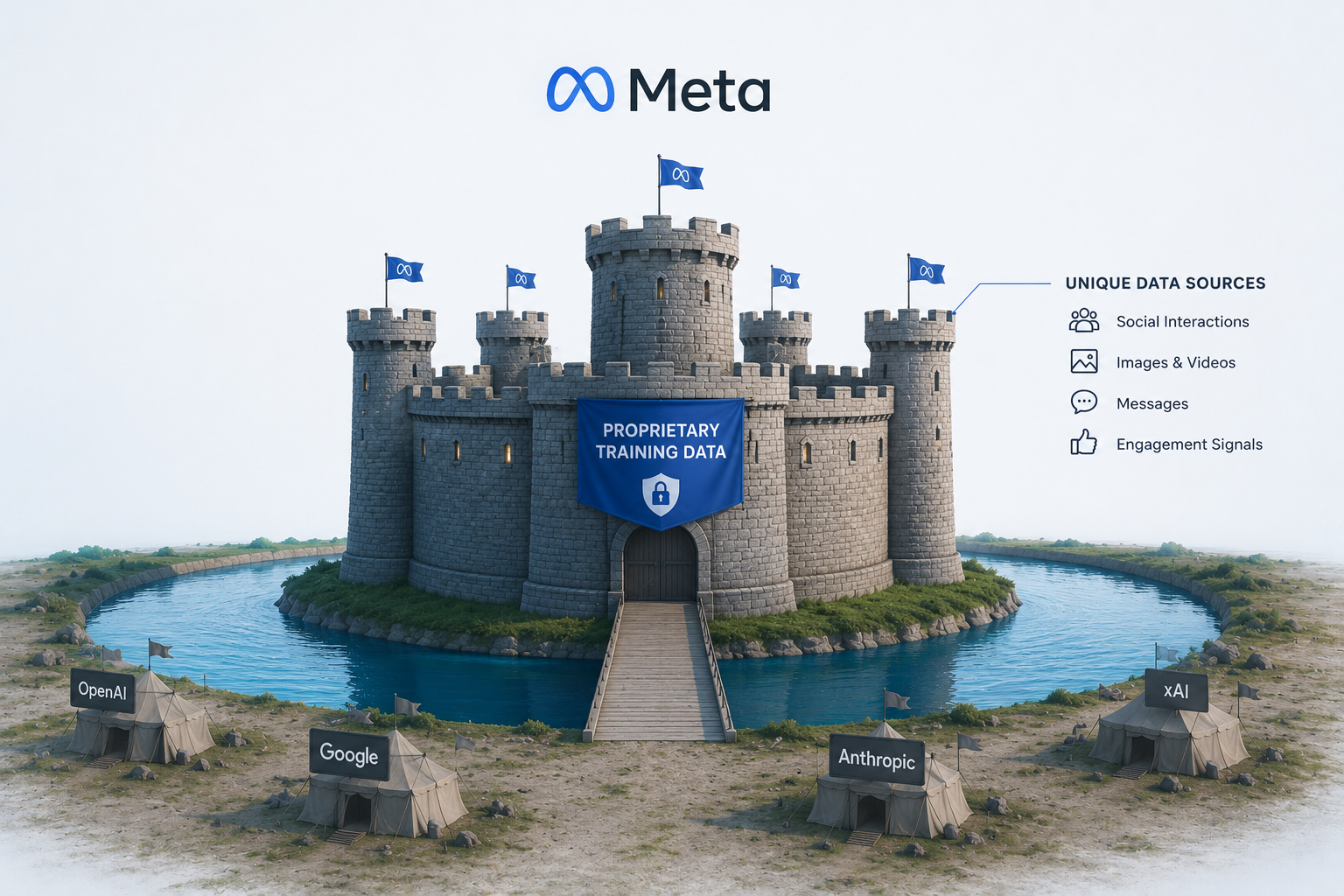
The proprietary training data moat why Meta’s Facebook ecosystem creates isn’t just impressive — it’s essentially unreplicable. I don’t say that lightly. I’ve spent years watching AI labs scramble to license web data, negotiate with publishers, and scrape whatever public sources they can find. Meanwhile, Meta is sitting on the largest interconnected dataset of human behavior ever assembled. Three billion daily active users generate text, images, video, voice notes, reactions, and purchase signals across Facebook, Instagram, and WhatsApp. No amount of compute power or algorithmic brilliance substitutes for that raw material.
Furthermore, this advantage compounds over time. Every new post, every shared Reel, every WhatsApp voice message adds fresh, diverse, multilingual data to Meta’s reservoir. OpenAI must negotiate expensive licensing deals. Google leans heavily on search queries and YouTube. However, neither company controls a social graph spanning nearly half the planet’s population — and that distinction matters enormously for where AI is headed.
Why Proprietary Data Beats Open Web Scraping
How Meta’s Integrated Ecosystem Creates Compounding Data Network Effects
Meta vs. OpenAI vs. AWS: A Data Advantage Comparison
Regulatory Barriers Make This Moat Even Wider
Why Scale Alone Isn’t Enough: Quality and Diversity of Proprietary Signals
Why Proprietary Data Beats Open Web Scraping
Most AI labs train on Common Crawl, Wikipedia, Reddit archives, and licensed news content. Valuable stuff, sure — but available to everyone. Consequently, those sources don’t create lasting competitive separation. When every lab trains on roughly the same corpus, differentiation comes down to compute budgets and fine-tuning tricks. That’s a thin moat.
Meta’s situation is fundamentally different.
The proprietary training data moat why Meta’s Facebook and Instagram datasets matter comes down to exclusivity. Nobody else can access:
- 3.07 billion daily active users across Meta’s family of apps, according to Meta’s investor relations page
- Billions of image-text pairings from Instagram posts and captions
- Multilingual conversational data from WhatsApp’s 100+ supported languages
- Behavioral signals like reactions, shares, saves, and dwell time
- Commerce intent data from Facebook Marketplace and Instagram Shopping
Specifically, these signals capture how real people communicate, express preferences, and make decisions — not what they chose to publish for an audience, but what they actually engaged with. A scraped webpage tells you what someone wrote. A Facebook interaction tells you what someone genuinely cared about. That’s a meaningful difference.
Quality matters more than quantity. Reddit threads contain sarcasm, trolling, and deliberately misleading content. Wikipedia is encyclopedic but emotionally narrow — when’s the last time a Wikipedia article made you laugh or cry? Meanwhile, Meta’s data captures the full human spectrum: joy, grief, humor, outrage, curiosity, boredom. That emotional diversity makes models trained on it more nuanced and, honestly, more useful in real-world applications.
How Meta’s Integrated Ecosystem Creates Compounding Data Network Effects
Here’s the thing: the proprietary training data moat why Meta’s Facebook platform stands apart from competitors isn’t just about volume — it’s about integration. Meta doesn’t run three separate apps. It runs one interconnected ecosystem where data flows between platforms in ways no competitor has managed to copy.
Cross-platform identity resolution is central to this advantage. A single user might post a vacation photo on Instagram, discuss restaurant recommendations in a WhatsApp group, and share a news article on Facebook. Because Meta can link those behaviors to one identity, it builds richer user profiles than any single-platform dataset could provide. Notably, this cross-platform signal is precisely what makes Meta’s AI models better at understanding context and intent — something I’ve found genuinely impressive when testing Meta’s recommendation features against competitors.
Network effects accelerate data quality. Here’s how the flywheel works:
1. More users join Meta’s platforms, generating more data
2. Better data produces better AI features (like recommendation algorithms)
3. Better AI features increase engagement and attract more users
4. More engagement generates even more high-quality data
5. The cycle repeats, widening the gap with competitors
This isn’t theoretical. Meta’s Llama models have improved dramatically with each release — Llama 3.1 showed capabilities competitive with GPT-4 in several benchmarks. Although Meta open-sources the model weights, it doesn’t share the training data. That’s the real kicker — competitors can study the architecture all they want, but they can’t copy the dataset.
Multimodal richness adds another decisive factor. Instagram alone generates billions of photos and videos daily, each paired with captions, hashtags, comments, and engagement metrics. This naturally multimodal data is ideal for training vision-language models. Additionally, WhatsApp’s voice messages provide speech data across dozens of languages and dialects that no commercial speech dataset comes close to matching. This surprised me when I first dug into it — the sheer linguistic diversity in WhatsApp’s voice data alone would be a significant asset for any AI lab.
Meta vs. OpenAI vs. AWS: A Data Advantage Comparison
Understanding the proprietary training data moat why Meta’s Facebook ecosystem dominates requires comparing it against major competitors. Each lab has a different data strategy, and the differences are stark.
| Factor | Meta | OpenAI | AWS/Amazon |
|---|---|---|---|
| Primary data source | Facebook, Instagram, WhatsApp (proprietary) | Licensed data, web scraping, partnerships | AWS customer usage, Alexa, Amazon retail |
| Daily active users | 3.07 billion | ~200 million ChatGPT weekly users | ~300 million Amazon customer accounts |
| Data diversity | Text, image, video, voice, commerce, social graph | Primarily text, some image/code | Commerce, voice (Alexa), cloud logs |
| Multilingual depth | 100+ languages via WhatsApp | Strong in English, moderate elsewhere | Limited multilingual depth |
| Data exclusivity | Fully proprietary | Mostly licensed (replicable) | Partially proprietary |
| Cost of data acquisition | Near zero (users generate it freely) | Expensive licensing deals | Moderate (tied to existing services) |
| Emotional/social signals | Extremely rich | Minimal | Minimal |
OpenAI’s data vulnerability is real — and I think it’s underappreciated in most coverage. The company has faced multiple lawsuits over training data, including from The New York Times. Every licensing deal OpenAI signs can be renegotiated, revoked, or outbid by a competitor willing to pay more. Therefore, OpenAI’s data access is fundamentally fragile in a way Meta’s simply isn’t. That’s not a knock on OpenAI’s engineering — it’s a structural vulnerability baked into their model.
AWS takes an infrastructure-first approach. Amazon certainly has valuable retail and Alexa data. Nevertheless, its AI strategy through Bedrock focuses on hosting other companies’ models rather than building frontier models from proprietary data. Amazon’s dataset lacks the social and conversational depth that Meta’s platforms provide — and that gap is hard to close.
Google is Meta’s closest data competitor. YouTube, Gmail, Search, and Maps generate enormous volumes of behavioral data. However, Google’s data is more transactional and less social. People search for answers on Google. They share their lives on Instagram. That distinction shapes the kind of AI each company can build — and consequently, what each company’s AI is actually good at.
Regulatory Barriers Make This Moat Even Wider
Here’s an underappreciated dimension of the proprietary training data moat why Meta’s Facebook dataset: regulation is actively making it harder for new entrants to build comparable datasets. Fair warning — this part of the story cuts against the standard “regulators will rein in Big Tech” narrative.
GDPR and its global equivalents restrict data collection. The European Union’s General Data Protection Regulation imposes strict consent requirements on data gathering. Any new social platform launching today faces far higher compliance costs than Meta faced during its growth years. Because Meta collected years of data under more permissive regulatory frameworks, that historical advantage simply can’t be copied — not legally, not practically.
Key regulatory barriers include:
- Consent requirements that make large-scale data collection expensive and slow
- Data localization laws that fragment datasets across jurisdictions
- AI-specific regulations like the EU AI Act that impose transparency requirements on training data
- Antitrust scrutiny that could prevent acquisitions of data-rich startups
Moreover, Meta has invested billions in compliance infrastructure. Smaller competitors simply can’t afford equivalent legal and technical teams. Ironically — and this is the part that surprised me — the same regulations critics hoped would constrain Meta have actually widened its data moat.
The “data gravity” effect matters too. Users have invested years building their social graphs, photo libraries, and message histories on Meta’s platforms. Switching costs are enormous. Consequently, Meta’s data advantage isn’t just about what it’s already collected — it’s about the ongoing stream of fresh data that competitors can’t divert, regardless of how much money they throw at the problem.
Similarly, Meta’s data agreements with users — buried in terms of service that billions have accepted — grant broad rights to use platform data for AI training. New entrants would need to negotiate similar agreements from scratch. That’s a years-long process with genuinely uncertain outcomes.
Why Scale Alone Isn’t Enough: Quality and Diversity of Proprietary Signals
Some observers argue that any company with enough money can simply buy equivalent data. But that argument misunderstands why the proprietary training data moat why Meta’s Facebook and Instagram signals are uniquely valuable. Scale matters, but quality and diversity matter more — and I’ve seen this play out repeatedly when comparing outputs from models trained on different data regimes.
Organic data beats synthetic data. Growing evidence shows that models trained primarily on AI-generated content suffer from “model collapse” — a gradual drop in output quality as the model essentially trains on its own mistakes. Meta’s data is overwhelmingly human-generated. Real people wrote those posts, took those photos, and recorded those voice messages. That authenticity translates directly into model quality in ways that are hard to fake.
Diversity of contexts is another critical advantage. Consider what Meta’s dataset includes:
- Casual conversation from Messenger and WhatsApp chats
- Professional content from Facebook business pages
- Creative expression from Instagram Reels and Stories
- Community discussion from Facebook Groups
- Commercial intent from Marketplace listings and Shopping tags
- Crisis communication from emergency check-ins and community alerts
- Cultural expression across every country where Meta operates
No curated dataset matches this breadth. Importantly, each data type teaches AI models something different about human communication. Casual WhatsApp messages teach colloquial language patterns. Business page content teaches professional tone. Instagram captions teach the relationship between visual and textual information. You’re essentially getting a graduate-level curriculum in human expression, delivered for free.
Engagement signals add another layer entirely. Meta doesn’t just have content — it has billions of data points about how people respond to content. Which posts get shared? Which get ignored? Which generate angry reactions versus laughing ones? These engagement signals work as implicit human feedback, essentially delivering free reinforcement learning from human feedback (RLHF) at planetary scale. That’s not a small thing.
Additionally, Meta’s data refreshes constantly. Models trained on static datasets grow stale — the internet of 2019 is a different beast from the internet of 2024. But Meta’s models can continuously learn from today’s conversations, trends, and cultural shifts. That freshness is a significant advantage that static dataset licensors like Common Crawl simply can’t provide.
The Strategic Implications for AI Competition
The proprietary training data moat why Meta’s Facebook ecosystem creates extends well beyond model benchmarks. It shapes the entire competitive picture of artificial intelligence — and, I’d argue, it’s the most important strategic story in AI that isn’t getting enough attention.
Meta can afford to open-source its models. This seems counterintuitive at first — why give away your AI? But here’s the thing: the models aren’t the moat; the data is. By open-sourcing Llama, Meta turns the model layer into a commodity. That move directly hurts OpenAI and Google, who charge for model access. Meanwhile, Meta keeps its true advantage: the proprietary dataset that makes each successive Llama release stronger than what competitors can train on open data alone. It’s a genuinely clever strategic move.
Vertical integration creates compounding returns. Meta uses its AI models to improve its own products. Better recommendation algorithms increase engagement, increased engagement generates more data, and more data improves the next generation of models. Consequently, Meta’s AI investment creates a self-reinforcing cycle that pure-play AI labs simply can’t match — because they don’t have the platform generating the data in the first place.
Three strategic implications stand out:
1. AI labs without proprietary data will hit a ceiling. Model architecture innovations face diminishing returns, making data quality the decisive differentiator over the next five years.
2. Data partnerships are fragile moats. OpenAI’s deals with publishers can be outbid, litigated, or legislated away — Meta’s first-party data faces none of these risks.
3. Multimodal AI favors platform companies. As AI moves beyond text to images, video, and voice, companies with diverse multimodal data gain disproportionate advantages — and that trend is accelerating.
Notably, this analysis doesn’t suggest Meta will “win” AI outright. Google’s data assets are formidable, and Apple’s on-device data strategy offers privacy-centric advantages worth watching. However, among all competitors, Meta’s combination of scale, diversity, exclusivity, and self-reinforcing network effects creates the most durable data advantage in the industry. I’ve been covering this space for a decade, and I haven’t seen a structural position quite like it.
Conclusion
Bottom line: the proprietary training data moat why Meta’s Facebook, Instagram, and WhatsApp ecosystem creates is ultimately about irreplicability. You can build a bigger GPU cluster. You can hire better researchers. You can even copy a model architecture. But you can’t conjure three billion daily active users generating authentic, diverse, multilingual, multimodal data across interconnected platforms. That’s not a gap you close with a funding round.
This advantage compounds with every passing day. Regulatory barriers make it harder for newcomers to build comparable datasets, network effects keep users locked into Meta’s ecosystem, and the shift toward multimodal AI plays directly to Meta’s strengths in image, video, and voice data. Furthermore, the freshness of Meta’s data stream means competitors aren’t just behind — they’re falling further behind.
Actionable takeaways for technology leaders and investors:
- Evaluate AI companies not just on model performance but on data asset durability — ask how easily a competitor could copy their training corpus
- Recognize that open-source model strategies (like Llama) can coexist with — and actually reinforce — proprietary data moats
- Monitor regulatory developments that could either widen or narrow data advantages, particularly around consent requirements and data localization
- Consider that the proprietary training data moat why Meta’s Facebook dataset has built may reshape enterprise AI procurement decisions more than any benchmark leaderboard
The compute arms race gets the headlines. But the data layer underneath will ultimately determine which AI companies build lasting advantages. On that dimension, Meta’s position is extraordinarily strong — and I don’t see that changing anytime soon.
FAQ
How does Meta’s proprietary training data differ from what OpenAI uses?
Meta’s data comes directly from its own platforms — Facebook, Instagram, and WhatsApp. This first-party data includes social interactions, images, videos, and voice messages from billions of users. OpenAI primarily relies on licensed third-party data, web scraping, and partnerships with publishers. Consequently, OpenAI’s data access can be disrupted by lawsuits, renegotiated contracts, or competitors offering higher licensing fees. Meta’s data is exclusive and self-generating, whereas OpenAI’s data is largely replicable by anyone willing to pay. That’s a meaningful structural difference, not just a talking point.
Is it legal for Meta to use user data for AI training?
Meta’s terms of service grant the company broad rights to use content posted on its platforms. However, this remains a contested legal area. How the proprietary training data moat why Meta’s Facebook data policies face scrutiny varies significantly by jurisdiction. European regulators have challenged certain data practices under GDPR. Nevertheless, Meta has invested heavily in compliance infrastructure and has generally prevailed in maintaining its data usage rights. Users who continue using the platforms implicitly accept these terms, although opt-out mechanisms exist in some regions — worth knowing if you’re keeping an eye on regulatory risk.
Can a startup replicate Meta’s data advantage?
Practically speaking, no. Building a social network with billions of users takes over a decade and billions of dollars — and that’s before you factor in today’s regulatory environment, which makes large-scale data collection far more expensive than when Facebook launched. The network effects that keep users on Meta’s platforms create enormous switching costs that a well-funded startup simply can’t overcome quickly. A startup could build a niche dataset in a specific domain, and that’s a legitimate strategy. But copying Meta’s breadth and scale of human behavioral data is essentially impossible. It’s not a money problem — it’s a time and trust problem.
How does Meta’s data moat affect its open-source AI strategy?
Meta’s willingness to open-source Llama models makes strategic sense precisely because the data — not the model — is the real competitive advantage. By releasing model weights publicly, Meta turns the model layer into a commodity, which undermines competitors like OpenAI who charge for API access. Moreover, open-sourcing Llama builds goodwill with the research community and attracts talent. Meanwhile, Meta keeps exclusive access to the training data that makes each Llama iteration competitive. Open-sourcing the model strengthens the moat by making the data advantage even more decisive — it’s a no-brainer when you understand the underlying strategy.
What role does WhatsApp play in Meta’s training data advantage?
WhatsApp contributes uniquely valuable data that other platforms can’t match. Specifically, it provides conversational data in over 100 languages, including many low-resource languages that are severely underrepresented in standard AI training corpora. Additionally, WhatsApp voice messages offer speech data across diverse accents and dialects at a scale no commercial speech dataset comes close to matching. Although WhatsApp messages are end-to-end encrypted, Meta can still use metadata, status updates, and business interactions — and regulators are watching this area closely. This multilingual conversational depth is particularly important for building globally capable AI models, and it’s an asset that competitors would need years to approximate.
Will regulation eventually erode Meta’s data advantage?
Regulation could theoretically force Meta to limit how it uses platform data for AI training. However, current trends suggest the opposite effect — and this is the counterintuitive part. Stricter data collection laws raise barriers for new entrants more than they constrain incumbents. Meta has already built its dataset and invested in compliance infrastructure that smaller competitors can’t afford to match. Furthermore, proposed AI regulations like the EU AI Act focus primarily on transparency and risk management rather than prohibiting the use of proprietary data. Therefore, regulation is more likely to widen Meta’s moat than narrow it — at least over the next several years. Nevertheless, it’s worth monitoring, because a sufficiently aggressive regulatory intervention could change the calculus entirely.
Keep reading
Here are the latest posts from the blog.
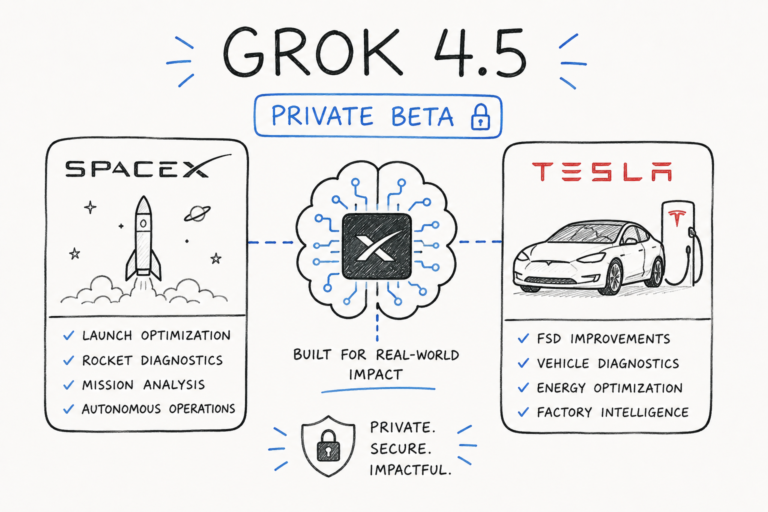
The grok private beta SpaceX and Tesla rollout is, honestly, one of the more interesting things I’ve seen xAI do. No fanfare, no press release — they just quietly dropped Gro…
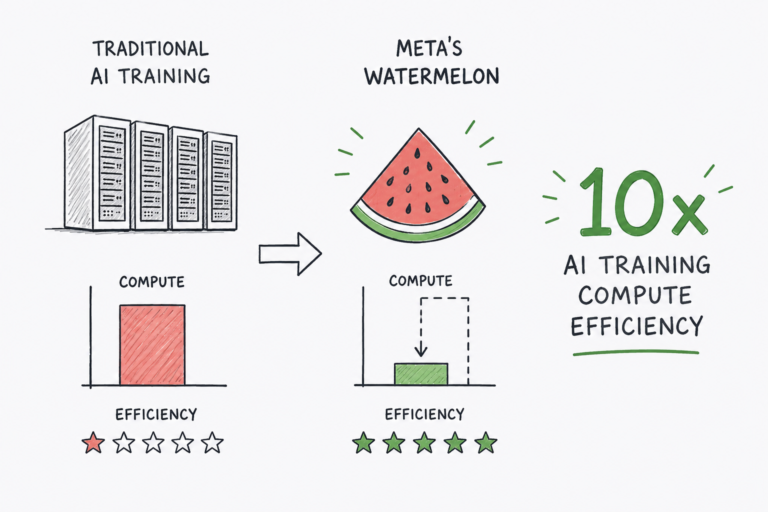
The race to build smarter AI just took a sharp turn — and honestly, it’s not the turn most people expected. Meta Watermelon AI training compute efficiency 10x improvements re…
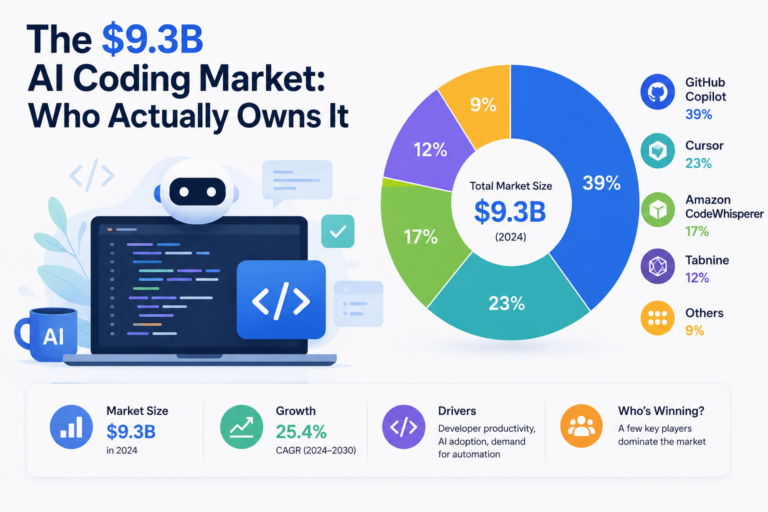
The AI coding market has changed fast — and I mean fast. What started as a niche experiment for early adopters is now a $9.3 billion industry that’s fundamentally reshaping h…