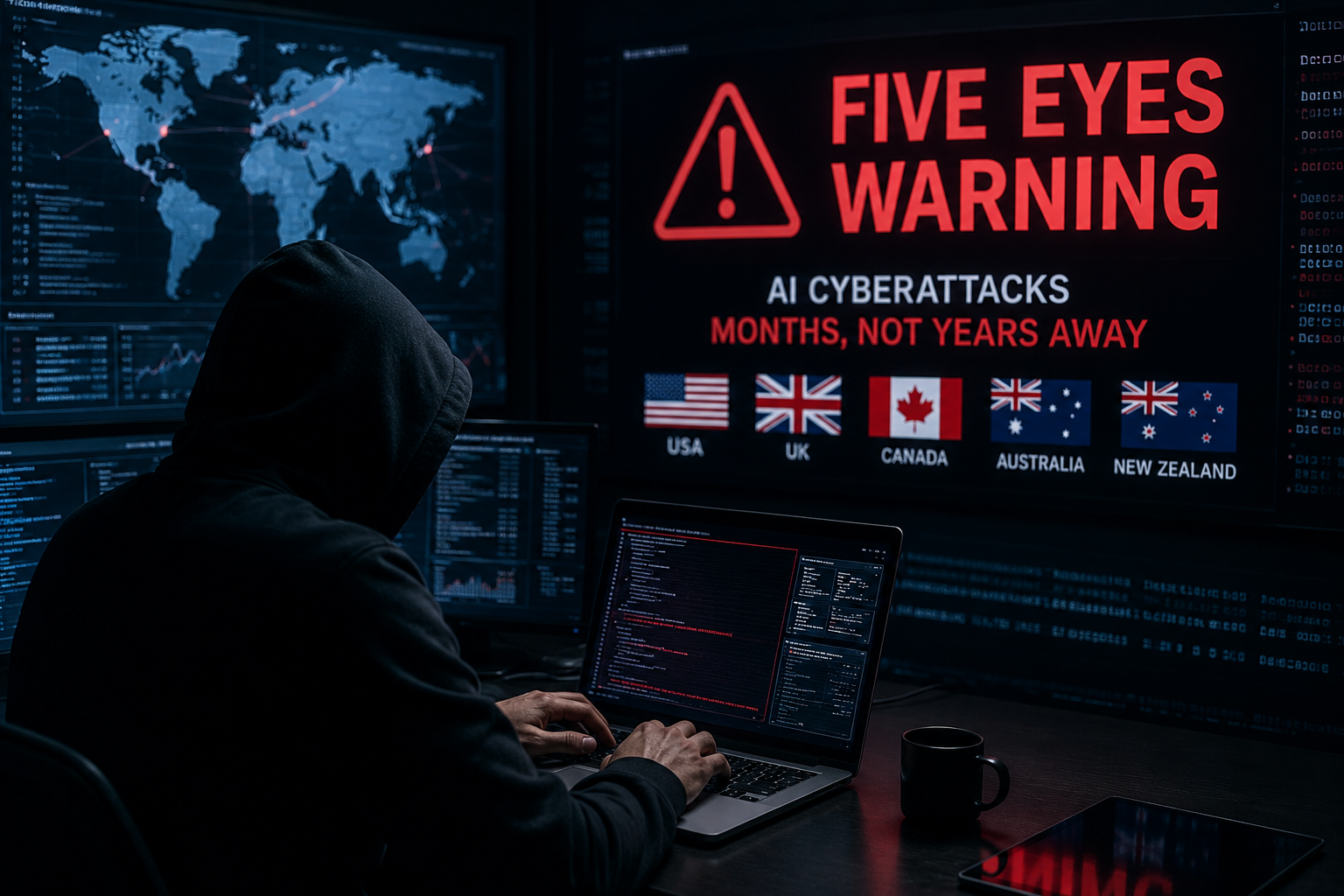
The Five Eyes warning AI cyberattacks months years timeline has genuinely rattled the cybersecurity world — and honestly, it should. Intelligence agencies from the United States, United Kingdom, Canada, Australia, and New Zealand have reached a rare consensus: AI-powered cyberattacks aren’t some distant, theoretical problem. They’re imminent.
I’ve been covering security threats for a decade, and joint assessments like this don’t happen often. When they do, you pay attention.
This isn’t agencies hedging their bets or padding a report. The world’s most powerful intelligence alliance is specifically telling organizations they have months — not years — to get ready. That distinction matters enormously for every technology leader, security team, and software company operating today.
What the Five Eyes Alliance Actually Said About AI Threats
Why the Timeline Says Months, Not Years
Specific Attack Vectors the Five Eyes Warning Identifies
How This Warning Connects to Broader AI Security Policy
Defensive Priorities for Organizations Facing AI-Enabled Threats
What the Five Eyes Alliance Actually Said About AI Threats
The Five Eyes intelligence alliance is the closest intelligence-sharing partnership on Earth. Five nations, one unified voice. When all five agree on a threat timeline, it’s drawing on classified intelligence most of us will never see — and that carries extraordinary weight.
Their warning about AI cyberattacks arriving in months, not years highlights some genuinely sobering findings:
- AI lowers the barrier to entry for less-skilled threat actors who’d previously lack the technical chops
- Nation-state actors are already weaving AI into offensive cyber operations — this isn’t hypothetical
- Large language models can automate reconnaissance, phishing, and malware generation at a scale no human team can match
- Deepfake technology enables sophisticated social engineering that’s nearly indistinguishable from the real thing
- AI-powered vulnerability scanning dramatically accelerates zero-day discovery — think hours, not weeks
Notably, this isn’t one lone agency sounding an alarm. The UK’s National Cyber Security Centre (NCSC) published a complementary assessment confirming that AI will “almost certainly increase the volume and heighten the impact of cyberattacks over the next two years.” Meanwhile, the NSA, CSIS, ASD, and GCSB have echoed nearly identical conclusions.
The consensus here is rare — and deliberate. These agencies want organizations moving now, not scrambling after the first major AI-driven breach dominates the headlines.
I’ve watched plenty of threat assessments come and go. Most get filed and forgotten. This one feels different, and the specificity of the language is a big reason why.
Why the Timeline Says Months, Not Years
Understanding why the Five Eyes warning specifies AI cyberattacks in months rather than years comes down to three converging factors. Each one independently accelerates the threat. Together, they create an unprecedented risk window — and that’s not hyperbole.
1. Open-source AI models are spreading fast. Models like Meta’s LLaMA and Mistral’s open-weight releases hand anyone access to genuinely powerful AI capabilities. Consequently, threat actors don’t need to build their own models from scratch — they fine-tune existing ones for malicious purposes. The marginal cost of doing this is essentially zero.
2. AI tooling has become remarkably accessible. Tools like AutoGPT, LangChain, and similar frameworks let users chain AI capabilities together into complex workflows. Therefore, a moderately skilled attacker can now automate multi-step attack sequences that previously required serious expert knowledge. Fair warning: this is the part that surprised me most when I first dug into it.
3. Guardrails are failing faster than anyone expected. Jailbreaking techniques for large language models evolve weekly — sometimes daily. Researchers at Carnegie Mellon University showed universal adversarial attacks against aligned models. Furthermore, underground forums are openly sharing prompt injection techniques right now. Today. Not someday.
The convergence timeline looks something like this:
Table: scroll sideways to view all columns when needed.
| Factor | 12 Months Ago | Today | 6 Months From Now |
|---|---|---|---|
| AI model access | Limited, mostly commercial | Open-source models widely available | Fine-tuned attack-specific models |
| Attack automation | Manual with some AI assist | Semi-automated attack chains | Fully autonomous attack agents |
| Social engineering | Basic phishing templates | AI-generated personalized lures | Real-time deepfake voice and video |
| Vulnerability discovery | Human-led, slow | AI-assisted scanning | AI-driven zero-day hunting at scale |
| Defensive readiness | Minimal AI defense tools | Early-stage AI security products | Still catching up to offensive AI |
Look at that last row. That’s the real kicker. Offensive capabilities are outpacing defensive ones — and that gap isn’t stabilizing. It’s widening. That’s precisely why the Five Eyes warning about AI cyberattacks frames the timeline in months, not years.
Specific Attack Vectors the Five Eyes Warning Identifies
The Five Eyes AI cyberattacks warning doesn’t traffic in vague generalities, which I appreciate. Intelligence agencies have identified concrete attack vectors that AI enables or dramatically improves. Knowing these helps security teams stop trying to defend everything equally and start prioritizing where it actually matters.
AI-enhanced phishing and social engineering. This is the most immediate threat — full stop. AI generates perfectly written, contextually relevant phishing emails in any language. Additionally, it scrapes social media profiles to personalize attacks at scale. The NCSC estimates AI will make phishing “highly effective” even against security-aware targets. I’ve seen demo outputs from these tools. They’re genuinely unsettling.
Automated vulnerability exploitation. AI models analyze codebases and spot vulnerabilities far faster than human researchers can. Similarly, they generate working exploit code directly from vulnerability descriptions. The MITRE ATT&CK framework already documents techniques that AI can automate end-to-end — worth bookmarking if you haven’t already.
Deepfake-enabled fraud. Voice cloning now requires only seconds of sample audio. Consequently, attackers impersonate executives in real-time phone calls with alarming accuracy. Several confirmed cases have already resulted in multi-million-dollar wire fraud losses. One UK energy firm lost $243,000 in a single call — in 2019, before this technology got dramatically better.
AI-powered malware. Polymorphic malware isn’t new. However, AI makes it vastly more effective. AI-generated malware adapts in real time to evade endpoint detection tools, analyzing defensive responses and modifying behavior accordingly. Your signature-based tools are increasingly useless against this.
Supply chain attacks with AI reconnaissance. AI maps complex software supply chains automatically, identifying the weakest links — typically small vendors with poor security practices. Moreover, it generates targeted attacks against those specific weak points with minimal human involvement.
Autonomous attack agents. Here’s the thing: researchers have already shown AI agents that independently perform penetration testing — identifying targets, scanning for vulnerabilities, attempting exploits, and pivoting through networks. Although still in early stages, the Five Eyes assessment suggests weaponized versions are closer than most people realize.
How This Warning Connects to Broader AI Security Policy
The Five Eyes warning about AI cyberattacks arriving in months, not years doesn’t exist in a vacuum. It sits inside a fast-moving policy environment, and governments worldwide are genuinely scrambling — not always elegantly — to address AI security risks through regulation, standards, and operational changes.
Supply chain risk designation efforts are already underway. The U.S. government is evaluating which AI components pose national security risks. Importantly, this includes both hardware (advanced chips) and software (foundation models). Export controls on AI accelerators reflect exactly this thinking in practice.
Government-gated AI access proposals are gaining traction. Some policymakers argue the most capable AI models should require licensing. Nevertheless, critics — with some justification — point out that open-source models already make such controls extremely difficult to enforce. It’s a legitimate tension without an obvious answer.
Compute rationing discussions connect directly to the Five Eyes assessment. Because AI-powered attacks scale with available compute, controlling access to computing resources becomes a legitimate defensive strategy, not just a geopolitical one. The 2023 Executive Order on Safe, Secure, and Trustworthy AI addressed several of these concerns, but it was revoked on January 20, 2025. It is historical context, not a current legal requirement.
Alternatively, some experts advocate for “offensive defense” — using AI to fight AI. This approach involves:
- Deploying AI-powered threat detection systems that learn faster than attackers can adapt
- Using machine learning to flag unusual network behavior before humans would notice it
- Automating incident response with AI decision-making (controversial, but increasingly necessary)
- Running AI-driven red team exercises continuously rather than annually
- Building AI models specifically trained to detect AI-generated content
The policy picture is genuinely complex, and anyone claiming simple answers here is selling something. However, the Five Eyes warning makes one thing clear: AI cyberattacks are months, not years from becoming a mainstream threat — and policy simply must move at the same speed, which historically it hasn’t.
Defensive Priorities for Organizations Facing AI-Enabled Threats
So given the Five Eyes warning that AI cyberattacks are months, not years away, what should organizations actually do? I get asked this constantly, and the honest answer involves both immediate tactical steps and longer-term structural changes. No single silver bullet here.
Immediate actions (next 30–90 days):
1. Upgrade email security to platforms that detect AI-generated phishing. Tools like Abnormal Security and Proofpoint are adding AI detection capabilities — and this is genuinely worth the cost right now.
2. Implement multi-factor authentication everywhere. Because AI makes credential theft trivially easy, MFA remains the single most effective countermeasure available. No excuses for not having this in 2024.
3. Deploy deepfake detection for financial authorization workflows. Any wire transfer request should require in-person or multi-channel verification — no exceptions.
4. Patch aggressively. AI-powered vulnerability scanning means known vulnerabilities get exploited faster than ever. Your comfortable patching window has shrunk dramatically, and that’s not reversible.
5. Train employees on AI-specific threats. Traditional security awareness training doesn’t cover AI-generated attacks. Update your materials immediately — moreover, do it before the next phishing simulation, not after.
Strategic changes (next 3–12 months):
- Adopt AI-powered security tools. Fight fire with fire. Solutions from CrowdStrike, SentinelOne, and Darktrace use AI for threat detection and response — I’ve tested several of these and they actually deliver on the core promise.
- Set up zero-trust architecture. Assume breach. Verify every access request regardless of source, because AI attacks exploit inherited trust relationships aggressively and systematically.
- Establish AI governance frameworks. Know which AI tools your employees are using. Shadow AI creates attack surfaces you can’t monitor or defend.
- Join threat intelligence sharing networks. The Five Eyes agencies share intelligence with each other — similarly, your organization should be sharing threat data with industry peers. It’s not weakness; it’s smart.
- Run AI-specific tabletop exercises. Simulate an AI-powered attack scenario and test your team’s response when deepfakes and automated attacks combine. Most teams have never run this scenario. Most would struggle badly.
The Five Eyes warning about AI cyberattacks in months, not years demands urgency. However, urgency without direction just burns budget. These prioritized steps give you a practical roadmap regardless of where you are in your security maturity right now.
Traditional Cyberattacks vs. AI-Enabled Cyberattacks
To truly understand why the Five Eyes warning frames AI cyberattacks as months, not years away, it helps to put traditional and AI-enabled attacks side by side. The differences are more stark than most people expect.
Table: scroll sideways to view all columns when needed.
| Dimension | Traditional Cyberattacks | AI-Enabled Cyberattacks |
|---|---|---|
| Speed of development | Weeks to months per campaign | Hours to days per campaign |
| Personalization | Generic or manually researched | Automatically personalized at scale |
| Language quality | Often contains telltale errors | Perfect grammar in any language |
| Adaptability | Static until manually updated | Dynamically adapts to defenses in real time |
| Scale | Limited by human operators | Virtually unlimited automation |
| Skill required | High technical expertise | Moderate with AI tool assistance |
| Detection difficulty | Pattern-based detection works reasonably well | Evades traditional signature-based tools |
| Cost per attack | Moderate to high | Dramatically lower — sometimes near zero |
| Target selection | Manual reconnaissance, time-consuming | AI-automated target profiling |
| Social engineering | Text-based primarily | Multi-modal: text, voice, and video |
Bottom line: AI doesn’t just make existing attacks incrementally better. It fundamentally changes the economics of cybercrime. Consequently, the Five Eyes warning about AI cyberattacks in months, not years reflects a structural shift — not merely an upgrade to existing threat categories.
Furthermore, the gap between offense and defense is growing in a way that should genuinely concern anyone running a security team. Attackers need to find one weakness; defenders need to protect everything. AI amplifies this asymmetry dramatically — an AI agent can test thousands of attack paths at once. Meanwhile, most security teams still rely heavily on manual processes and chronically understaffed SOCs (Security Operations Centers).
That’s precisely the imbalance the intelligence community is flagging. That’s why the Five Eyes issued this warning: AI cyberattacks are months, not years from overwhelming current defensive capabilities at many organizations.
Conclusion
The Five Eyes warning that AI cyberattacks are months, not years away is one of the most significant cybersecurity alerts I’ve seen in my decade covering this space. Five nations with the world’s most sophisticated intelligence capabilities are telling us — clearly, specifically, urgently — to prepare now. That’s not something you file away for next quarter’s planning meeting.
Here are your actionable next steps:
1. Audit your current security posture against AI-specific attack vectors this week — not next month
2. Brief your executive team on the Five Eyes assessment and what it actually means for your risk profile
3. Allocate budget for AI-powered defensive tools before your next fiscal cycle closes
4. Update incident response plans to include AI-enabled attack scenarios specifically
5. Engage with industry threat-sharing groups like ISACs relevant to your sector
The window for preparation is shrinking — notably faster than most organizations currently appreciate. The Five Eyes warning about AI cyberattacks arriving in months, not years gives us a clear, if uncomfortable, deadline. Organizations that act now will be positioned to absorb and survive these threats. Those that wait are essentially betting their business that the timeline is wrong.
I wouldn’t take that bet.
FAQ
What exactly is the Five Eyes alliance?
The Five Eyes alliance is an intelligence-sharing partnership between the United States, United Kingdom, Canada, Australia, and New Zealand. It originated during World War II and remains the closest multilateral intelligence arrangement in the world. Importantly, when all five nations issue a joint assessment, it reflects the highest confidence level in the underlying intelligence — this isn’t one agency speculating.
Why does the Five Eyes warning say months, not years?
The Five Eyes warning says AI cyberattacks are months, not years away because of three converging factors hitting at the same time. Open-source AI models are widely available to anyone with a laptop. Attack automation tools have matured rapidly beyond what most people realize. And guardrail bypasses for AI models are spreading across underground forums weekly. Together, these factors compress the timeline dramatically compared to earlier estimates — and they’re not slowing down.
What AI cyberattacks should organizations worry about most?
The most immediate threats are AI-enhanced phishing, deepfake-enabled fraud, and automated vulnerability exploitation. Specifically, AI-generated phishing emails are nearly impossible to tell apart from legitimate communications — even for trained security professionals. Additionally, voice cloning technology enables real-time impersonation of trusted individuals with just seconds of audio sample. These attacks require the least sophistication and deliver the highest impact, which makes them the obvious starting point for criminal adoption.
Can AI also help defend against these new threats?
Absolutely — and this is genuinely the most encouraging part of the picture. AI-powered security tools from companies like CrowdStrike, Darktrace, and SentinelOne detect unusual behavior that traditional signature-based tools completely miss. Nevertheless, defensive AI currently lags behind offensive AI capabilities, and that’s not a small gap. The Five Eyes warning about AI cyberattacks in months, not years emphasizes this imbalance clearly. Deploy AI defenses, but don’t treat them as a complete solution — because they aren’t, not yet.
How does this warning affect small and medium businesses?
Small and medium businesses face disproportionate risk here, and that’s the part of this story that doesn’t get enough attention. Because AI lowers the cost of attacks dramatically, smaller targets become economically viable for criminals who’d previously ignored them. Moreover, smaller organizations typically have far fewer security resources to draw on when something goes wrong. The Five Eyes warning that AI cyberattacks are months, not years away applies to businesses of all sizes — not just enterprise. Basic steps like MFA, regular employee training, and aggressive patching become even more critical as a result. They’re no longer optional hygiene; they’re survival basics.
What government policies are being developed in response?
Multiple policy initiatives are underway, though the pace of policy rarely matches the pace of threat. The 2023 Executive Order 14110 addressed AI safety and security, before its revocation on January 20, 2025. Export controls on advanced AI chips restrict adversary access to the compute resources needed for large-scale attacks. Furthermore, proposals for AI model licensing and supply chain risk designation are advancing through various government agencies. These policies aim to slow the spread of offensive AI capabilities — while the Five Eyes warning about AI cyberattacks in months, not years continues driving urgency across the entire policy picture. Whether policy moves fast enough is, honestly, an open question.