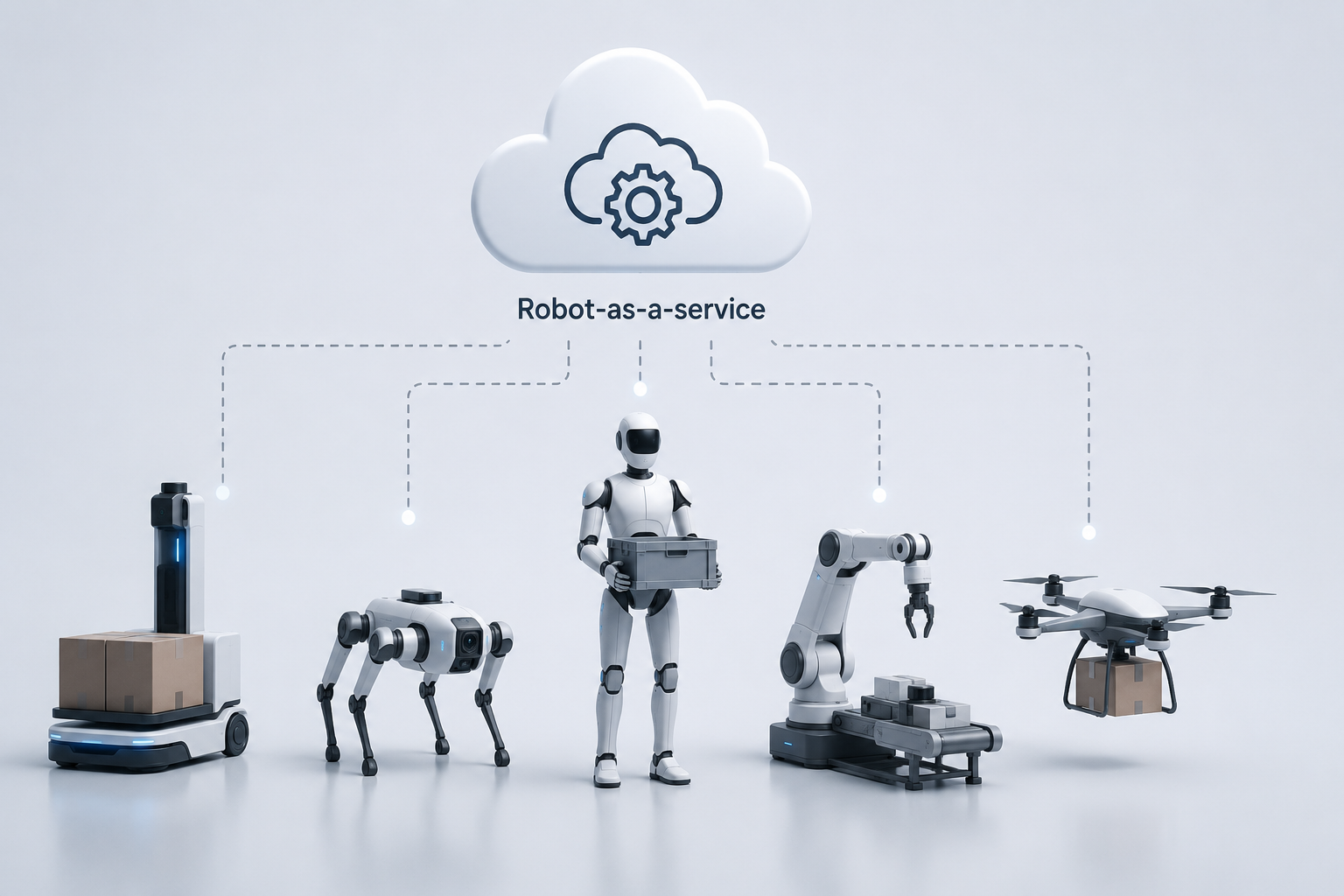
The concept of robot-as-a-service explained why renting robot smarter than buying has genuinely reshaped how companies approach automation. Five years ago, deploying a robot meant writing a six-figure check and crossing your fingers. Today, you can subscribe to one like software — and that shift changes everything about how you think about the economics.
Robot-as-a-Service (RaaS) lets businesses rent robots on monthly or annual subscriptions. You pay for outcomes, not hardware. For most companies, this model dramatically lowers risk, speeds up ROI, and eliminates painful capital expenditure. The math, however, isn’t always obvious at first glance. This piece breaks down the financial analysis, real case studies, and a decision matrix so you can figure out the smartest path for your specific operation.
The Financial Case: Capital Expenditure vs. RaaS Subscriptions
Understanding robot-as-a-service explained why renting robot smarter starts with the numbers — specifically, the ones most vendors don’t put on the front page of their brochure. Buying an industrial robot involves far more than the sticker price. Consequently, many companies badly underestimate the true cost of ownership, and I’ve watched this mistake play out more times than I can count.
Upfront costs of buying a robot typically include:
- Robot hardware: $50,000–$400,000 per unit
- Integration and programming: $30,000–$100,000
- Safety infrastructure: $10,000–$50,000
- Operator training: $5,000–$15,000
- Ongoing maintenance contracts: 8–12% of purchase price annually
A single robotic arm for welding might cost $150,000 to purchase. Add integration, safety cages, and training, and you’re looking at $250,000 before the robot does its first weld. Furthermore, that robot depreciates on your balance sheet over five to seven years — not exactly a fun conversation with your CFO.
Meanwhile, a RaaS subscription for the same capability might run $3,000–$8,000 per month. That covers hardware, software updates, maintenance, and often technical support. Specifically, companies like Formic offer pay-per-hour pricing where you only pay when the robot is actually working. That model alone surprised me when I first dug into it.
Here’s a simplified five-year comparison:
Table: scroll sideways to view all columns when needed.
| Cost Factor | Buying Outright | RaaS Subscription |
|---|---|---|
| Year 1 total cost | $250,000 | $72,000 |
| Year 2 total cost | $18,000 (maintenance) | $72,000 |
| Year 3 total cost | $18,000 (maintenance) | $72,000 |
| Year 4 total cost | $35,000 (maintenance + upgrades) | $72,000 |
| Year 5 total cost | $18,000 (maintenance) | $72,000 |
| Five-year total | $339,000 | $360,000 |
| Break-even point | ~47 months | Immediate value |
| Technology refresh | None (aging hardware) | Included |
| Cash flow impact | Severe Year 1 hit | Predictable monthly |
At first glance, buying looks cheaper over five years. However, this comparison quietly ignores several critical factors. The purchased robot becomes outdated, you bear all repair risk, and that $250,000 upfront cost carries a real opportunity cost. Had you invested that capital elsewhere — even at a modest return — the gap narrows significantly. And that’s before you account for the stress of an unexpected breakdown eating into your margins.
Additionally, the RaaS model typically includes technology upgrades as standard. Your rented robot gets better over time. Your purchased robot doesn’t. Therefore, the true total cost of ownership almost always favors renting a robot for businesses without dedicated robotics teams — which, honestly, is most businesses.
ROI Timelines and Break-Even Analysis for RaaS
ROI timelines dominate boardroom discussions about robotas-a-service explained why renting robot smarter. Executives want to know one thing: when does this actually pay for itself?
For purchased robots, the typical ROI timeline looks like this:
1. Months 1–6: Installation, integration, debugging, and staff training
2. Months 7–12: Ramp-up period with only partial productivity gains
3. Months 13–24: Full productivity, but still digging out from the initial investment
4. Months 25–48: True ROI starts accumulating
5. Months 49+: Robot may need significant upgrades or outright replacement
Most purchased industrial robots don’t deliver positive ROI until month 30–40. That’s nearly three years of waiting. Notably, the International Federation of Robotics reports that robot lifespans average 12–15 years. However, technology cycles now move much faster than hardware lifespans — so you’re often stuck with capable-but-dated equipment well before the machine actually dies.
For RaaS deployments, the timeline compresses dramatically:
1. Weeks 1–4: Deployment and calibration (vendor-managed, not your headache)
2. Months 2–3: Full productivity with measurable output gains
3. Month 4+: Positive ROI already accumulating
The difference is stark. RaaS customers often see positive ROI within 90 days because there’s no massive upfront investment to recover. Consequently, the break-even calculation fundamentally changes — and that’s the real kicker when you’re presenting this to a skeptical leadership team.
Here’s a practical example. Suppose a warehouse operation spends $22 per hour on manual labor for a picking task. A RaaS robot handles the same task for $8 per hour — subscription cost amortized. That’s $14 per hour saved. Running one shift of eight hours daily, five days a week, the savings hit $29,120 in the first year alone. Moreover, the robot doesn’t call in sick, take breaks, or file workers’ compensation claims. Fair warning: I know that sounds almost too clean, but the math holds up in real deployments I’ve followed closely.
Similarly, manufacturing companies report 30–50% productivity gains when deploying collaborative robots through RaaS programs. The key insight: renting a robot smarter aligns costs with revenue generation from day one — not month 30.
Case Studies: RaaS Wins in Manufacturing and Warehousing
Real-world examples make the case for robot-as-a-service explained why renting robot smarter far more convincingly than any spreadsheet can. So let’s look at what’s actually happened.
Manufacturing: Small Metalworks Shop in Ohio
A 45-person metal fabrication shop needed to automate welding to compete with larger rivals. Buying a welding cobot would have cost $180,000 upfront — a number that would’ve wiped out their operating cushion. Instead, they partnered with Formic on a RaaS contract at $2,100 per month. Within six weeks, the robot was operational. The shop redirected its two most skilled welders to complex custom jobs, and output increased 35%. Importantly, the company avoided taking on debt or draining cash reserves. After 18 months, they added a second robot under the same model. No drama, no scramble for capital.
Warehouse Automation: Mid-Size E-Commerce Fulfillment
A fulfillment center processing 8,000 orders daily explored autonomous mobile robots (AMRs) for picking operations. Purchasing a fleet of 15 AMRs from a vendor like Locus Robotics would have required roughly $750,000 plus integration costs. Instead, they chose a RaaS subscription. The robots deployed in under three weeks, pick rates jumped 2.5x, and seasonal scaling became effortless — they added robots during holiday peaks and scaled back down in January. That flexibility alone is worth a serious conversation.
Food Processing: Palletizing Line in Texas
A food manufacturer needed palletizing automation but faced genuinely uncertain demand due to a pending retail contract. Buying a palletizing system represented too much risk. Nevertheless, they couldn’t afford to lose the contract by relying solely on manual labor — a classic no-win situation. A RaaS palletizer solved the dilemma. Monthly costs stayed predictable, and when the retail contract came through, they scaled up immediately. Had it fallen through, they could have returned the robot with minimal penalty. The model absorbed business uncertainty that ownership never could.
These cases share a common thread. Each company needed automation but couldn’t justify — or afford — the capital expenditure, and RaaS removed that barrier entirely. Alternatively, each could have waited years to save enough capital, losing competitive ground in the process. I’ve seen that happen too, and it’s painful to watch.
When Buying Still Makes Sense: A Decision Matrix
Although robot-as-a-service explained why renting robot smarter holds true for most businesses, buying isn’t always the wrong call. Certain conditions genuinely favor capital purchase over subscription — and I’d be doing you a disservice if I didn’t lay those out honestly.
You should consider buying when:
- Your application is highly specialized and won’t meaningfully change for 7+ years
- You have in-house robotics engineering talent for maintenance and programming
- Production volume is extremely high and consistent year-round
- You’ve already amortized similar equipment successfully before
- Tax benefits of capital depreciation outweigh subscription deductions in your situation
- You operate in a regulated industry requiring full hardware ownership and control
You should lean toward RaaS when:
- You’re deploying robots for the first time (seriously, don’t skip this one)
- Cash flow predictability matters more than long-term cost minimization
- Your production needs fluctuate seasonally
- You lack in-house robotics expertise — and most companies do
- Technology evolution matters and you want the latest capabilities
- You need to prove ROI before committing larger budgets
The National Institute of Standards and Technology (NIST) provides solid frameworks for evaluating robotic systems in industrial settings. Their guidance can help you assess technical requirements before you even touch the financial model — worth bookmarking.
Decision matrix summary:
Table: scroll sideways to view all columns when needed.
| Factor | Favors Buying | Favors RaaS |
|---|---|---|
| Upfront capital available | Yes | No |
| In-house robotics team | Yes | No |
| Application stability (7+ years) | High | Low/uncertain |
| Seasonal demand variation | Minimal | Significant |
| Technology refresh needs | Low | High |
| First-time automation | No | Yes |
| Risk tolerance | High | Low |
| Time to deployment | Flexible | Urgent |
Score yourself across these eight factors. If five or more favor RaaS, renting a robot smarter aligns with your situation. Conversely, if most factors favor buying, ownership might genuinely deliver better long-term value. No shame in that — just be honest about where you actually land.
The Hidden Advantages of RaaS Most Companies Overlook
Beyond the obvious financial benefits, the robot-as-a-service explained why renting robot smarter argument includes several underappreciated advantages that rarely show up in vendor pitch decks. These are the ones I find myself talking about most.
Reduced technology risk. Robotics evolves rapidly — faster than most industries realize. A robot you buy today may be outperformed by next year’s model. RaaS providers absorb that obsolescence risk entirely. Specifically, companies like Amazon Robotics continuously upgrade their fleet capabilities. RaaS customers benefit from similar upgrade cycles without repurchasing hardware. I’ve tested dozens of automation setups over the years, and the technology gap between a three-year-old owned system and a current RaaS deployment can be genuinely jarring.
Simplified compliance and safety. Robot safety standards like ISO 10218 and ISO/TS 15066 require ongoing compliance — and they do get updated. When you own a robot, compliance is your responsibility. Under RaaS, the provider typically handles safety certifications, risk assessments, and regulatory updates. That’s a significant hidden cost eliminated. Moreover, it’s one less thing keeping your operations manager up at night.
Workforce transition support. Most RaaS providers include training as part of the subscription, so your team learns to work alongside robots without a separate training budget line. Furthermore, that support continues as the technology updates. You don’t train once and hope for the best — which, in my experience, is exactly what happens with purchased systems.
Data and analytics. Modern RaaS platforms generate operational data that purchased robots often don’t produce out of the box. You get dashboards showing throughput, error rates, downtime, and optimization opportunities. The data layer alone can justify the subscription for operationally-minded teams.
Insurance and liability simplification. Owning a robot means insuring it, valuing it, and worrying about it. A RaaS subscription typically bundles insurance into the monthly fee. Additionally, liability for hardware failures often falls on the provider, not you. That’s a genuinely underrated benefit.
These advantages can compound over time, although the return depends on the deployment. McKinsey’s 2022 Global Industrial Robotics Survey found that buyers valued providers offering implementation, maintenance and support together. Its analysis identifies robotics as a service as one way providers can offer that full-service model.
Conclusion
The case for robot-as-a-service explained why renting robot smarter than buying rests on hard financial logic — not hype. Lower upfront costs, faster ROI, predictable cash flow, and built-in technology upgrades make RaaS the stronger choice for most businesses entering automation. Nevertheless, buying still makes sense for companies with deep robotics expertise, stable long-term applications, and available capital. Know which camp you’re actually in before you sign anything.
Here are your actionable next steps:
1. Audit your current manual processes and identify the top three candidates for robotic automation
2. Request RaaS quotes from at least two providers for your specific use case
3. Run a five-year total cost comparison using the framework in this article
4. Score your situation against the decision matrix to confirm whether renting or buying fits better
5. Start with a single pilot deployment — RaaS makes this nearly risk-free
6. Measure results for 90 days before scaling
The beauty of the RaaS model is that you don’t need to get it perfect on day one. Start small, prove value, and expand. That flexibility alone makes renting a robot smarter than buying for the vast majority of businesses entering the automation era — and frankly, it’s the approach I’d take if it were my capital on the line.
FAQ
What exactly is Robot-as-a-Service (RaaS)?
RaaS is a subscription model where businesses rent robots instead of purchasing them outright. Monthly fees typically cover the robot hardware, software, maintenance, updates, and technical support. It works similarly to Software-as-a-Service (SaaS), but with physical machines you can actually trip over in your warehouse. The model makes robot-as-a-service explained why renting robot smarter a practical reality for companies of all sizes — not just enterprises with deep pockets.
How much does a typical RaaS subscription cost per month?
Costs vary widely based on robot type and application. Simple collaborative robots for basic tasks might run $1,500–$3,000 monthly, while complex industrial systems can reach $5,000–$15,000 per month. Some providers offer pay-per-hour or pay-per-pick pricing instead, which can work out even better for variable-volume operations. Specifically, warehouse AMRs often fall in the $2,000–$5,000 monthly range per unit — worth getting a few quotes to see what’s realistic for your use case.
Can I scale my robot fleet up or down with RaaS?
Yes — and this is honestly one of the biggest advantages. Most RaaS contracts let you add or remove robots based on demand, which is particularly valuable for seasonal businesses. You might run 20 robots during holiday peaks and scale back to 8 in slower months. Consequently, you only pay for what you actually need, rather than carrying idle hardware through your quiet season.
What happens if a rented robot breaks down?
The RaaS provider handles repairs and maintenance — that’s their problem, not yours. Most contracts include service level agreements (SLAs) guaranteeing response times, often within 24 hours, and some providers keep spare units on standby for immediate swaps. You don’t bear the repair cost or the burden of tracking down qualified technicians at 2am. This is a major reason why renting a robot smarter appeals to companies without dedicated technical staff — which, notably, is most small and mid-size operations.
Are there long-term contracts, or can I cancel anytime?
Contract terms vary by provider. Some offer month-to-month agreements, while others require 12–36 month commitments, with longer terms usually carrying lower monthly rates. Although early termination fees may apply, they’re typically far less painful than being stuck with a $200,000 robot you no longer need. Quick note: always negotiate exit terms before signing — it’s the clause most people skip and later regret.
Will RaaS robots integrate with my existing systems?
Most RaaS providers handle integration as part of the deployment, connecting the robot to your warehouse management system (WMS), manufacturing execution system (MES), or enterprise resource planning (ERP) platform. Moreover, integration support is usually ongoing throughout the subscription — so if your systems change, the provider adjusts the robot’s configuration accordingly. That ongoing support is something purchased systems almost never include after the initial setup.