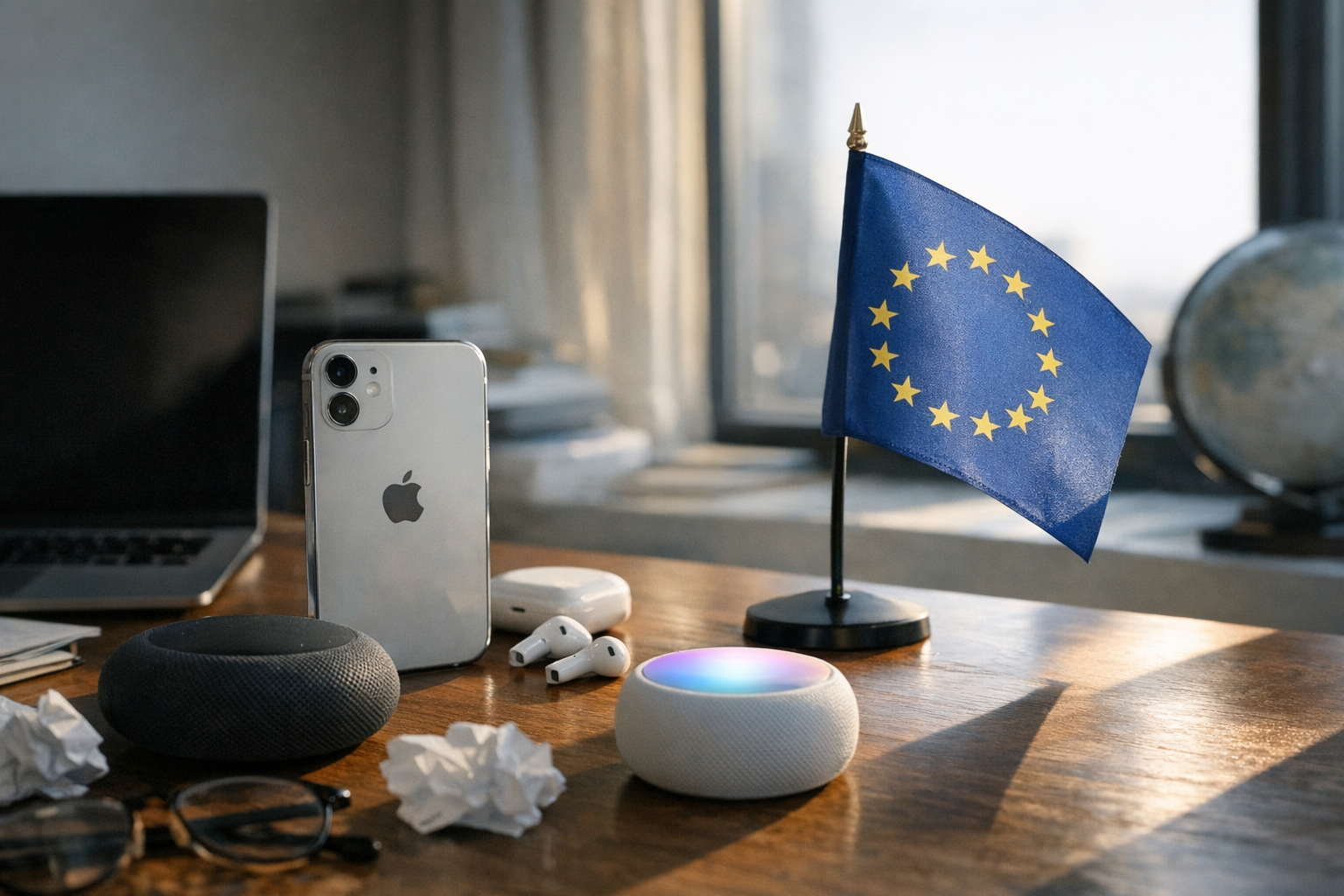
Apple refused to comply with EU rules, and now Gemini Siri won’t be launching in Europe anytime soon. That one decision sends shockwaves through the global tech industry. It fragments the user experience, delays innovation for millions of people, and raises some genuinely hard questions about who actually loses here.
The standoff between Apple and European regulators isn’t new. However, the stakes have never been higher. AI assistants are becoming central to how we use our phones. Blocking Gemini-powered Siri from an entire continent is a bold — and potentially very costly — move.
Why Apple Refused to Comply With EU Rules on Gemini Siri
The Ripple Effect: How Regulatory Friction Fragments Global Products
Competitors Who Adapted Faster — And What Apple Could Learn
The Cost-Benefit Analysis: Compliance vs. Market Access
What This Means for Users on Both Sides of the Atlantic
The Bigger Picture: Tech Regulation and the Future of Global AI
Why Apple Refused to Comply With EU Rules on Gemini Siri
The root of this conflict is the Digital Markets Act (DMA). The European Commission designed the DMA specifically to curb Big Tech’s gatekeeping power — targeting companies that control major platforms like Apple’s iOS and App Store.
The DMA requires so-called “gatekeepers” to open up their ecosystems. That means allowing third-party app stores, enabling sideloading, and sharing data with competitors. Apple has pushed back on nearly every front.
Apple’s core argument is straightforward. Complying with these rules would compromise user privacy and security. The company has repeatedly stated that opening iOS to third parties introduces risks it simply can’t control — and honestly, that argument isn’t entirely without merit.
Consequently, when Apple announced its partnership with Google to integrate Gemini into Siri, Europe was conspicuously absent from the rollout plan. The reason? Apple refused to comply with EU rules around Gemini Siri integration because regulators wanted guarantees about data sharing, interoperability, and AI transparency that Apple wasn’t willing to provide.
Here’s what the DMA specifically demands that conflicts with Apple’s AI plans:
- Data portability: Users must be able to move their AI-generated data freely
- Interoperability: Competing AI assistants must get equal access to system-level features
- Transparency: Companies must disclose how AI models process personal data
- Non-preferential treatment: Apple can’t favor Gemini over rival AI assistants
Apple views these requirements as fundamentally incompatible with a tightly integrated AI experience. Therefore, instead of compromising, Apple chose to withhold the feature entirely.
That last part is what surprised me most when I first dug into this. Not the refusal itself — but how absolute it was. No modified rollout, no partial compliance, no timeline. Just nothing for European users.
The Ripple Effect: How Regulatory Friction Fragments Global Products
When Apple refused to comply with EU rules on Gemini Siri, it didn’t just affect one feature. It created a template for how tech companies handle regulatory disagreements — and that template is fragmentation.
Europe is becoming a different tech universe. Features that American users take for granted simply don’t exist across the Atlantic. This isn’t limited to Gemini Siri — Apple Intelligence, the company’s broader AI suite, also launched without European availability. Moreover, this pattern extends well beyond Apple.
Here’s how fragmentation plays out in practice:
- Feature delays — European users wait months or sometimes years for features Americans get at launch
- Reduced functionality — When features do finally arrive, they’re often stripped down to meet compliance requirements
- Developer confusion — App makers must build and maintain separate versions for different regions
- Consumer frustration — People traveling between the US and Europe experience jarring differences on the same device
The cost isn’t theoretical. Developers spend an estimated 20–30% more on compliance-related engineering when building for fragmented markets. Additionally, product teams must maintain parallel roadmaps — one for the US, one for Europe. That’s real money and real time.
This two-tier experience directly undermines Apple’s brand promise. The company has always sold a unified, consistent ecosystem. Nevertheless, regulatory friction is eroding that promise market by market — and faster than Apple’s leadership seems willing to admit.
Furthermore, the fragmentation creates an information gap that’s easy to overlook. American users get early access to AI features and provide feedback that shapes the product’s direction. European users are cut out of that loop entirely. By the time they finally get the feature, it’s been shaped by a completely different user base. That’s not just unfair to Europeans — it actually makes the product worse for everyone.
Competitors Who Adapted Faster — And What Apple Could Learn
Not every tech giant has taken Apple’s hardline approach. Importantly, some competitors found ways to comply with EU regulations while still delivering strong products — and the contrast is striking.
Google — ironically, the company behind Gemini — has been notably more flexible. Google’s approach to DMA compliance includes choice screens for default services, data portability tools, and interoperability features. Google Assistant works across Europe without major feature gaps. Meanwhile, Samsung took a similarly practical approach — its Galaxy AI features launched globally, including in EU markets, because Samsung built compliance into the product design from the start rather than treating it as an afterthought.
Meta adjusted its advertising model and data practices to meet EU requirements. The company launched its AI features across European markets with modifications, rather than withholding them entirely.
Here’s how the major players compare:
| Company | EU AI Feature Availability | DMA Compliance Approach | User Experience Gap |
|---|---|---|---|
| Apple | Blocked (Gemini Siri withheld) | Resistance and delays | Severe |
| Available with modifications | Proactive compliance | Minimal | |
| Samsung | Available globally | Built-in compliance | None |
| Meta | Available with adjustments | Negotiated compliance | Moderate |
| Microsoft | Available with Copilot | Early compliance | Minimal |
The table shows a clear pattern. Apple is the outlier. Every major competitor found a way to bring AI features to Europe. Apple alone chose to withhold them.
Notably, Google’s willingness to comply hasn’t destroyed its business model. Google Search still leads in Europe, and Android still tops market share. Compliance didn’t equal surrender — and that point deserves more attention than it gets.
So what could Apple actually learn here? Three things stand out:
- Design for compliance from day one — Don’t bolt it on as an afterthought six months before launch
- Negotiate, don’t stonewall — The EU has shown real willingness to work with companies that engage in good faith
- Partial compliance beats total absence — A modified Gemini Siri is better than no Gemini Siri
That last point sounds obvious. Apparently it isn’t, because here we are.
The Cost-Benefit Analysis: Compliance vs. Market Access
When Apple refused to comply with EU rules around Gemini Siri, the company made a calculated bet. But does the math actually support that decision?
The European market is massive. The EU represents roughly 450 million consumers, and Apple’s European revenue accounts for approximately 25% of its global total. Walking away from feature parity in that market carries real financial risk — the kind that shows up in earnings calls eventually.
Here’s both sides of the equation.
Costs of compliance:
- Engineering resources to build EU-specific versions
- Potential security risks from opening the ecosystem
- Loss of competitive advantage if rivals get equal system access
- Legal liability if AI features cause harm under stricter EU standards
- Ongoing compliance monitoring and reporting
Costs of non-compliance:
- Fines up to 10% of global annual turnover under the DMA
- Loss of ground against Samsung and Google in Europe
- Brand damage as European users increasingly feel like second-class customers
- Regulatory escalation — the EU could impose even stricter requirements
- Developer ecosystem fragmentation
The math isn’t clean. Apple’s global revenue exceeded $380 billion in fiscal 2024. A 10% fine would be enormous — roughly $38 billion. However, the EU hasn’t yet imposed maximum penalties on any tech company, so that number is more theoretical ceiling than realistic projection.
Conversely, compliance costs likely land in the hundreds of millions, not billions. Building interoperability features and data portability tools is expensive, but manageable for a company sitting on Apple’s cash reserves. This is a solvable problem.
The hidden cost is strategic. Because Apple refused to comply with EU rules for Gemini Siri, European consumers are actively considering alternatives right now. Samsung’s Galaxy AI works everywhere. Google’s Pixel phones offer Gemini without geographic restrictions. Every month Gemini Siri stays absent from Europe, Apple loses a little more ground.
Additionally, there’s a precedent problem here. If Apple successfully withholds features to pressure regulators, other companies might try the same tactic. The EU is unlikely to tolerate that. Consequently, Apple’s resistance could trigger even more aggressive regulation — and Apple would have brought it on itself.
What This Means for Users on Both Sides of the Atlantic
The fact that Apple refused to comply with EU rules on Gemini Siri creates real, daily consequences for real people. This isn’t abstract tech policy — it affects what your phone can actually do.
For American users, the impact seems positive at first glance. You get Gemini Siri without delays or compromises — fully integrated and powerful, just as Apple intended. But there’s a catch. Features built for one market don’t benefit from global feedback. European users bring diverse languages, use cases, and expectations. Without their input, Gemini Siri develops in a narrower bubble than it should.
For European users, the situation is genuinely frustrating. You bought the same iPhone — often at a higher price than American customers pay — yet you don’t get the same product. That feels unfair because it is.
Similarly, European developers face a real dilemma. Should they build apps that lean on Gemini Siri’s capabilities? If they do, those apps won’t work properly for their local user base. If they don’t, they fall behind American competitors who can use the full feature set.
The practical differences are significant:
- Smart home control — Gemini Siri can manage complex multi-device routines. European users can’t access this.
- Email and messaging AI — Intelligent replies, summaries, and drafts are unavailable in Europe.
- Photo and search intelligence — AI-powered visual search and organization features are missing.
- Contextual awareness — Gemini Siri’s ability to understand context across apps doesn’t work in EU markets.
- Third-party app integration — Apps using Siri’s new AI capabilities behave differently depending on your region.
Furthermore, travelers face an awkward reality. An American visiting Paris might find certain Gemini Siri features suddenly stop working. An EU resident visiting New York might discover capabilities they’ve never seen on their own phone. The experience is jarring — and not in a good way.
Importantly, this isn’t just about convenience. AI assistants are becoming accessibility tools, and people with disabilities rely on intelligent voice assistants for daily tasks. Withholding advanced AI features from an entire continent carries real accessibility implications that rarely get discussed.
The Bigger Picture: Tech Regulation and the Future of Global AI
The standoff over Apple refusing to comply with EU rules around Gemini Siri is really about something much larger — specifically, who gets to set the rules for AI in the 21st century. That question matters to everyone, not just Apple shareholders.
The EU has positioned itself as the world’s leading tech regulator. The DMA, the AI Act, and GDPR together form the most thorough regulatory framework on the planet. No other jurisdiction has anything comparable — and that gap is widening.
America’s approach is fundamentally different. The US favors industry self-regulation and market-driven solutions, with no federal equivalent to the DMA. Consequently, American tech companies operate with far more freedom domestically. That freedom has produced extraordinary innovation — and also some genuinely troubling outcomes.
This regulatory gap creates a tension that companies like Apple must manage constantly. Do you build one global product and comply with the strictest regulations everywhere? Or do you split by region and offer different experiences based on local rules? Apple has clearly chosen option two. Because Apple refused to comply with EU rules for Gemini Siri, it’s doubling down hard on that fragmented approach.
Nevertheless, history suggests this isn’t sustainable long-term. GDPR initially triggered similar resistance — companies complained loudly that it was unworkable. Today, most tech companies comply with GDPR globally because maintaining separate data practices costs more than universal compliance. The same logic will almost certainly apply to AI regulation. Although Apple resists now, running two separate AI ecosystems will eventually cost more than building one compliant version from the start.
Other countries are watching closely. India, Brazil, Japan, and South Korea are all developing their own digital market regulations. If Apple splits its product for every jurisdiction, the complexity becomes genuinely unmanageable. Therefore, universal compliance may ultimately be the only practical path — and the companies that figure that out early will have a real advantage.
Moreover, the OECD’s work on AI governance is pushing toward international standards. Companies that already comply with strict EU rules will have a meaningful head start when those global norms arrive. The EU’s rules aren’t going away. The only question is whether Apple adapts on its own timeline or gets forced to adapt on someone else’s.
Conclusion
The fact that Apple refused to comply with EU rules on Gemini Siri isn’t just a headline worth skimming — it’s a defining moment for global tech regulation. This decision fragments Apple’s product experience, disadvantages European consumers, and creates long-term strategic risks that will grow over time. Competitors like Google, Samsung, and Microsoft have shown that compliance is achievable without gutting product quality. Apple’s resistance looks increasingly like an outlier strategy, not a principled stand.
Here’s what you should actually do with this information:
- If you’re a US Apple user, enjoy Gemini Siri but understand your experience isn’t universal. Features shaped without global input may have real blind spots you won’t notice until later.
- If you’re a European Apple user, it’s worth genuinely considering whether competitors offer better AI experiences right now. Samsung and Google deliver AI features without geographic restrictions — straightforward comparison shopping.
- If you’re a developer, plan for fragmentation now. Build your apps to handle the absence of Gemini Siri features in EU markets gracefully, because that absence isn’t going away overnight.
- If you’re an investor, watch the regulatory trajectory carefully. Because Apple refused to comply with EU rules around Gemini Siri, potential DMA fines represent material financial risk that the market may be underpricing.
The standoff will eventually resolve — regulatory pressure, competitive dynamics, and consumer demand will push Apple toward compliance. The only question is how much market share and goodwill the company gives up before it gets there. And given how fast AI is moving right now, every month matters.
FAQ
Why did Apple refuse to comply with EU rules for Gemini Siri?
Apple argues that the DMA’s requirements around interoperability, data sharing, and non-preferential treatment directly conflict with its privacy and security standards. Specifically, Apple doesn’t want to give competing AI assistants the same system-level access that Gemini Siri enjoys. The company views these requirements as fundamentally incompatible with delivering a safe, tightly integrated AI experience — although critics argue that position is more about competitive control than genuine security concerns.
Will Gemini Siri ever launch in Europe?
Most likely yes — but the timeline is genuinely uncertain. Apple will probably negotiate modified compliance terms with the European Commission at some point. Alternatively, the company may develop a stripped-down version of Gemini Siri that meets EU requirements without fully opening the ecosystem. However, don’t expect it before late 2026 at the earliest, and even that estimate feels optimistic given how slowly these negotiations tend to move.
Can European users access Gemini Siri through a VPN?
Technically, some users have tried using VPNs to access region-locked features. Nevertheless, Apple ties feature availability to your device’s registered region and Apple ID country — not just your IP address. Simply using a VPN won’t unlock Gemini Siri in Europe. You’d need to change your Apple ID region entirely, which affects your App Store access and payment methods. It’s more hassle than it’s worth for most people.
What fines could Apple face for non-compliance with the DMA?
The DMA allows the European Commission to impose fines of up to 10% of a company’s global annual turnover. For Apple, that could theoretically exceed $38 billion. Additionally, repeated non-compliance can trigger fines of up to 20% — a number that would be genuinely damaging. Although the EU hasn’t yet imposed maximum penalties on any tech company, the European Commission has signaled clearly that it will enforce the DMA aggressively going forward. The first major fine against a big player will change the calculus for everyone overnight.
Are other Apple Intelligence features also blocked in Europe?
Yes — and this is important context. The issue extends well beyond Gemini Siri. Several Apple Intelligence features — including writing tools, notification summaries, and advanced photo capabilities — have faced delays or outright restrictions in EU markets. Apple has gradually rolled out some features with modifications, which shows that compliance is possible when the company chooses to pursue it. However, the most advanced AI capabilities remain unavailable in Europe because Apple’s broader compliance stance affects its entire AI product line, not just one integration.
References
Keep reading
Here are the latest posts from the blog.

The ideogram best open weight image model dropped news landed like a thunderclap in the AI community this week. And honestly? It deserves the hype. Ideogram 4.0 isn’t just an…

The multi-model strategy has crossed the line from interesting theory to genuine survival tactic. Teams still running a single large language model (LLM) in production are bl…

The numbers are staggering. 192,000 tech jobs gone in just five months — and for once, companies aren’t hiding behind vague corporate-speak about it. Between January and May…