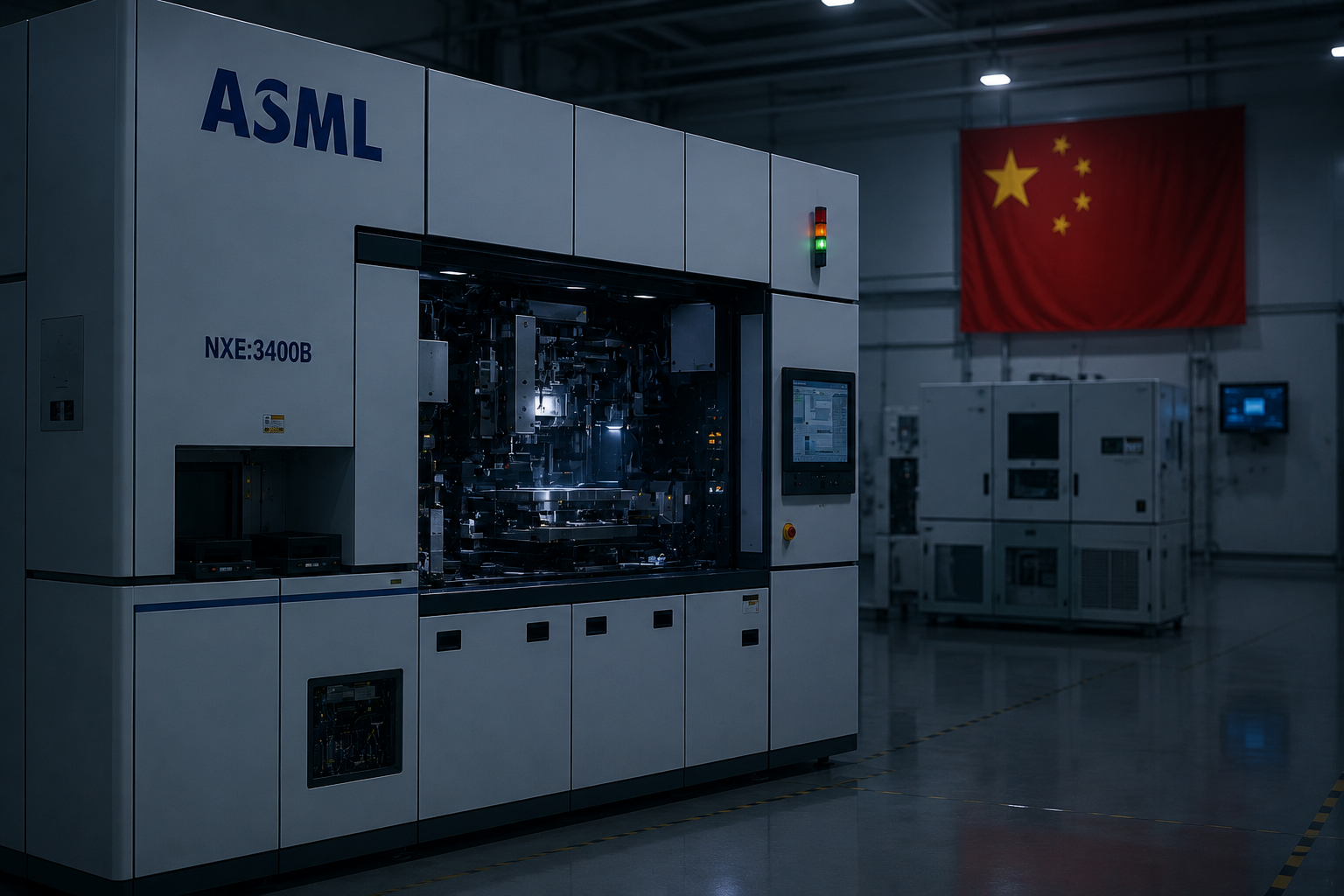
The question of whether China has obtained ASML’s restricted chip machine technology keeps surfacing in geopolitical circles — and it’s not going away anytime soon. This isn’t just a trade dispute. It’s a battle over who controls the future of artificial intelligence, and the answer is a lot messier than most headlines let on.
ASML Holding, the Dutch semiconductor equipment maker, builds the only machines capable of producing the world’s most advanced chips. These extreme ultraviolet (EUV) lithography systems cost over $200 million each. Consequently, they’ve become the most restricted technology on Earth — the crown jewels of the entire chip industry.
Why ASML’s EUV Machines Matter So Much
Timeline of Restrictions: How the US and Netherlands Blocked China
What China Can and Cannot Produce Without EUV Access
The Ripple Effects on AI Training Infrastructure
How China Might Have Accessed Restricted Technology
Why ASML’s EUV Machines Matter So Much
To understand why China obtaining ASML’s restricted chip machine dominates headlines, you first need to understand what EUV lithography actually does. Traditional chip-making uses deep ultraviolet (DUV) light to etch circuits onto silicon wafers. EUV uses a much shorter wavelength — just 13.5 nanometers — allowing chipmakers to print transistors at 7nm, 5nm, 3nm, and beyond.
Only ASML makes these machines. No other company on Earth has cracked the engineering challenge. Each EUV system contains over 100,000 parts and uses a laser to vaporize tin droplets 50,000 times per second. I’ve followed semiconductor equipment for years, and that detail still genuinely impresses me every time.
Here’s the thing: advanced AI chips — like NVIDIA’s H100 and A100 — require EUV lithography for manufacturing. Without access to these machines, a country simply cannot produce frontier AI processors. Therefore, controlling EUV access means controlling AI capability. Full stop.
Key facts about ASML’s position:
- Market share: 100% of the EUV lithography market
- Revenue: Over €27.6 billion in 2023
- Customers: TSMC, Samsung, Intel, and SK Hynix
- Backlog: Years-long waiting lists for new machines
- Employees: Approximately 42,000 worldwide
Notably, ASML isn’t just a Dutch company in practice. Its supply chain spans the US, Germany, and Japan, and American components are critical to every single EUV system. This gives Washington significant — and arguably underappreciated — influence over where these machines end up. That’s the real kicker here.
Timeline of Restrictions: How the US and Netherlands Blocked China
The story of whether China has accessed ASML’s restricted chip machine technology unfolds across a decade of escalating restrictions. Fair warning: the timeline is dense, but the pattern it reveals is worth understanding.
2018–2019: The Trump administration began pressuring the Netherlands to block EUV sales to China. Although ASML had been in discussions with Chinese chipmakers, the Dutch government quietly withheld export licenses. No formal ban existed yet — nevertheless, not a single EUV system shipped to China.
October 2022: The Bureau of Industry and Security at the US Commerce Department issued sweeping chip export controls. These rules targeted China’s ability to manufacture advanced semiconductors. Additionally, they restricted American citizens from supporting Chinese chip production — a provision that surprised many people in the industry.
January 2023: The US, Netherlands, and Japan reached a trilateral agreement aligning export controls across all three countries. Specifically, it covered both EUV and advanced DUV lithography systems, and ASML confirmed it would comply.
September 2023: The Dutch government formally established new export control rules. ASML could no longer ship its most advanced DUV systems — the TWINSCAN NXT:2000 and newer — to China. Furthermore, all EUV systems remained completely off-limits.
2024: Reports emerged suggesting China may have obtained restricted ASML technology through indirect channels. Meanwhile, ASML reported that China accounted for 49% of its equipment sales in Q1 2024 — mostly older DUV systems still permitted under the rules. That number raised a lot of eyebrows, and rightly so.
2025: Restrictions tightened further. Whether China has obtained ASML’s restricted chip machine capabilities through workarounds or smuggling remains under active investigation by multiple governments.
Each restriction prompted Chinese efforts to find alternatives, and each workaround prompted tighter controls. It’s a genuine cat-and-mouse game — and the stakes are measured in trillions.
What China Can and Cannot Produce Without EUV Access
Understanding the technical gap is essential. When people ask whether China has obtained ASML’s restricted chip machine technology, they’re really asking: can China make advanced AI chips?
The short answer is no — not at the frontier. Here’s a comparison of what’s possible with and without EUV lithography:
| Capability | With EUV Access | Without EUV Access (China’s Position) |
|---|---|---|
| Smallest node | 3nm and below | 7nm (with difficulty) |
| Transistor density | 100+ million per mm² | ~40 million per mm² |
| AI chip performance | Frontier (H100-class) | 2–3 generations behind |
| Power efficiency | Industry-leading | Significantly higher power draw |
| Yield rates | High (mature process) | Lower, especially at 7nm |
| Production volume | Mass production capable | Limited, expensive runs |
| Cost per wafer | Optimized | 2–5x higher at comparable nodes |
China’s most advanced chipmaker, SMIC, has reportedly produced 7nm chips using older DUV equipment. However, this requires a technique called multi-patterning — essentially, the machine exposes the wafer multiple times to achieve finer patterns. It works, but it’s slow, expensive, and produces lower yields. I’ve seen this technique described as “doing algebra with a crayon” — technically possible, but not pretty.
Importantly, 7nm is where NVIDIA’s older A100 chips were manufactured. NVIDIA’s current H100 and H200, however, use TSMC’s 4nm process, which requires EUV. Consequently, China faces a growing — not shrinking — performance gap in AI training hardware.
What China is doing instead:
- Stockpiling older DUV machines before restrictions tighten further
- Investing billions in domestic lithography through companies like Naura and Shanghai Micro Electronics Equipment (SMEE)
- Developing alternative chip designs that squeeze more performance out of older nodes
- Exploring chiplet designs that combine multiple smaller chips into one package
- Acquiring restricted technology through third countries — a practice under increasing scrutiny
SMEE, China’s domestic lithography champion, currently produces machines capable of roughly 90nm processes. That’s about 15 years behind ASML’s EUV capability. Similarly, building the entire supply chain — from specialized mirrors to ultra-pure chemicals — presents enormous challenges that money alone can’t solve overnight. Closing this gap isn’t impossible, but most experts put the timeline at a decade or more. And that’s assuming no further setbacks.
The Ripple Effects on AI Training Infrastructure
The question of China obtaining ASML’s restricted chip machine access connects directly to AI competitiveness — more directly than most people realize. Modern large language models require massive computing power. Training GPT-4-class models reportedly costs over $100 million in compute alone, and the chips doing that work need the most advanced manufacturing possible.
How chip restrictions shape AI capabilities:
- Training speed — Frontier AI chips process data faster. Without them, training runs take longer and cost more.
- Model size limits — Less efficient chips mean practical limits on how large a model can be.
- Energy costs — Older-node chips consume more power per operation. This makes large-scale training facilities significantly more expensive to run.
- Inference deployment — Running trained models at scale also requires efficient chips. Older hardware means slower, costlier AI services.
This hardware bottleneck is exactly why governments treat chip-making equipment like weapons. The logic is brutally straightforward: control the chips, and you control AI development. As the Brookings Institution notes in its analysis of AI geopolitics, this dynamic is reshaping how nations think about technology competition.
Additionally, the restrictions create a two-tier global AI ecosystem. Countries with access to EUV-manufactured chips can build frontier AI — countries without access cannot. Therefore, geographic location increasingly determines AI capability. That’s a genuinely unsettling dynamic if you think it through.
China’s workarounds for AI training:
- Huawei’s Ascend 910B — Made on older processes, it’s China’s best domestic AI training chip. However, it reportedly delivers roughly 60–70% of the NVIDIA A100’s performance. Not nothing, but not enough.
- Cloud access — Some Chinese companies have accessed advanced chips through overseas cloud providers, though the US has moved to close this loophole.
- Efficiency innovations — Chinese AI labs like DeepSeek have shown impressive results with fewer resources. Their DeepSeek-V3 model showed that clever engineering can partly offset hardware disadvantages. This surprised me when I first dug into the benchmarks — the gap is narrower than the hardware specs suggest.
Nevertheless, efficiency gains have limits. At some point, raw compute matters — and raw compute depends on chip manufacturing capability. Consequently, the question of whether China has obtained ASML’s restricted chip machine technology isn’t just about trade policy. It’s about the future balance of AI power between nations.
How China Might Have Accessed Restricted Technology
Several credible reports suggest that despite restrictions, some restricted ASML technology may have reached China. The methods are varied and sometimes surprising. Specifically, investigators and journalists have identified at least four distinct pathways — and none of them involve anything as dramatic as smuggling a 180-ton machine across a border.
Diversion through third countries. Restricted equipment gets shipped to a permitted country, then re-exported to China. The US Department of Commerce has flagged multiple cases of suspected diversion, and shell companies in Southeast Asia and the Middle East have drawn particular scrutiny. This is the most well-documented route.
Secondhand equipment markets. Older EUV and advanced DUV machines sometimes appear on secondary markets when fabs upgrade. Although ASML tracks its installed base carefully, enforcement gaps exist. Moreover, individual components can be harder to trace than complete systems — and components are often what matters most.
Talent recruitment. China has aggressively recruited engineers with EUV experience from ASML, TSMC, and Samsung. While a person isn’t a machine, specialized knowledge speeds up domestic development enormously. ASML has reportedly lost hundreds of employees to Chinese competitors over the past five years. That’s the kind of slow-burn technology transfer that’s very hard to stop.
Reverse engineering and domestic development. With access to older DUV systems, Chinese engineers can study lithography principles and attempt to build domestic alternatives. This path is the slowest but hardest to restrict — and therefore, in some ways, the most concerning long-term.
But here’s the thing: there’s also real reason for skepticism about the most dramatic claims. A complete EUV system weighs approximately 180 tons and requires specialized installation teams. It needs ongoing service and maintenance that only ASML provides. Smuggling one would be extraordinarily difficult. Furthermore, running it without ASML’s support infrastructure would be nearly impossible — these aren’t plug-and-play devices.
So when headlines ask whether China has obtained ASML’s restricted chip machine capabilities, the honest answer involves degrees. Full EUV capability? Almost certainly not. Incremental technology gains through various channels? Quite possibly. The distinction matters enormously — and it’s one most headlines flatten into something simpler.
What Comes Next in the Semiconductor Standoff
The battle over whether China has accessed ASML’s restricted chip machine technology won’t end soon. Several developments will shape the next phase, and the next two years are likely to be decisive.
ASML’s next-generation High-NA EUV systems are now shipping to leading chipmakers. These machines cost roughly $380 million each and enable 2nm and smaller chip production. They represent an even wider technology gap for China to bridge. Alternatively — and this is worth sitting with — they create even stronger incentive for China to find workarounds. The higher the stakes, the more aggressive the response.
Tightening enforcement remains a priority for the US and its allies. The Bureau of Industry and Security has expanded its foreign direct product rule, giving Washington authority over any technology containing American components — regardless of where it’s manufactured. That’s a significant reach, and it’s being tested constantly.
China’s domestic investment continues at unprecedented levels. Beijing has committed over $47 billion to its “Big Fund III” for semiconductor development. Although money alone can’t solve physics and engineering challenges, sustained investment at this scale will eventually narrow the gap. You shouldn’t underestimate what a determined, well-funded effort can accomplish — even against long odds.
Key indicators to watch:
- SMIC’s ability to produce chips below 7nm consistently
- SMEE’s progress toward advanced DUV capability
- ASML’s quarterly reports on China revenue (a useful proxy for permitted sales)
- US enforcement actions against suspected diversion networks
- Breakthroughs in alternative lithography techniques like nanoimprint
Importantly, this isn’t just a bilateral US-China issue. Japan’s Tokyo Electron and other equipment makers face similar restrictions. The entire global semiconductor supply chain is being restructured along geopolitical lines — and this fragmentation raises costs for everyone while potentially slowing overall innovation. That’s a tradeoff most policy discussions gloss over, and it deserves more attention.
Conclusion
The question of whether China has obtained ASML’s restricted chip machine technology has a complicated answer — and anyone offering you a simple one is probably selling something. Full EUV capability hasn’t reached China through official channels. However, partial technology transfer through talent recruitment, individual components, and older systems continues despite tightening controls. The cat-and-mouse game between restriction and circumvention shows no signs of ending.
For anyone following AI development, understanding this hardware dimension is essential. China’s access — or lack of access — to ASML’s restricted chip machines directly determines which countries can build frontier AI systems. The chips powering tomorrow’s AI models depend on today’s lithography machines. That’s not hype. That’s just how the physics works.
What you should do next:
- Follow ASML’s quarterly earnings reports for China revenue data
- Track BIS enforcement actions for signs of technology diversion
- Monitor Chinese chipmakers’ node advancement announcements
- Read analyses connecting chip restrictions to AI capability gaps
- Consider how semiconductor geopolitics affects your own technology investments and career
Bottom line: the semiconductor supply chain isn’t just a tech industry story anymore. It’s the foundation of the AI race — and whoever controls the machines that make the chips will shape the future of artificial intelligence. Pay attention to this one.
FAQ
Has China actually obtained an ASML EUV machine?
There’s no confirmed public evidence that China has obtained a complete, functional ASML EUV system. The Dutch government has blocked export licenses since 2019. Nevertheless, reports of partial technology acquisition through indirect channels persist. A full EUV system weighs 180 tons and requires ASML’s ongoing support, making covert acquisition extremely difficult.
Why can’t China build its own EUV lithography machine?
EUV lithography is arguably the most complex technology humans have ever built. It requires specialized components from dozens of suppliers across multiple countries. China’s most advanced domestic lithography company, SMEE, currently produces machines roughly 15 years behind ASML’s EUV capability. Furthermore, building the entire supporting ecosystem — from ultra-flat mirrors to specialized light sources — requires decades of accumulated expertise that can’t simply be purchased or rushed.
What chips can China currently manufacture without EUV access?
China’s SMIC has shown it can produce 7nm chips using older DUV lithography with multi-patterning techniques. However, yields are reportedly low and costs are high. Most Chinese chip production remains at 14nm and above. Consequently, China cannot domestically manufacture chips comparable to NVIDIA’s latest H100 or H200 AI processors, which require EUV-based 4nm or 5nm processes.
How do ASML restrictions affect China’s AI development?
Without access to EUV-manufactured chips, China’s AI training infrastructure lags roughly 2–3 generations behind the US. This means longer training times, higher energy costs, and practical limits on model size. Although Chinese labs like DeepSeek have shown impressive efficiency gains, the hardware gap creates a real ceiling. Additionally, the restrictions affect inference deployment, making it costlier to serve AI applications at scale.
Could China catch up in chip manufacturing despite the restrictions?
Catching up is theoretically possible but practically very difficult. China’s massive semiconductor investments — over $47 billion in Big Fund III alone — show serious commitment. However, lithography isn’t just about money. It requires deep expertise in optics, materials science, precision engineering, and software. Most experts estimate China is at least 10–15 years from producing competitive EUV-class systems domestically. Meanwhile, ASML continues advancing to High-NA EUV, potentially widening the gap further.
Why does the Netherlands control such a critical technology?
ASML’s dominance stems from decades of European investment in precision optics and lithography research. The company was spun out of Philips in 1984 and built its EUV capability over 20 years with contributions from research institutions like IMEC in Belgium. Importantly, ASML’s supply chain is genuinely global — American company Cymer provides the light source, and German company Zeiss makes the mirrors. This multinational dependency gives multiple governments real influence over where the technology goes. Specifically, US components in every EUV system give Washington effective veto power over exports — a point that often gets lost in coverage framing this as purely a Dutch policy story.
References
Keep reading
Here are the latest posts from the blog.
Understanding what makes model ‘frontier’ fuzzy line labs use isn’t just about reading press releases. It’s about digging into the evaluation frameworks that actually back th…
Geopolitical AI access: why location matters isn’t just a theoretical concern anymore. It’s a daily reality for millions of researchers, developers, and businesses worldwide…
Table of contents Introduction Why This Matters Step-by-Step Implementation Comparison Table Common Mistakes to Avoid FAQ Conclusion Introduction Choosing between teleoperati…