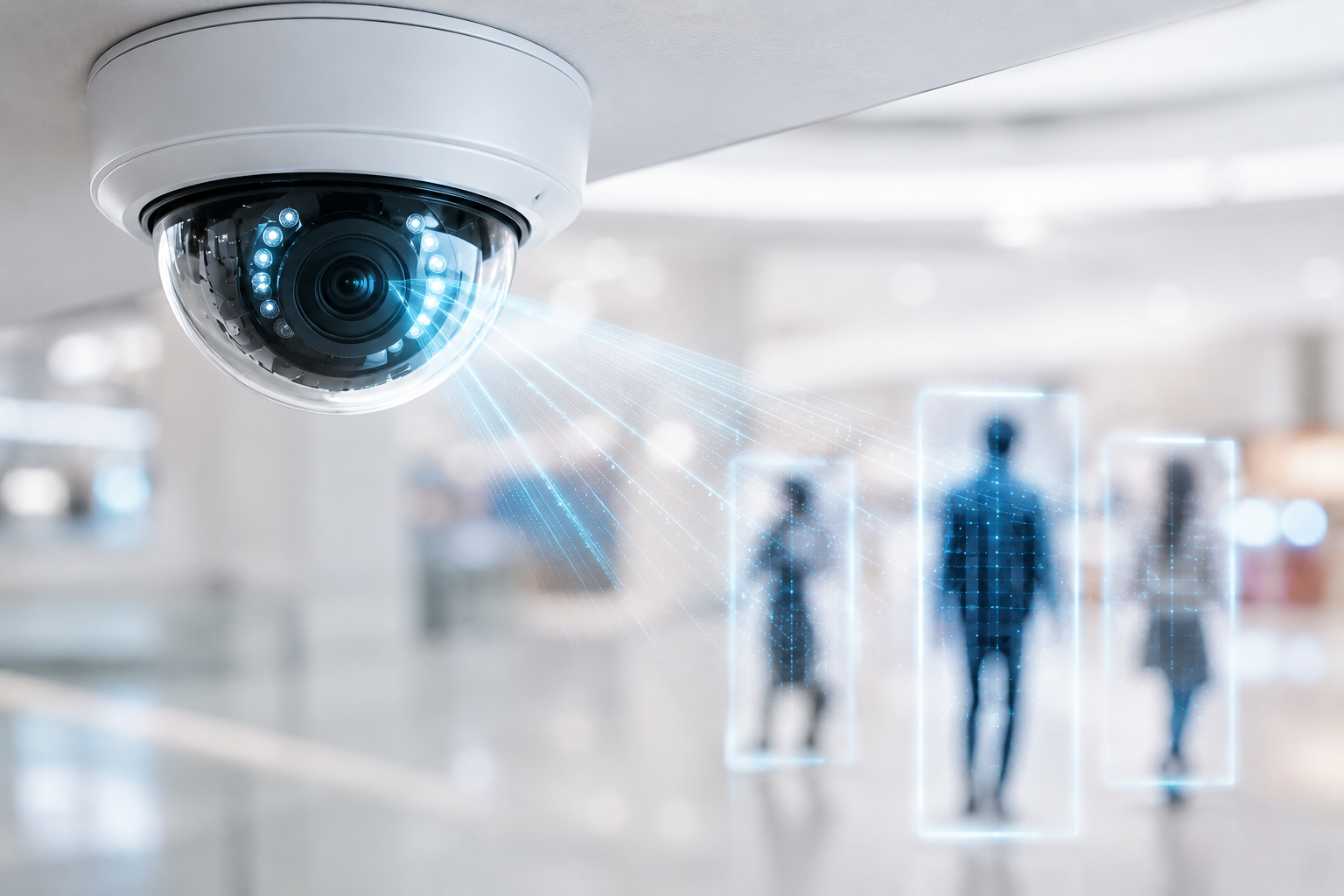
The world of edge AI vision sensors hardware acceleration inference is evolving fast. Cameras aren’t just capturing images anymore. They’re thinking, deciding, and acting — all without phoning home to a cloud server.
And this shift matters more than you might expect. When a self-driving car needs to identify a pedestrian, milliseconds count. When a factory robot inspects parts on a conveyor belt, latency kills throughput. Consequently, the industry is moving intelligence directly onto the sensor itself. Hardware acceleration at the edge isn’t a luxury — it’s becoming a necessity.
Furthermore, geopolitical realities are forcing companies to rethink their dependence on centralized compute infrastructure. Edge processing reduces that reliance dramatically. I’ve been watching this space for years, and the pace of change right now is genuinely unlike anything I’ve seen before. Specialized vision sensors with built-in hardware acceleration are reshaping real-time AI inference, and the reasons why are worth understanding closely.
How Edge AI Vision Sensors Transform On-Device Perception
Why Hardware Acceleration Is Essential for Real-Time Inference
Edge Processing vs. Cloud-Based Inference: A Direct Comparison
Geopolitical Implications of Edge AI Hardware Acceleration
Key Technologies Powering Edge AI Vision Sensor Inference
How Edge AI Vision Sensors Transform On-Device Perception
Traditional computer vision follows a simple but slow pipeline. A camera captures an image, that image travels to a server, the server runs a neural network, and results come back. This round trip introduces latency, consumes bandwidth, and creates a single point of failure.
Edge AI vision sensors flip this model entirely. They embed processing power directly into the sensor module. Specifically, chips like NVIDIA’s Jetson series or custom ASICs handle neural network inference right where data is born — no round trip required.
Consider SiLC Technologies and their Eyeonic Edge 4D vision sensor. It doesn’t just capture 3D point clouds — it processes them on-device using integrated silicon. Similarly, companies like Sony are building AI processors directly into their image sensors, producing a genuinely self-contained perception unit. This surprised me when I first dug into it. The idea that inference can happen before the data even leaves the chip is a fundamental rethink of the whole pipeline.
Why does this matter practically? Here are the key advantages:
- Zero network dependency. The sensor works even if connectivity drops completely.
- Lower latency. Inference happens in microseconds, not hundreds of milliseconds.
- Reduced bandwidth costs. Only processed results leave the device, not raw video streams.
- Better privacy. Sensitive visual data never leaves the edge.
- Improved reliability. Fewer moving parts in the data pipeline mean fewer failure points.
Moreover, edge processing addresses a growing concern about data sovereignty. When visual data stays on-device, companies don’t need to worry about cross-border data transfer regulations. That’s especially relevant for defense, healthcare, and critical infrastructure — sectors where the rules are strict and the stakes are high.
The shift toward edge AI vision sensors hardware acceleration inference also aligns with broader trends in custom silicon design. Companies are increasingly building purpose-built chips rather than renting time on general-purpose GPUs sitting in distant data centers. The architecture of AI is moving closer to the physical world, and that’s a big deal.
Why Hardware Acceleration Is Essential for Real-Time Inference
Running neural networks is computationally expensive. A typical object detection model like YOLOv8 requires billions of multiply-accumulate operations per frame. General-purpose CPUs simply can’t keep up at real-time frame rates — that’s where hardware acceleration enters the picture.
Hardware acceleration means offloading specific computational tasks to specialized circuits. These circuits are designed to do one thing extremely well: matrix math. Because neural networks are fundamentally chains of matrix multiplications, dedicated accelerators can run them orders of magnitude faster than CPUs. It’s not a marginal improvement — it’s transformative.
There are several types of hardware accelerators used in edge AI vision sensors:
- GPUs (Graphics Processing Units). Parallel processors originally designed for rendering. Good at matrix operations but notably power-hungry for edge deployments.
- NPUs (Neural Processing Units). Purpose-built for neural network inference. More power-efficient than GPUs, which is why you see them everywhere in mobile AI.
- FPGAs (Field-Programmable Gate Arrays). Reconfigurable chips that can be customized for specific models. Flexible, but fair warning: the programming complexity is real.
- ASICs (Application-Specific Integrated Circuits). Fully custom silicon optimized for a single task. Highest performance per watt, but expensive to develop from scratch.
Notably, the choice of accelerator depends heavily on your deployment scenario. A drone might use an NPU for its power efficiency. A factory inspection system might use an FPGA for its flexibility. An autonomous vehicle might use a custom ASIC for raw performance. There’s no universal right answer here.
The performance gap is massive. Running a MobileNet model on a standard ARM CPU might yield around 5 frames per second. The same model on Google’s Edge TPU hits 400 frames per second — an 80x improvement at a fraction of the power consumption. I’ve tested several of these platforms head-to-head, and that gap holds up in practice.
Additionally, hardware acceleration enables techniques that would be impossible on CPUs alone:
- Multi-model pipelines. Run detection, classification, and tracking simultaneously on a single device.
- Higher resolution processing. Handle 4K or 8K sensor feeds without downsampling.
- Temporal analysis. Process sequences of frames for action recognition, not just single-frame snapshots.
- Sensor fusion. Combine LiDAR, radar, and camera data in real time without a separate processing box.
This is precisely why hardware acceleration for real-time inference at the edge isn’t optional. It’s the foundation that makes everything else possible.
Edge Processing vs. Cloud-Based Inference: A Direct Comparison
The debate between edge and cloud processing isn’t black and white. Nevertheless, understanding the trade-offs helps you make better architectural decisions. Here’s a detailed comparison:
| Factor | Edge AI Vision Sensors | Cloud-Based Inference |
|---|---|---|
| Latency | Sub-millisecond to low milliseconds | 50–500+ ms depending on network |
| Bandwidth | Minimal (sends results only) | High (sends raw video/images) |
| Privacy | Data stays on device | Data transmitted to remote servers |
| Reliability | Works offline | Requires stable internet |
| Model size | Constrained by edge hardware | Virtually unlimited |
| Power consumption | Low (optimized silicon) | High (data center energy) |
| Scalability | Each device is independent | Centralized scaling needed |
| Update flexibility | Requires OTA firmware updates | Models update server-side instantly |
| Cost per device | Higher upfront hardware cost | Lower device cost, ongoing cloud fees |
| Geopolitical risk | Minimal external dependency | Reliant on cloud provider infrastructure |
Importantly, many production systems use a hybrid approach. The edge sensor handles time-critical inference, while the cloud handles model training, analytics, and periodic model updates. This architecture gives you the best of both worlds — and honestly, it’s what I’d recommend as a starting point for most teams.
However, the trend is clearly moving toward more edge capability. According to Arm’s analysis of edge AI workloads, the vast majority of AI inference will happen at the edge by 2026. The economics simply favor it for perception tasks. That number tracks with what I’m seeing across the industry.
Edge AI vision sensors with hardware acceleration for inference particularly shine in scenarios where:
- Network connectivity is unreliable or unavailable
- Latency requirements are under 10 milliseconds
- Data privacy regulations restrict cloud transmission
- Operating costs need to stay predictable long-term
- Systems must function completely autonomously
Conversely, cloud inference still makes sense for training large models, running complex multi-modal AI, and performing batch analytics on historical data. It’s not an either/or — it’s about being deliberate with where computation lives.
Geopolitical Implications of Edge AI Hardware Acceleration
Here’s an angle most tech blogs overlook entirely.
The global chip supply chain is fragile. Export controls, trade restrictions, and semiconductor shortages have made access to advanced compute infrastructure a genuine strategic concern — not just a procurement headache. Edge AI vision sensors with hardware acceleration directly address this vulnerability.
When your AI inference depends on cloud data centers, you’re implicitly dependent on the companies and countries that operate them. Specifically, you need their GPUs, their power grids, their network infrastructure, and their continued willingness to serve you. That’s a lot of invisible dependencies baked into what looks like a simple API call.
Edge processing changes this equation fundamentally. Once a vision sensor with an embedded accelerator ships, it’s self-sufficient. It doesn’t need ongoing access to TSMC’s latest process node to keep running. It doesn’t need a cloud subscription. It just works. And for a lot of mission-critical applications, that independence is worth a significant premium.
This matters for several critical sectors:
- Defense and national security. Military systems can’t depend on foreign cloud providers. Edge inference ensures operational independence regardless of geopolitical conditions.
- Critical infrastructure. Power grids, water treatment, and transportation systems need autonomous monitoring that survives network outages — and potentially hostile interference.
- Agriculture in remote areas. Precision farming sensors must work in fields with no cellular coverage. Full stop.
- Disaster response. When networks go down, edge AI vision sensors keep functioning — often exactly when you need them most.
Furthermore, the push toward domestic chip manufacturing in the United States — supported by the CHIPS and Science Act — directly benefits edge AI hardware development. More domestic fabrication capacity means more reliable supply chains for specialized vision processors. Whether that investment pays off at scale remains to be seen, but the direction is clear.
Although the largest AI models still require massive data center GPUs, the inference models deployed on edge AI vision sensors are typically smaller and more efficient. They can run on chips manufactured at mature process nodes. That reduces dependency on cutting-edge fabrication facilities concentrated in just a handful of countries. That’s the real point here — edge AI isn’t just a performance story, it’s a resilience story.
Therefore, investing in edge AI hardware acceleration for inference isn’t purely a technical decision. It’s a strategic one. Companies that build edge-first architectures are meaningfully more resilient to supply chain disruptions and geopolitical shifts. That resilience is starting to show up in procurement conversations at the executive level.
Key Technologies Powering Edge AI Vision Sensor Inference
Several breakthrough technologies make modern edge AI vision sensors hardware acceleration inference possible. Understanding them helps you evaluate products and make informed purchasing decisions — rather than just trusting a spec sheet.
Model compression and optimization. Large neural networks must be shrunk to fit edge hardware. Techniques include quantization (reducing numerical precision from 32-bit to 8-bit or even 4-bit), pruning (removing unnecessary connections), and knowledge distillation (training a small model to mimic a large one). Tools like TensorFlow Lite make this process accessible, though notably, getting quantization right without accuracy loss still takes real expertise.
4D sensing. Traditional cameras capture 2D images, and depth sensors add a third dimension. Sensors like SiLC’s Eyeonic Edge add a fourth dimension: velocity. This 4D data — x, y, z, and speed — gives AI models dramatically better context for understanding scenes. Consequently, inference accuracy improves while model complexity can actually decrease. I didn’t fully appreciate how much that velocity dimension changes things until I saw it applied to crowded intersection monitoring.
Neuromorphic computing. Instead of processing frames sequentially, neuromorphic chips process events asynchronously. They only compute when something changes in the scene, which cuts power consumption and latency at the same time. Companies like Intel (with Loihi) are leading the way here. It’s still early, but the efficiency gains are legitimately impressive.
In-sensor computing. Rather than separating the image sensor from the processor, some designs perform computation directly in the pixel array. Sony’s IMX500 sensor embeds an AI processor behind the pixel layer, so data never leaves the chip as raw images. Additionally, this eliminates the bottleneck of transferring data between sensor and processor — a bottleneck that’s easy to underestimate until you’re trying to push 4K at 60fps.
Heterogeneous computing architectures. Modern edge AI platforms combine multiple processor types on a single chip. A typical system-on-chip might include a CPU for control logic, an NPU for neural network inference, a GPU for image preprocessing, and a DSP for signal processing. Each handles what it does best, working in parallel.
These technologies work together to enable real-time inference on edge vision sensors at performance levels that were impossible just three years ago. Specifically, current-generation edge accelerators can run complex object detection models at 60+ frames per second while consuming under 5 watts. That would’ve seemed far-fetched not long ago.
Practical tips for evaluating edge AI vision hardware:
- Check the TOPS (Tera Operations Per Second) rating, but don’t rely on it alone. Real-world performance depends heavily on model compatibility and memory bandwidth.
- Verify supported frameworks. Can it run ONNX, TensorFlow Lite, or PyTorch models without painful conversion steps?
- Ask about power consumption under load, not just idle — those numbers can be very different.
- Evaluate the software development kit seriously. A powerful chip with poor tools is a productivity killer.
- Test with your actual models, not vendor benchmarks. I can’t stress this one enough.
- Consider the update path. Can you deploy new models via over-the-air updates without reflashing the entire device?
Building an Edge-First AI Vision Architecture
Moving from cloud-dependent AI to edge AI vision sensors with hardware acceleration for inference requires real architectural changes. Here’s a practical roadmap that I’d actually use.
Step 1: Audit your current pipeline. Map every point where visual data leaves the edge device. Identify which inference tasks could run locally, and prioritize tasks where latency, privacy, or reliability matter most. You’ll probably find more candidates than you expect.
Step 2: Select your hardware platform. Match your model requirements to available edge accelerators. For lightweight classification, a Google Coral module might suffice. For complex multi-object tracking, you’ll need something like NVIDIA’s Jetson Orin. For ultra-low-power applications, consider dedicated NPUs — and budget time for proper evaluation, because the options have exploded.
Step 3: Optimize your models. Don’t just port your cloud model to the edge — retrain specifically for edge deployment. Use quantization-aware training and benchmark on target hardware early and often. Similarly, don’t wait until the end of the project to discover your model doesn’t fit in available memory.
Step 4: Design for graceful degradation. What happens when the edge sensor encounters a scenario outside its training distribution? Build fallback mechanisms. Maybe it flags uncertain predictions for later cloud review, or defaults to a simpler but more robust model. This step gets skipped constantly and causes problems in production.
Step 5: Plan your update strategy. Edge models need periodic updates. Design your system for over-the-air model deployment, version your models carefully, and always — always — maintain a rollback capability. Importantly, a bad model update on thousands of deployed sensors is a genuinely bad day.
Step 6: Monitor performance in production. Edge doesn’t mean unmonitored. Collect inference confidence scores, processing times, and error rates. Send lightweight telemetry to your backend for fleet-wide analysis. You need visibility into what’s actually happening out there.
Alternatively, you can adopt a phased approach. Start with a hybrid architecture where both edge and cloud run inference, then gradually shift more workloads to the edge as you gain confidence. That’s often the lower-risk path. Moreover, it lets your team build edge expertise incrementally rather than all at once.
The key insight is this: edge AI vision sensors hardware acceleration inference isn’t about eliminating the cloud entirely. It’s about putting intelligence where it’s needed most — at the point of perception. Everything else follows from that principle.
Conclusion
The case for edge AI vision sensors hardware acceleration inference is compelling and getting stronger every quarter. Latency-sensitive applications demand on-device processing. Privacy regulations favor local data handling. Geopolitical realities reward infrastructure independence. And specialized silicon makes it all technically feasible right now, not in some hypothetical future.
We’ve covered how edge vision sensors cut cloud dependency, why hardware acceleration is non-negotiable for real-time performance, and how emerging technologies like 4D sensing and in-sensor computing are pushing the boundaries further. The comparison between edge and cloud architectures shows clear advantages for perception tasks that need speed and reliability. And the geopolitical angle — honestly, that’s the argument that’s starting to move budgets in ways pure technical specs never did.
Your actionable next steps:
- Evaluate your current AI vision pipeline for edge migration opportunities
- Test at least one edge AI accelerator platform with your actual production models
- Benchmark latency, power, and accuracy against your cloud-based baseline — not synthetic tests
- Factor geopolitical resilience into your hardware sourcing strategy
- Start with a hybrid architecture and progressively move inference to the edge as confidence grows
The future of computer vision isn’t in bigger data centers — it’s in smarter sensors. Edge AI vision sensors with hardware acceleration for real-time inference represent the most practical path forward for teams building reliable, fast, and genuinely independent perception systems. The technology is ready. The question is whether your architecture is.
FAQ
What are edge AI vision sensors?
Edge AI vision sensors are camera modules with built-in AI processing capabilities. They combine an image sensor with a hardware accelerator — such as an NPU or ASIC — on a single device, allowing them to run neural network inference locally. Consequently, they don’t need to send data to a cloud server for analysis. Examples include Sony’s IMX500 and SiLC’s Eyeonic Edge 4D sensor.
Why does hardware acceleration matter for edge inference?
Neural networks require billions of mathematical operations per frame. Standard CPUs can’t handle this workload at real-time speeds. Hardware acceleration uses specialized circuits designed specifically for matrix math. These accelerators deliver 10x to 100x better performance per watt compared to general-purpose processors. Therefore, they’re essential for running AI models at the frame rates that real-world applications actually demand.
How does edge AI reduce geopolitical risk?
When AI inference runs on cloud servers, you depend on external infrastructure — including data centers, network connections, and cloud provider relationships — all of which trade restrictions or geopolitical events can disrupt. Edge AI vision sensors with hardware acceleration for inference operate independently. Once deployed, they function without ongoing access to external compute resources, making them inherently more resilient to disruptions outside your control.
Keep reading
Here are the latest posts from the blog.

NVIDIA NemoClaw Isaac Sim lets developers talk to robots using plain English instead of wrestling with complex code. That single shift changes everything. Forget joysticks, f…

The internet works because DNS tells browsers where to go. But agent discovery — why AI agents need a version of this same routing logic — is a question most people haven’t s…

No source code needed. No access to training data. No hacking required. A model distillation attack works like this: someone points their code at your API, sends thousands of…