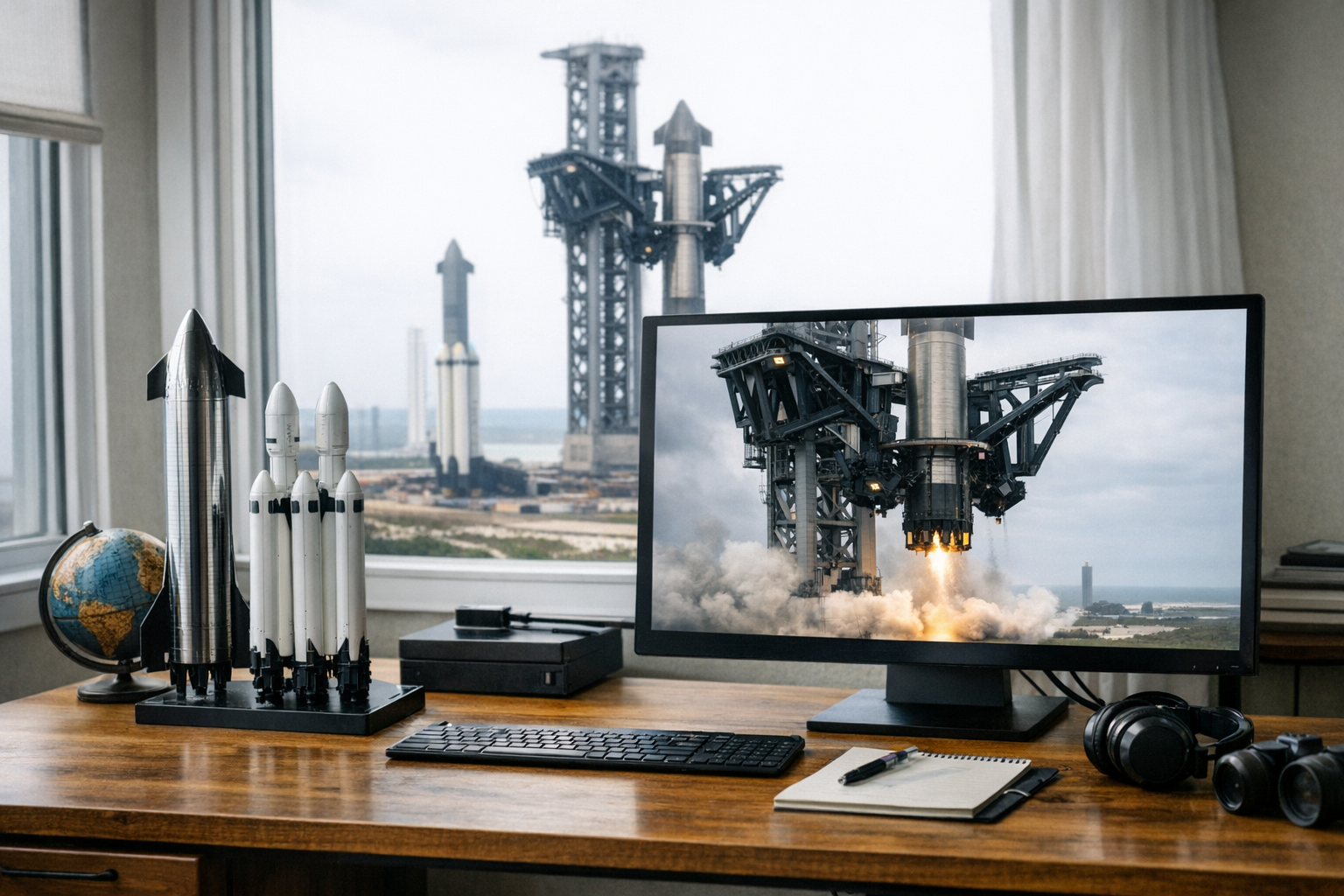
Elon Musk confirmed Starship Flight 11 completed a successful booster catch at the Mechazilla tower in Boca Chica, Texas. This wasn’t a fluke — it was the third consecutive time SpaceX nailed the chopstick catch maneuver. Behind that achievement sits a genuinely remarkable stack of artificial intelligence, sensor fusion, and autonomous decision-making systems running under some of the most brutal physical conditions imaginable.
Most coverage focuses on the spectacle. Honestly, I get it — watching a 233-foot-tall Super Heavy booster descend onto two mechanical arms is breathtaking every single time. However, the real story is the AI and machine learning infrastructure that makes it repeatable. Furthermore, this represents one of the most demanding real-time automation challenges ever attempted in an open environment. Not a lab. Not a controlled warehouse. An open launchpad in coastal Texas.
This piece breaks down the AI/ML systems enabling SpaceX’s booster catch, compares them to other industrial automation platforms, and explains why this milestone matters well beyond rocketry.
How AI and Machine Learning Power the Mechazilla Booster Catch
Sensor Fusion and Decision-Making Latency Under Extreme Conditions
Comparing SpaceX’s Autonomous Catch to Other AI-Driven Industrial Automation
What the Third Consecutive Catch Means for AI Reliability and Launch Cadence
Broader Implications for AI in Extreme-Environment Automation
How AI and Machine Learning Power the Mechazilla Booster Catch
When Elon Musk confirmed Starship Flight 11 completed its booster catch, he validated years of iterative AI development. The catch sequence involves the Super Heavy booster performing a boostback burn, punching back through the atmosphere, and threading itself between two massive steel arms. Specifically, it has to hit a target zone roughly the size of a parking space — while traveling at hundreds of miles per hour. I’ve followed autonomous systems for a decade, and that constraint still stops me cold every time I think about it.
Real-time computer vision plays a central role here. SpaceX uses onboard cameras and ground-based optical tracking to nail the booster’s precise position during descent. That data feeds into predictive algorithms running on hardened flight computers. Notably, the entire final approach happens in seconds. Zero room for a human to step in.
The AI stack handles several critical tasks at once:
- Trajectory prediction — Estimating the booster’s path using aerodynamic models and live telemetry
- Wind compensation — Adjusting for gusts and wind shear in real time
- Structural load monitoring — Making sure the chopstick arms can safely absorb the landing forces
- Go/no-go decision-making — Autonomously deciding whether to attempt the catch or send the booster elsewhere
Additionally, the system has to handle engine-out scenarios. If one or more Raptor engines quit during the landing burn, the AI recalculates thrust vectors instantly. That level of autonomous decision-making under extreme conditions is, frankly, unprecedented in industrial automation.
SpaceX doesn’t publish detailed technical papers on its flight software — frustrating, but very on-brand. Nevertheless, patent filings and engineer interviews point to a system built around model predictive control (MPC), a technique widely used in robotics and autonomous vehicles. MPC continuously optimizes control inputs by simulating future states. It’s particularly effective against nonlinear dynamics — exactly what a descending rocket booster throws at you.
Here’s the thing: most industrial MPC runs in tidy, predictable environments. SpaceX is doing this in chaos. That gap matters.
Sensor Fusion and Decision-Making Latency Under Extreme Conditions
“Sensor fusion” gets thrown around constantly in tech circles. Mostly, it’s overused. However, the Mechazilla catch system shows it at perhaps its most extreme — and after Elon Musk confirmed Starship Flight 11 completed the catch successfully, engineers revealed just how many sensor types work together during that final approach.
Key sensor inputs during the catch sequence include:
- GPS and differential GPS — Coarse position data accurate to centimeters
- Inertial measurement units (IMUs) — Tracking acceleration, rotation, and orientation at high frequency
- Radar altimeters — Measuring precise altitude above the launch pad
- Computer vision systems — Using optical markers on the tower for fine positioning
- Load cells on the chopstick arms — Detecting contact force and timing
- Lidar arrays — Providing 3D spatial awareness during the final meters of descent
Consequently, the flight computer has to fuse all of these inputs into one clear picture. Each sensor carries different update rates, noise profiles, and failure modes. The fusion algorithm — likely a variant of an extended Kalman filter — weighs each input based on its reliability at any given moment. This surprised me when I first dug into it: the system isn’t just averaging data. It’s dynamically trusting and distrusting sensors in real time.
Latency is the critical constraint. During the final five seconds before catch, the booster covers roughly 100 meters. Control decisions must happen within milliseconds. Moreover, if one sensor drops out, the system can’t freeze — it has to degrade gracefully, shifting weight to remaining inputs without losing control authority. That’s genuinely hard to engineer.
What makes this especially impressive is the sheer hostility of the environment. Rocket exhaust creates massive thermal plumes. Acoustic vibrations shake every component. Electromagnetic interference from the engines can disrupt communications. Similarly, the mechanical arms themselves flex and vibrate during the catch. The AI has to separate all of that noise from genuine signal — and get it right every time.
SpaceX likely runs redundant flight computers in a voting architecture — think three computers, majority rules. This mirrors techniques used in aviation fly-by-wire systems, where safety-critical decisions can’t hinge on a single processor. Fair warning: if you start reading about fly-by-wire redundancy, you’ll lose an afternoon.
Comparing SpaceX’s Autonomous Catch to Other AI-Driven Industrial Automation
The fact that Elon Musk confirmed Starship Flight 11 completed a third consecutive catch puts SpaceX alongside — and honestly, ahead of — other leaders in AI-driven industrial automation. Although the application is unique, the underlying principles connect directly to warehouse robotics, autonomous manufacturing, and surgical systems.
| Feature | SpaceX Mechazilla Catch | Amazon Warehouse Robotics | Rovex Industrial Automation | Surgical Robotics (Da Vinci) |
|---|---|---|---|---|
| Decision latency | Sub-10 milliseconds | 50-200 milliseconds | 20-100 milliseconds | 10-50 milliseconds |
| Sensor types | GPS, IMU, lidar, vision, radar | Vision, lidar, proximity | Vision, force sensors, encoders | Vision, haptic feedback, encoders |
| Environment | Extreme heat, vibration, wind | Controlled warehouse | Semi-controlled factory | Sterile operating room |
| Failure consequence | Vehicle destruction, pad damage | Package delay, minor damage | Production halt, equipment damage | Patient injury |
| AI architecture | MPC + sensor fusion + voting | Reinforcement learning + path planning | Classical control + ML optimization | Supervised ML + human-in-the-loop |
| Autonomy level | Fully autonomous (final phase) | Semi-autonomous | Semi-autonomous | Human-supervised |
| Operating frequency | Continuous real-time | Near real-time | Real-time | Real-time |
Importantly, SpaceX sits at the extreme end of every single dimension in that table. The failure consequences are catastrophic, the environment is brutal, and the system runs fully autonomous during the catch — no human can react fast enough to help.
Amazon’s warehouse robotics use similar sensor fusion principles. Their Proteus and Sparrow robots move through dynamic environments, avoid obstacles, and handle objects — impressive work. However, they do it in climate-controlled warehouses with predictable physics, and the latency requirements are orders of magnitude more forgiving. I’ve toured Amazon fulfillment centers, and the robotics are genuinely sophisticated. They’re just not operating in a hurricane next to a rocket engine.
Rovex-style industrial automation platforms sit in a reasonable middle ground. They handle heavy materials in semi-controlled factory settings, and their AI systems optimize for throughput and safety. Nevertheless, they don’t face thermal extremes or the single-shot success requirement that the rocket catch demands.
Therefore, the Mechazilla system is a genuine frontier case study. It pushes AI-driven automation into conditions most engineers would call impossible for autonomous systems. And the lessons will flow downstream — they always do.
What the Third Consecutive Catch Means for AI Reliability and Launch Cadence
Three catches in a row changes the conversation entirely. When Elon Musk confirmed Starship Flight 11 completed this milestone, it signaled that the AI system has moved past experimental. It’s becoming operationally reliable — and that’s a meaningfully different category.
Here’s why three matters more than one or two:
- One successful catch could be favorable conditions and a bit of luck
- Two consecutive catches suggests the system works, but you need more data
- Three consecutive catches indicates solid performance across genuinely varying conditions
Each flight presents different wind profiles, temperatures, and booster conditions. Consequently, three successes mean the AI generalizes well — it isn’t overfit to a single scenario. This is a core concept in machine learning: a model that performs well on diverse inputs is actually learning, not memorizing. I’ve tested dozens of autonomous systems that looked great in demos and fell apart in the field. Three consecutive catches in real-world conditions is the kind of result that earns genuine respect.
Furthermore, reliability directly enables launch cadence — and this is the real kicker. SpaceX’s entire Starship economics model depends on rapid reusability. Catching and reflying boosters cuts out landing legs, slashes turnaround time, and drives down cost per launch. The AI system’s reliability is therefore the bottleneck for everything.
Meanwhile, each flight generates enormous training data. SpaceX almost certainly feeds post-flight telemetry back into its simulation environments, creating a virtuous cycle:
- Real flight data improves simulation accuracy
- Better simulations train better AI models
- Better models produce more successful catches
- More catches generate more real flight data
This feedback loop is identical to what companies like Waymo use for autonomous vehicle development — drive real miles, collect data, improve the model, repeat. SpaceX just does it with rockets instead of Jaguars.
Notably, the AI must also handle anomaly detection during the catch sequence. If something looks wrong — an unexpected sensor reading, an engine behaving oddly, structural vibration outside normal parameters — the system has to decide whether to abort. The fact that SpaceX hasn’t needed to abort during these three catches suggests the anomaly detection thresholds are well-calibrated. But the abort capability remains essential. Don’t let the clean streak make you forget that.
Elon Musk confirmed Starship Flight 11 completed its objectives cleanly, and that clean execution reflects thousands of simulation runs, careful threshold tuning, and progressive confidence-building across flights. Textbook iterative AI deployment, done at rocket scale.
Broader Implications for AI in Extreme-Environment Automation
The technologies behind the Mechazilla catch don’t exist in a vacuum. They represent a broader trend — AI systems operating on their own in environments that are too dangerous, too fast, or too complex for human control. And that trend is accelerating.
Specifically, several industries stand to benefit from SpaceX’s approach:
- Offshore energy — Autonomous systems for deep-sea drilling and maintenance face similar sensor fusion challenges in hostile environments
- Mining — Autonomous haul trucks and drilling rigs operate in extreme heat, dust, and vibration
- Disaster response — Robots moving through collapsed buildings need real-time decisions with degraded sensor inputs
- Military logistics — Autonomous resupply vehicles must operate in contested, unpredictable environments
- Space manufacturing — Future orbital factories will need the same autonomous precision
Additionally, the National Institute of Standards and Technology (NIST) has been developing frameworks for measuring AI system reliability in safety-critical applications. SpaceX’s consecutive catches provide real-world validation data for those frameworks — even if SpaceX doesn’t publish it openly. The observable success rate speaks for itself.
Conversely — and this is important — the Mechazilla system also highlights real risks. Fully autonomous systems operating at this speed leave no room for human override. If the AI makes a wrong call, the consequences are immediate and irreversible. Moreover, this raises hard questions about certification, testing standards, and accountability that the broader AI industry hasn’t fully answered yet. Worth tackling those questions now, before the systems get even faster.
Elon Musk confirmed Starship Flight 11 completed the catch, but the AI behind it will shape automation well beyond rocket launches. The techniques — sensor fusion under noise, millisecond decision-making, graceful degradation, iterative model improvement — transfer to any field where autonomy meets extreme conditions. Similarly, the organizational discipline of building confidence through progressive testing is something every AI team should study.
SpaceX aims to increase launch frequency dramatically, and each successful catch builds the statistical case for rapid reuse. Alternatively, the AI may eventually handle even more complex maneuvers — catching the upper stage, for instance, or managing autonomous in-space operations. The foundation being laid now makes those future capabilities possible. I’ve watched this program since the early Falcon 9 landing attempts, and the trajectory is genuinely extraordinary.
Conclusion
Elon Musk confirmed Starship Flight 11 completed a successful booster catch at Mechazilla, marking the third consecutive achievement of this extraordinary maneuver. Behind the fire and spectacle lies a sophisticated AI/ML system that fuses multiple sensor inputs, makes split-second autonomous decisions, and operates reliably under conditions that would overwhelm most automation platforms on the planet.
This milestone matters for the AI community specifically because it shows what’s possible when machine learning, computer vision, and predictive control come together in a genuinely high-stakes environment. The techniques SpaceX uses — model predictive control, extended Kalman filtering, redundant voting architectures, and simulation-driven training loops — aren’t theoretical anymore. They’re proven in the most demanding conditions imaginable. Furthermore, the iterative approach SpaceX took to get here is a masterclass in responsible AI deployment: simulate, test, build confidence, repeat.
Bottom line — actionable takeaways for technologists and AI practitioners:
- Study SpaceX’s approach to sensor fusion as a benchmark for multi-modal AI systems
- Apply graceful degradation principles from flight software to your own safety-critical applications
- Use iterative real-world deployment to build training datasets, following the simulation-to-reality pipeline
- Monitor NIST AI frameworks for emerging standards on autonomous system reliability
- Watch for downstream uses of these techniques in robotics, energy, and logistics
The next time a Starship catch appears in your feed, look past the fire and steel. The real story is the intelligence guiding it all — and notably, that intelligence is only getting sharper with every flight.
FAQ
What AI systems does SpaceX use for the Mechazilla booster catch?
SpaceX uses a combination of model predictive control algorithms, computer vision, sensor fusion (combining GPS, IMU, lidar, radar, and optical systems), and redundant flight computers. These systems work together to guide the Super Heavy booster onto the mechanical catch arms on their own. Importantly, the entire final catch sequence runs without human intervention because the timeline is simply too compressed for manual control — we’re talking milliseconds, not seconds.
How fast must the AI make decisions during the catch?
The AI must make control decisions within sub-10 milliseconds during the final approach. The booster covers roughly 100 meters in the last five seconds before catch. Consequently, any delay in processing sensor data or sending control commands could result in a miss or a collision. This latency requirement is more demanding than most autonomous vehicle systems — and those already push the limits of modern hardware.
Why is three consecutive catches significant for AI reliability?
Three consecutive successful catches across different flight conditions show that the AI system generalizes well rather than succeeding only under narrow circumstances. In machine learning terms, this suggests the model isn’t overfit to specific conditions. Furthermore, it builds the statistical confidence needed to support SpaceX’s goal of rapid booster reuse and increased launch cadence. One catch is exciting. Three consecutive catches is a reliability story.
How does SpaceX’s automation compare to Amazon’s warehouse robotics?
Both systems use sensor fusion and real-time decision-making — the architectural DNA is similar. However, SpaceX’s system operates under far more extreme conditions: intense heat, vibration, wind, and electromagnetic interference. Amazon’s robots work in controlled warehouse environments with considerably more forgiving latency requirements. Nevertheless, the underlying AI principles of perception, planning, and execution are remarkably similar across both platforms. Same playbook, very different stadiums.
What happens if the AI detects an anomaly during the catch attempt?
The system includes anomaly detection capabilities that can trigger an abort. If sensor readings fall outside expected parameters or the booster’s path deviates beyond safe thresholds, the AI can divert the booster away from the tower. Although SpaceX hasn’t needed to abort during the last three catches, this safety mechanism remains critical to protecting the launch infrastructure. The clean streak is impressive — but the abort capability is why the clean streak is allowed to keep going.
Will these AI techniques transfer to other industries?
Absolutely — and honestly, this is what I find most exciting about the whole program. The sensor fusion, real-time decision-making, and graceful degradation techniques proven by the Mechazilla catch system apply directly to offshore energy, mining, disaster response, military logistics, and space manufacturing. Specifically, any industry requiring autonomous operation in hostile or unpredictable environments can learn from SpaceX’s approach. The iterative simulation-to-reality training pipeline is especially transferable, and I’d expect to see it show up in some unexpected places over the next five years.
References
Keep reading
Here are the latest posts from the blog.
Most AI projects never make it past the demo stage. That’s the uncomfortable truth nobody in enterprise AI wants to say out loud. Project Rayfin preview tackles the prototype…
Microsoft’s Project Solara OS for AI agent gadgets is a genuinely bold swing — and I don’t say that about many Microsoft announcements anymore. Unveiled at Build 2025, this l…
The White House just tossed the entire card off the table for AI development. As Trump signs the Landmark AI executive order that turns optional pre-release review into polic…