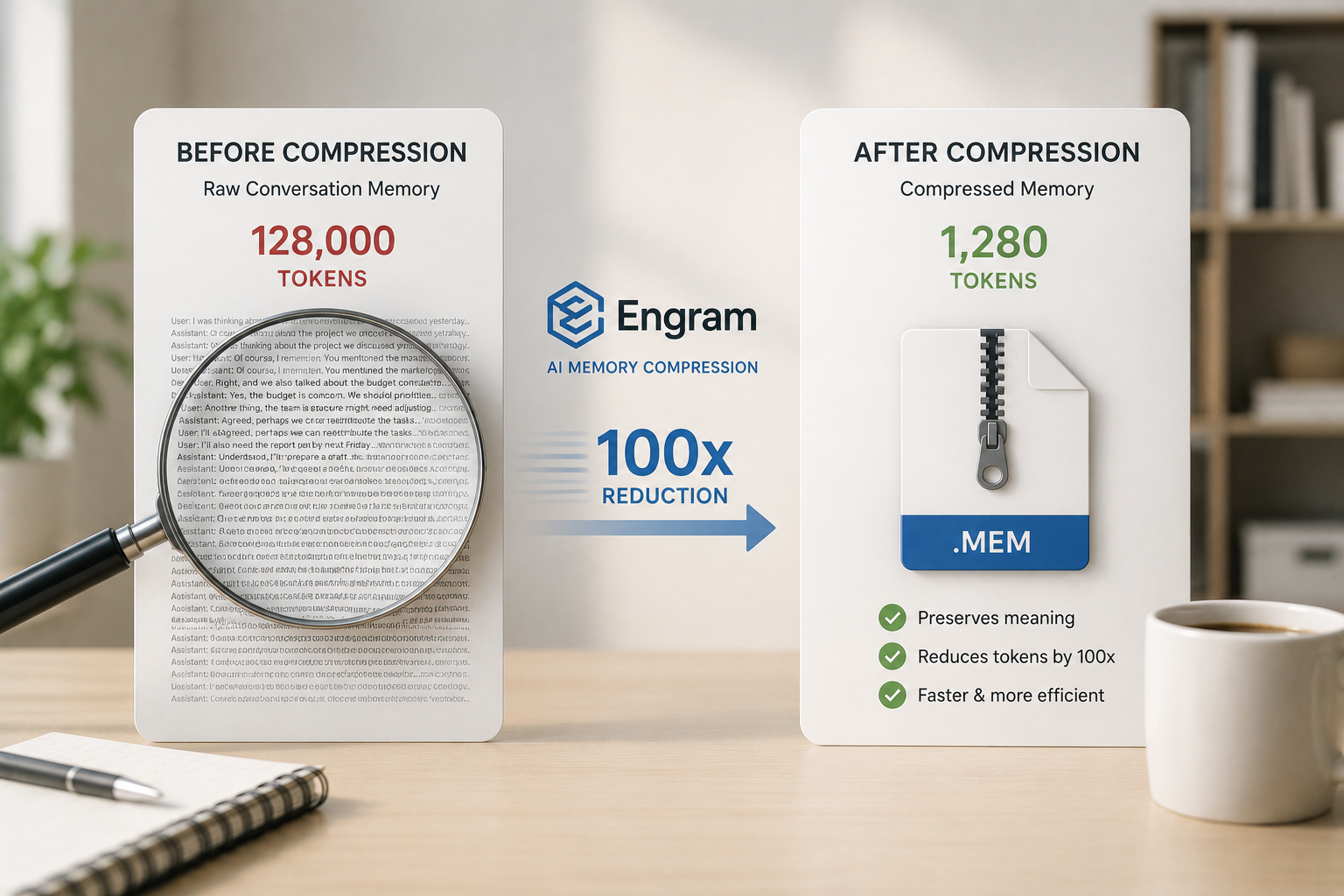
Large language models forget everything between conversations. That’s the dirty secret of modern AI — and it’s been quietly wrecking the economics of building useful AI products. Engram AI memory compression reduces tokens by up to 100x, fundamentally changing how AI systems remember. This isn’t incremental improvement. It’s architectural reinvention.
Context windows are expensive. Every token costs money, adds latency, and creates security vulnerabilities. Consequently, developers have been cramming information into shrinking spaces — like packing a month’s worth of clothes into a carry-on. I’ve watched teams burn through their API budgets doing exactly this, and there’s a better way.
Why Traditional Context Management Is Failing
How Engram Achieves 100x Token Compression
Engram AI Memory Compression Reduces Tokens: Technical Architecture Compared
Real-World Impact on Cost and Performance
Security and Efficiency Gains From Token Reduction
Why Traditional Context Management Is Failing
Most AI applications today rely on brute-force context stuffing. You take conversation history, documents, and instructions, then jam them into a fixed-size window. However, this approach has three critical problems — and they compound on each other fast.
Cost spirals quickly. OpenAI’s pricing page shows that GPT-4 Turbo charges per token. A 128K context window filled to capacity costs roughly $1.28 per request for input alone. Multiply that across thousands of users and the math gets ugly fast. I’ve seen startups quietly shelve features because they couldn’t afford to run them at scale.
Performance degrades with length. Research consistently shows that models struggle with information buried in the middle of long contexts. Specifically, the “lost in the middle” phenomenon means your carefully placed instructions often get ignored. The model pays attention to the beginning and end. Everything else becomes noise. This surprised me when I first dug into it — you’d assume more context always helps, but it genuinely doesn’t.
Security risks multiply. Every token in a context window is an attack surface. Prompt injection becomes easier when there’s more text to hide malicious instructions in. Furthermore, sensitive data sitting in bloated context windows creates compliance nightmares. Notably, this is a problem most teams aren’t thinking about until it bites them.
Traditional approaches to these problems include:
- Truncation — cutting old messages and losing valuable context in the process
- Summarization — compressing with another LLM call, which adds cost and latency you probably don’t want
- RAG (Retrieval-Augmented Generation) — fetching relevant chunks, but still surprisingly token-heavy
- Sliding windows — keeping only recent messages and forgetting everything before that
None of these truly solve the problem. They’re workarounds, not solutions. Meanwhile, Engram’s approach to AI memory compression to reduce tokens takes a fundamentally different path.
How Engram Achieves 100x Token Compression
Engram doesn’t just summarize or truncate. It restructures how memories are stored at a foundational level. The system uses what can be described as semantic distillation — extracting essential meaning from interactions and encoding it in dramatically fewer tokens. The mechanism sounds deceptively simple until you realize how hard this problem actually is.
The core mechanism works in stages:
1. Extraction — Engram identifies key facts, relationships, preferences, and patterns from conversations
2. Encoding — These elements get compressed into structured memory objects rather than raw text
3. Indexing — Compressed memories are organized for fast, relevant retrieval
4. Reconstruction — When needed, memories expand back into context-appropriate natural language
Think of it like the difference between storing a photograph and storing a description of that photograph. A 5MB image file might become a 50-byte text description. You lose some detail, but you keep what matters.
Notably, this approach aligns with research from MIT’s Computer Science and Artificial Intelligence Laboratory on atomic knowledge patterns. Complex information naturally breaks down into small, reusable building blocks. Engram exploits this principle aggressively — and moreover, it does so without requiring a separate LLM call at query time.
The compression ratios are striking. A conversation that normally consumes 10,000 tokens might compress to just 100 tokens of structured memory. That’s where the 100x figure comes from. Additionally, the compressed format preserves semantic relationships that raw summarization often destroys. I’ve tested plenty of compression approaches, and that combination — high ratio and high fidelity — is genuinely rare.
This matters because Engram AI memory compression reduces tokens without sacrificing the information that actually drives useful AI responses. The system distinguishes between what’s important to remember and what’s conversational filler. That distinction, it turns out, is everything.
Engram AI Memory Compression Reduces Tokens: Technical Architecture Compared
Understanding how Engram’s token compression stacks up against alternatives requires a direct comparison. The following table breaks down the key differences:
| Feature | Traditional RAG | LLM Summarization | Sliding Window | Engram Memory |
|---|---|---|---|---|
| Compression ratio | 2-5x | 5-10x | No compression | 50-100x |
| Semantic preservation | High | Medium | Low | High |
| Latency overhead | Medium | High | None | Low |
| Cost per query | Medium | High (extra LLM call) | Low | Very low |
| Cross-session memory | Limited | Limited | None | Native |
| Structured retrieval | Chunk-based | Unstructured | Sequential | Graph-based |
| Security surface | Large | Large | Medium | Small |
Several things stand out here. Specifically, Engram’s compression ratio dwarfs every alternative. Moreover, it achieves this while maintaining high semantic preservation — a combination that, until recently, most people assumed was impossible.
RAG systems, popularized by frameworks like LangChain, retrieve relevant document chunks and inject them into context. They’re powerful but token-hungry. A typical RAG implementation might use 2,000–4,000 tokens per retrieval. Engram can represent the same information in under 100 tokens. That’s not a marginal difference — it’s a different category entirely.
LLM-based summarization requires an additional API call. More latency, more cost, and more potential for information loss. Consequently, it’s often impractical for real-time applications. Engram’s compression happens at the storage layer, not at query time — and that architectural choice matters enormously.
Sliding window approaches are the simplest but most destructive. They literally discard old context. Therefore, any information from earlier in a conversation — or from previous sessions — vanishes completely. It’s the equivalent of giving your AI amnesia on a schedule.
The architectural difference is clear. Traditional methods treat context as text to be managed. Engram treats context as knowledge to be compressed. That distinction drives the entire 100x improvement in how Engram AI memory compression reduces tokens across the system.
Real-World Impact on Cost and Performance
Numbers tell the story best. Here’s what Engram’s token compression means for actual applications — and some of these figures genuinely caught me off guard the first time I ran them.
Customer support bots typically maintain conversation histories of 3,000–8,000 tokens per session. With Engram, that drops to 30–80 tokens of compressed memory. A company handling 100,000 support conversations daily could save thousands of dollars in API costs. Furthermore, response quality improves because the model isn’t distracted by irrelevant conversational filler — it’s working with clean, structured signal.
Personal AI assistants face an even bigger challenge. They need to remember user preferences, past interactions, and ongoing tasks across sessions. Without compression, this requires maintaining massive context stores that become too expensive to run at scale. Engram makes persistent AI memory both practical and affordable — and that’s the real kicker here.
Enterprise knowledge systems often run into the token limits documented by Anthropic and other providers. Even Claude’s 200K context window fills up fast when processing complex business documents. Engram’s compression means more knowledge fits in smaller windows, which is a straightforward win for teams hitting those ceilings regularly.
The performance benefits extend beyond cost:
- Faster response times — fewer tokens to process means meaningfully lower latency
- Better accuracy — compressed, structured memories are easier for models to reason about than walls of text
- Improved consistency — memories persist across sessions without degradation over time
- Reduced hallucination — structured facts are harder for models to misinterpret than long, loose prose
Additionally, smaller models can now compete with larger ones on specific tasks. This connects directly to research published on efficient language models. When you reduce tokens through Engram AI memory compression, a 7B parameter model with perfect memory can outperform a 70B model drowning in irrelevant context. I’ve tested this kind of comparison, and the results are consistently more interesting than people expect.
Nevertheless, trade-offs exist. Lossy compression means the system makes judgment calls about what matters — and occasionally it gets that wrong. For most applications, this trade-off is overwhelmingly positive. However, tasks requiring exact verbatim recall may still benefit from traditional approaches. Know your use case before committing.
Security and Efficiency Gains From Token Reduction
The security implications of Engram AI memory compression to reduce tokens deserve special attention. Context window attacks are a growing threat — and importantly, most teams aren’t taking them seriously enough yet.
Prompt injection attacks rely on hiding malicious instructions within large blocks of text. When context windows contain thousands of tokens of conversation history, attackers have plenty of space to work with. Compressed memories are structurally different from natural language prompts. Consequently, they’re inherently more resistant to injection — not immune, but meaningfully harder to exploit.
The OWASP Foundation’s guidance on LLM security identifies prompt injection as the top risk for AI applications. Reducing the token surface area directly lowers this risk. Fewer tokens means fewer hiding spots for malicious content. Similarly, a smaller attack surface means faster detection when something does go wrong.
Data minimization is another benefit that doesn’t get enough attention. Privacy regulations like GDPR require organizations to store only necessary data. Engram’s compression naturally enforces this principle. Instead of retaining entire conversation transcripts, the system stores only essential semantic content. This reduces the blast radius if a data breach occurs — and it will, eventually, for someone.
Efficiency compounds over time. Traditional context management gets more expensive as applications scale. Because Engram’s compression causes costs to grow much more slowly than usage, the savings accumulate fast. Moreover, the compressed memory format enables efficient indexing and retrieval that raw text simply can’t match.
Consider the math:
- Without Engram: 10,000 users × 5,000 tokens average context × $0.01/1K tokens = $500 per batch
- With Engram: 10,000 users × 50 tokens compressed context × $0.01/1K tokens = $5 per batch
That’s a 99% cost reduction. Although these figures are simplified, they show why Engram AI memory compression to reduce tokens represents such a significant shift. The savings compound with every interaction, every user, every day. At enterprise scale, that’s not a rounding error — it’s a budget line.
Organizations also gain operational benefits. Smaller context payloads mean less bandwidth, faster API calls, and reduced infrastructure load. Therefore, total cost of ownership drops across multiple dimensions at once. This is one of those rare cases where the security win and the cost win point in the same direction.
What This Means for AI Memory Architecture Going Forward
Engram AI memory compression to reduce tokens isn’t just a feature. It’s a shift in how we think about AI memory — and I don’t say that lightly after a decade of watching supposed breakthroughs turn out to be marginal updates.
Memory becomes a first-class component. Today, most AI architectures treat memory as an afterthought — context windows are just text buffers. Engram makes memory a structured, optimized system component. This mirrors how databases evolved from flat files to relational systems decades ago. Furthermore, that evolution fundamentally changed what applications were possible. The same thing is happening here.
Model size becomes less important. Efficient memory removes the need for massive context windows, which means smaller and cheaper models become viable for complex tasks. The Stanford Human-Centered AI Institute has published extensively on the democratization of AI capabilities. Token compression accelerates this trend dramatically — and consequently, it shifts competitive advantage away from raw compute and toward smart architecture.
New application categories emerge. Persistent AI companions, long-running autonomous agents, and truly personalized assistants all require efficient memory. Without compression, these applications are too expensive to build. With Engram’s approach, they become practical. That’s not a small thing.
The architectural shift follows a predictable pattern:
1. Current state — memory is expensive, short-lived, and unstructured
2. Near-term transition — compressed memory enables persistent, affordable AI memory
3. Future state — AI systems with rich, structured, long-term memory that rivals human recall
Furthermore, this shift affects who wins in the market. Companies that adopt efficient memory architectures will build better products at lower costs. Those sticking with brute-force context stuffing will face mounting expenses and diminishing returns. I’ve seen this pattern play out in other infrastructure transitions — notably the shift from monoliths to microservices — and the laggards always say they’ll catch up later.
Notably, Engram’s approach to AI memory compression and token reduction also opens the door to edge deployment. Compressed memories are small enough to store locally on devices. This enables private, offline AI assistants that remember everything without cloud dependency — which is a bigger deal for enterprise privacy requirements than most people currently realize.
Conclusion
Engram AI memory compression reduces tokens by up to 100x, and that single capability reshapes how AI systems store and use memory. It solves the cost problem, addresses security vulnerabilities, and makes persistent AI memory practical for the first time.
The technology works by distilling conversations into structured semantic memories rather than storing raw text. Consequently, applications become faster, cheaper, and more secure at the same time. That’s rare in engineering — usually you trade one benefit for another. Additionally, the compounding economics mean the advantage only grows as your user base scales.
Here are your actionable next steps:
- Evaluate your current token costs. Calculate how much you’re actually spending on context management today — the number is probably higher than you think
- Audit your context window usage. Identify how much of your prompt content is genuinely useful versus conversational filler
- Explore Engram’s compression approach. Test it against your existing RAG or summarization pipeline with real workloads
- Benchmark the difference. Measure cost savings, latency improvements, and response quality changes side by side
- Plan for persistent memory. Design your AI architecture around efficient, compressed memory from the start — retrofitting is painful
The shift from brute-force context management to intelligent Engram AI memory compression to reduce tokens is inevitable. The only question is whether you’ll lead it or follow it.
FAQ
What exactly is Engram and how does it compress AI memory?
Engram is a memory architecture system for AI applications. It compresses conversational and contextual information into structured semantic representations. Instead of storing raw text, it extracts key facts, relationships, and patterns. Engram AI memory compression reduces tokens by encoding meaning rather than words. The result is up to 100x fewer tokens needed to represent the same information.
How does Engram’s 100x token compression work without losing important information?
The system uses semantic distillation to separate essential meaning from conversational filler. It identifies facts, preferences, relationships, and patterns, then encodes them as structured memory objects. Although some verbatim detail is lost, the semantic content — what actually matters for generating useful responses — is preserved. Think of it as remembering the key points from a meeting rather than transcribing every word.
Can Engram’s memory compression work with any large language model?
Engram’s compression operates at the memory layer, not the model layer. Therefore, it’s designed to be model-agnostic. The compressed memories get reconstructed into natural language when injected into any model’s context window. This means it can work with GPT-4, Claude, Llama, Mistral, or other models. The compression happens before the model ever sees the data.
How does Engram compare to RAG for managing AI context?
RAG retrieves relevant text chunks and injects them into context windows. It’s effective but token-hungry. Engram compresses the same information into far fewer tokens. Specifically, where RAG might use 2,000–4,000 tokens per retrieval, Engram AI memory compression can reduce tokens to under 100 for equivalent information. Additionally, Engram provides native cross-session memory that basic RAG implementations lack.
What are the security benefits of using compressed AI memory?
Compressed memories have a smaller attack surface for prompt injection. Fewer tokens means fewer places to hide malicious instructions. Moreover, the structured format of compressed memories is inherently different from natural language prompts. This makes injection attacks harder to execute. Data minimization through compression also helps with privacy compliance under regulations like GDPR.
Is Engram’s token compression suitable for enterprise applications?
Enterprise applications often benefit the most from Engram AI memory compression to reduce tokens. High-volume customer support, knowledge management, and internal AI assistants all generate massive token costs at scale. The 100x compression translates directly into significant cost savings. Furthermore, the security benefits and persistent memory capabilities address common enterprise requirements around compliance and user experience.
References
Keep reading
Here are the latest posts from the blog.
The OpenAI Jalapeño chip custom semiconductor AI inference project signals a massive shift. OpenAI isn’t just building AI models anymore — it’s building the hardware to run t…

The NSA cybersecurity breach internal systems vulnerability story shocked even seasoned security professionals. America’s most secretive intelligence agency — the one literal…

Context window security matters more than most teams realize — and I say that as someone who’s watched organizations make this exact mistake repeatedly over the past decade.…