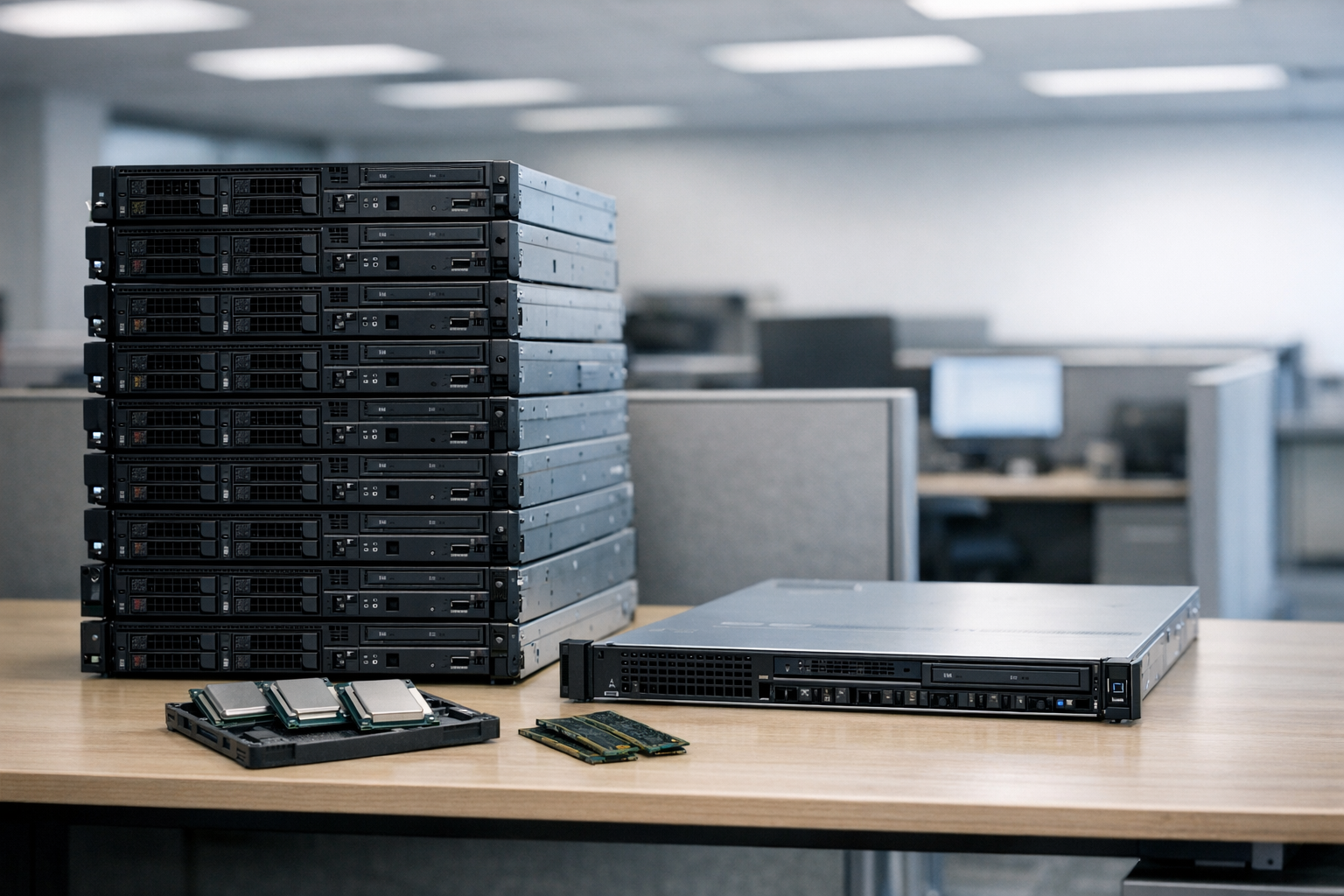
Enterprise data centers are facing a real reckoning right now. Intel Xeon server consolidation at a 9:1 ratio isn’t some vendor slide deck fantasy — it’s a measurable, repeatable outcome that the Xeon 6 processor family is actually delivering. If you’re still running Xeon E5 or Skylake-era hardware, you could collapse nine racks into one. That’s not an exaggeration.
Why does this matter right now, specifically? Power costs are surging, cooling demands keep intensifying, and tax incentives — like Ohio’s recent data center exemptions — actively reward smaller footprints. Consequently, the smartest enterprises aren’t building more data centers. They’re aggressively shrinking the ones they have.
This piece breaks down the benchmarks, TCO math, and virtualization density gains that make Intel Xeon server consolidation the defining infrastructure story heading into 2026.
Why Intel Xeon Server Consolidation Ratios Have Reached 9:1
Benchmark Data Behind Intel Xeon Server Consolidation Claims
TCO Breakdown: The Financial Case for Intel Xeon Server Consolidation
Virtualization Density and the 2026 Infrastructure Shift
Power and Cooling Savings That Justify Intel Xeon Server Consolidation
Why Intel Xeon Server Consolidation Ratios Have Reached 9:1
Previous Xeon generations offered consolidation gains that were, honestly, underwhelming. You’d typically see 3:1 or 4:1 ratios when upgrading — enough to justify a refresh, but nothing that changed the shape of your data center. The Xeon 6 family changes that equation dramatically, and I don’t say that lightly.
Core count explosion. The Intel Xeon 6 P-core processors ship with up to 128 performance cores per socket. A dual-socket server therefore delivers 256 cores. Compare that to a dual-socket Xeon E5-2690 v4 from 2016, which offered just 28 cores total. That’s not an incremental improvement — that’s a different category of hardware.
Efficiency cores join the mix. Intel’s E-core variants (Sierra Forest) pack up to 288 efficiency cores per socket. These aren’t desktop-class cores bolted onto a server chassis — they’re purpose-built for cloud-native, scale-out workloads. Specifically, they excel at microservices, web serving, and containerized applications where throughput matters more than single-thread latency.
Here’s the simple math behind a 9:1 ratio:
- A 2016-era server: 28 cores, 256 GB RAM, ~300W TDP
- A 2025 Xeon 6 server: 256 P-cores, 4 TB RAM, ~350W TDP
- Core-for-core, one new server replaces nine old ones
- Power draw barely increases despite 9× the compute
Moreover, memory bandwidth has quadrupled — and this detail gets overlooked more than it should. The Xeon 6 platform supports DDR5-6400 across 12 channels per socket. That eliminates the memory bottleneck that previously capped VM density before you ever ran out of cores. Additionally, CXL 2.0 (Compute Express Link) support enables memory pooling across servers, pushing consolidation even further in environments that can use it.
This surprised me when I first dug into the spec sheets — the memory architecture improvement is arguably as important as the core count jump.
Benchmark Data Behind Intel Xeon Server Consolidation Claims
Numbers matter more than marketing slides. I’ve seen enough vendor benchmarks cherry-picked into irrelevance, so let’s talk about the ones that actually hold up.
SPECrate 2017 Integer scores make a compelling case. The Xeon 6980P achieves roughly 2,400 on SPECrate 2017_int_base. A Xeon E5-2690 v4 scored approximately 260 — a 9.2× improvement that independently validates the 9:1 consolidation claim with a standardized, vendor-neutral benchmark. That’s not marketing math. That’s reproducible.
Virtualization throughput paints a similarly strong picture. VMware published VMmark 3.x results showing Xeon 6-based platforms sustaining 30+ tiles per host. Older Broadwell systems managed 3–4 tiles. Each tile represents a mixed workload of mail, database, web, and idle VMs — so this isn’t a synthetic single-workload test.
Database performance also scales impressively. On TPC-style benchmarks, Xeon 6 P-core systems deliver 7–10× the transactions per second of Xeon v4 platforms. Importantly, they do this while consuming only marginally more power per server — which is the real kicker when you’re thinking about long-term operating costs.
Here’s a consolidated benchmark comparison:
| Metric | Xeon E5-2690 v4 (2016) | Xeon Gold 6348 (2021) | Xeon 6980P (2025) | Improvement vs. 2016 |
|---|---|---|---|---|
| Cores (2S) | 28 | 56 | 256 | 9.1× |
| SPECrate 2017 Int (est.) | ~260 | ~680 | ~2,400 | 9.2× |
| Max RAM per server | 1.5 TB | 4 TB | 8 TB | 5.3× |
| Memory bandwidth | 153 GB/s | 410 GB/s | 614 GB/s | 4.0× |
| VMmark tiles per host | ~3 | ~12 | ~30+ | 10× |
| TDP per socket | 135W | 235W | 350W | 2.6× |
Nevertheless, raw performance isn’t the whole story. The real savings come from what you don’t need anymore: eight fewer servers, eight fewer network ports, eight fewer OS licenses, and eight fewer points of failure. I’ve talked to infrastructure leads who say the operational simplification alone justified the upgrade — and I believe them.
TCO Breakdown: The Financial Case for Intel Xeon Server Consolidation
Total cost of ownership drives every infrastructure decision worth making. Intel Xeon server consolidation at 9:1 creates meaningful savings across five major cost categories — and the numbers compound fast.
- Hardware acquisition costs. A single Xeon 6-based 2U server costs roughly $25,000–$40,000 fully configured. Nine legacy servers, even at depreciated replacement value, run $90,000–$135,000 collectively. That’s a 60–70% hardware savings on day one — before you’ve touched power, cooling, or licensing.
- Power consumption. Nine old servers draw approximately 2,700W under load (300W each). One Xeon 6 server draws roughly 700W under equivalent consolidated load. Annually, that difference amounts to about 17,500 kWh per consolidation group. At $0.10/kWh, you’re saving $1,750 per year per group. Scale that across 100 groups and you’re looking at $175,000 annually on electricity alone. Consequently, the power savings alone often fund the refresh.
- Cooling costs. The U.S. Department of Energy estimates cooling accounts for 30–40% of data center energy use. Reducing server count by 88% slashes cooling requirements proportionally. Furthermore, newer Xeon 6 platforms support liquid cooling, which is 1,000× more thermally efficient than air — and that’s not a rounding error, that’s a fundamentally different approach to heat removal.
- Software licensing. This one catches people off guard. VMware, Red Hat, and Windows Server licenses are typically per-socket or per-core. Consolidating from 18 sockets down to 2 cuts licensing costs by up to 89%. Similarly, Oracle and SQL Server per-core licensing drops sharply when higher per-core performance lets you reduce physical core counts. Fair warning: modeling this out takes time, but it’s absolutely worth doing before you finalize your business case.
- Operational overhead. Fewer servers mean fewer firmware updates, fewer disk replacements, and fewer support tickets at 2 a.m. IT teams consistently report 40–50% reductions in operational labor after aggressive consolidation projects — and that’s not a soft benefit, that’s headcount you can redeploy.
Here’s a five-year TCO comparison for a 90-server-to-10-server consolidation:
| Cost Category | 90 Legacy Servers (5-Year) | 10 Xeon 6 Servers (5-Year) | Savings |
|---|---|---|---|
| Hardware | $900,000 | $350,000 | $550,000 |
| Power | $875,000 | $245,000 | $630,000 |
| Cooling | $350,000 | $98,000 | $252,000 |
| Licensing | $1,200,000 | $400,000 | $800,000 |
| Operations/labor | $500,000 | $250,000 | $250,000 |
| Total | $3,825,000 | $1,343,000 | $2,482,000 |
Consequently, five-year savings exceed $2.4 million for a modest 90-server environment. Larger enterprises running thousands of servers see proportionally greater returns — and the math doesn’t get worse as you scale up.
Virtualization Density and the 2026 Infrastructure Shift
The 2026 enterprise infrastructure refresh cycle is shaping up to be unlike anything we’ve seen in a decade. Specifically, a massive wave of Broadwell and Skylake-era servers will hit end-of-life at the same time, and Intel Xeon server consolidation is the primary strategy serious infrastructure teams are planning around right now.
VM density per host has transformed. A well-configured Xeon 6 P-core server can comfortably run 200+ VMs — and that’s not a theoretical ceiling, it’s a practical target with proper resource allocation. By comparison, a Broadwell-era host typically maxed out at 20–25 VMs before you started making uncomfortable tradeoffs.
Key virtualization density factors include:
- Core count: 256 cores allow 1:1 vCPU-to-pCPU ratios for 200+ VMs
- Memory capacity: 8 TB per server eliminates RAM as the bottleneck
- NVMe storage: PCIe 5.0 delivers 128 GB/s of storage bandwidth per socket
- Network throughput: 400 GbE support prevents network bottlenecks at scale
Kubernetes density tells a similar story. Cloud-native workloads running on Kubernetes see pod density improvements of 8–10× on Xeon 6 platforms. Each node handles more pods, notably reducing cluster sprawl and simplifying orchestration in ways that your platform engineering team will genuinely appreciate.
The hypervisor picture is shifting too. Broadcom’s VMware licensing changes have pushed many enterprises toward KVM-based alternatives like Proxmox and OpenStack — and honestly, that’s not necessarily a bad thing. Notably, these open-source hypervisors perform exceptionally well on Xeon 6 hardware and eliminate per-socket licensing entirely, which amplifies the consolidation savings beyond what the base TCO model suggests.
What about AI workloads? Intel’s AMX (Advanced Matrix Extensions) in Xeon 6 P-cores speeds up inference workloads directly on the CPU. Previously, these tasks required dedicated GPUs — separate infrastructure, separate power budgets, and separate management headaches. Although GPUs still dominate training workloads, consolidating inference onto Xeon 6 CPUs reduces the need for standalone AI infrastructure in many real-world deployments. Therefore, Intel Xeon server consolidation extends meaningfully beyond traditional workloads into AI inference territory — which is increasingly relevant as more enterprises put ML models into production.
Planning for the 2026 wave requires action now. Lead times for enterprise servers remain 8–12 weeks, and budget cycles for fiscal year 2026 are closing in Q3–Q4 2025. Organizations waiting until 2026 to start planning will face supply constraints, rushed deployments, and configurations they’ll regret. I’ve seen this movie before, and it doesn’t end well.
A practical migration checklist:
- Inventory all servers older than five years
- Sort workloads as P-core (performance) or E-core (efficiency) candidates
- Run capacity planning tools like VMware Aria Operations or Turbonomic
- Calculate per-workload resource requirements
- Model target consolidation ratios (aim for 7:1 minimum, 9:1 optimal)
- Budget for DDR5 memory — it’s the largest single line item and the one that surprises people most
- Plan network upgrades to 25/100 GbE minimum
Power and Cooling Savings That Justify Intel Xeon Server Consolidation
Data center operators care about one metric above all others: power usage effectiveness (PUE). The Uptime Institute reports the global average PUE remains stubbornly around 1.58 — and that number hasn’t moved much in years. Intel Xeon server consolidation directly attacks it.
Fewer servers mean less total power draw. This is obvious but worth quantifying properly. Eliminating 80 servers from a 90-server cluster removes approximately 24 kW of IT load. At a PUE of 1.58, that’s 37.9 kW of total facility power saved. Over a year, that equals 332,000 kWh — roughly $33,200 at average US commercial electricity rates. Per consolidation project. That adds up fast.
Thermal density improves with consolidation — paradoxically. Concentrating compute into fewer, higher-wattage servers is actually more efficient than spreading it across many low-wattage ones. Modern cooling systems — especially rear-door heat exchangers and direct liquid cooling — work best with concentrated heat sources. Conversely, legacy air-cooled environments waste significant energy pushing air across half-empty racks, which is both inefficient and a little embarrassing from an engineering standpoint.
Sustainability reporting benefits matter too, and increasingly so. Publicly traded companies must disclose Scope 2 emissions from purchased electricity, and the scrutiny is only growing. Reducing server count by 88% creates a measurable, auditable cut in carbon footprint that your ESG team can actually put in front of investors. Meanwhile, ESG-focused investors are actively rewarding companies that show concrete infrastructure efficiency improvements — not vague commitments, but verifiable numbers.
Real-world power savings examples:
- A financial services firm consolidated 450 servers to 50, saving 1.2 MW of power draw
- A healthcare organization reduced its data center footprint by 60%, avoiding a $4M facility expansion
- A SaaS provider cut cooling costs by 72% after migrating to Xeon 6-based infrastructure
Additionally, Intel’s built-in power management features contribute meaningfully to day-to-day efficiency. Speed Select Technology lets operators assign higher frequencies to critical cores while throttling idle ones — granular control that simply wasn’t available on older platforms. It further improves performance-per-watt ratios during mixed workload scenarios, which is most of the time in real enterprise environments.
The connection to tax incentives is also direct. States like Ohio offer data center tax exemptions tied to investment thresholds and job creation. Smaller, more efficient data centers can still meet these thresholds while operating at dramatically lower costs. So Intel Xeon server consolidation lets enterprises capture tax benefits without overbuilding — which is, honestly, a no-brainer if you’re operating in one of those jurisdictions.
Conclusion
Intel Xeon server consolidation at 9:1 ratios represents a generational shift in data center economics. The combination of 128+ cores per socket, DDR5 memory, PCIe 5.0, and AMX acceleration makes the Xeon 6 family the most compelling server upgrade in at least a decade. I’ve covered a lot of supposedly game-changing hardware launches over the years — this one actually earns the label.
The math is straightforward. Nine old servers become one. Power drops by 74%. Licensing costs fall by up to 89%. Five-year TCO savings exceed $2.4 million for even modest environments.
Here are your actionable next steps:
- Audit your current fleet. Identify every server older than 2020. These are your consolidation candidates — no exceptions.
- Run workload assessments. Determine whether each workload fits P-core or E-core Xeon 6 variants. The distinction matters more than people expect.
- Model your specific consolidation ratio. Conservative environments will see 7:1. Optimized ones will hit 9:1 or better.
- Budget for Q1 2026 deployment. Start procurement conversations now to avoid supply chain delays you’ll definitely regret.
- Engage your VMware/hypervisor vendor. Licensing changes may make this the right time to switch platforms entirely — and the economics increasingly support it.
Bottom line: Intel Xeon server consolidation isn’t optional for enterprises planning to stay competitive. It’s the foundation of the 2026 infrastructure shift, and moreover, it’s the kind of project that pays for itself several times over. Organizations that act now will run leaner, greener, and more cost-effective data centers for the next decade. The ones that wait will be playing catch-up — and catch-up is always more expensive.
FAQ
How does Intel Xeon 6 achieve a 9:1 server consolidation ratio?
The Xeon 6 P-core processors offer up to 128 cores per socket — 256 cores in a dual-socket setup. Older Xeon E5 v4 servers had just 28 cores across two sockets. Specifically, the 9.1× core count improvement, combined with 4× memory bandwidth gains and DDR5 capacity up to 8 TB, allows one new server to handle the workloads of nine legacy systems. Intel Xeon server consolidation at this ratio is validated by SPECrate 2017 benchmark improvements of 9.2× — not a vendor estimate, a standardized third-party result.
What workloads benefit most from Intel Xeon server consolidation?
Virtualized environments see the largest gains. VMware and KVM-based platforms can run 200+ VMs per Xeon 6 host. Database workloads, web serving, and containerized microservices also benefit enormously. Additionally, AI inference workloads can consolidate onto Xeon 6 CPUs using AMX extensions, eliminating the need for separate GPU infrastructure in many cases — which is a bigger deal than it sounds once you factor in GPU acquisition costs and management overhead.
How much money can enterprises save with a 9:1 consolidation?
A 90-server-to-10-server Intel Xeon server consolidation project typically saves over $2.4 million across five years. The savings break down across hardware (60–70% reduction), power (72–74% reduction), cooling (70%+ reduction), software licensing (up to 89% reduction), and operational labor (40–50% reduction). However, exact savings depend on your current hardware age, power costs, and licensing agreements — so model your specific environment before committing to a business case number.
Is the Xeon 6 E-core variant suitable for server consolidation?
Yes, but for different workloads. The E-core (Sierra Forest) variant packs up to 288 efficiency cores per socket, built for scale-out, throughput-oriented tasks like web serving, CDN nodes, and microservices. Conversely, the P-core variant is better for latency-sensitive workloads like databases and ERP systems. Many enterprises will deploy both variants in a tiered consolidation strategy — and notably, that flexibility is one of the things that makes the Xeon 6 family genuinely useful rather than just impressive on paper.
What infrastructure upgrades are needed beyond the servers themselves?
Network upgrades are typically required. Consolidating 9 servers into 1 concentrates network traffic onto fewer ports, so you’ll need 25 GbE or 100 GbE connectivity at minimum. Furthermore, storage infrastructure should support NVMe over PCIe 5.0 for maximum throughput. Power distribution may also need reconfiguration, although total power draw decreases significantly. Importantly, cooling infrastructure may need updates to handle higher per-rack thermal density — this is the piece that most migration plans underestimate.
When should enterprises start planning their Intel Xeon server consolidation projects?
Now. Seriously. Budget cycles for fiscal year 2026 are closing in late 2025, and server lead times remain 8–12 weeks. Moreover, the massive wave of Broadwell and Skylake-era servers hitting end-of-life in 2026 will create demand spikes for Xeon 6 platforms that will make procurement painful for anyone who waits. Organizations that begin capacity planning and procurement in Q3–Q4 2025 will avoid supply constraints and rushed deployments. Early movers also capture more months of power and licensing savings — and at these numbers, every month counts.
References
Keep reading
Here are the latest posts from the blog.

The Orion-100B 100 billion parameter model trained at just $1.25 per hour isn’t a typo. I had to re-read it myself. But it’s real — and it represents a genuine shift in how w…

ChatGPT dreaming memory coherent user profiles replace the old, frankly tedious way AI assistants handled context. Until recently, every single conversation started from zero…

The AI cost war has a new front-runner — and honestly, nobody saw this coming quite so fast. DeepSeek proved you can build frontier AI at a fraction of US spending, and the n…