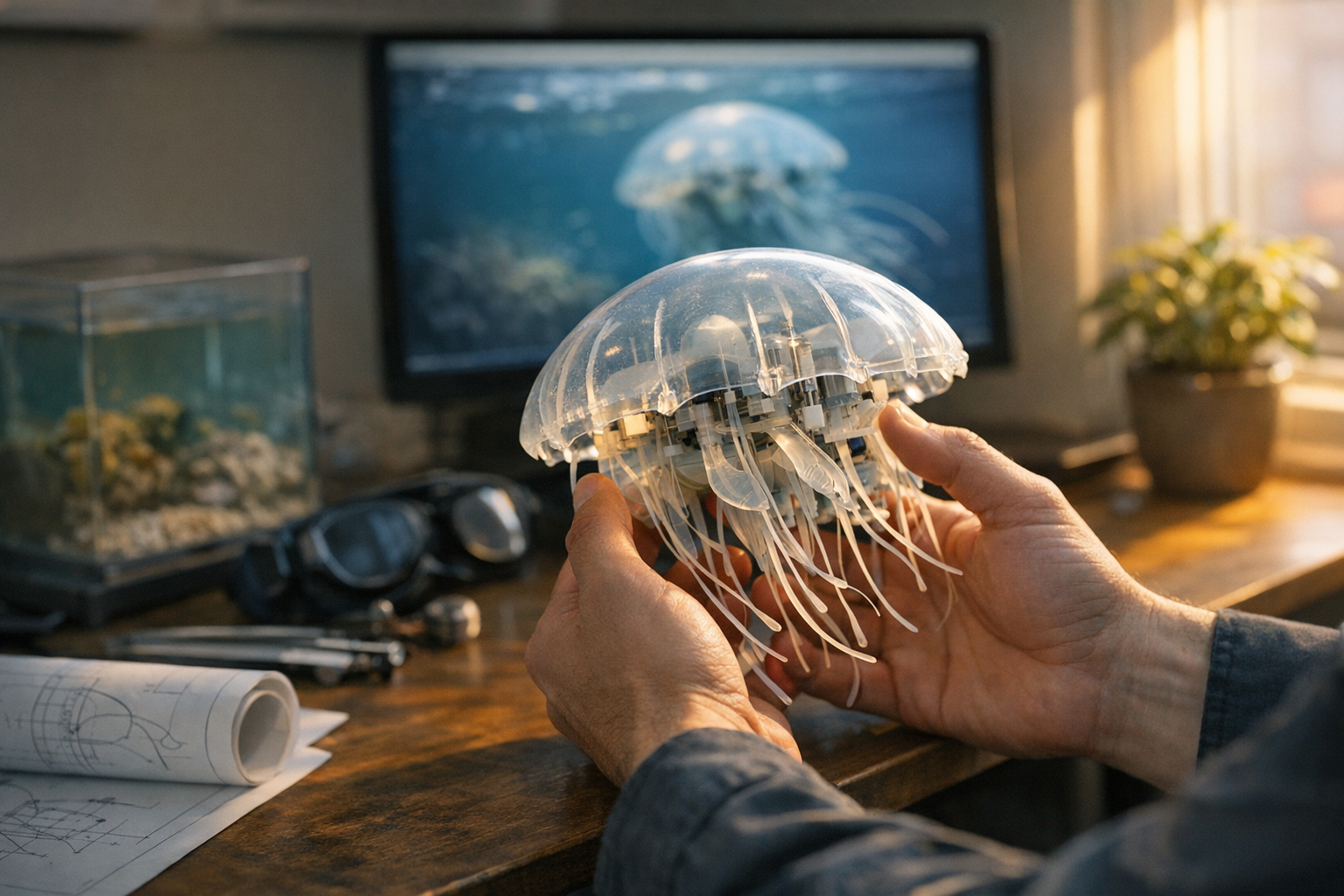
A jellyfish-inspired robot swims record speed without any batteries onboard — and honestly, that’s the kind of headline I’d normally roll my eyes at. But this one’s real, and it’s rewriting the rules of underwater robotics in ways that actually matter. Engineers at multiple universities have cracked a problem that’s stumped the field for years: building soft, flexible machines that harvest energy directly from their surroundings.
No tethered power cables. No heavy battery packs. Just a pulsing, bio-inspired machine slipping through water like the real thing.
Consequently, these robots are lighter, cheaper, and capable of reaching places traditional underwater vehicles simply can’t. Furthermore, the implications stretch well beyond ocean research — we’re talking medical devices, environmental monitoring, and disaster response. The jellyfish-inspired robot represents a genuine shift in how we think about autonomous machines, not just incremental progress.
How Engineers Reverse-Engineer Jellyfish Locomotion
Jellyfish have been around for over 500 million years. That’s not luck — that’s a locomotion strategy so efficient that evolution never bothered improving it. Naturally, engineers want to steal their secrets.
The bell contraction cycle is where it all starts. A jellyfish contracts its bell-shaped body, pushes water out the bottom, and moves forward. Then the bell relaxes and refills. That’s it. Two phases, surprising thrust, minimal complexity.
Researchers at Virginia Tech were among the first to study this systematically. They used particle image velocimetry to map fluid dynamics around live jellyfish. What they found is striking: jellyfish actually recover energy during the relaxation phase. The bell’s elastic recoil creates a secondary vortex ring — essentially free propulsion that adds extra push without any additional energy input.
Key biomechanical principles engineers borrowed:
- Radial symmetry allows omnidirectional movement
- Flexible materials store and release elastic energy
- Passive energy recovery during relaxation reduces total power needs
- Low Reynolds number swimming works well at small scales
- Negative pressure zones behind the bell boost efficiency
Moreover, jellyfish have no brain, no bones, and no complex nervous system. That simplicity is a feature — engineers can replicate the locomotion with minimal electronics, which is exactly what makes battery-free operation feasible.
Similarly, research teams studying moon jellyfish (Aurelia aurita) at the Monterey Bay Aquarium Research Institute found that the animal’s cost of transport — energy burned per unit of distance — is the lowest of any measured animal. The lowest. Of any animal ever measured. A jellyfish-inspired robot swims record speed without the complex musculature that fish or dolphins depend on, and that’s precisely the point.
Why jellyfish beat other bio-inspiration models. Fish need coordinated fin movements. Birds require feathers and complex wing joints. Insects demand incredibly fast actuation. Jellyfish, however, need only a single repeating contraction — making them ideal templates for soft robots with limited computing power. It’s almost unfairly elegant.
Material Science Breakthroughs Powering Battery-Free Robots
Here’s the thing: the locomotion strategy only works if the materials can keep up. And for a long time, they couldn’t.
The jellyfish-inspired robot swims record speed without batteries specifically because of recent breakthroughs in smart materials. Traditional robots use rigid frames and electric motors. These machines use something fundamentally different.
Dielectric elastomer actuators (DEAs) are essentially artificial muscles. A thin, stretchy membrane sits between two flexible electrodes. Apply voltage and the membrane compresses and expands. Remove it, and the membrane snaps back. The motion mimics a jellyfish bell contraction almost perfectly — and demo footage of these things genuinely looks biological.
Notably, researchers at ETH Zurich developed DEAs that work in saltwater. Earlier versions short-circuited immediately — not ideal for an underwater robot. The breakthrough involved silicone-based encapsulation layers only a few micrometers thick. That’s thinner than a human hair.
Ionic polymer-metal composites (IPMCs) bend when a small voltage is applied. They’re lightweight, work well underwater, and — this is the real kicker — a single IPMC strip can detect water currents and generate swimming motion at the same time. One component, two jobs. Additionally, they work at low voltages, which matters a lot when you’re harvesting ambient energy.
Shape-memory alloys (SMAs) take a different approach. Nickel-titanium wires contract when heated and return to their original shape when cooled. Some jellyfish robots run thin SMA wires radially through the bell — a tiny current heats the wire, contracting it, while the surrounding water handles the cooling reset. Therefore, the ocean itself becomes part of the actuation system. That’s clever in a way that takes a moment to fully appreciate.
Energy harvesting approaches that eliminate batteries:
- Triboelectric nanogenerators (TENGs) — harvest energy from water flow across surfaces
- Piezoelectric films — generate electricity from mechanical movement during swimming
- Osmotic power — use salinity gradients between freshwater and saltwater
- Solar-powered surface charging — robots surface periodically to top up supercapacitors
- Thermoelectric generators — convert ocean temperature gradients into usable power
Importantly, stacking multiple harvesting methods creates redundancy. One source drops off, and the others compensate. The jellyfish-inspired robot swims record speed without batteries because it’s continuously drawing from ambient energy — not relying on a single depleting reservoir.
Hydrogel bodies are another development worth highlighting. Some jellyfish robots are now built almost entirely from water-based gels — transparent, flexible, and acoustically invisible to marine life. Consequently, the robots don’t disturb the ecosystems they’re supposed to be monitoring. That’s not a small thing when you’re doing sensitive environmental research.
| Material | Function | Key Advantage | Limitation |
|---|---|---|---|
| Dielectric elastomer | Artificial muscle | High strain, fast actuation | Requires high voltage |
| IPMC | Bending actuator/sensor | Low voltage, dual function | Degrades in some fluids |
| Shape-memory alloy | Contraction wire | Strong force output | Slower cycle speed |
| Hydrogel | Structural body | Biocompatible, transparent | Mechanically fragile |
| Piezoelectric film | Energy harvesting | Self-powered sensing | Low power output |
| Silicone composite | Encapsulation | Waterproof, flexible | Adds mass |
Why the Jellyfish-Inspired Robot Swims Record Speed Without Traditional Power
Speed has always been soft robotics’ weak point. Flexible and safe, sure — but historically, painfully slow. Nevertheless, recent designs have genuinely shattered expectations, and that’s not something to say lightly after a decade of watching “breakthrough” claims come and go.
The record-breaking design centers on one elegant insight: resonance tuning. The team matched the robot’s contraction frequency to the natural resonance of its flexible bell. At resonance, energy input drops sharply while output peaks.
Think of pushing a kid on a swing. Time your pushes correctly, and a gentle nudge keeps things moving indefinitely. Push at the wrong moment, and you’re fighting the physics the whole time. Similarly, the jellyfish robot’s bell stores elastic energy at the top of each stroke. That stored energy then powers the recovery phase essentially for free. The jellyfish-inspired robot swims record speed without batteries partly because the robot’s own body is doing work on its behalf.
Factors contributing to record speed:
- Optimized bell geometry — thinner edges, thicker center for ideal flex patterns
- Vortex ring enhancement — trailing edge modifications create stronger thrust vortices
- Multi-modal actuation — combining DEAs with SMA wires for faster cycle rates
- Reduced drag profiles — smooth hydrogel surfaces cut friction losses
- Passive tentacle stabilization — trailing elements prevent tumbling and improve directional control
Additionally, computational fluid dynamics simulations played a huge role. Engineers at institutions like MIT tested thousands of bell shapes virtually before committing to physical prototypes. That kind of speed would’ve been impossible a decade ago.
The speed-efficiency paradox is worth dwelling on. Conventional wisdom says faster swimming costs more power — proportionally, predictably. Jellyfish robots break that assumption. Because they recover energy passively, increasing speed doesn’t proportionally increase power use. The relationship is nonlinear. Consequently, the jellyfish-inspired robot swims record speed without the steep energy costs that make propeller-driven vehicles so battery-hungry.
Compared to traditional autonomous underwater vehicles — heavy, propeller-driven, lithium-ion-powered — jellyfish robots occupy a genuinely interesting sweet spot. They’re not the fastest thing in the water. But for long-duration missions, endurance beats sprint speed every time. Although these robots haven’t matched propeller-driven AUV top speeds, they don’t need to.
Without batteries, mission duration becomes theoretically unlimited. That’s not a small trade-off — that’s a different category of tool entirely.
Real-World Applications From Ocean Floors to Operating Rooms
The fact that a jellyfish-inspired robot swims record speed without batteries doesn’t just make for a good headline — it opens genuine doors across multiple industries. Notably, several of these applications are already in prototype or early deployment stages. This isn’t purely speculative.
Underwater environmental monitoring is probably the most immediate opportunity. Ocean acidification, coral bleaching, and microplastic distribution all require persistent, wide-area monitoring. Traditional sensor buoys sit still. Battery-powered AUVs run out of juice. Jellyfish robots, however, can patrol continuously. They’re small enough to move through coral reefs without causing damage, and furthermore, their soft bodies won’t harm marine life during accidental contact.
The National Oceanic and Atmospheric Administration (NOAA) has already expressed interest in bio-inspired platforms for long-duration ocean observation. Swarms of these robots mapping temperature, salinity, and chemical gradients at the same time — that’s a genuinely compelling vision.
Deep-sea exploration is another clear application. The deep ocean remains mostly unmapped, crewed submarines are expensive and dangerous, and rigid battery-powered robots struggle with crushing pressure. Soft jellyfish robots handle pressure differently — their flexible bodies compress uniformly, avoiding stress concentrations. Specifically, hydrogel-based designs are nearly incompressible because they’re already mostly water.
Medical microrobots are where things get genuinely science-fiction-adjacent — except the science is real. Scale the jellyfish design down to millimeters and you have a candidate for targeted drug delivery inside the human body. Importantly, the biocompatible materials involved — hydrogels, silicones, and biodegradable polymers — are already approved for medical use. The locomotion mechanism works at small scales because it relies on low Reynolds number fluid dynamics, exactly the conditions inside blood vessels. Clinical trials are likely still years away, but the lab demonstrations are legitimately promising.
Infrastructure inspection is the unglamorous application that might actually drive commercial adoption first. Underwater pipelines, bridge supports, and dam walls all need regular inspection. Currently that means human divers or expensive remotely operated vehicles. Jellyfish robots are cheaper, safer, and can squeeze into tight spaces that rigid robots can’t reach. Additionally, their quiet operation doesn’t disturb nearby wildlife, which matters in environmentally sensitive areas.
Military and defense applications are obvious, even if the details stay classified. Soft, translucent robots produce minimal acoustic signatures and are nearly invisible to sonar. The Defense Advanced Research Projects Agency (DARPA) has funded bio-inspired underwater robotics research for years — they clearly see the potential.
Search and rescue rounds out the list. After tsunamis or hurricanes, underwater debris fields are lethal for human divers. Swarms of autonomous jellyfish robots could search flooded areas, locate survivors, and map hazards. Because the jellyfish-inspired robot swims record speed without batteries, there’s no recharging pause during critical rescue windows.
Challenges and the Road Ahead
Lab breakthroughs and real-world deployment are two very different things. The jellyfish-inspired robot swims record speed without the constraints that held back soft robotics for decades — genuinely impressive — but real engineering challenges still stand between here and widespread use.
Control and navigation is the biggest gap right now. Jellyfish robots are great at swimming. Steering is a different story. Real jellyfish don’t navigate precisely — they drift with currents and make broad directional adjustments. Practical applications need GPS integration, obstacle avoidance, and waypoint navigation. Nevertheless, recent work on distributed sensor networks embedded within the robot body shows genuine promise. This gap will likely close faster than most people predict.
Underwater communication remains stubbornly difficult. Radio waves don’t penetrate water well. Acoustic communication is slow. Optical communication requires line of sight. Consequently, coordinating swarms of jellyfish robots is still technically challenging. Some researchers are exploring bio-luminescent signaling — robots that communicate by flashing light patterns, much like real deep-sea organisms. It’s either brilliant or completely impractical, and the jury’s still out.
Durability is a real concern that doesn’t get enough attention. Soft materials degrade faster than metal or hard plastics. UV exposure, biofouling, and mechanical fatigue all shorten operational life in ways that are hard to predict from lab testing alone. Self-healing polymers exist, but they haven’t been built into swimming robots at any meaningful scale yet.
Scaling manufacturing is the other big challenge. Building one jellyfish robot in a controlled lab is straightforward. Mass-producing thousands for ocean monitoring swarms is a fundamentally different engineering problem. Moreover, companies like Festo have already shown commercial bio-inspired robots work — which at least proves market viability — but the manufacturing pipeline for soft robotics is still maturing.
Current limitations versus future targets:
- Speed — currently 1–3 body lengths per second; target is 5+ body lengths per second
- Depth rating — tested to hundreds of meters; target is full ocean depth (11,000 meters)
- Payload capacity — currently grams; target is sensor packages of 50+ grams
- Communication range — currently meters; target is kilometers via acoustic relay networks
- Operational lifespan — currently days to weeks; target is months to years
Alternatively, hybrid approaches may be the pragmatic path forward. Some teams are combining jellyfish-style locomotion with small onboard batteries for electronics. They use energy harvesting to extend battery life tenfold. It’s a reasonable compromise — you keep the bio-inspired swimming efficiency while adding the control capabilities that real-world missions demand.
Conclusion
The story of how a jellyfish-inspired robot swims record speed without batteries is ultimately a story about biomimicry at its best. Engineers looked at one of nature’s simplest swimmers, borrowed its mechanics, improved the materials, and built something genuinely novel.
These robots aren’t replacing traditional AUVs overnight — and anyone claiming otherwise is selling something. However, they’re carving out a clear niche. The underlying material science advances — smart elastomers, energy-harvesting films, self-healing hydrogels — will spread into fields well beyond underwater robotics. Furthermore, the fact that a jellyfish-inspired robot can work indefinitely without a battery changes the basic economics of ocean monitoring in ways we’re only beginning to understand.
What you can do next:
- Follow the research — bookmark labs at Virginia Tech, MIT, and ETH Zurich; they publish frequently and write accessibly
- Explore open-source designs — several jellyfish robot designs include full build instructions for anyone willing to experiment
- Consider career paths — soft robotics, marine engineering, and biomimetic design are growing fields with strong and diversifying funding
- Support ocean research — organizations like NOAA and MBARI genuinely depend on public awareness and advocacy
- Stay skeptical but optimistic — commercial deployment will take years of additional engineering, but the trajectory is real
The ocean covers 71% of Earth’s surface. Most of it remains unexplored. Battery-free, bio-inspired robots might finally give us the tools to actually change that — and that’s more exciting than almost anything else happening in robotics right now.
FAQ
How does a jellyfish-inspired robot swim at record speed without batteries?
The robot uses smart materials like dielectric elastomer actuators and shape-memory alloys to mimic a jellyfish’s bell contraction. Energy comes from harvesting ambient sources — water flow, temperature gradients, and salinity differences. Specifically, the robot’s bell is tuned to its natural resonance frequency, which maximizes thrust while minimizing energy input. The combination of efficient locomotion and continuous ambient energy harvesting is what eliminates the need for onboard batteries entirely.
What materials make battery-free jellyfish robots possible?
Several advanced materials work together. Dielectric elastomers act as artificial muscles, expanding and contracting with applied voltage. Ionic polymer-metal composites bend with minimal power and double as sensors at the same time. Piezoelectric films generate electricity from the robot’s own swimming motion. Additionally, hydrogels form the robot’s transparent, flexible body. These materials are lightweight, waterproof, and increasingly durable — though durability at scale remains an active research challenge.
Can jellyfish robots replace traditional underwater vehicles?
Not entirely — at least not yet. Traditional AUVs carry heavier sensor payloads and communicate over longer distances. However, jellyfish robots excel in specific niches: long-duration monitoring, delicate environments like coral reefs, and confined spaces where rigid robots can’t go. Notably, the jellyfish-inspired robot swims record speed without the time limits that constrain battery-powered vehicles. The two technologies will almost certainly complement each other rather than compete.
What are the medical applications of jellyfish-inspired robots?
Miniaturized versions could eventually move inside the human body. Researchers envision tiny jellyfish robots delivering drugs directly to tumors, clearing blocked arteries, or assisting with micro-surgery. The biocompatible materials — hydrogels and medical-grade silicones — are already approved for human use. Moreover, the gentle pulsing motion works well in the low-flow conditions found inside blood vessels. Clinical trials are likely still years away, but lab demonstrations are genuinely promising.
How fast can these jellyfish robots actually swim?
Current prototypes reach roughly 1 to 3 body lengths per second — significantly faster than earlier soft robot designs. For context, a 10-centimeter robot moving at 3 body lengths per second covers about 30 centimeters per second. That’s modest compared to propeller-driven AUVs. Nevertheless, the jellyfish-inspired robot swims record speed without batteries, meaning it can sustain that pace indefinitely. For most real-world missions, endurance matters considerably more than top speed.
Who is funding research into bio-inspired underwater robots?
Multiple organizations are backing this work. DARPA funds military and defense applications, while NOAA supports environmental monitoring research. The National Science Foundation (NSF) backs fundamental university science. Furthermore, private companies like Festo invest in commercial bio-inspired robotics. International agencies across Europe and Asia contribute significant funding as well. The field attracts broad investment precisely because the applications span military, commercial, medical, and environmental sectors at the same time.
References
Keep reading
Here are the latest posts from the blog.

AI hallucination in healthcare diagnosis Ontario medical AI systems isn’t just a technical glitch. It’s a patient safety emergency — and honestly, the healthcare industry is…

Privacy concerns around AI are louder than ever — and honestly, they’re not going away. Meta incognito mode offers a private way to chat with AI without leaving a permanent t…

Building low-latency voice agents in just a few lines of code sounds like the kind of thing someone puts in a conference talk title and then spends 40 minutes walking back. B…